For , fixed zero endpoint temperatures are homogeneous Dirichlet boundary conditions:An initial condition is also needed to determine a particular solution of the heat equation.
By Fourier's law, . With nonzero thermal conductivity , zero outward heat flux at both endpoints gives homogeneous Neumann boundary conditions:The outward normal has opposite signs at the two ends, but a zero-flux condition gives zero derivative at each.
Put and . Direct differentiation of givesso , the heat equation. At , the sine factor vanishes; at , it is for integer . Thus the homogeneous Dirichlet boundary conditions hold. The nonzero, nonredundant spatial modes use ; is the zero function and negative only change the amplitude sign.
For , direct differentiation again gives and . Thus it satisfies the heat equation. Moreover,vanishes at both endpoints for integer , proving the homogeneous Neumann boundary conditions. Now gives the nonzero constant mode , which does not decay. It represents conserved mean temperature in an insulated plate.
The reference to part “(c)(i)” in the source is circular; the relevant modes are those verified in part (b)(i). Linearity of the heat equation and its homogeneous Dirichlet boundary conditions allows superposition of those modes:Match the initial uniform interior temperature using the orthogonality of the Fourier sine series:Thus for even integers and for odd integers , givingFor every , the exponential factor makes the series and the derivatives needed in the heat equation converge uniformly on later time intervals. At , the Fourier sine series equals at interior points but zero at the endpoints: the instantaneous cooling boundary condition is incompatible with the pre-immersion endpoint values. This corner mismatch is physically the idealization of an instantaneous bath contact and does not invalidate the solution for .
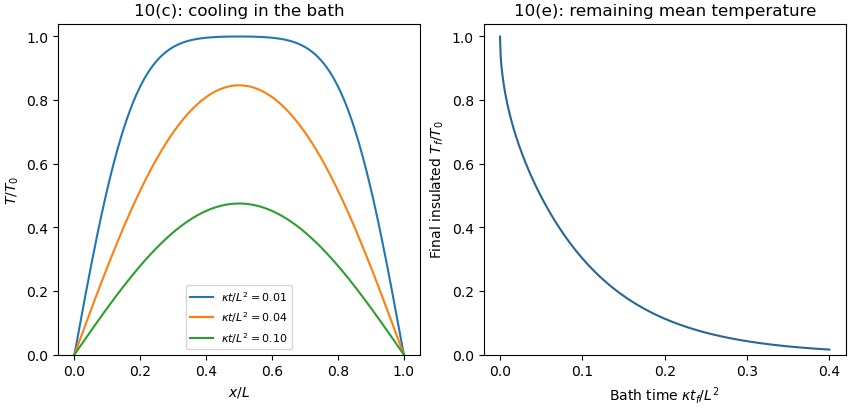

Write after removal, with . Neglecting heat loss to air means thermal insulation, rather than an end to internal thermal conduction. The evolution and conditions areHere is the nonuniform bath-cooled profile derived in part (c). At the switching instant it need not have zero endpoint derivatives: the sudden replacement of Dirichlet boundary conditions by Neumann boundary conditions can produce another initial-boundary corner incompatibility. The insulated heat equation nevertheless recovers the given profile and satisfies its new boundary conditions for .
After bath cooling followed by insulated equilibration, the remaining mean temperature is conserved: integrating the insulated heat equation givesFor constant density, specific heat capacity and cross-section, this is conservation of energy. Its Fourier cosine series has a constant mode equal to the initial integral average; every nonconstant mode decays. Therefore the eventual uniform temperature isFor each mode with an odd integer index in part (c), . Integrating the bath-cooled series yieldsFor , uniform convergence justifies termwise integration; the result also follows by dominated convergence of the summable positive coefficients. As a check, gives for zero bath time, and as . More bath time strictly lowers the retained average temperature when and .
Articles by others on the same topic
There are currently no matching articles.