Photochemistry studies chemical changes initiated or influenced by light. Absorption of a photon can prepare an electronically excited molecule, opening reaction pathways different from those available on its ground-state potential energy surface.[ref]
IUPAC Compendium of Chemical Terminology, fifth edition (Gold Book). Photochemistry P04588 and photochemical reaction P04585
The absorbed energy is , so changing wavelength changes both which species absorb and which states are reached. Photodissociation of molecular oxygen is an atmospheric example. Absorption alone does not guarantee chemical conversion: relaxation and competing reactions affect the quantum yield. A photon-initiated chain can produce more than one product event per absorbed photon, so a chemical quantum yield need not be at most one.
Molecular internal conversion is a radiationless transition between electronic states of the same spin multiplicity. Electronic and vibrational energy are redistributed without emission of a photon in the transition itself. IUPAC describes the step as isoenergetic: a lower electronic state can be reached with increased vibrational excitation, followed by subsequent relaxation.[ref]
This is distinct from intersystem crossing, which connects states of different multiplicity, and from vibrational relaxation within an electronic state. It is also distinct from nuclear internal conversion. A molecular singlet-to-singlet transition such as fits the molecular definition; the energy need not be immediately transferred as heat to a surrounding solvent.
An original population model separates internal conversion from later decay. Suppose an impulsive excitation places population in , transfer to occurs at rate , and loses population at total rate :For ,The lower-state population first rises and later decays. If only part of is radiative, fluorescence intensity is proportional to that radiative rate times , not simply to the loss rate of .
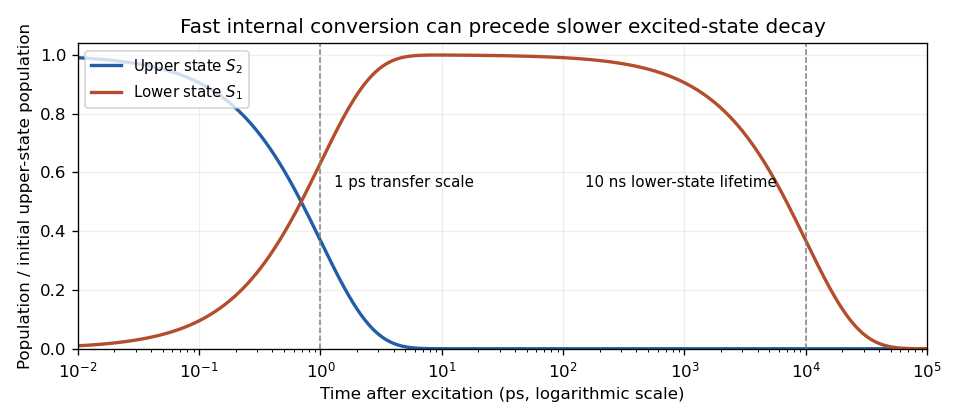
Original sequential-population model with a 1 ps upper-state transfer scale and a 10 ns lower-state lifetime; no measured molecular rates are implied
. Details. For stipulated and , the transfer time scale is 1 ps while the lower-state lifetime is 10 ns. A fast population transfer can therefore precede much slower emission. These are model constants, not measured values assigned to every molecule.
An informative experiment resolves the time dependence of upper- and lower-state signals after a pulse and tests whether the proposed transfer accounts for both. A decay trace alone can have several explanations; spectral assignment and competing channels matter. Sequential excited-state population kinetics is one model to test against those measurements.
Michael Kasha's 1950 analysis linked radiationless transitions among like-multiplicity states to emission from the lowest excited level of a given multiplicity.[ref]
Characterization of electronic transitions in complex molecules by Michael Kasha. printed pp. 14–15, abstract and Internal Conversion
The rate competition supplies a physical motivation for Kasha's rule, while leaving room for molecules whose competing pathways behave differently.Sequential excited-state population kinetics describes transfer from an initially prepared excited state into another excited state that subsequently decays. The measured rise and decay are consequences of both population flow and the detection model. A single fitted exponential function need not identify a unique molecular step.
Let upper-state loss rate be , lower-state loss rate and transfer rate . Starting with , ,For ,The transfer branching fraction is . If upper-state loss has competing channels, not every initial excitation reaches the lower state.
The equal-rate limit is finite, although the displayed difference quotient looks singular. Taking givesFor stipulated in consistent inverse-time units, the lower population peaks at with value . The apparent denominator singularity is a numerical representation issue, not infinite population.
For unequal rates, the peak time isWith and , it is about 9.21 ps. This differs from the upper-state time constant of 1 ps: a population maximum and a single-step time constant are not interchangeable observations.
An instrument-response limit in sequential population inference enters when observed fluorescence is a convolution of the radiative population signal with the instrument response, plus background. Temporal broadening can obscure a very fast rise. Spectral overlap can also mix upper- and lower-state contributions. A proposed analysis fits the response-convolved model to multiple assigned signals rather than interpreting an unresolved rise as an exact molecular rate.
For same-multiplicity electronic states, molecular internal conversion supplies one physical transfer mechanism. IUPAC defines it as a radiationless transition with vibrational excitation possible in the lower electronic state.[ref] The equations above are original kinetic models; their parameters require experimental determination for the molecule and conditions studied.
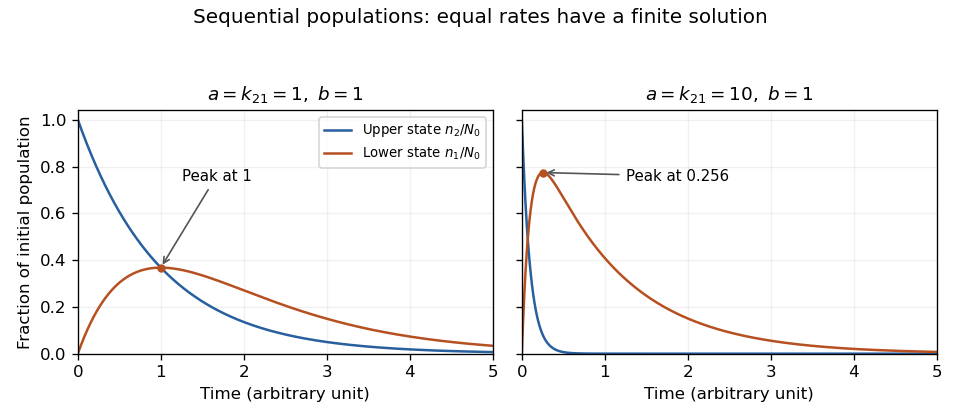
Exact sequential population solutions for coincident and separated loss rates. The equal-rate limit is finite and its lower-state population peaks after the upper-state population has begun to decay.
Details. An instrument-response limit in sequential population inference is a practical limit on identifying fast transfer or decay rates from a temporally broadened measurement. It depends on the instrument response function, photon statistics, timing calibration and the assumed kinetic model. The response width is not a universal hard cutoff below which every rate becomes unknowable.
For an original sequential model, take normalized lower-state photon-arrival densitywith , , and zero density before excitation. It corresponds to two successive independent exponential waiting times. A normalized instrument response produces modeled signalwith total signal scale and background . The measured curve is a convolution, not the molecular population curve alone. As grows with fixed, approaches : the fast-step signature becomes concentrated near the onset.
The arrival-time mean and variance areFor a zero-mean response of variance , independent timing broadening adds that variance. With lower-state lifetime 100 ps, transfer times 2 and 10 ps give intrinsic means 102 and 110 ps. A response standard deviation of 25 ps broadens both traces and makes their rapid onsets less distinct. An uncertain time-zero shift can further mimic part of the mean difference.
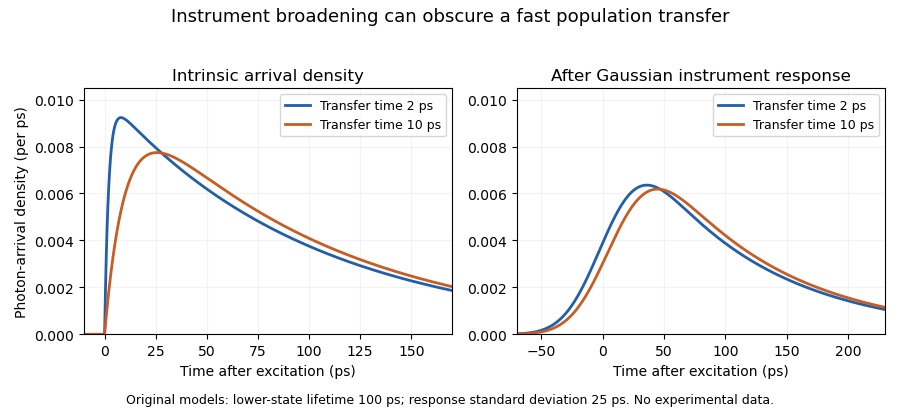
Original sequential-arrival models before and after Gaussian instrument broadening; the response obscures but does not erase every difference
. Details. A primary manufacturer technical note describes measuring an instrument response using a scattering sample and fitting by iterative reconvolution. It also explains why favorable photon counts can permit recovery of lifetimes shorter than the response width.[ref]
Time-Correlated Single Photon Counting (technical note v. 2.1) by Michael Wahl. printed p. 3, instrument response, reconvolution and measurement resolution
Thus an unresolved-looking rise can support a model-dependent bound rather than a precise, independently identified transfer rate.A useful experiment records the response under matching optical conditions, checks timing offsets and background, and compares response-convolved predictions across spectral channels. Confidence intervals or sensitivity to nuisance parameters reveal what the data actually constrain. A fine histogram bin width alone does not create temporal information absent from the measurement.
Kasha's rule states that appreciable luminescence normally originates from the lowest excited electronic state of a given spin multiplicity. In the familiar molecular notation, fluorescence is usually associated with and phosphorescence with , even when absorption initially prepares a higher state. The rule is a spectroscopic regularity, rather than a guarantee that all excited molecules emit.
Michael Kasha presented the underlying classification of electronic transitions in 1950, discussing the connection between radiationless conversion and the lowest emitting level.[ref]
Characterization of electronic transitions in complex molecules by Michael Kasha. Discussions of the Faraday Society 9, 14–19; printed pp. 14–15
Molecular internal conversion provides a route from a higher electronic state to a lower state of the same multiplicity before appreciable higher-state emission occurs.An original rate-competition model makes the condition quantitative. For an initially populated state, let be conversion to , upper-state radiative decay and other loss. The fraction emitting directly from isWith stipulated , and no other loss, this fraction is about . Fast conversion suppresses upper-state emission even though the molecule absorbs into that state. If conversion is slowed until it competes with radiation, appreciable higher-state emission becomes possible. These values illustrate kinetics, not universal molecular constants.
The rule concerns the emitting electronic state. It does not by itself assert an excitation-wavelength-independent fluorescence quantum yield; that is the separate Kasha-Vavilov rule. Competing photochemistry, intersystem crossing and state preparation can affect the number of emitted photons even when the eventual fluorescence band comes from .
A proposed experimental test compares emission spectra after excitation into different absorption bands, correcting for absorbed photon counts and detector response. Similar emission-band shapes support a common emitting state, while time-resolved measurements test whether a fast relaxation precedes emission. A different band requires checking sample purity, distinct species and instrumental artifacts before assigning emission from a higher electronic state.
The rate argument also explains why a rigid drawing of one downward arrow is insufficient evidence. Measure which states are populated, how fast they exchange population and which transitions radiate. This connects an empirical rule with a falsifiable kinetic model, while preserving the distinction between a common behaviour and an exception-free law.
The Kasha-Vavilov rule states that the quantum yield of luminescence is normally independent of excitation wavelength. IUPAC explicitly notes exceptions.[ref]
IUPAC Compendium of Chemical Terminology, fifth edition (Gold Book). Kasha–Vavilov rule K03371
The statement concerns emitted photons per absorbed photon, not equal detector counts under equal incident optical power.An original photon-accounting model writesfor monochromatic incident power , wavelength and absorbance . Comparing raw fluorescence at different wavelengths without correcting incident photon number and absorbed fraction can therefore give a misleading yield comparison.
For equal incident powers and equal absorbed fractions at 400 and 500 nm, the absorbed photon rates have ratio . A molecule obeying the rule with unchanged yield then emits 25% more photons per second under the 500 nm condition. Unequal raw emission is entirely consistent with equal emitted-per-absorbed-photon yield.
Absorbed-photon normalization in quantum-yield comparisons also needs detector-response correction. The observation system measures a selected fraction of an emission spectrum, not automatically all emitted photons. Keep excitation and emission spectral responses, sample geometry and optical density in the comparison.
The distinction from Kasha's rule is physical as well as verbal. Kasha's rule concerns the emitting electronic state. Suppose a wavelength-dependent fraction of absorbed excitations reaches the same emitting state, whose radiative and nonradiative rates are . ThenThe same emitting state and band shape can coexist with a wavelength-dependent yield if upstream branching changes. Fast molecular internal conversion can make the simple wavelength-independent approximation useful, but does not prove it for every system.
A proposed experiment compares corrected integrated emission with absorbed photon counts while checking concentration, chemical stability and competing absorption. A persistent excitation-dependent yield after those corrections is a scientific result to explain, rather than something to normalize away by assuming the rule in advance.
Absorbed-photon normalization in quantum-yield comparisons compares emitted events with the photons actually absorbed by the sample. The quantum yield uses absorbed photons as its denominator; equal incident optical power does not generally establish equal absorbed photon rates.[ref]
For monochromatic incident power , excitation wavelength and absorbance , the idealized absorbed photon flux isThis model assumes that the measured attenuation is attributed appropriately to absorption rather than unaccounted scattering or other optical losses. If background-corrected detected count rate is , where includes the specified collection and detection efficiency, thenDifferent emission spectra or collection conditions can change ; treating it as equal requires justification.
An original example uses equal incident powers at 400 and 600 nm, with absorbed fractions and . The absorbed photon rates have ratioIf count rates are 10,000 and 22,500 per second at equal detection efficiency, the inferred yield ratio is one. A raw brightness increase by 2.25 is entirely consistent with unchanged fluorescence quantum yield.
The weak-absorption approximation needs its stated range. At , the exact absorbed fraction is 0.5 while the approximation gives . Using it here would overestimate absorbed photons by about 39 percent and underestimate the inferred yield.
NIST's primary fluorescence-calibration guide separately treats emission response, excitation-beam intensity and relative quantum-yield measurement, including refractive-index corrections in its comparison model.[ref]
Standard Guide to Fluorescence - Instrument Calibration and Validation by Paul C. DeRose. NISTIR 7458, §§5–6 and §11.2, Eq. (2)
Its framework motivates independently checking excitation and detection corrections. Inner filter effects, photobleaching and chemical changes can also defeat a naive comparison. Normalization corrects a specified measurement model; it should not force the Kasha-Vavilov rule to hold when corrected yields genuinely differ.Excited-state intramolecular proton transfer, abbreviated ESIPT, is transfer of a proton between sites within the same molecule after electronic excitation. A hydrogen bond can connect donor and acceptor sites, while excitation changes the energetic preference along the proton transfer coordinate. The resulting excited tautomer may emit at a different energy from the initially excited form.
The classic 3-Hydroxyflavone study by Pradeep K. Sengupta and Michael Kasha compared absorption, green emission in room-temperature solution, violet emission in a rigid matrix, excitation spectra and deuteration effects.[ref]
Excited state proton-transfer spectroscopy of 3-hydroxyflavone and quercetin by Pradeep K. Sengupta and Michael Kasha. Printed pp.382–384, Figures1–4
The change of emission did not require a change in elemental composition: it concerned different arrangements and electronic states of the same molecular system.A large Stokes shift is informative but is not a direct measurement of a reaction barrier. For an original example, absorbing a photon and emitting at corresponds to energies near and , using . Their difference, about , includes the overall relaxation and emission energy balance; it is not automatically the activation energy of the transfer step.
An original pulsed-excitation model makes a kinetic prediction. Let and denote populations of the normal and transferred excited forms, with and . Neglect reverse transfer and writewhere includes transfer and all other normal-state decay, is total transferred-state decay and . For ,If , the limiting expression is . The initially absent transferred form rises and then decays; its maximum occurs at for positive unequal decay rates.
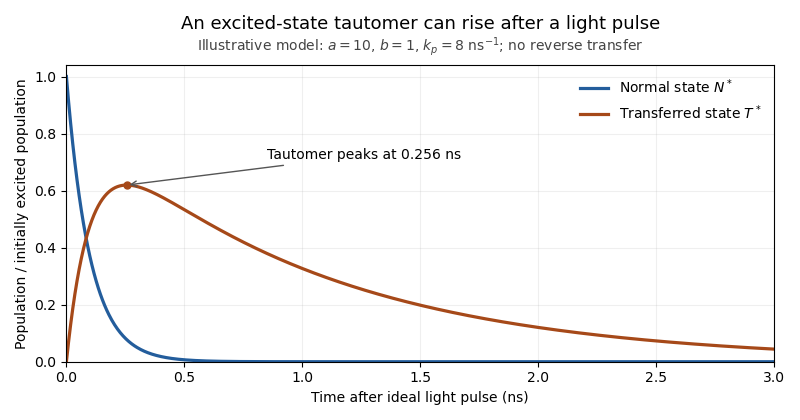
For chosen , and , the transferred population peaks at approximately . These are model values, not rate measurements from the historical experiment. Detected emission instead weights each population by its radiative rate and instrument response. Fluorescence lifetime and fluorescence instrument response must therefore be considered alongside spectral band ratios when testing a transfer mechanism.
Articles by others on the same topic



Photochemistry is a branch of chemistry that studies the chemical effects of light. It focuses on the interactions between light and matter, specifically how light (typically ultraviolet, visible, or infrared radiation) can induce chemical reactions or cause changes in the properties of substances. Key aspects of photochemistry include: 1. **Mechanisms of Light Absorption**: When molecules absorb photons (light particles), they can reach an excited state, leading to various chemical reactions.