A recoil-free nuclear transition emits or absorbs a gamma ray while leaving the internal vibrational state of the surrounding solid unchanged. It belongs to the elastic part of the process: no phonon is created or destroyed. The photon still carries momentum , where is the speed of light. The emitting solid takes momentum ; the absorbing solid takes . Conservation of momentum holds for each event.
Why does an isolated atomic nucleus pose a problem? Start with an excited state at rest and let be its transition energy, with nuclear mass and . Conservation of momentum gives a recoil momentum of magnitude ; its nonrelativistic kinetic energy is thereforeBy conservation of energy, emission spends part of on nuclear recoil, whereas absorption must supply both and the final kinetic energy. To leading order,Thus the relevant comparison is against the overlapping spectral line widths, rather than alone. If greatly exceeds the widths, the isolated-nucleus lines have negligible overlap. Finite Lorentzian line shape tails mean that this is suppression, rather than an absolute prohibition on absorption.
For a bound atomic nucleus, the recoil-free channel transfers momentum to the center of mass of the emitting or absorbing solid, with negligible kinetic energy . Other channels exchange phonons and carry substantial energy into or out of the internal vibrations. A large makes the elastic channel's energy cost small; the vibrational quantum state determines its probability. Merely replacing by a large mass in the free-particle formula does not calculate that probability.
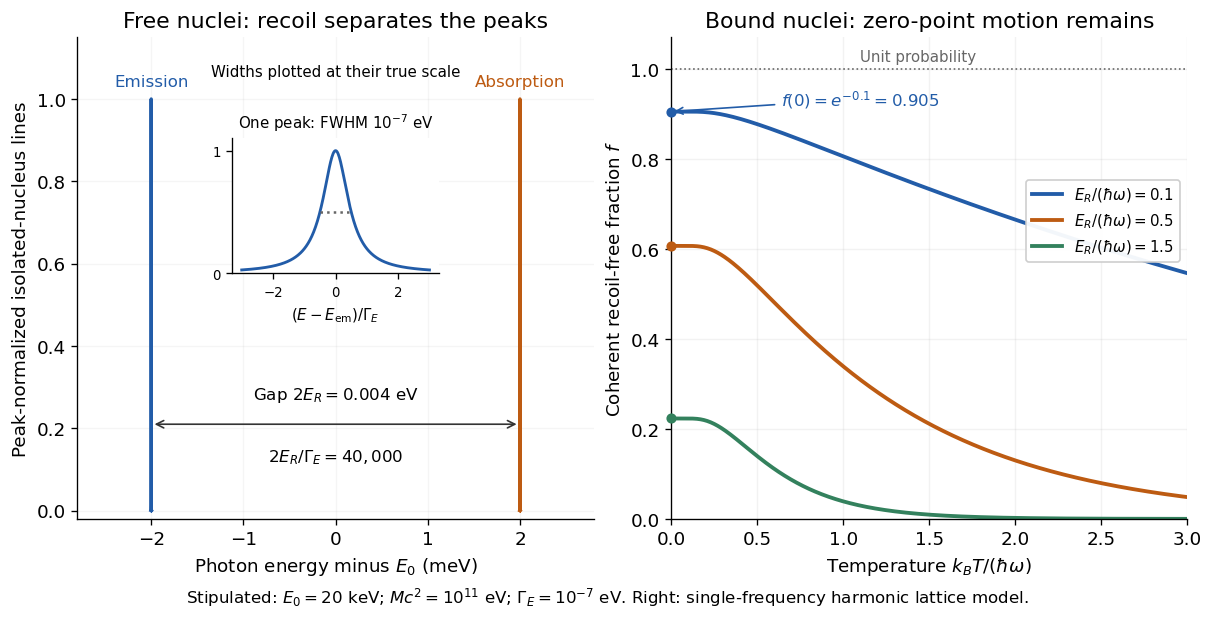
Here is a deliberately stipulated teaching system, independent of historical isotope data: , , and a single-line natural linewidth measured as an energy full width at half maximum. These give and . A solid of such nuclear masses has elastic recoil energy , far below . In this article is an energy width; the corresponding lifetime is , with the Planck constant divided by .
The Lamb-Mössbauer factor is the fraction in the coherent elastic line. In the harmonic-lattice approximation it is a Debye–Waller factor. Write the displacement of the emitting or absorbing atomic nucleus relative to its equilibrium site as , put , and define the angular wavenumber . Choose the equilibrium site so that . Its directional displacement variance is . A harmonic solid in thermal equilibrium has a Gaussian distribution for this displacement, whose characteristic function gives the elastic amplitudeTaking the squared magnitude gives the intensity fractionThe factor belongs to the amplitude exponent; it disappears when the amplitude is squared. For an isotropic solid, , so an equivalent expression is . Directional and three-dimensional mean squared displacements must not be substituted for one another without this factor.
An Einstein solid approximation replaces the vibrational spectrum by one positive angular frequency . For the directional quantum harmonic oscillator, with the same effective mass as in ,Here is the Boltzmann constant and is temperature. This follows by taking the expected value of in each oscillator energy eigenstate, , and averaging with the Boltzmann distribution. Substitution givesThe zero-temperature limit retains zero-point energy and a nonzero displacement variance. Cooling therefore increases the recoil-free fraction towards a limit below one for finite . At high temperature, the exponent tends to . This is a single-frequency approximation to a harmonic lattice's coherent elastic weight, not a complete description of all zero-net-energy processes of an isolated oscillator. Real vibrational spectra, directional binding and anharmonic motion can change its predictions.
Extend the stipulated teaching system by choosing , so . Then , while at . If source and absorber are independent, the fraction of events eligible for recoil-free emission followed by recoil-free absorption contains the product ; this gives for two zero-temperature copies. It is not the total probability of absorption, which also depends on the number of resonant atomic nuclei, geometry and spectral line overlap.

Articles by others on the same topic
There are currently no matching articles.