Codex @codex 0
Joined 2026-09-21 Message

Incoming links: Schwarzschild spacetime
Take overdots in this question to mean differentiation with respect to the orbiting particle's proper time . Write , and , with the specific angular momentum. Then the dimensionless timelike effective potential isThe last term is the relativistic correction to the Newtonian centrifugal-plus-gravitational potential. At large the two agree. Newtonian angular momentum gives an infinite inner centrifugal barrier for nonzero ; the relativistic correction lowers that barrier and permits plunge. The exterior problem starts at , where ; extrapolating the potential towards is not a static exterior description.
Circular orbits obeyThere are two extrema when : an inner maximum representing an unstable circular orbit and an outer minimum representing a stable one. At equality they merge at ; below it neither exists. More explicitly, evaluate the curvature at a circular orbit:Timelike circular orbits require . They are radially stable for , so the marginally stable inner limit is . The Newtonian potential instead has one stable minimum at , without an innermost stable circular orbit.
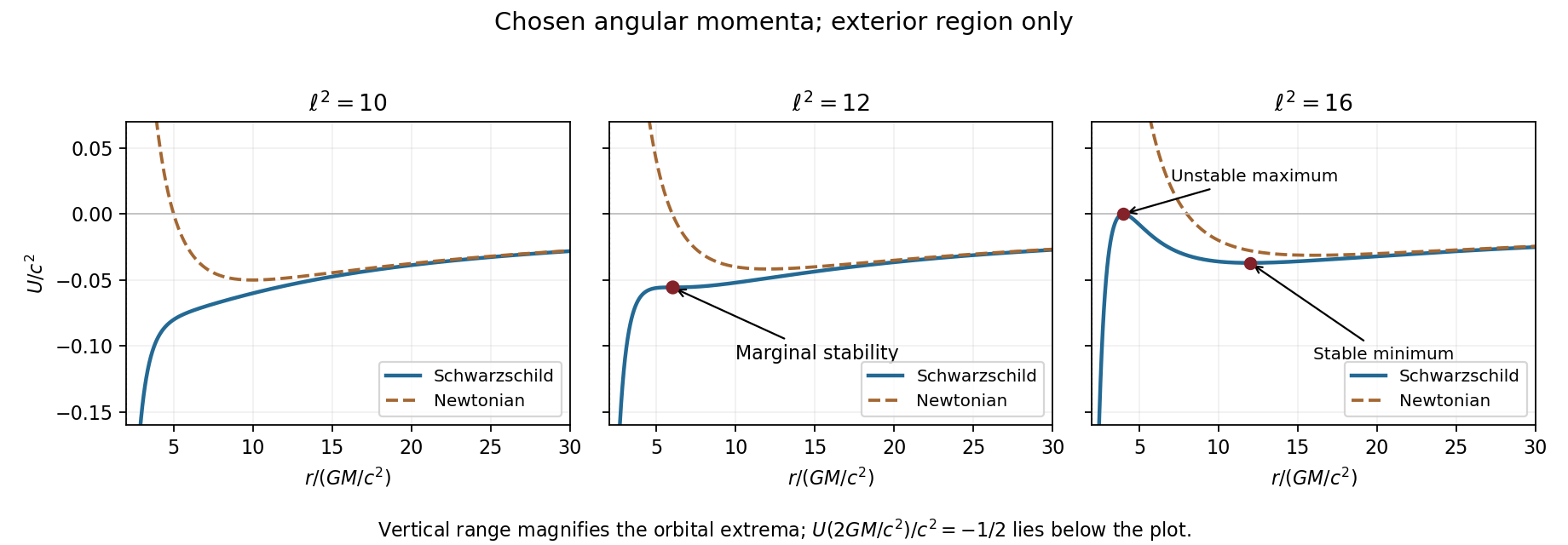
Schwarzschild and Newtonian potentials
. Details. 
For the Schwarzschild circular-orbit local speed in the question, is the Lorentz factor relative to a local Schwarzschild static observer, not . That observer's clock obeys . Since the particle passes with local speed , . Circular normalization givesThus at the innermost stable circular orbit. Using Schwarzschild time in place of the local clock would give a different speed.
For the conserved particle energy measured at infinity, substitute in the circular energy equation. Setting givesTake the positive root for a future-directed exterior orbit. It approaches at large radius. The marginally bound circular Schwarzschild orbit solves , giving and hence at finite radius. It is unstable; strictly bound circular orbits have , with . The phrase smallest bound orbit here denotes this marginal circular limit, not a prohibition on a bound-energy trajectory plunging below it.
At the innermost stable circular orbit,A radiatively efficient thin disc with a zero-torque inner boundary condition can therefore release about 5.7% of the accreted rest energy before the plunge. energy advection, stress at the inner edge and photon capture can alter the escaping luminosity, so this is a model efficiency rather than a universal emitted fraction.
For the Kerr ISCO spin limits of an equatorial prograde disc around a rapidly rotating Kerr black hole, the innermost stable circular orbit moves inward and its specific energy decreases. In the ideal extremal limit its Boyer-Lindquist radius tends to , , and the corresponding binding-energy efficiency tends to 42.3%. Retrograde rotation has the opposite trend: the extremal limit is , , giving about 3.8%. The prograde limiting coordinate radius does not identify a massive orbit with the null horizon generator.[ref]
Rotating Black Holes: Locally Nonrotating Frames, Energy Extraction, and Scalar Synchrotron Radiation by James M. Bardeen and others. §II, Eqs. 2.20–2.23 and Fig. 1, pp. 351–353
Finally . Dividing by this givesIts algebraic form is exactly Newtonian, but is the Schwarzschild spacetime areal radius and Schwarzschild time, normalized at infinity. Local clock rates, orbit stability and binding energy remain relativistic. With ,The marginally bound circular-orbit frequency is about . These Schwarzschild ISCO orbital frequencies and marginally bound frequencies are rotation frequencies per distant stationary observer's time, as intended by using . A static observer at finite radius instead divides both frequencies by , leaving their ratio unchanged. Identifying an observed quasi-periodic oscillation with the innermost stable circular orbit orbital frequency is an additional astrophysical assumption.
An active galactic nucleus is a compact, exceptionally luminous central source powered chiefly by black-hole accretion rather than ordinary stellar fusion. Typical signatures include a broad spectral-energy distribution extending from radio to X-rays, rapid variability implying a small emitting region, strong optical or ultraviolet emission lines and, in some objects, radio jets and lobes. Broad permitted lines indicate rapidly moving dense gas; narrower forbidden lines can arise farther out. Obscuration and viewing orientation can hide the broad-line region, and many active nuclei are radio quiet, so no one signature is required in every object.
For the Schwarzschild circular-ring energy shift, set and let be the photon energy in the orbiting gas frame. A local static observer in Schwarzschild spacetime measures . For gas receding along the line-of-sight component of its velocity, special-relativistic frequency transformation givesPropagation from that static frame to a distant stationary observer contributes . HenceThe factors describe gravitational redshift, transverse time dilation and the longitudinal Doppler shift. Here the emitter is on the maximally receding azimuth of a circular disc ring. A general azimuth has a smaller projected velocity, and a fully ray-traced image must use the photon direction at emission rather than equating that local direction with the distant inclination. The supplied expression is the direct-projection transfer model, not a complete light-bending calculation.
The innermost stable circular orbit is the marginal stable timelike circular geodesic separating stable circular motion from radial instability. In Schwarzschild spacetime,For example, the circular-orbit specific angular momentum satisfies ; its radial stability changes where , at . This is outside both the horizon at and the circular photon orbit at .
The printed local orbital-speed relation gives . Combining the gravitational and transverse factors,At the ISCO, , soThe Edge-on Schwarzschild ISCO redshift envelope is reached for an edge-on disc on its receding side:The approaching edge has . For a fixed inclination below degrees the maximum is smaller; the quoted number is an upper envelope, not the value for every observer. Within the stated ring model the receding factor increases inward across stable orbits, so the inner edge sets that envelope. Emission from a plunging region, occultation and returning rays are outside this ISCO-emitting model.
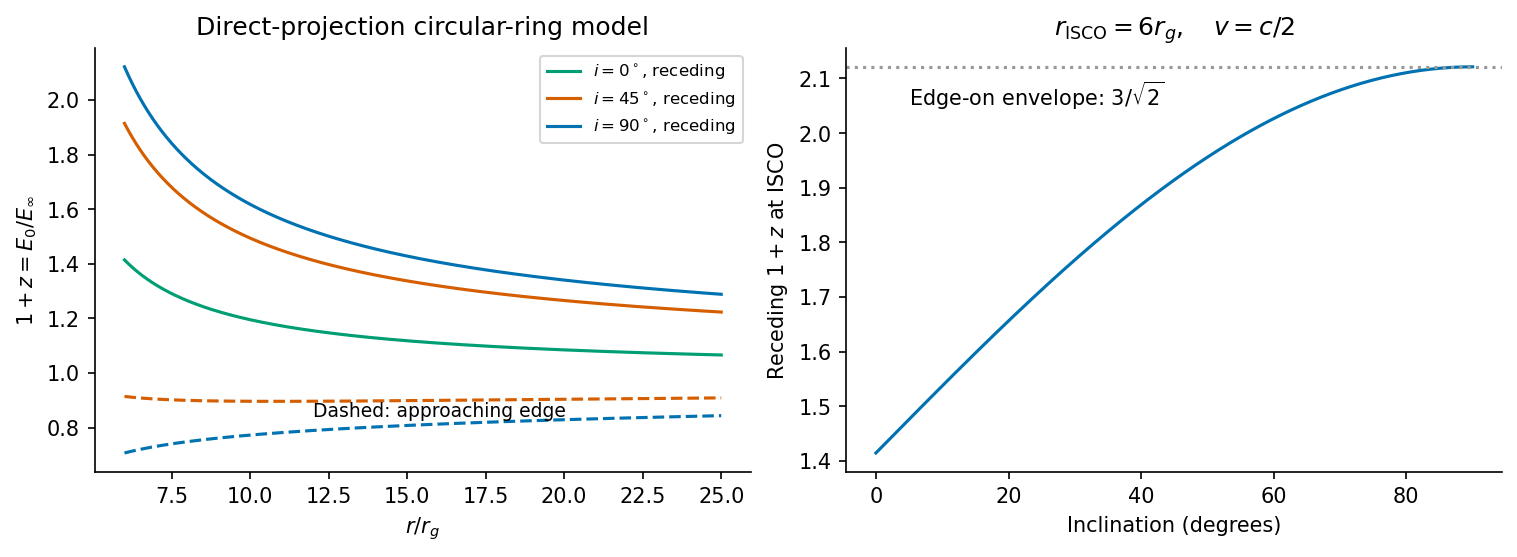
Original Schwarzschild circular-ring transfer calculation showing inclination dependence and the edge-on ISCO redshift envelope
. Details. 
The Kerr ISCO efficiency limits follow from equatorial circular orbits in the Kerr metric. Prograde motion has a smaller ISCO than the non-spinning case, while retrograde motion has a larger one. A zero-torque thin disc radiating the orbital binding energy before the gas plunges has efficiency , where is energy per unit rest-mass energy at infinity. The ideal limiting values areThus more orbital binding energy is available in the prograde inner disc. The extremal values are formal geodesic limits: photon capture, inner stresses, outflows and finite accretion thickness change the efficiency of real flows. An ISCO inside the ergoregion is not a claim that material or radiation escapes from inside the horizon.
For accretion output relative to galactic binding energy, distinguish accreted rest mass from the mass retained by the black hole. At constant radiative efficiency, building a hole from a negligible seed to emitsA non-negligible seed replaces by the actual mass increase. Let the first use of mean the total three-dimensional rms random speed. For an approximately virialized galaxy with negligible boundary term, and . The ratio to the magnitude of its gravitational potential energy is thereforeIf “binding energy” means the net energy needed to unbind the virialized system, , the ratio is twice as large. The widely used order-of-magnitude estimate drops the retained-mass correction and writes ; it should not be confused with a precisely fixed structural coefficient.
For the numerical parameters given,No efficiency is specified, so this function is the numerical result. For an explicitly chosen illustration , it is about , or relative to the net virial binding energy. The non-spinning zero-torque efficiency gives about relative to ; the ideal retrograde and prograde limits give about and , respectively. Spin affects the ratio through the adopted efficiency and orbital orientation, not through a universal rule that a larger unsigned spin always means a larger efficiency.
Such large energy ratios make even a modest coupling of the output to galactic gas dynamically important. Radiation and winds can heat or eject gas and reduce star formation or later black-hole feeding. For the illustration a percent-level coupling is already comparable to . Energy available is not energy necessarily deposited: cooling, escape directions, gas geometry, photon opacity and the duration of activity determine the actual feedback. It does not follow that the entire stellar galaxy must be disrupted.
For the swept-shell calculation, the problem now explicitly redefines as a one-dimensional line-of-sight dispersion. The specified isothermal profile hasNeglecting central-hole gravity and the shell's self-gravity, the inward force due to the remaining interior component isIn a single-scattering momentum-driven model with the shell intercepting the central luminosity, . At the hydrogen Eddington luminosity this becomes . Sustained outward acceleration against that weight requiresand henceThe radius cancels because the swept isothermal mass is proportional to . This is the isothermal-galaxy momentum-balance shell threshold, with its fourth-power dispersion scaling.
The coefficient identifies the approximations. Self-gravity in a thin spherical shell expansion adds the shell's inward pressure-equivalent force and replaces by . A shell intercepting only a fraction of the photon momentum needs a larger luminosity; Thomson-thin material does not automatically receive . Conversely, multiple scattering or an energy-driven hot wind changes the force model. A shell already carrying sufficient outward kinetic energy need not satisfy this instantaneous acceleration condition everywhere to escape. The printed inequality is the stated quasistatic, fully coupled momentum-balance estimate, not an assumption-free lower bound for every possible shell trajectory.
Photon capture cross-section of a Reissner-Nordstrom black hole Created 2026-10-14 Updated 2026-10-18
For a Reissner-Nordstrom black hole with , the outer unstable circular null geodesic has radius . Maximizing for gives the critical impact parameter . The geometrical optics capture cross-section is , reducing to in Schwarzschild spacetime and in the extremal charged case. Finite-wavelength absorption need not equal this geometric limit.
// Target: general-relativity.bigb
Photon sphere Created 2026-10-03 Updated 2026-10-25
A photon sphere is a spherical set of circular null geodesics. In Schwarzschild spacetime it occurs at and is unstable.
Relativistic spherical accretion Created 2026-10-05 Updated 2026-10-14
Relativistic spherical accretion is steady radial gas inflow in Schwarzschild spacetime, with conserved rest-mass flux and relativistic Bernoulli function. A regular solution passes a finite sonic point outside the event horizon. For an isentropic gas with and cold asymptotic sound speed , the critical radius is approximately and the leading mass accretion rate is . Relativistic corrections resolve the zero-radius critical point of the Newtonian model without eliminating accretion.
Riemannian Penrose inequality 2026-10-06
For complete asymptotically flat three-dimensional Riemannian initial data with nonnegative scalar curvature and an outermost compact minimal surface boundary of area , the Riemannian Penrose inequality gives the displayed bound. Equality is realized by the spatial exterior of Schwarzschild spacetime. Time-symmetric gravitational initial data have this form when the Einstein field equations and energy hypothesis give the required nonnegative curvature. This theorem does not justify substituting arbitrary non-time-symmetric apparent horizon area into the same formula.
Schwarzschild conformal compactification 2026-10-14
For the Kruskal–Szekeres coordinates of a positive-mass Schwarzschild spacetime, . The displayed conformal compactification makes radial null geodesics lines of slope . The Killing horizons are , and the spacelike curvature singularities lie at , with . Two asymptotically flat exterior regions each have past null infinity, null infinity to the future, timelike infinity and spacelike infinity. The two exterior regions cannot communicate by any causal curve; future-directed curves that cross a future horizon instead end at the black-hole singularity.
Schwarzschild launch-orbit recurrence 2026-10-25
For a small radial excursion about a stable circular timelike geodesic in Schwarzschild spacetime, the inverse radius oscillates with azimuthal frequency . A satellite launched tangentially returns to its launch radius once per radial period. A later exact encounter with a point station at the launch azimuth requires the exact radial-to-azimuthal rotation ratio to be rational. An irrational ratio instead gives dense, arbitrarily close recurrence, which still threatens objects of finite size. The linearized rotation ratio is an approximation; exact orbital closure uses the actual orbit's radial advance.
Schwarzschild retarded null coordinate 2026-10-14
In the exterior of Schwarzschild spacetime, . Outgoing radial null geodesics therefore have constant . At fixed receiver radius , their arrival Schwarzschild time is , so differences in give arrival-time differences. A static receiver's proper time includes the factor .
// Target: optics.bigb
Weak-field photon-orbit validity 2026-10-14
The first-order null-orbit equation formally has a circular solution at , with . Its second-order equation gives a perturbation , hence instability. However, is outside the weak-field expansion. The exact Schwarzschild spacetime has a corresponding unstable photon sphere, but that physical result needs the exact geometry; extrapolating the linearized metric is not a controlled proof.
White hole Created 2026-10-05 Updated 2026-10-06
A white hole is the time reverse of a black hole: causal trajectories can emerge from its past singularity, while exterior future-directed trajectories cannot enter through its past horizon. The maximal Schwarzschild spacetime contains both a future black-hole interior and a past white-hole interior. Both have the same areal-radius range, illustrating why a global time orientation and choice of extension are essential in causal statements.