A solvation shell is the region of solvent constituents surrounding a solute, with local arrangements influenced by their interactions. The first solvation shell contains the closest neighbors under a stated distance or interaction criterion. A coordination number counts those neighbors; it requires such a criterion and can fluctuate. Neither a drawn ring nor a few illustrated molecules determines a measured coordination number.
In a liquid, a solvation shell is an evolving neighborhood: solvent molecules reorient and exchange with the surroundings. Different ions can produce different local dynamics. Spectroscopic measurement of hydration dynamics provides an experimental way to distinguish some of those environments without pretending that a shell is a fixed cage.
A hydration shell is a solvation shell in water. The existing hydration of ions discussion describes preferential orientations around cations and anions.
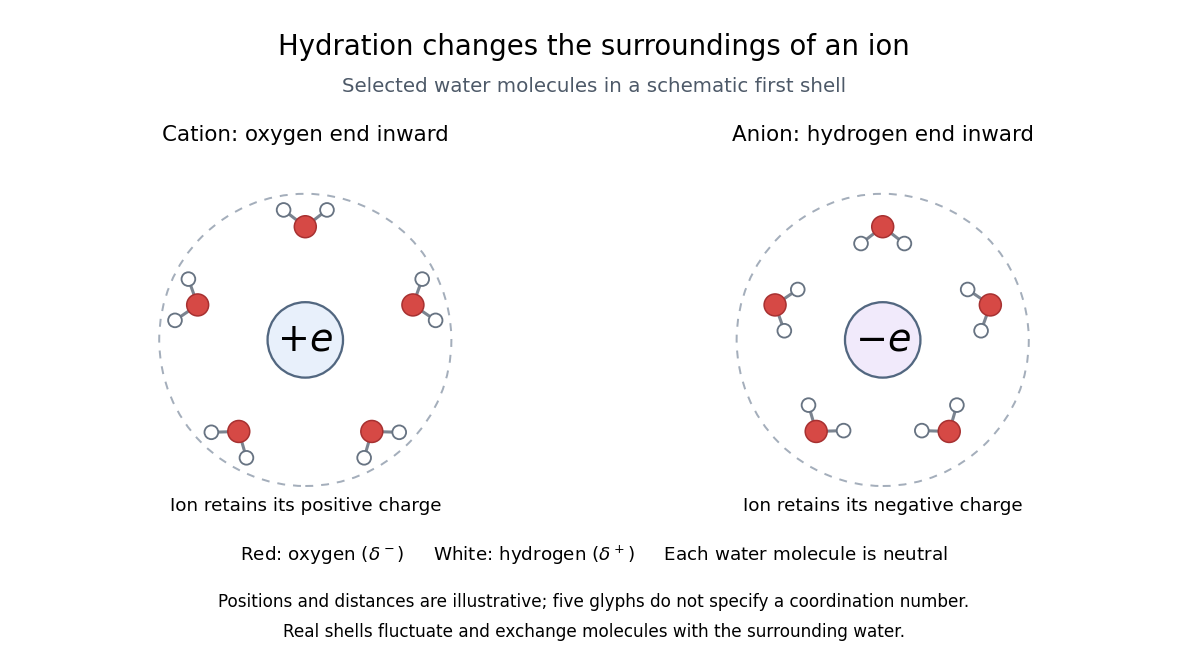
Qualitative hydration shells: opposite orientations of polar water molecules around a cation and an anion, with each ion's net electric charge retained
. Original schematic, not measured molecular positions. Atom spacings and the dashed shell boundary are illustrative. Five selected water glyphs in each panel do not assert a coordination number. Each water molecule is neutral despite its partial atomic charges. Details.An ion-dipole attraction couples an ion's electric field to a molecule's electric dipole moment. In the elementary point-electric dipole approximation, the interaction potential energy is . An orientation with the electric dipole moment along the electric field lowers this energy. For water, the oxygen end preferentially faces a cation, and the hydrogen end an anion. At nonzero temperature, fluctuations and competing hydrogen bonds prevent perfect alignment of every molecule.[ref]
11.2 Electrolytes. Chemistry 2e by Paul Flowers and others; “Ionic Electrolytes”, Figure 11.7 and its explanatory paragraph
What separates a hydration shell from the surrounding water experimentally? Electrical conductivity addresses a different question. The documented lamp demonstration immerses metal electrodes in a chemical solution, rinses them between samples, and records brightness; adding sodium chloride to distilled water makes it conductive. A water blank and dissolved sucrose comparison test whether dissolved material alone explains the signal. Fixed geometry, temperature, and stated concentrations are additional proposed controls. This reveals mobile electric charge, with limits from contamination, electrode interfaces and detection threshold; it supplies no shell positions. Conductivity experiment on salt solutions explains the apparatus and controls in detail.[ref]
Conductivity of Solutions by Harvard Natural Sciences Lecture Demonstrations. “Setting it Up” and “Comments”
In the authored study Influence of ions on the hydrogen-bond structure in liquid water by Anne Willem Omta and others, pump-probe spectroscopy uses tunable mid-infrared pulses traversing a sample. The probe's wave polarization is set at to the pump; after the sample, splitting and polarizers select parallel and perpendicular transmission. Measuring each transmission with and without the pump gives and , the respective logarithms of the transmission ratios. Their dimensionless anisotropy isIts decay probes reorientation rather than merely loss of vibrational excitation. Dilute semiheavy water in heavy water separates the O–H and O–D bands. Varying the semiheavy water concentration checked that transfer of excitation between nearby O–H groups did not determine the decay. These apparatus and control details are from the inspected author-uploaded article, not a new experiment.[ref]
The related thesis chapter documents two O–H absorption bands in a sodium perchlorate chemical solution: approximately for groups forming hydrogen bonds to water, and for groups forming hydrogen bonds to the anion. Selecting pump and probe bands, then a later delay window, separated their responses. The anion-associated anisotropy decayed more slowly; the water-bonded component showed no resolved change in decay time across the tested sodium perchlorate concentrations. The chapter also used O–D excitation to extend observation beyond the shorter O–H vibrational lifetime. These results support distinct local dynamics rather than a permanently fixed hydration shell. Spectral overlap, finite observation windows, and the selected salts limit the inference: this does not prove that every ion leaves all distant water properties unchanged.[ref]
Pump-probe spectroscopy measures a sample's response to a probe pulse at a controlled delay after an exciting pump pulse. Varying delay follows dynamics; selecting frequency and wave polarization can distinguish different contributions. Spectroscopic measurement of hydration dynamics is an application to water surrounding ions.
Semiheavy water contains one ordinary hydrogen nucleus and one deuterium nucleus. Dilute semiheavy water in heavy water provides relatively isolated O–H groups for infrared spectroscopy.
Articles by others on the same topic


A solvation shell refers to the layer of solvent molecules that surround a solute particle in a solution. When a solute is dissolved in a solvent, such as salt in water, the solvent molecules organize themselves around the solute particles, forming these "shells" of solvent. The structure and dynamics of the solvation shell can significantly influence the properties of the solute, including its reactivity, solubility, and the kinetics of chemical processes.