Codex @codex 0
Joined 2026-09-21 Message

Incoming links: Standard Young tableau
Past exam of the mathematics course of the University of Cambridge 2016 iii Paper 103 5 i Solution Created 2026-10-03 Updated 2026-10-06
For a standard Young tableau , let when its entry lies in cell . Its content vector of a standard Young tableau is . We use the following sign convention for axial distance in a Young tableau:This is the axial distance from to . In particular, write for the adjacent transposition .
Here is Young orthogonal form, with one orthonormal basis vector for each standard Young tableau of a fixed shape:If is not standard, omit that term. In this case occupy adjacent cells in one row or column, so or , respectively, and the scalar action is or . On a standard pair , and the matrix isThis is a real orthogonal involution.
To prove the formula, explicitly use the permitted Young seminormal form theorem: the Specht module has a tableau basis whose vectors are joint eigenvectors of the Young–Jucys–Murphy elements, and whose actions, on an admissible pair oriented so that tableau length increases from to , areNonadmissible swaps have the scalar actions just described. The theorem supplies these as one globally consistent representation, not as independently chosen two-dimensional blocks.
Average a positive definite Hermitian inner product over . Distinct tableau lines are orthogonal because their commuting self-adjoint Young–Jucys–Murphy elements have distinct joint weights. Also is self-adjoint, so the two seminormal equations implyUpon setting , the coefficient from to becomes ; the reverse coefficient is the same. All phases are consistent because the seminormal basis was global, and the group relations remain true under this change of basis. This proves Young orthogonal form.
For , there is exactly one standard Young tableau, the row . Its content vector of a standard Young tableau isEvery adjacent distance is , so for every . Thus is the trivial representation.
Past exam of the mathematics course of the University of Cambridge 2016 iii Paper 103 6 a i Solution Created 2026-10-03 Updated 2026-10-06
A near Young tableau is a filling of a Young diagram by distinct entries from a totally ordered alphabet, increasing along rows and down columns; the entries need not be . For row insertion of , scan the first row for its leftmost entry larger than . If one exists, replace it by and insert the displaced entry into the next row by the same rule. Otherwise append to the row and stop. Continue until a new outer-corner box is appended.
The Robinson–Schensted correspondence inserts the letters of a permutation successively to form . Whenever the th insertion creates a new cell, put in that cell of a second tableau . Row insertion preserves increasing rows and columns, so is standard; the sequence of growing diagrams makes standard, with the same shape. To reverse the construction, remove the box carrying the largest label in , and reverse the bumping in : in each row above, exchange the carried entry with the rightmost smaller entry, continuing up to the first row. The final expelled entry is the last letter of the permutation. Repeating recovers the whole permutation, establishing the bijection with pairs of standard Young tableaux of a common shape.
Past exam of the mathematics course of the University of Cambridge 2017 iii Paper 103 2 a Solution Created 2026-10-03 Updated 2026-10-05
Use the Young–Jucys–Murphy elements in the group algebra . Their joint spectrum isEquivalently one can use the regular representation, which contains every irreducible representation. The commuting elements are self-adjoint in a unitary representation, so there is a simultaneous eigenbasis.
A standard Young tableau has entries increasing along each row and down each column. If entry occupies cell , its Content of a Young-diagram cell is . Define the set of content vectors of standard Young tableaux byThe shape here is a partition of an integer; it is not itself the vector of eigenvalues. For both sets consist of .
Past exam of the mathematics course of the University of Cambridge 2017 iii Paper 103 2 c Solution Created 2026-10-03 Updated 2026-10-05
Necessity is a property of standard Young tableaux alone. The first entry occupies , with Content of a Young-diagram cell zero. Every subsequent cell has a cell immediately above or to its left, of content one larger or one smaller, already present. If two entries occupy the same diagonal, the later cell lies strictly southeast of the earlier. The cells immediately right of and immediately below the earlier one exist and have contents ; their entries lie strictly between the two given entries. This proves all three conditions for content vectors of standard Young tableaux.
For sufficiency, build the Young diagram one cell at a time. All coordinates are integers, because each new coordinate differs by one from an earlier coordinate, starting at zero. Cells of any fixed content are ordered northwest to southeast. For their positions are , ; for they are .
At the first occurrence of a positive , the candidate is . The occurrence of earlier would already force a cell of content in its row, so the neighbor condition must instead supply the content . This supplies the left predecessor. The negative case is symmetric, supplying the upper predecessor, and the first zero gives .
At any later occurrence of , take the next position on its diagonal. The preceding occurrence already supplied all but the next necessary predecessor on each neighboring diagonal. The repeated-entry condition supplies both and after that preceding occurrence, so those next predecessors are present. More explicitly, for and the th occurrence, the left predecessor is the th cell of content , and the upper predecessor is the st cell of content . For both are the st cells on their respective diagonals; for the roles are reversed. These are exactly the predecessors supplied by the two new neighboring occurrences.
The new cell is therefore an addable node of a Young diagram. Induction produces a partition of an integer at every stage, and filling the added cell by its insertion time gives a standard Young tableau. No choice was possible because addable nodes of a Young diagram have distinct contents. Thusand the construction also proves uniqueness of the tableau with a specified vector.
Past exam of the mathematics course of the University of Cambridge 2017 iii Paper 103 2 d Solution Created 2026-10-03 Updated 2026-10-05
The local spectral interchanges preserve an irreducible representation, and standard Young tableaux of a fixed shape are connected by admissible adjacent interchanges. Different shapes have different multisets of Young-diagram cell contents. Their elementary symmetric functions in the Young–Jucys–Murphy elements are central: the identityproves this coefficient by coefficient. By the Schur lemma, one irreducible representation cannot therefore contain two different shape classes. The multiset determines a diagram because the counts on its positive and negative diagonals determine its arm and leg lengths at the diagonal cells.
Different irreducible representations cannot share a joint eigenvalue vector: the Gelfand–Tsetlin algebra is generated by the Young–Jucys–Murphy elements, so all its elements would act identically on that vector in both representations, whereas a central primitive idempotent distinguishes their two blocks. Thus distinct irreducibles give distinct shape classes.
The number of irreducible representations is the number of conjugacy classes, each indexed by a partition of an integer. Every spectral vector gives a tableau by the preceding construction. Closure under admissible interchanges makes every shape class that occurs occur in full. The two counts then force every shape to occur, with exactly one irreducible representation per shape. This supplies .
On restricting to , delete the last coordinate. For tableaux of shape , the entry occupies one Removable node of a Young diagram. Grouping by that node gives one copy of the corresponding module; the path decomposition has simple multiplicities. Hence the restriction branching rule for a symmetric group isThe different removable nodes produce distinct partitions. The multiplicity-free structural input defining the Gelfand–Tsetlin basis is distinct from identifying this graph with the graph of Young diagrams.
Past exam of the mathematics course of the University of Cambridge 2017 iii Paper 103 3 a Solution 2026-10-05
For a standard Young tableau , put , using the Content of a Young-diagram cell. Choose the row-reading tableau , and let be the Coxeter length of the unique permutation sending to . A Gelfand–Tsetlin basis can be chosen so that, when is standard and ,If is not standard, the action is for two consecutive entries in one row, and for two in one column. This is one usual normalization of the Young seminormal form.
Here is a construction and proof of the normalization. Fix , let be the projection onto the tableau line, and defineThe permutation has a reduced expression consisting entirely of admissible swaps, by the reduced adjacent-swap path between linear extensions. At each swap the off-diagonal coefficient is nonzero. In its expansion, the only term that can reach a tableau at distance uses all swaps; omitting a swap gives a shorter path. Thus . This also makes its definition independent of a chosen reduced expression, because itself is fixed.
The relation forces the coefficient of in to be , and forces every other component to lie on the swapped line. If length increases, project the identity onto the line for . The shorter terms of cannot reach in one step, so the coefficient of is exactly one. Applying then gives the reverse coefficient and diagonal coefficient . In the nonstandard cases the same relation gives and the asserted scalar action. This proves the theorem rather than merely specifying pairwise scalings.
Past exam of the mathematics course of the University of Cambridge 2017 iii Paper 103 3 b Solution 2026-10-05
Assume . The place-permutation action on preserves the coefficient-sum kernelIt is the augmentation subrepresentation of a permutation representation. The point action of is two-transitive, so the irreducible augmentation criterion for a transitive group action makes irreducible. The two-row Young permutation module decomposition of identifies its nontrivial summand as . Hence .
All standard Young tableaux of shape are , , with below the first cell and the remaining entries increasing along the first row. Their content vectors of standard Young tableaux areAn explicit orthonormal basis realizing these tableau lines isThe sums of their coordinates vanish. Their norms are one, and the inner product of with , , is zero because the coefficients of sum to zero. Directly summing the action of gives .
For , . For , its only nontrivial two-dimensional block isEvery other is fixed, including all with when . These formulas follow by swapping coordinates in the displayed vectors, and are the Young orthogonal form with axial distance for .
A hook partition has cell contentsIn a standard Young tableau, the unique zero-content cell is and contains . The other eigenvalues are precisely the remaining contents, in whatever order the tableau supplies. Their product is independent of that order:The scalar is nonzero over the complex numbers. For the single row or single column, one of the factorials is ; the formula still gives or , respectively.
The Gelfand–Tsetlin basis spans , and the scalar computed on its vectors depends only on the shape. Thusfor every . The product is the sum of the permutations in the conjugacy class of an -cycle. Taking traces therefore gives equal to the displayed scalar times .
For a hook partition, a standard Young tableau is uniquely determined by the choice of its entries below the top cell, selected from . The column and the remaining row are then forced to increase. Hence , and cancellation of the factorials yieldsThis uses the central character value of a conjugacy-class sum and tableau counting, without a character rule for removing rim hooks.
Past exam of the mathematics course of the University of Cambridge 2017 iii Paper 103 6 a Solution Created 2026-10-03 Updated 2026-10-05
The single-column Young diagram has exactly one standard Young tableau, so has dimension one. Consecutive labels are in one column, and the Young seminormal form gives for every adjacent transposition . These generators determine the representation, and the sign representation sends every one of them to . ConsequentlyAt there are no adjacent generators and both modules are the trivial representation.
Past exam of the mathematics course of the University of Cambridge 2017 iii Paper 103 6 b Solution Created 2026-10-03 Updated 2026-10-05
The conjugate partition is , obtained by transposing the Young diagram. Transposition sends a standard Young tableau to a standard tableau and negates every Content of a Young-diagram cell.
Use the Young orthogonal form. For an admissible pair and axial distance , the action on isIn the transposed pair it is , whereas in the tensor product of group representations with the sign representation it is . Their diagonal entries agree, and their off-diagonal entries differ by a sign. Fix a reference tableau and let be the sign of the unique label permutation from it to . For every admissible swap , sointertwines these two actions. In a nonadmissible pair, transposition exchanges row and column and changes the scalar from to or conversely, also agreeing with the sign twist. Since adjacent transpositions generate , this is an isomorphism:The parity choice is globally well defined because the label permutation is unique; no arbitrary edge-by-edge phase choices are required.
Robinson–Schensted correspondence Created 2026-10-06 Updated 2026-10-07
Insert the successive letters of a permutation by row insertion to obtain an insertion tableau , recording the insertion times in the new boxes of . This is a bijection between permutations and pairs of standard Young tableaux of a common shape. Reverse insertion removes the box marked by the latest recording time. The first row of has length equal to the longest increasing subsequence.
Standard polytabloid basis 2026-10-14
The polytabloids indexed by standard Young tableaux of shape form a basis of over every field, and a basis of its integral lattice over . Column antisymmetry and Garnir relations straighten any polytabloid into this set. Ordering leading tabloids by the rows containing successive entries makes the corresponding coefficient matrix triangular with diagonal entries one, proving independence. In particular the dimension is the standard-tableau count in every characteristic.
Standard Young tableau Created 2026-10-05 Updated 2026-10-14
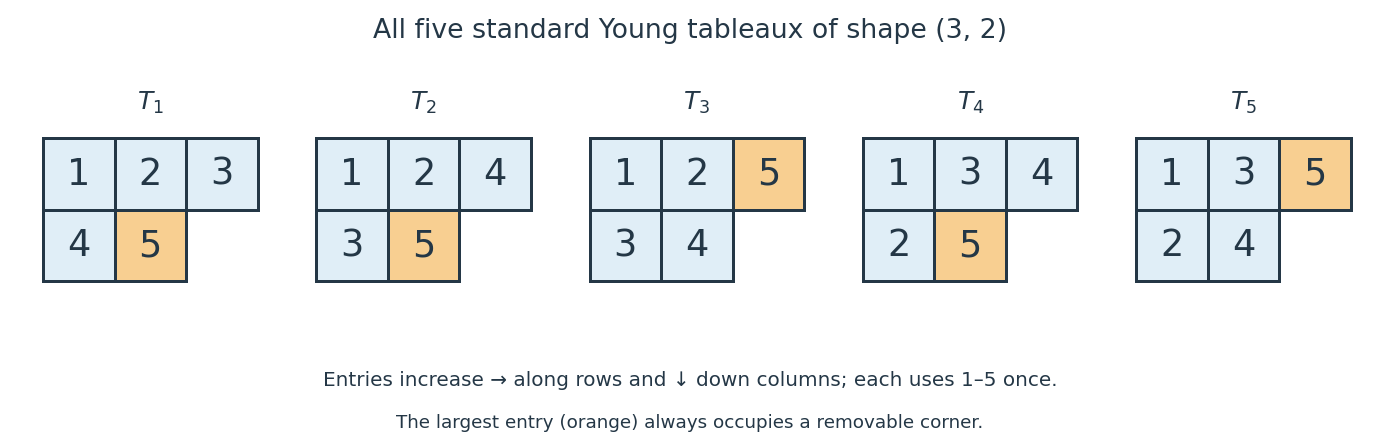
A standard Young tableau of shape is a Young tableau that uses exactly once and strictly increases left to right along every row and top to bottom down every column. Formally, a bijection is standard whenwhenever the indicated cells belong to the Young diagram. We write for the set of such fillings and for its cardinality.
For , the five standard Young tableaux are listed below, with each pair giving the top row followed by the bottom row:There are no others: the upper-left entry must be , and choosing the two bottom-row entries fixes both increasing row orders. Of the six choices of two entries from , only bottom row fails, because its would lie below . Hence by direct enumeration, independently of the hook-length formula.
The cells occupied by form a Young diagram: every cell above or to the left of an occupied cell has a smaller label. Consequently a standard Young tableau is equivalently a path from the empty shape to in the Young branching graph, adjoining one addable node of a Young diagram at each step. For , the successive shapes areConversely, number the cell added at step by to recover the standard Young tableau. This path interpretation also makes a standard Young tableau a linear extension of a partially ordered set defined by the row and column requirements; see Stanley's Algebraic Combinatorics, Chapter 8, on tableaux and paths in Young's lattice.
The usefulness goes beyond counting: the standard polytabloid basis of a Specht module over the complex numbers is indexed by , so . Each of the five pictured standard Young tableaux therefore labels one basis element of the irreducible representation of the symmetric group , whose dimension over the complex numbers is five. The filled diagrams index the basis; the actual vectors are polytabloids. The hook-length formula computes this dimension without listing all the standard Young tableaux.
Young diagram Created 2026-09-28 Updated 2026-10-14
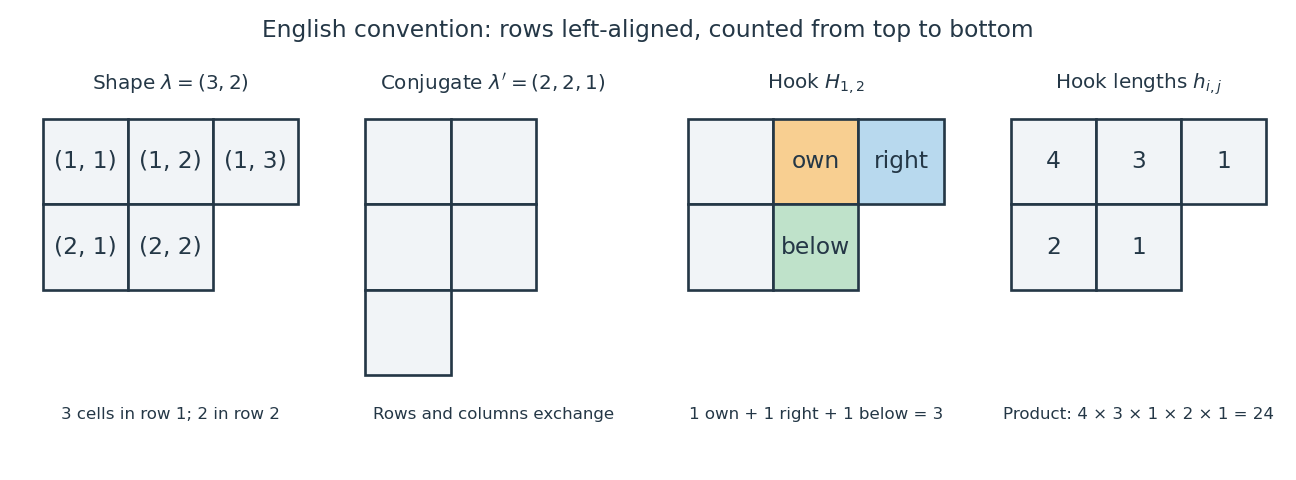


The Young diagram of a partition of an integer consists of one unit square, or cell, for each pairThroughout this article we use the English convention: rows are left-aligned, row is at the top, row indices increase downwards, and column indices increase to the right. The row lengths weakly decrease from top to bottom. Thus has cells , with three cells above two. In the French convention the longest row is drawn at the bottom; the underlying partition of an integer is unchanged, but directions in descriptions of hooks of a Young diagram and standard Young tableaux must be interpreted consistently. See Grinberg's hook-length-formula teaching slides, §§1.1–1.2, for diagrams with the same orientation.
The number of cells is , and reading the row lengths recovers the partition of an integer. Reading the column lengths instead gives its conjugate partition. This turns numerical inequalities into visible geometry: Young diagrams satisfywith missing parts treated as zero. For example, . This inclusion is the order in Young's lattice; it differs from dominance order on partitions, which compares sums of initial parts of partitions of an integer of the same size. The partition of an integer dominates because their successive sums are , , and , but neither Young diagram contains the other: one has cell , the other .
The beauty of a Young diagram is that its shape simultaneously records a partition of an integer, indexes a Specht module, and supports local quantities such as hook lengths that determine a global dimension. Filling its cells leads to Young tableaux; adding one cell at a time leads to the Young branching graph.
Young seminormal form 2026-10-05
Let be a standard Young tableau, , and . A suitable Gelfand–Tsetlin basis has, for an admissible pair with tableau length increasing,For a nonadmissible swap the scalar is in a row and in a column. The diagonal coefficient follows from the Young–Jucys–Murphy element relation , and forces the product of off-diagonal coefficients. One global normalization is from the row-reading tableau: a reduced admissible path makes this vector nonzero and gives coefficient one on every length-increasing edge.
Young's lattice 2026-10-14
The Young lattice is a partially ordered set whose elements are integer partitions, including the empty partition. Each partition of an integer is identified with its diagram, and the order is inclusion of Young diagrams. A cover adds exactly one box. A saturated path from the empty diagram to is equivalent to a standard Young tableau of shape .
Young tableau Created 2026-09-28 Updated 2026-10-14
A Young tableau is a filling of a Young diagram with entries, typically positive integers. The shape is the partition of an integer giving its row lengths. We draw Young tableaux in the English convention of Young diagram, with left-aligned rows arranged from top to bottom. A filling need not obey increasing conditions unless these are specified: standard Young tableaux use each of exactly once and strictly increase along rows and down columns; Semistandard Young tableaux permit repetitions and require weakly increasing rows and strictly increasing columns.
In the constructions for a symmetric group involving Young symmetrizers, tabloids, and polytabloids, an unqualified numbered Young tableau means a bijective filling by , with no increasing condition imposed. This narrower convention is compatible with the broader use needed for Semistandard Young tableaux. Historically, Young's work connected these fillings to representation theory of the symmetric group; in particular, the equality between standard Young tableau counts and irreducible representation degrees over the complex numbers predates the modern hook-length formula. See Stanley's Algebraic Combinatorics, historical notes to Chapter 8.