Taxonomy names and classifies organisms. Classification can organize known diversity and make comparisons useful, but ranks and names are not themselves evidence of ancestry. Phylogenetics infers that ancestry; a clade includes an ancestor and all its descendants. A shared feature such as lacking a cell nucleus need not identify an exclusive clade. The organism branch here organizes cell types for reading and is not a proposed phylogenetic tree. See OpenStax Biology 2e, 20.1: classification and evolutionary history.
A biological domain is a high-level rank used to classify organisms in the three-domain system. Distinguish a taxonomic rank from a primary branch in an inferred phylogenetic tree: retaining familiar names does not settle the branching relationships.
The three-domain system recognizes bacteria, archaea and eukaryotes as three domains. In 1990, Woese, Kandler and Wheelis proposed the domain rank and the names Bacteria, Archaea and Eucarya, using molecular comparisons to argue that the older prokaryote/eukaryote division hid important differences. See Woese, Kandler and Wheelis, 1990: Towards a natural system of organisms.
The associated three-domain ancestry model places the nuclear lineage of eukaryotes alongside archaea, rather than within them. This historically influential interpretation should be distinguished from the two-domain system; listing three familiar groups does not establish three independent primary branches.
The two-domain system recognizes bacteria and archaea as the two primary lineages, placing the nuclear ancestry of eukaryotes within archaea. In this model, archaea as a complete clade includes that eukaryotic lineage; restricting the name to prokaryotic members describes a different grouping. Williams and colleagues' study, published online in 2019 and in a 2020 journal issue, found support for this model and a close relationship to Asgard archaea. See Williams et al., 2020: Phylogenomics provides robust support for a two-domains tree of life.
This updates the interpretation of the 1977 and 1990 classifications rather than undoing their discovery of deep differences between bacteria and archaea. Deep phylogenetic trees depend on the sampled genes, organisms and inference model; the precise closest archaeal relatives and early sequence of events require further evidence. Bacterial ancestry of mitochondria through endosymbiosis is a separate part of eukaryotic history.
A species is a named unit of biological classification. The useful criteria vary among groups: reproductive compatibility can inform classification in many animals, while microbial comparisons also use genomes and other characters. Escherichia coli is a species; K-12 MG1655 identifies a particular strain within it. See OpenStax Biology 2e, 18.2: species concepts.
A species concept states what should make organisms members of the same species; an operational criterion states what observations will test that claim. Reproductive isolation, distinguishable morphology and ancestry inferred through phylogenetics answer different questions. In a lineage-based interpretation, they are evidence for separation of evolving biological populations, and need not appear together. [ref]
Species Concepts and Species Delimitation by Kevin de Queiroz. pp. 880–883, Table 1, Figure 1 and “Conceptualization versus Delimitation”: distinguish defining properties from operational evidence
The biological species concept groups naturally interbreeding biological populations with viable, fertile offspring, distinguished from other such groups by reproductive isolation. An operational test examines mating, fertilization, offspring survival and offspring reproduction, rather than only whether two adults can be paired. Sexual reproduction is its scope: fossils and organisms studied only through asexual reproduction cannot supply the same mating evidence. [ref]
Biology 2e by Mary Ann Clark and others. §18.2, “Species and the Ability to Reproduce”, “Speciation” and “Reproductive Isolation”
For an original hypothetical example, imagine two separated biological populations that reproduce successfully after contact. The separation alone did not demonstrate reproductive isolation. Conversely, failure to mate in one unfamiliar chamber could reflect the assay conditions. Field observations of gene flow and tests under suitable conditions address the biological question more directly. A successful laboratory pairing does not establish frequent interbreeding in nature.
A morphological species concept distinguishes species using morphology: measurable differences in form or structure. It can be applied to preserved specimens and fossils when mating cannot be observed. Similar appearance need not imply the same species, and different appearance need not imply different species. [ref]
Biology 2e by Mary Ann Clark and others. §18.2, “Species and the Ability to Reproduce”, paragraphs accompanying Figures 18.9–18.10: appearance can mislead
An original operational example is to compare a chosen structure in specimens of comparable age, sex and rearing conditions. Suppose two apparent groups differ in size, but one group contains only juveniles. The observed difference does not yet diagnose two species. Specify the measured phenotype, variation within each sample, and whether the distinction persists across comparable specimens. A single striking specimen is a poor substitute for that comparison.
Phylogenetic species concepts use ancestry and diagnostic inherited differences; versions differ over requiring a clade, an exclusive ancestry pattern at genetic loci, or a distinguishable character combination. State which criterion is intended. [ref]
Species Concepts and Species Delimitation by Kevin de Queiroz. p. 880, Table 1: distinct monophyletic, genealogical and diagnosable versions of phylogenetic criteria
For an original operational example, suppose a phylogenetic tree inferred from one genetic locus separates two sampled biological populations. Compare further genetic loci and additional local samples before interpreting that branch as a species boundary. Otherwise the test may merely identify the particular ancestry of the sampled alleles. Adding more sites from the same genetic locus improves that locus's evidence without creating an independent ancestry test.
Species delimitation infers the boundaries and number of species from evidence. No single arbitrary percentage of nucleotide sequence difference is a universal boundary. Divergence within an old, widespread species can exceed divergence between recently separated species; geography and multiple kinds of evidence matter. [ref]
Species Concepts and Species Delimitation by Kevin de Queiroz. pp. 884–885, “Alternatives to the Traditional Properties”: divergence cutoffs and geographic differentiation
An original counterexample to a universal percentage rule: an assay could examine a strongly conserved gene in one comparison and a rapidly changing nucleotide sequence in another. Equal percentages then answer different historical questions. Even the denominator needs specifying: all sites, aligned sites, or only a filtered region? A threshold is an operational rule for a stated assay and group of organisms, whose errors need evaluating. It is not a definition that automatically transfers to every species.
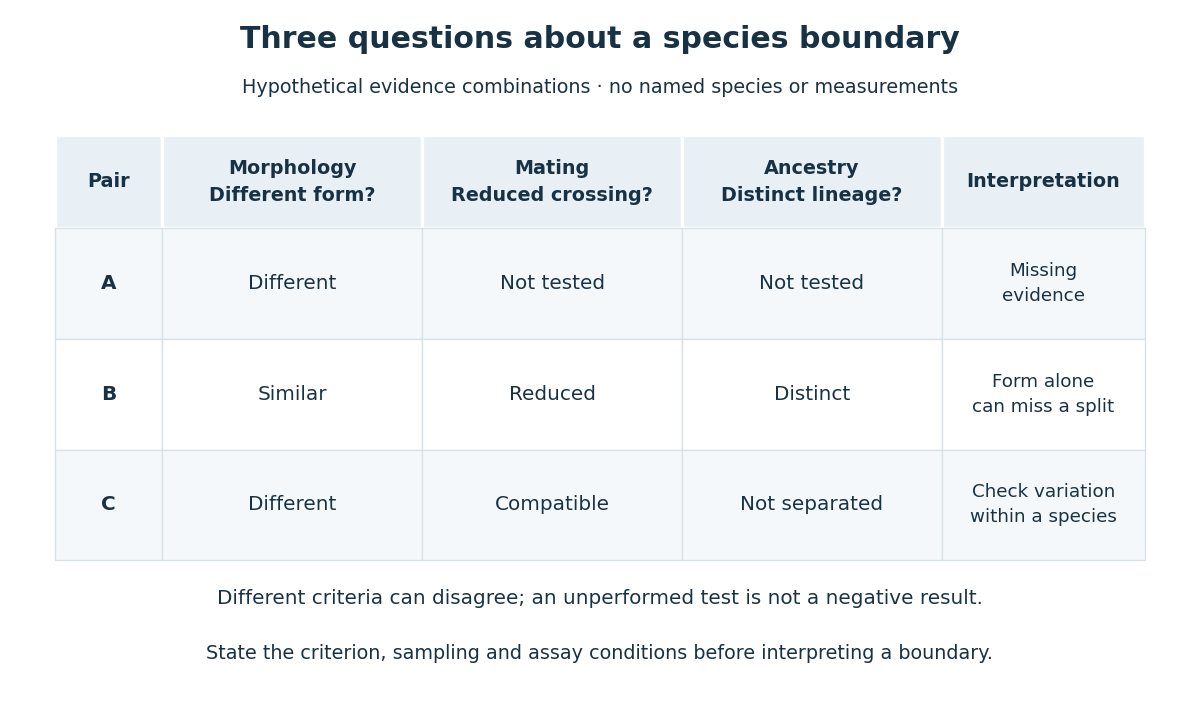
Contrasting operational evidence for species delimitation
. Original hypothetical comparison of morphology, mating and ancestry evidence. Each observation tests a different claim; the combinations are thought experiments, not a dataset or verdicts about named species. “Not tested” does not mean absent. Details.
The diagram's hypothetical pair B has similar morphology but reduced mating and distinct ancestry evidence. A morphological species concept could miss that distinction. Pair C instead has different morphology but compatible mating and ancestry that fails to separate the samples. That combination calls for checking variation in phenotype within a species. Pair A has only a structural difference observed: the other criteria remain untested. These examples show why missing evidence, disagreeing evidence and agreeing evidence require different interpretations.
A species can encompass many biological populations. A biological population specifies a set of organisms in a place and time; a biological strain identifies a maintained variant or lineage, often in a laboratory. A species name, a local census and a biological strain designation therefore describe different things. Multiple independently maintained cultures can also share the same biological strain designation.
For example, a culture identified as Escherichia coli K-12 MG1655 specifies more than the species alone. Two flasks inoculated from that culture are separate experimental biological populations; the separate containers do not establish two species or two different biological strains. This is an original experimental bookkeeping example, not a claim that every biological strain name encodes a complete genotype.
Articles by others on the same topic
There are currently no matching articles.