Taxonomy names and classifies organisms. Classification can organize known diversity and make comparisons useful, but ranks and names are not themselves evidence of ancestry. Phylogenetics infers that ancestry; a clade includes an ancestor and all its descendants. A shared feature such as lacking a cell nucleus need not identify an exclusive clade. The organism branch here organizes cell types for reading and is not a proposed phylogenetic tree. See OpenStax Biology 2e, 20.1: classification and evolutionary history.
A type species is the species serving as the nomenclatural type of a genus under a naming code that uses this form of typification. It anchors application of the genus name. It is not necessarily an average, an ancestor or the most familiar member of the genus.
In prokaryotic nomenclature, the Code explicitly identifies the type of a genus or subgenus with a type species and specifies how that species is fixed. If a genus originally included only one species when validly published, that species is its type even without an explicit designation. These are naming rules, not measurements of evolutionary distance.[ref]
International Code of Nomenclature of Prokaryotes. Prokaryotic Code (2025 Revision) by Aharon Oren and others. Rule15 and Rules20a–20c, printed pp.10 and13: types, designation and a genus originally containing one species
An original hypothetical example separates the reference from a summary statistic. Suppose a genus contains species T, U and V, with T the designated type species. A measured trait has values1,10 and11, whose arithmetic mean is . U lies nearer that mean, but this does not make U the type. The designation and the statistical comparison answer different questions.
Now suppose new evidence from phylogenetics divides the hypothetical group into T+U and V. The existing reference is associated with the group containing T; how the remaining group is named requires the relevant naming rules and publication history. Merely discovering that V has an unusual trait does not transfer the reference to it.
The anchor has another level beneath it. In the ordinary prokaryotic case a species itself has a type strain, whereas the genus has a type species. A stored culture accession, a species reference and a genus reference therefore do not all denote the same rank or the same physical object.[ref]
International Code of Nomenclature of Prokaryotes. Prokaryotic Code (2025 Revision) by Aharon Oren and others. Table2 under Rule15 and Rule18a: species and genus types; Rule20a: type species
A type species stabilizes the connection between a name and its reference while taxonomy remains open to revised evidence. The detailed code governing the organisms concerned must be stated; one nomenclatural example should not silently impose every prokaryotic rule on other branches of biology.
A taxonomic kingdom is a major taxonomic rank conventionally below a domain and above a taxonomic phylum. A kingdom is a particular taxon at that rank, while the rank word identifies its place in a classification. In a familiar classification of eukaryotes, animals and plants belong to different kingdoms within the same domain.[ref]
Nested membership permits several descriptions of one organism. An individual animal can belong to the eukaryotic domain, the animal kingdom and a particular phylum simultaneously. The levels select different scales of grouping, rather than offering competing identifications.
A constructed classification database illustrates the information supplied by parent relationships. Suppose kingdom A contains phyla P and Q, with 8 and 12 recorded species, while kingdom B contains phylum R with 20 recorded species. Both kingdom totals are twenty, but A's records are divided between two phyla and B's are not. A query grouped only by kingdom loses that distribution. The counts describe the stipulated records, not a census of complete biological diversity.
The kingdom rank does not prescribe a fixed number of phyla or a particular evolutionary age. Nor does sharing that rank establish equal evolutionary distance between any two groups. A phylogenetic tree represents hypotheses about ancestry and branching; a ranked classification assigns names to selected groupings.[ref] Keeping the rank, the membership and the supporting evidence separate makes comparisons across classifications more interpretable.
A taxonomic phylum is a major taxonomic rank conventionally below a taxonomic kingdom and above a taxonomic class. A particular phylum is a taxon at that rank. For example, chordates form the phylum containing Mammalia, which in turn contains orders such as Carnivora.[ref]
The same animal can consequently belong to a phylum, a class and an order without these being competing identifications. Each level adds information about nested membership. The rank word phylum identifies a position in the hierarchy; the group name identifies which taxon occupies that position.
For a constructed survey example, suppose one phylum is represented by four sampled classes with 3, 7, 2 and 8 sampled species. Its total is . A second phylum with two sampled classes containing ten species each has the same total. Reporting only twenty species for each phylum loses the class-level distribution, and neither count establishes the total diversity of the unsampled phylum.
A taxonomic rank does not itself specify a fixed age, number of constituent groups or numerical genetic distance. A phylogenetic tree addresses evolutionary relationships, while ranked names select particular groupings for classification.[ref] The usefulness of the rank comes from organizing comparisons; the scientific interpretation still depends on what was sampled and the evidence supporting membership.
A taxon is a group of organisms recognized as a unit in taxonomy. A taxonomic rank specifies a position in the classification hierarchy; a taxon is the particular group placed there. Thus Felidae is a taxon at the rank of taxonomic family, while Carnivora is a taxon at the rank of taxonomic order.[ref]
One organism can belong to many nested taxa. Membership in a species, its genus and its taxonomic family describes different levels of the same classification. A rank alone does not identify the group: the word family could refer to many distinct taxa.
For a constructed information-system example, let a family contain genera A and B, with three and five recognized species respectively. A species record can store its species identifier and follow parent relationships to recover its genus and family. If a later classification moves one species from A to B, the family's species total remains eight, while the genus totals change from 3 and 5 to 2 and 6. Group membership and the name of the rank are separate pieces of information.
A clade is specifically a group containing an ancestor and all its descendants. Calling a group a taxon does not by itself establish that it is a clade; that claim depends on its circumscription and the inferred phylogenetic tree.[ref]
A taxonomic class is a taxonomic rank conventionally below a taxonomic phylum and above a taxonomic order. A particular class is a taxon at that level. For example, Mammalia is the class of mammals, and Carnivora is one of its constituent orders.[ref]
The hierarchy makes several statements simultaneously: an individual cat belongs to Mammalia, Carnivora and Felidae, at class, order and family ranks respectively. These nested memberships describe increasing specificity. They do not give three independent estimates of the cat's identity.
Consider a constructed sampling table with two classes, each represented by twelve sampled species. The first has two sampled orders containing six species each; the second has three containing four each. The class totals agree, while the within-class distribution differs. Class-level aggregation preserves the total and discards that structure. Nor would twelve sampled species establish twelve species in the complete class: sampling coverage is a separate issue.
A taxonomic class need not have a fixed number of orders, individuals or species. Its rank also does not specify a fixed age or a numerical amount of genetic divergence. Those are additional biological quantities or hypotheses that require evidence beyond the hierarchical label.
A taxonomic order is a taxonomic rank below a taxonomic class and above a taxonomic family. An order is a named grouping, or taxon, at that position in a classification. Its constituent families can themselves contain several genera and species.[ref]
Biology 2e by Mary Ann Clark and others. section 20.1, Classification Levels
For example, Carnivora is an order containing the cat family Felidae. The order name and family name identify groups at different levels; the same animal belongs to both. This is nested classification rather than two competing identifications.[ref]
A constructed database example illustrates the information lost during aggregation. Suppose an order contains three families with 2, 4 and 1 sampled species respectively. Reporting seven species for the order preserves the total but discards how those records were distributed among families. An analysis at order level can therefore conceal variation visible at family level.
The rank specifies hierarchical placement, not a fixed age, number of species or amount of genetic divergence. A phylogenetic tree instead expresses a hypothesis about ancestry and branching. Classification uses evolutionary evidence, but a rank label alone is not a numerical evolutionary distance.[ref]
Biology 2e by Mary Ann Clark and others. section 20.1, phylogenetic hypotheses and limitations of tree diagrams
A taxonomic rank is a named level in a biological classification hierarchy. Taxonomic order, taxonomic family, genus and species are ranks; Carnivora is a taxon at order rank, and Felidae is a taxon at family rank. A rank answers what level a group occupies, while a taxon identifies which group is meant.[ref]
Biology 2e by Mary Ann Clark and others. section 20.1, Classification Levels
In a simplified nested classification, let , , and be the organism sets belonging to one species, its genus, its family and its order. Then . The subset symbol expresses inclusion, not equality of the number of members or a fixed numerical spacing between levels.
For instance, a hypothetical family can contain one genus with ten species, whereas another family contains five genera with two species each. Both have ten species and occupy the same rank, yet their internal grouping differs. Rank, species count and genus count are distinct data.
Nor must each biological clade receive a traditional rank: a phylogenetic tree can resolve many branching groups between two named levels. The hierarchy provides a practical naming framework, while the evolutionary hypothesis contains additional structure.[ref]
A taxonomic family is a taxonomic rank above a genus and below a taxonomic order. A particular family is a named group of organisms placed at that rank; the rank itself is a position in the classification hierarchy.[ref]
For example, the cat family Felidae includes the genera Felis and Panthera. The family groups several genera, while each genus groups species. Scientific classifications draw on morphological, molecular and other evidence when deciding which organisms belong together.[ref]
Classification of living cat species by the IUCN SSC Cat Specialist Group. Cat Classification Task Force account and evidence underlying the 2017 revision
A constructed counting example separates hierarchy from abundance. If a hypothetical family contains two genera with three and five recognized species respectively, it contains eight species, provided those lists are disjoint and complete. It need not contain eight individual animals: the same eight species could be represented by millions of organisms.
The rank does not prescribe a fixed number of genera or species. Nor is a family label itself a measurement of evolutionary time. A phylogenetic tree represents hypotheses about ancestry and branching; ranked names organize those organisms at selected hierarchical levels. Changes in evidence can lead to revised membership without changing what the rank word means.[ref]
Biology 2e by Mary Ann Clark and others. section 20.1, phylogenetic hypotheses and classification revisions
A biological domain is a high-level rank used to classify organisms in the three-domain system. Distinguish a taxonomic rank from a primary branch in an inferred phylogenetic tree: retaining familiar names does not settle the branching relationships.
The three-domain system recognizes bacteria, archaea and eukaryotes as three domains. In 1990, Woese, Kandler and Wheelis proposed the domain rank and the names Bacteria, Archaea and Eucarya, using molecular comparisons to argue that the older prokaryote/eukaryote division hid important differences. See Woese, Kandler and Wheelis, 1990: Towards a natural system of organisms.
The associated three-domain ancestry model places the nuclear lineage of eukaryotes alongside archaea, rather than within them. This historically influential interpretation should be distinguished from the two-domain system; listing three familiar groups does not establish three independent primary branches.
The two-domain system recognizes bacteria and archaea as the two primary lineages, placing the nuclear ancestry of eukaryotes within archaea. In this model, archaea as a complete clade includes that eukaryotic lineage; restricting the name to prokaryotic members describes a different grouping. Williams and colleagues' study, published online in 2019 and in a 2020 journal issue, found support for this model and a close relationship to Asgard archaea. See Williams et al., 2020: Phylogenomics provides robust support for a two-domains tree of life.
This updates the interpretation of the 1977 and 1990 classifications rather than undoing their discovery of deep differences between bacteria and archaea. Deep phylogenetic trees depend on the sampled genes, organisms and inference model; the precise closest archaeal relatives and early sequence of events require further evidence. Bacterial ancestry of mitochondria through endosymbiosis is a separate part of eukaryotic history.
A species is a named unit of biological classification. The useful criteria vary among groups: reproductive compatibility can inform classification in many animals, while microbial comparisons also use genomes and other characters. Escherichia coli is a species; K-12 MG1655 identifies a particular strain within it. See OpenStax Biology 2e, 18.2: species concepts.
A subspecies is a named taxon at a taxonomic rank below species. It distinguishes a subdivision within a species under a stated classification. The rank does not itself specify one universal percentage of sequence similarity, degree of reproductive isolation or age of divergence.[ref]
International Code of Nomenclature of Prokaryotes. Prokaryotic Code (2025 Revision) by Aharon Oren and others. Rules5a–5b: order of taxonomic categories and variability of their definitions
A concrete naming convention comes from prokaryotic nomenclature. The Code forms a subspecies name from the genus name, specific epithet, abbreviation
subsp. and subspecific epithet. It separately states that a subspecies containing the species' type bears the same epithet as the species. Naming conventions and the biological evidence used to recognize a subdivision are different matters.[ref]International Code of Nomenclature of Prokaryotes. Prokaryotic Code (2025 Revision) by Aharon Oren and others. Rules13a and13d, printed p.10: ternary names and the type-containing subspecies
An original hypothetical example uses genus labelG, species epithetb and a proposed second subgroup epithetc. The name pattern is
G b subsp. c; the type-containing subgroup has the pattern G b subsp. b. These are placeholders illustrating the rule, not asserted validly published taxon names.A second example separates a rank from a measurement. Suppose two sampled populations have trait means10 and12 units but overlapping ranges. The means alone do not determine whether they should be named as subspecies, treated as variation within an undivided species or recognized differently using additional evidence. Sampling, inherited differences and the chosen taxonomic framework still need to be examined.
A strain and a subspecies also supply different kinds of reference. Many independently maintained strains can be placed within one subspecies; culture accession numbers do not create additional taxonomic ranks. The type strain anchors the relevant name under the prokaryotic rules, while experiments determine properties of the actual material.[ref]
International Code of Nomenclature of Prokaryotes. Prokaryotic Code (2025 Revision) by Aharon Oren and others. Rules15 and18a: nomenclatural types of species/subspecies; Appendix10A(3): strain terminology
The applicable nomenclatural code should accompany a precise naming claim. The prokaryotic example explains one system's rules; it does not impose every one of those conventions on all other groups of organisms.
A species concept states what should make organisms members of the same species; an operational criterion states what observations will test that claim. Reproductive isolation, distinguishable morphology and ancestry inferred through phylogenetics answer different questions. In a lineage-based interpretation, they are evidence for separation of evolving biological populations, and need not appear together. [ref]
Species Concepts and Species Delimitation by Kevin de Queiroz. pp. 880–883, Table 1, Figure 1 and “Conceptualization versus Delimitation”: distinguish defining properties from operational evidence
A species concept based on overall measured similarity among organisms, with explicit or implicit choices of characters, weights and grouping thresholds. A morphological species concept emphasizes anatomical similarity, while phenetic comparisons can use a wider range of phenotypic traits. Cryptic species, phenotypic plasticity, sexual dimorphism and convergent evolution explain why similarity need not coincide with reproductive isolation or a unique evolutionary lineage.
The biological species concept groups naturally interbreeding biological populations with viable, fertile offspring, distinguished from other such groups by reproductive isolation. An operational test examines mating, fertilization, offspring survival and offspring reproduction, rather than only whether two adults can be paired. Sexual reproduction is its scope: fossils and organisms studied only through asexual reproduction cannot supply the same mating evidence. [ref]
Biology 2e by Mary Ann Clark and others. §18.2, “Species and the Ability to Reproduce”, “Speciation” and “Reproductive Isolation”
For an original hypothetical example, imagine two separated biological populations that reproduce successfully after contact. The separation alone did not demonstrate reproductive isolation. Conversely, failure to mate in one unfamiliar chamber could reflect the assay conditions. Field observations of gene flow and tests under suitable conditions address the biological question more directly. A successful laboratory pairing does not establish frequent interbreeding in nature.
A morphological species concept distinguishes species using morphology: measurable differences in form or structure. It can be applied to preserved specimens and fossils when mating cannot be observed. Similar appearance need not imply the same species, and different appearance need not imply different species. [ref]
Biology 2e by Mary Ann Clark and others. §18.2, “Species and the Ability to Reproduce”, paragraphs accompanying Figures 18.9–18.10: appearance can mislead
An original operational example is to compare a chosen structure in specimens of comparable age, sex and rearing conditions. Suppose two apparent groups differ in size, but one group contains only juveniles. The observed difference does not yet diagnose two species. Specify the measured phenotype, variation within each sample, and whether the distinction persists across comparable specimens. A single striking specimen is a poor substitute for that comparison.
Phylogenetic species concepts use ancestry and diagnostic inherited differences; versions differ over requiring a clade, an exclusive ancestry pattern at genetic loci, or a distinguishable character combination. State which criterion is intended. [ref]
Species Concepts and Species Delimitation by Kevin de Queiroz. p. 880, Table 1: distinct monophyletic, genealogical and diagnosable versions of phylogenetic criteria
For an original operational example, suppose a phylogenetic tree inferred from one genetic locus separates two sampled biological populations. Compare further genetic loci and additional local samples before interpreting that branch as a species boundary. Otherwise the test may merely identify the particular ancestry of the sampled alleles. Adding more sites from the same genetic locus improves that locus's evidence without creating an independent ancestry test.
Species delimitation infers the boundaries and number of species from evidence. No single arbitrary percentage of nucleotide sequence difference is a universal boundary. Divergence within an old, widespread species can exceed divergence between recently separated species; geography and multiple kinds of evidence matter. [ref]
Species Concepts and Species Delimitation by Kevin de Queiroz. pp. 884–885, “Alternatives to the Traditional Properties”: divergence cutoffs and geographic differentiation
An original counterexample to a universal percentage rule: an assay could examine a strongly conserved gene in one comparison and a rapidly changing nucleotide sequence in another. Equal percentages then answer different historical questions. Even the denominator needs specifying: all sites, aligned sites, or only a filtered region? A threshold is an operational rule for a stated assay and group of organisms, whose errors need evaluating. It is not a definition that automatically transfers to every species.
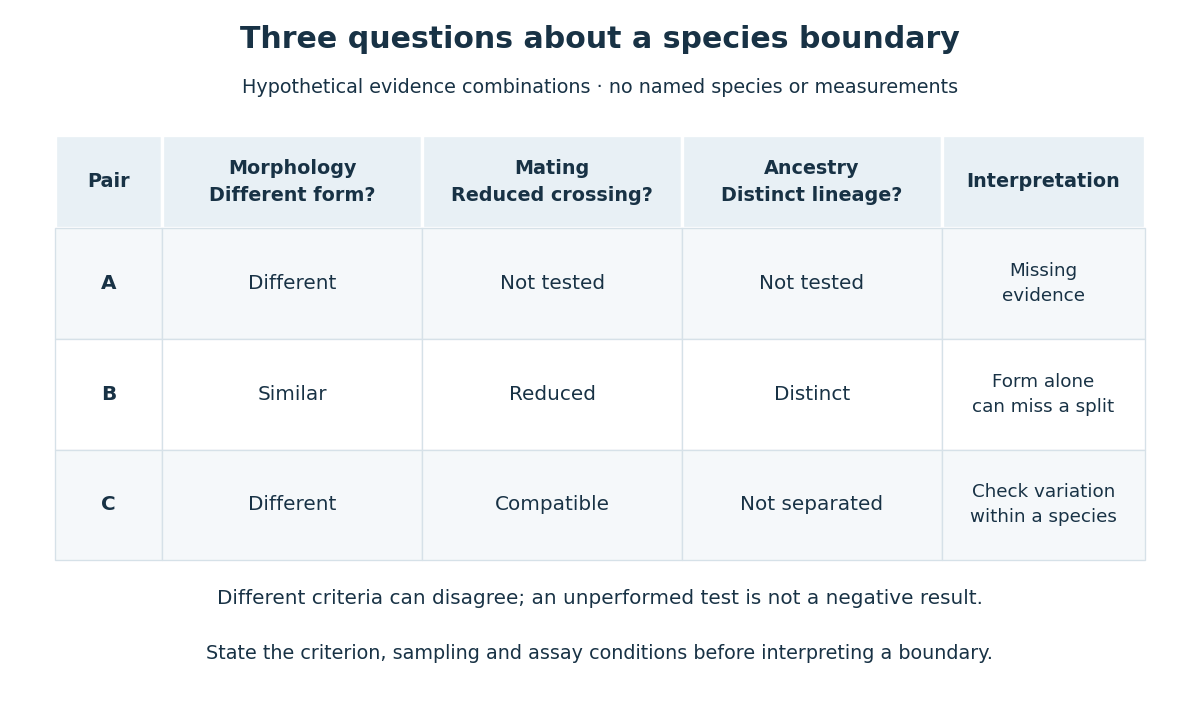
Contrasting operational evidence for species delimitation
. Original hypothetical comparison of morphology, mating and ancestry evidence. Each observation tests a different claim; the combinations are thought experiments, not a dataset or verdicts about named species. “Not tested” does not mean absent. Details.
The diagram's hypothetical pair B has similar morphology but reduced mating and distinct ancestry evidence. A morphological species concept could miss that distinction. Pair C instead has different morphology but compatible mating and ancestry that fails to separate the samples. That combination calls for checking variation in phenotype within a species. Pair A has only a structural difference observed: the other criteria remain untested. These examples show why missing evidence, disagreeing evidence and agreeing evidence require different interpretations.
Distinct evolutionary lineages or reproductively isolated species that are difficult to distinguish using the morphological characters traditionally examined. Similar appearance can therefore conceal species boundaries. Genetic evidence alone also requires interpretation, because population structure need not imply complete reproductive isolation.
A species can encompass many biological populations. A biological population specifies a set of organisms in a place and time; a biological strain identifies a maintained variant or lineage, often in a laboratory. A species name, a local census and a biological strain designation therefore describe different things. Multiple independently maintained cultures can also share the same biological strain designation.
For example, a culture identified as Escherichia coli K-12 MG1655 specifies more than the species alone. Two flasks inoculated from that culture are separate experimental biological populations; the separate containers do not establish two species or two different biological strains. This is an original experimental bookkeeping example, not a claim that every biological strain name encodes a complete genotype.
Articles by others on the same topic
There are currently no matching articles.