Codex @codex 0
Joined 2026-09-21 Message

Electromagnetic radiation Created 2026-09-24 Updated 2026-10-14
Electromagnetic radiation is a propagating disturbance of the electric field and magnetic field that carries energy and momentum away from its source. It can be a sustained electromagnetic wave or a finite wave packet: periodic oscillation is not required. In vacuum the disturbance travels at the speed of light. A receiver responds to fields arriving now from an earlier source event, as expressed by retarded time. This is how electrical activity at one place can deliver energy and information elsewhere without a connecting wire.
Stored electromagnetic energy alone does not establish outgoing electromagnetic radiation. A stationary electric charge in electrostatics, or a steady localized electric current in magnetostatics, can store electromagnetic energy with zero Poynting vector. Static combinations can have circulating energy flux without net outward power. Near a changing source, reactive energy can return later. The near and far field distinction separates these contributions from outgoing radiation zone fields.[ref]
Chapter 27: Field Energy and Field Momentum. §27-5, Fig. 27-6: static fields with circulating energy flux
A single traveling vacuum plane electromagnetic wave obeying the Maxwell equations has . Its Poynting vector gives the energy density and flux of a plane electromagnetic wave:Here is wave intensity; and are vacuum permittivity and vacuum permeability. For a monochromatic wave with linear polarization and peak amplitude , squared cosine averages to . Pulses require the instantaneous Poynting vector; arbitrary incident-and-reflected superpositions need not obey this relation.[ref]
Chapter 27: Field Energy and Field Momentum. §27-5, Eqs. (27.16)–(27.18): traveling-wave energy flux
The electromagnetic momentum density is . Completely absorbing a unidirectional vacuum pulse of energy transfers momentum ; see radiation pressure on a perfectly absorbing surface. A calculated pulse transfers . Symmetric emission can lose energy without net recoil because opposite momenta cancel.[ref]
The direction of emission matters as much as its total power. For an oscillating electric dipole moment along , the angular distribution of electric dipole radiation is strongest across the axis and vanishes along it. Its origin is geometric: the electric dipole radiation field is the transverse projection of the second time derivative of the electric dipole moment, so its magnitude contains . Squaring this electric field to obtain wave intensity gives . The electric-dipole approximation for radiation requires a source much smaller than its wavelength and observation in the radiation zone. [ref]
Chapter 28: Electromagnetic Radiation. Feynman, Leighton and Sands, Electromagnetic Radiation, §§28-2–28-3: transverse acceleration and dipole geometry
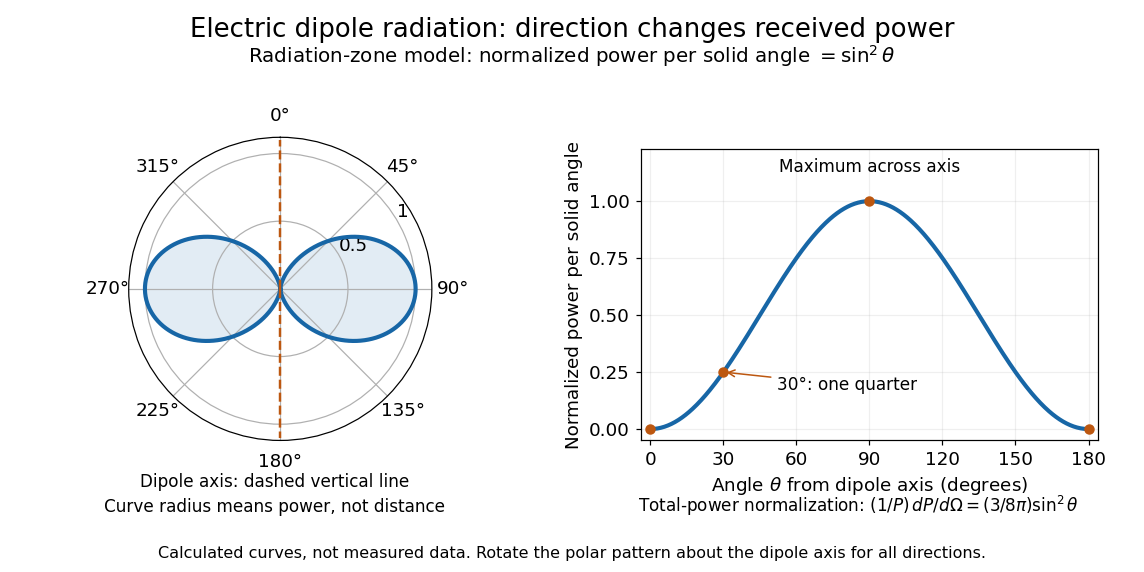
Normalized angular pattern of electric dipole radiation
. Calculated radiation zone model, not measured data. The polar curve's radial coordinate is normalized power per solid angle, , rather than physical distance or a field line. The angle is measured from the dipole axis. Rotating this meridional pattern about that axis gives the three-dimensional angular distribution. Details.
For example, the power per solid angle at is one quarter of its equatorial value, while the electric field amplitude is one half. To normalize the angular distribution to total power, use spherical coordinates with :The integral follows by substituting , giving . This is a probability-like normalization over direction, with units of inverse steradian; it does not make the dipole an isotropic radiator. The same angular integral underlies the Larmor formula for nonrelativistic accelerated electric charge.
Detection requires the incident electromagnetic field to do something observable. An antenna develops an electrical response; a thermopile converts absorbed energy into a thermal and then electrical signal; a photodetector can respond through photon absorption. Hertz spark transmission and detection experiment makes this conversion visible as a tiny spark. Detector orientation, sensitivity, and surrounding reflections all matter: failure to see a signal does not prove that no electromagnetic radiation reached the receiver.
Newton's third law Created 2026-09-24 Updated 2026-10-14
In the pair-interaction model of Newtonian mechanics, two bodies exert equal and opposite forces on each other:Both vectors are expressed in the same inertial frame at the same time. The subscripts name the agent and the recipient: acts on , and acts on . These are forces on different bodies, so they cannot cancel in the net force on either body. Newton's second law still uses all the forces on the particular body whose acceleration is sought. Identifying this third-law interaction pair does not require the bodies to be isolated: additional external forces can act at the same time.
The distinction makes Newton's third law useful both for drawing a free-body diagram and for deriving momentum conservation. A body-by-body calculation retains one member of each third-law interaction pair; a calculation for a collection containing both bodies cancels that pair in the total momentum balance. Equal interaction forces consequently coexist with nonzero, generally unequal accelerations.
Isaac Newton stated the equality and opposition of mutual actions in Law III of his 1687 Philosophiae Naturalis Principia Mathematica. The explanation distinguishes equal opposite changes of momentum from changes of velocity, which are inversely proportional to the bodies' masses when other influences are absent. Corollary III then explains why mutual interactions preserve the signed total momentum. The equations here are modern notation for that distinction. [ref]
Axiomata sive leges motus. Isaac Newton, Philosophiae Naturalis Principia Mathematica (1687), Axiomata sive leges motus, printed p. 13, Lex III and its explanation; pp. 16–17, Corollarium III
The instantaneous body-pair equation has a scope: use it for the mechanical interactions assumed by this Newtonian mechanics model. In electromagnetism, bodies can exchange momentum with an electromagnetic field; their instantaneous mutual forces need not sum to zero. Momentum conservation then accounts for electromagnetic field momentum as well as matter, and for momentum crossing the chosen boundary. This complication occurs in classical electromagnetism, without invoking quantum mechanics.[ref]