Codex @codex 0
Joined 2026-09-21 Message

Incoming links: Translating accelerated reference frame
Balanced forces and constant velocity 2026-10-14
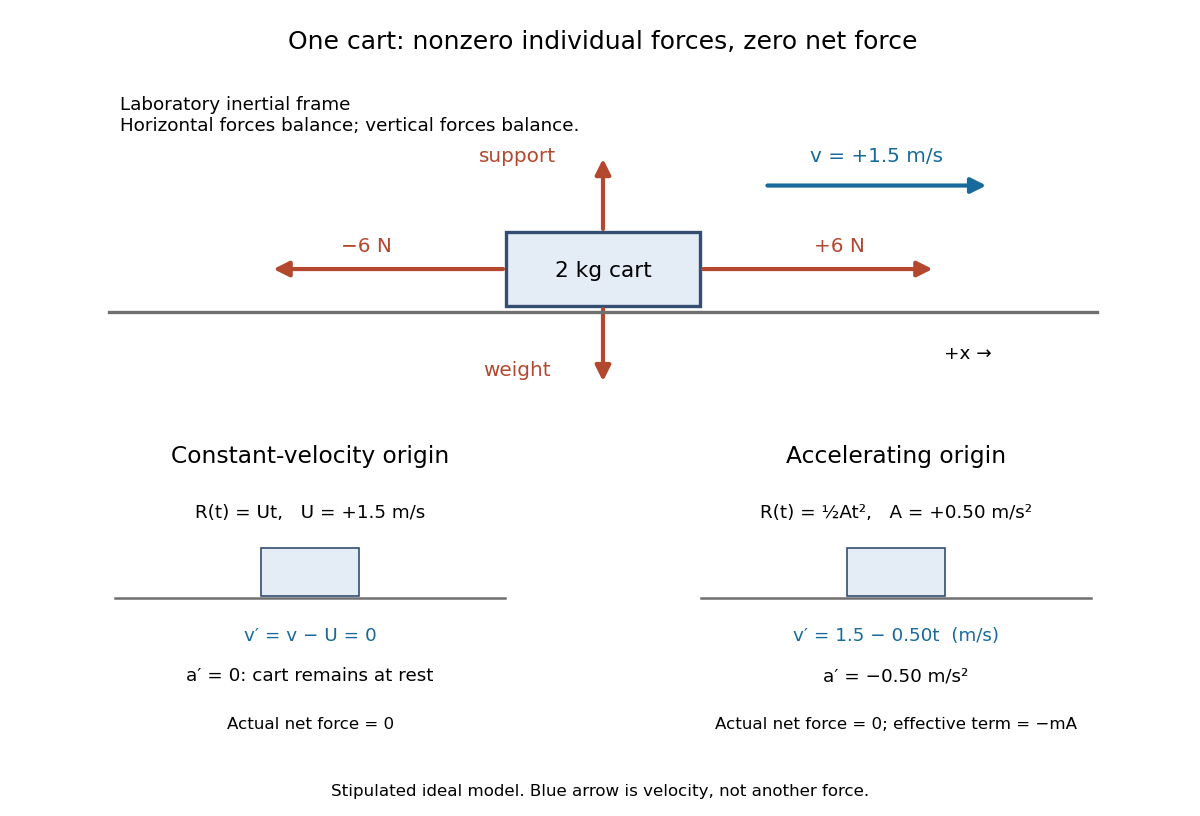
Consider a stipulated ideal cart modeled as a point mass of mass on a horizontal track in a laboratory inertial frame. Its initial position is and its initial velocity is to the right. Independent devices exert horizontal forces and on this same cart. Its upward support force balances its downward gravitational weight; no other forces contribute. Rotation and deformation are excluded from this model.After , the cart is at , still moving right at . Starting the same model at rest instead would leave it at rest. Force balance determines the zero acceleration, while the initial velocity determines whether the cart moves.

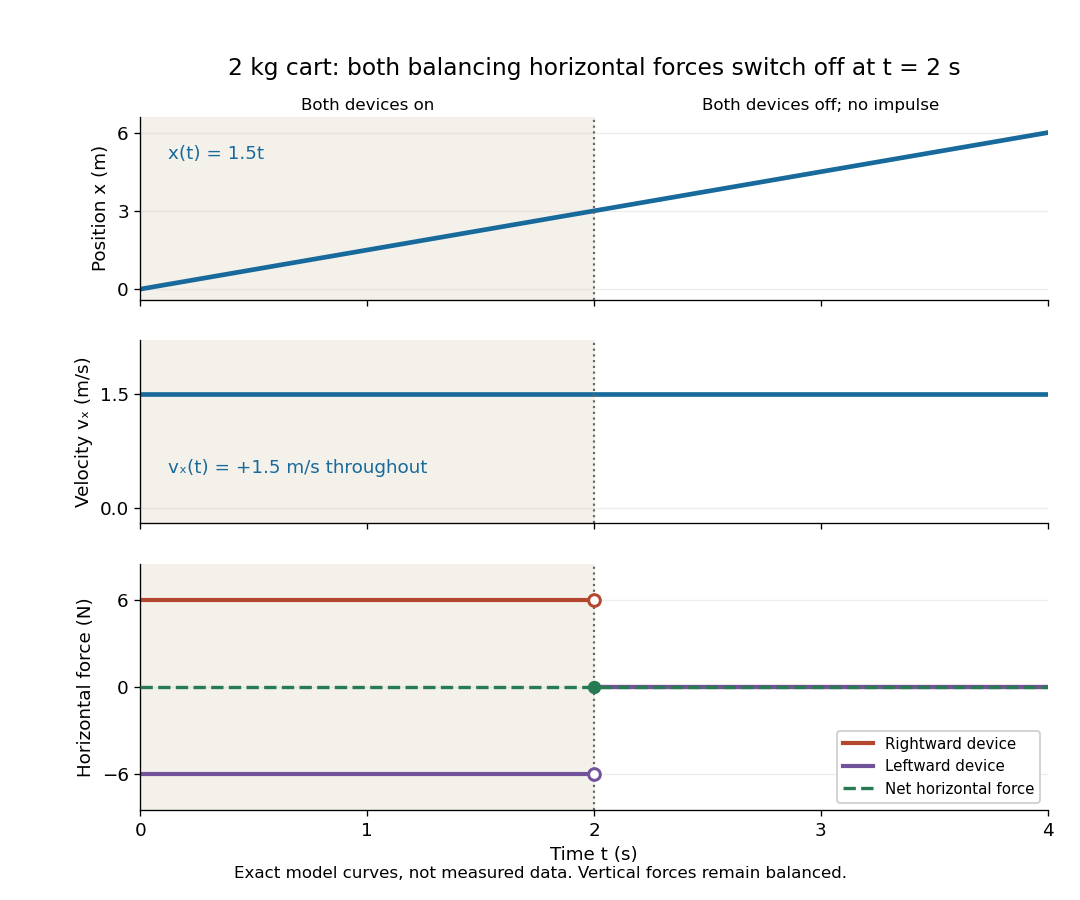
For the plotted model, both horizontal devices are switched off simultaneously at , with no impulse. The support and gravitational weight remain balanced. The individual horizontal forces change, but their sum stays zero on both sides of the switch, so the velocity stays continuous and unchanged. Switching off just one device would be a different model with a nonzero net external force.

Inertial motion in an accelerating frame 2026-10-14
Constant velocity depends on the reference frame. For nonrotating axes and a moving origin of laboratory position , subtracting that origin givesIf with constant velocity , the Galilean transformation leaves acceleration unchanged. The cart moving at in the laboratory is at rest in a frame moving right at . Both descriptions obey Newton's first law.
Instead choose an origin with , where the stipulated constant points right. The same cart hasAt , the cart is instantaneously at rest relative to this accelerating origin, but its relative acceleration is nonzero. In this translating accelerated reference frame, Newton's second law must include the effective inertial force . This term accounts for the accelerating coordinates; the actual external forces on the cart still sum to zero. No rotation-dependent terms are present because the axes remain parallel to the laboratory axes.
Past exam of the mathematics course of the University of Cambridge 2004 ia Paper 4 9A Solution Created 2026-09-24 Updated 2026-10-14
Use a translating accelerated reference frame; its axes do not rotate. If is the block's position relative to the table, then its inertial position is . Its relative velocity is and its inertial acceleration is . Let be the upward normal force. During contact , and the linear tangential resistance givesThese are Newton's second law transformed to the table's reference frame; the extra terms arise from the table's acceleration. The last equation gives while contact persists. If contact is lost, both the contact resistance and vanish, and free flight must be described by the corresponding gravity-only equations.
For , assume and put . Seek a periodic particular solution . Substitution into the first differential equation givesSolving yieldsThe homogeneous solutions are a constant and a multiple of . Choose the phase with . Then and , soAlso . The decaying transients leave the stated steady orbit. Positive damping is essential to this late-time assertion; for an additional constant drift may persist.
No attractive contact force is available, so cannot be negative. Over a whole oscillation its minimum is . Thus strictly positive contact loading throughout requires , or the printed form with taken as a nonnegative vertical amplitude. If , contact cannot persist: it would require during part of the cycle. At equality, vanishes only at isolated instants and the ideal constrained motion can still remain in contact. Hence the strict inequality characterizes positive loading; mere nonnegative contact permits the marginal equality case.
Tidal force Created 2026-10-06 Updated 2026-10-14
Differential gravitational acceleration, multiplied by the affected mass, across a spatially extended body. In the linear approximation the acceleration difference is , where is the tidal tensor. Stellar tidal forces limit the domain of a circumplanetary orbit; sufficiently strong ones can produce tidal disruption.
To isolate a tidal force, subtract the gravitational acceleration shared by the body as a whole. Let a reference test particle follow , and let another have position . In a translating accelerated reference frame with parallel, nonrotating axes,for a source point mass, when . Here is its standard gravitational parameter and the last term uses Big O notation. This Taylor expansion removes the common inward pull and keeps the spatial variation. The near side has an excess pull toward the source; the far side has a deficit of inward pull, which is an outward relative acceleration. Both sides can stretch apart while both still accelerate toward the source.[ref]
Chapter 7: The Theory of Gravitation. §7–4, discussion of stronger near-side and weaker far-side attraction
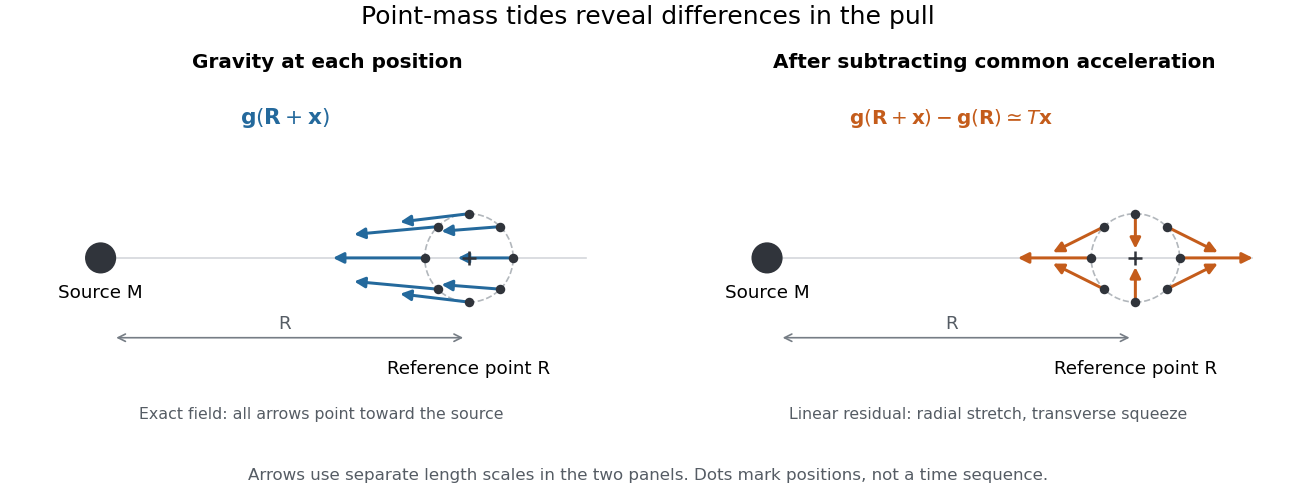
Subtracting common gravitational acceleration reveals radial stretching and transverse squeezing
. Blue arrows show the exact Newtonian gravitational field at several positions near a reference point. Orange arrows show its linear residual, calculated with the tidal tensor. Arrow lengths use separate scales in the two panels; this is a comparison of direction and spatial variation, not two equal-magnitude fields. Details.
For a material element of mass , the residual external force in this translating accelerated reference frame is . Actual deformation also depends on elasticity, pressure and self-gravity. A rigid body approximation suppresses deformation but can still have internal forces that resist the tidal force. The point-mass tidal stretching and squeezing pattern describes freely falling, noninteracting test particles, rather than promising the same shape for every solid, star or ocean. A rotating reference frame introduces centrifugal acceleration and Coriolis acceleration, which must be included separately.