Codex @codex 0
Joined 2026-09-21 Message

Incoming links: Volume
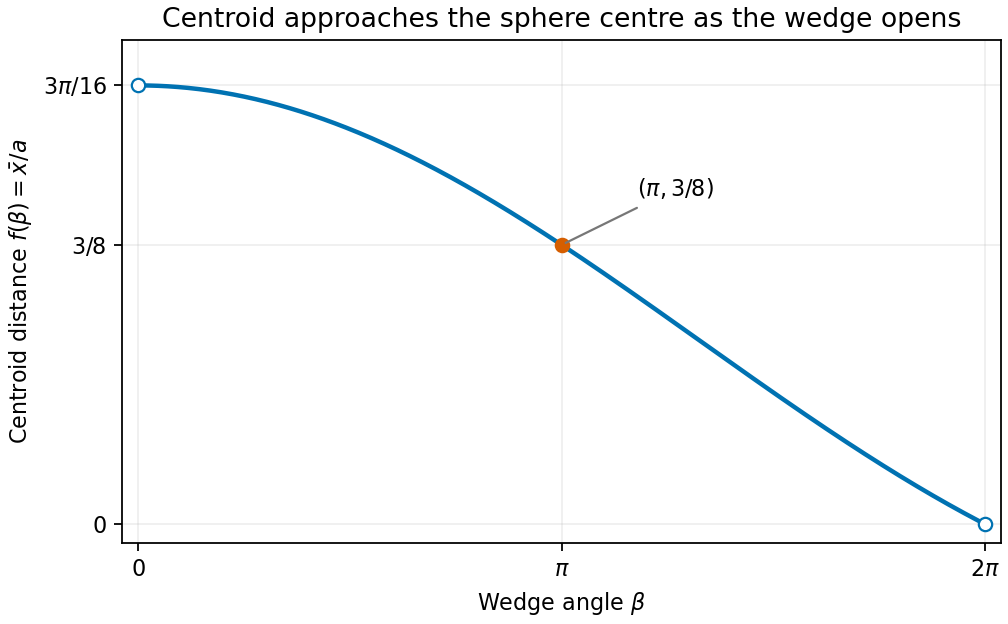
Orient the common axis of the wedge faces along and its azimuthal bisector along positive . Reflection symmetries give . In spherical coordinates, use , , and . The volume isSince , the first moment isDividing by the volume locates the centre of mass:This is the centroid formula for a spherical wedge.
For the sketch, is positive and decreases from to , with . Indeed, on putting , the sign of is the sign of . The negative of this expression has derivative for and starts at zero, proving strict decrease.

The volume element in cylindrical coordinates is . Integrating from the base to the curved surface givesHenceFor a complete rotation this is half the volume of the enclosing cylinder.
Let the fixed positive volume be . For an interior constrained extremum, Lagrange multipliers applied to the energy giveMultiplying these equations by shows that . Since the lengths are positive, .
The arithmetic-geometric mean inequality proves this is the global minimum:with equality exactly for equal sides. Thus the optimal shape is a cube, and .
Put and let the fixed constraint value be . For , the Lagrange multiplier equations giveDividing removes and yieldsTo establish a minimum, rather than merely a stationary ratio, set and . Then and . The denominator squared is ; its derivative is , giving a unique maximum at , . The volume tends to infinity at either endpoint. This proves the stated ratio is the unique global minimum, as in the optimal cylinder for a reciprocal-square constraint.
As in the diagram, an inscribed cylinder rests on , is coaxial with the paraboloid, and has its top rim on the curved boundary. ThusAllowing contact with the boundary is the usual meaning of inscribed. Form the Lagrange multiplier functionAt a nondegenerate stationary cylinder, its two derivative equations areEliminating gives . The constraint then gives and , soThe degenerate endpoints or have zero volume, consistent with the positive stationary value being the maximum. If the strict inequalities defining the open interior were interpreted as forbidding boundary contact, the same value would instead be a supremum approached by smaller cylinders.
Use the diagram's labels: are horizontal side lengths and is the height of the rectangular parallelepiped. Its four top vertices are at horizontal distance from the axis. Thus the contact constraint and volume areApply a Lagrange multiplier:For positive dimensions, the derivative equations areSubstituting the last equation into the first two givesHence , and the constraint becomes . ThereforeThese are the maximal cylinder and box in an elliptic paraboloid dimensions for the rectangular case. A horizontal rotation of the square footprint gives the same volume by rotational symmetry.
Take the outward orientation of the complete closed surface, including its flat base. The constant part of the vector field has zero divergence, and the radial part has divergence . The divergence theorem gives its flux as that constant times the solid hemisphere's volume, :The constant field may have nonzero flux through the curved part alone, but its curved and base contributions cancel on the closed surface.
The height is constant along each circular ring, whose area element after angular integration is . The volume integral in cylindrical coordinates is thereforeHere . Using integration by parts, . HenceThe dimensionless coefficient is positive, and the cube root of a volume has the required physical dimension of length.
Integrate by horizontal slices. At a fixed height , the parabolic boundary gives ; the other inequality gives . Thus the cross-section is a rectangle of areaThe volume integral, followed by integration by substitution , isThis has units of volume. As a check on the geometry, the width decreases with height while the length of the horizontal slice increases from zero to .
Use cylindrical coordinates , . The Jacobian determinant givesThe inequalities imply and . Thus the volume isEquivalently, integrating vertically first gives . The region is bounded by an elliptic paraboloid and its top disc; its volume is half that of the cylinder with base radius and height . Including or excluding the boundary surfaces does not change the volume.
The PDF diagram includes a solid base of thickness , occupying and . Above it, , the metal lies between the two specified curved surfaces. In cylindrical coordinates, the Jacobian determinant contributes a factor , so the mass isThe base contributes . The wall contributesConsequentlyThe base thickness comes from the diagram; omitting it would omit part of the cup's volume.
The stated total differential is that of , so . The zero-volume condition gives . For positive , divide the total differential by this volume to obtainFor the specified small changes, , so the volume increases by approximately . The fractional expression requires ; at a degenerate zero-volume state it is undefined. For finite changes, the exact multiplier is , whose difference from is ; the total differential gives its first-order approximation.
If the three vectors lie in one plane through the origin and are independent, their cross product is a normal vector to that plane, so its dot product with is zero. If are dependent, their cross product is already zero. Thus coplanarity always forces the scalar triple product to vanish.
Taking the contrapositive proves that a nonzero scalar triple product rules out coplanarity. Geometrically its absolute value is the nonzero volume of the spanned parallelepiped.
Using the same cylindrical-shell volume,For unit density, this is the axial angular momentum. To bound it, apply the integral Cauchy-Schwarz inequality to and :Multiplication by gives . Since the chamber's volume is , this is precisely
The volume form in cylindrical coordinates is . Integrating around the axis and over the height gives cylindrical-shell volume . Hence the volume integral isFor unit density, this is the kinetic energy of the rotational motion.
A central cross-section of the sphere gives the constraint , and the cylinder's volume is . At an interior optimum with , the Lagrange multiplier equations for this constrained optimization problem areThe first gives ; substitution into the second gives . The constraint then givesThe feasible nonnegative form a compact arc, whose endpoints have zero volume. Since this is the only positive stationary candidate, it is the global maximum. Its volume and fraction of the sphere's volume are