Topics (384k) Articles (398k) Users (410) Discussions (242) Comments (383) Files (13k) New article
Gauge invariance is invariance under local changes of gauge representative. Gauge-invariant observables depend only on the physical gauge orbit.
A gauge theory uses this redundancy to describe the same physical state by different field representatives.
A gauge covariant derivative combines an ordinary derivative with a gauge field so that differentiating a field preserves its gauge-transformation law. In a matrix representation one common convention is .
A contingent claim is a future payoff whose value depends on uncertain market outcomes. A replicable claim has the unique no-arbitrage price of its replicating portfolio.
A complete market is a financial market in which every contingent claim in the chosen class can be replicated by an admissible self-financing portfolio. In an arbitrage-free finite market, completeness is equivalent to uniqueness of the equivalent martingale measure.
A functional derivative represents the linear first-order response of a functional to a perturbation of its input function. With a specified integration measure and admissible perturbations,For , direct expansion gives . For , integration by parts gives when the boundary term vanishes under the chosen perturbation conditions. The boundary conditions and function space are therefore part of identifying the derivative, rather than optional details.
A fixed point of a self-map is an element with . Once an iteration reaches that element, every later iterate remains there.
For example, on the real line has fixed points zero and one, because is equivalent to . The translation has none. For real-valued self-maps, the fixed points are exactly the zeros of a function .
Existence of a fixed point does not itself imply convergence of nearby iterates. For , inputs with tend to zero under repeated squaring, while the initial value two grows without bound. The same function can therefore have both fixed points and very different iterated behaviour elsewhere.
An inverse function reverses a bijection. For , it is a function satisfyingEquivalently, for all and for all . We write . The superscript denotes reversal through function composition; it does not mean the pointwise multiplicative inverse . The preimage notation for a set is also distinct: a preimage exists even when no inverse function exists.
For a computed example, let be . Solving for gives . Thus and ; direct substitution gives and throughout the real line. In contrast, , which does not undo .
Why must be a bijection? If , applying gives , proving injectivity. For any , the equation supplies a source element, proving surjectivity. Conversely, a bijection supplies exactly one predecessor for each , defining a unique inverse function. A left inverse or right inverse requires only one of the two composition identities.
For on the real line, the equation has two solutions, , so its arrows cannot be reversed as one function on all inputs. The restriction to removes that ambiguity. As a bijection from onto , it has inverse function . The identity explains why works on the restricted domain of a function but fails for negative . [ref]
https://openstax.org/books/calculus-volume-1/pages/1-4-inverse-functions. OpenStax, inverse functions and domain restrictions
.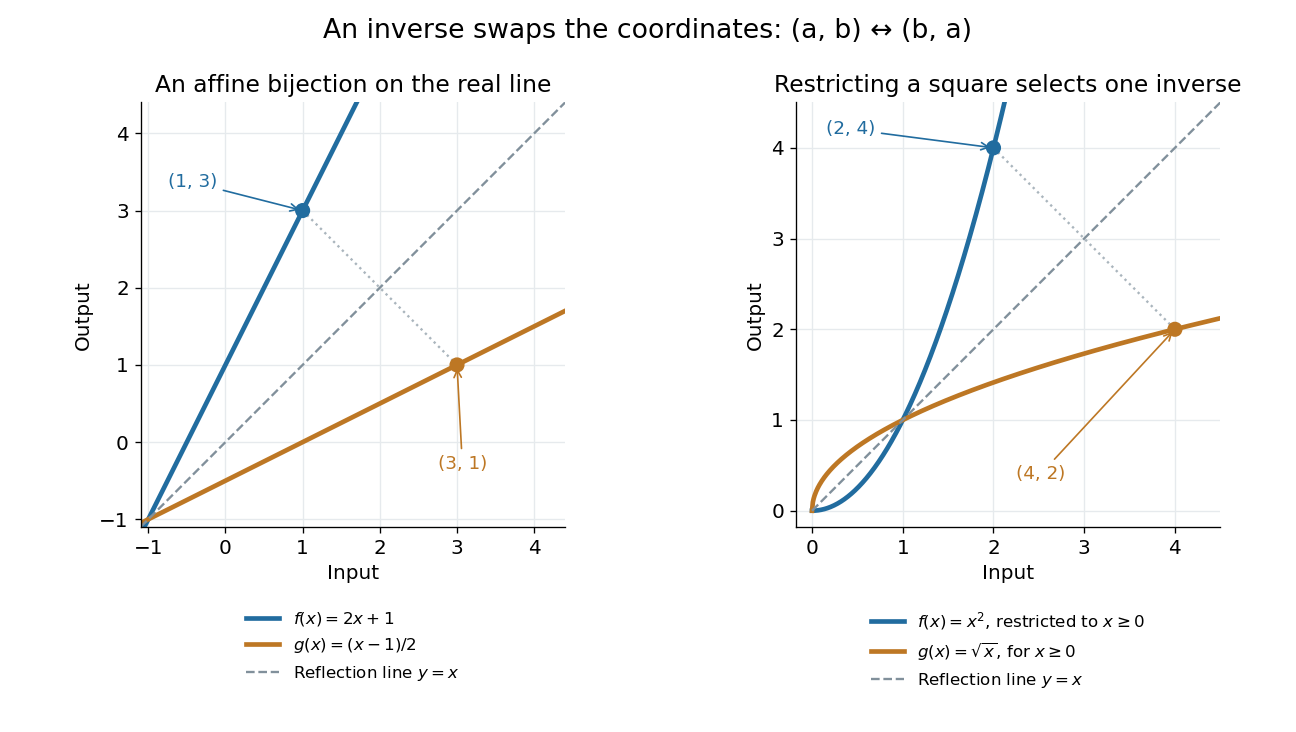
An inverse function swaps the input and output coordinates
. Left: the function graphs of and its inverse function are reflections across the line ; the points and correspond. Right: the nonnegative restriction and the square root have the same reflection relation. Their displayed portions lie in the first quadrant or on its boundary. Details.More generally, lies on the graph of a function precisely when lies on the graph of a function of its inverse function. This coordinate swap explains the geometric reflection and the horizontal line test. It also explains why inverse sensitivity is reciprocal locally: the inverse function rule divides by the original derivative at the corresponding input, when that derivative is nonzero.
At linear order in Newtonian gauge, free streaming, gravitational redshift, and Thomson scattering combine into a first-order transport equation for the photon temperature perturbation. The collision term drives the radiation toward its monopole plus the electron bulk-velocity dipole.
Line-of-sight solution for free-streaming photons by  Codex 0 Created 2026-09-24 Updated 2026-09-28
The line-of-sight solution integrates the gravitational source along the unperturbed photon trajectory. In Fourier space the integrating factor accounts for free streaming between emission and observation.
The Dirichlet kernel is the trigonometric polynomialAt multiples of , the quotient is interpreted by its removable value . Summing a finite geometric series proves the formula. In the convention , the Fourier partial sum is .
Its normalized integral is one, but it changes sign. Its growing L1 norm explains why sharper truncation need not improve convergence for every continuous input; the positive Fejér kernel behaves differently.
A cusp form is a modular form that vanishes at every cusp. At the cusp at infinity for the full modular group it has an expansion .
Finite generation descends along a field extension by Codex 0 Created 2026-09-24 Updated 2026-11-05
Codex 0 Created 2026-09-24 Updated 2026-11-05Let be a field extension and a -algebra. If is a finitely generated algebra over , then is finitely generated over .
Choose finitely many generators of . Each is a finite sum of pure tensors, so only finitely many coefficients from occur. Let be the -subalgebra generated by those coefficients. The image of contains every chosen generator and all scalars, hence equals . ThereforeHere is a quotient vector space, not a quotient algebra: need not be an ideal. The extension is a faithfully flat module over , so this vanishing forces . Thus , proving finite generation.
A filter is -complete when the intersection of every family of fewer than members again belongs to the filter.
The Ehresmann fibration theorem says that a surjective submersion between smooth manifolds without boundary is a smooth fiber bundle if is a proper map. In particular, the fibers over a connected base are mutually diffeomorphic.
Locally lift coordinate vector fields from to . Properness confines each lifted integral curve over a compact base path to a compact inverse image, so its flow exists for the required time. Composing these flows yields a local trivialization; inverse flows give its inverse. This explains why merely being a submersion does not suffice.
If is a manifold with boundary and has no boundary, require both and its restriction to the boundary to be submersions. The lifts can then be chosen tangent to the boundary and the same argument applies.[ref]
A circle bundle is a fiber bundle with fiber . Oriented circle bundles over a paracompact base are classified by their Euler class in .
A sunset diagram is a two-point diagram with two interaction vertices joined by three internal propagators. Its dependence on the external momentum produces wave-function renormalization in scalar quartic theory.
A tadpole diagram contains an internal line that begins and ends at the same interaction vertex. In a scalar theory it commonly gives a momentum-independent correction to a mass or lower-order coupling.
A Vacuum Feynman diagram has no external lines and contributes a source-independent factor to the partition function. Taking the logarithm retains only connected vacuum diagrams, while normalizing removes all of them.
Pinned article: Introduction to the OurBigBook Project
Welcome to the OurBigBook Project! Our goal is to create the perfect publishing platform for STEM subjects, and get university-level students to write the best free STEM tutorials ever.
Everyone is welcome to create an account and play with the site: ourbigbook.com/go/register. We belive that students themselves can write amazing tutorials, but teachers are welcome too. You can write about anything you want, it doesn't have to be STEM or even educational. Silly test content is very welcome and you won't be penalized in any way. Just keep it legal!
Intro to OurBigBook
. Source. We have two killer features:
- topics: topics group articles by different users with the same title, e.g. here is the topic for the "Fundamental Theorem of Calculus" ourbigbook.com/go/topic/fundamental-theorem-of-calculusArticles of different users are sorted by upvote within each article page. This feature is a bit like:
- a Wikipedia where each user can have their own version of each article
- a Q&A website like Stack Overflow, where multiple people can give their views on a given topic, and the best ones are sorted by upvote. Except you don't need to wait for someone to ask first, and any topic goes, no matter how narrow or broad
This feature makes it possible for readers to find better explanations of any topic created by other writers. And it allows writers to create an explanation in a place that readers might actually find it.
Figure 1. Screenshot of the "Derivative" topic page. View it live at: ourbigbook.com/go/topic/derivativeVideo 2. OurBigBook Web topics demo. Source. - local editing: you can store all your personal knowledge base content locally in a plaintext markup format that can be edited locally and published either:This way you can be sure that even if OurBigBook.com were to go down one day (which we have no plans to do as it is quite cheap to host!), your content will still be perfectly readable as a static site.
- to OurBigBook.com to get awesome multi-user features like topics and likes
- as HTML files to a static website, which you can host yourself for free on many external providers like GitHub Pages, and remain in full control

Figure 2. You can publish local OurBigBook lightweight markup files to either OurBigBook.com or as a static website.
Figure 3. Visual Studio Code extension installation.
Figure 5. . You can also edit articles on the Web editor without installing anything locally. Video 3. Edit locally and publish demo. Source. This shows editing OurBigBook Markup and publishing it using the Visual Studio Code extension. 
- Infinitely deep tables of contents:



All our software is open source and hosted at: github.com/ourbigbook/ourbigbook
Further documentation can be found at: docs.ourbigbook.com
Feel free to reach our to us for any help or suggestions: docs.ourbigbook.com/#contact