Topics (384k) Articles (398k) Users (410) Discussions (242) Comments (383) Files (13k) New article
A uniformly continuous function has one input tolerance valid throughout its domain of a function. For , with , uniform continuity meansChoose the output tolerance first, then a positive valid for every pair of function inputs. It may depend on , the function and its domain of a function, but not on the pair’s location. The absolute values measure input and output distance.[ref]
Basic Analysis: Introduction to Real Analysis, Volume I by Jiří Lebl. §3.4, Definition 3.4.1: a single positive input tolerance for all pairs in the specified real domain
Compare the quantifier order with the epsilon-delta definition of continuity:Both lines end with . In the first, can depend on the point ; in the second, it is chosen before . Thus uniform continuity implies continuity at every point. Each requested gets its own shared tolerance.
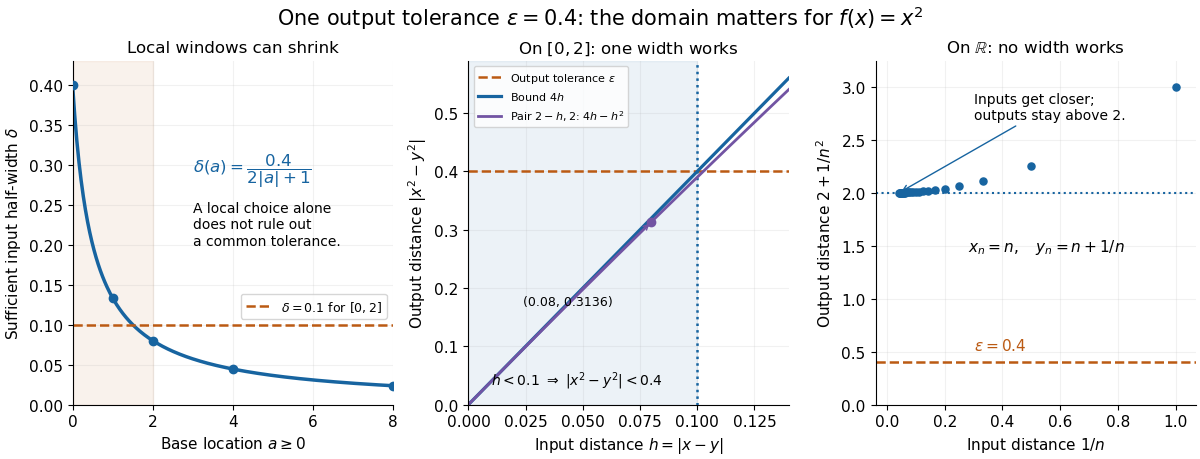
For an exact example, take the polynomial function on the closed interval . For every pair of function inputs in that interval, polynomial factorization givesConsequently works everywhere on this domain of a function. With , the common tolerance is . Near the right endpoint, for example, and have input distance and output distance . The bound is sufficient; it does not claim the largest admissible input window at each point.
On the whole real line, the same polynomial function is a continuous function but fails uniform continuity. Take the sequences and , for positive integers . ThenFor any proposed , choose an integer . The inputs are closer than , yet their outputs violate the fixed tolerance . The sequences need not themselves have a finite limit: their mutual distance is what tends to zero. This is the obstruction captured by the sequential criterion for uniform continuity. Restricting the domain of a function to removes these escaping pairs.
A uniformly continuous function need not be a bounded function. The identity function on the real line has , so always works, although its image of a function is the unbounded real line. Uniform continuity controls changes between nearby inputs, not the overall size of outputs. Likewise, an unbounded domain of a function does not by itself prevent uniform continuity.
The square root supplies a different common tolerance on the interval . Assuming , put and . Since ,Interchanging the inputs when necessary provesThus guarantees uniform continuity on the entire domain of a function, including zero. For , any input distance below suffices. The pairs and both have input distance ; their output distances are respectively and . The common guarantee accommodates quite different local sensitivities.
This Hölder continuity bound allows a curved tolerance rule. It is weaker than a Lipschitz bound: at zero the output change divided by the input change isNo finite Lipschitz constant works near zero, even though uniform continuity does. A Lipschitz function does have uniform continuity, choosing when its Lipschitz bound is positive; when it is a constant function.[ref]
Basic Analysis: Introduction to Real Analysis, Volume I by Jiří Lebl. §3.4, Proposition 3.4.8 and Example 3.4.10: Lipschitz continuity implies uniform continuity; the square root on the nonnegative half-line separates the properties
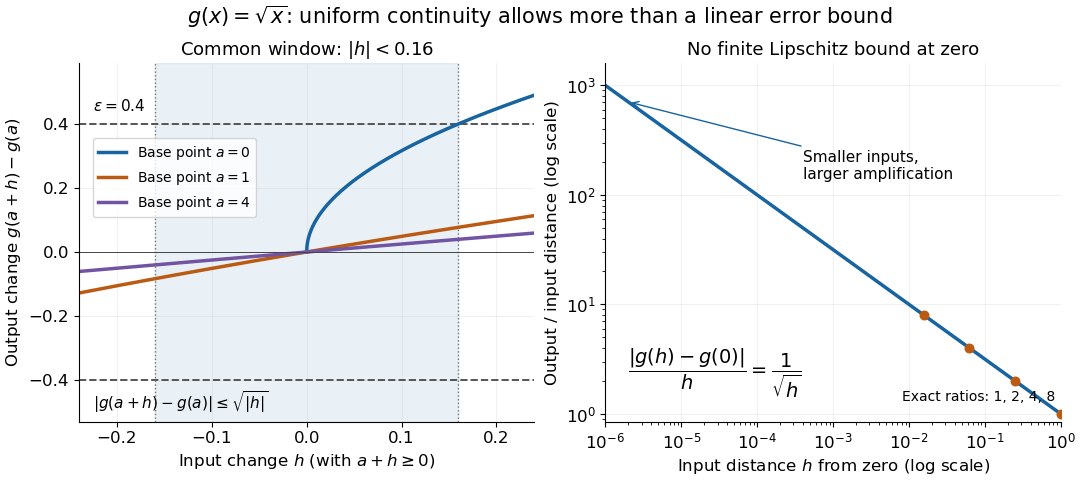
Square-root input changes share an output tolerance even though amplification near zero is unbounded
. At left, the exact output changes for base points stay inside whenever and . The right panel computes the amplification for inputs : it grows without bound as decreases. These are calculated function graphs, with no experimental measurements. Details.For general metric spaces, replace the absolute values by the respective distance functions. The Heine-Cantor theorem gives an existence guarantee: every continuous function on a compact metric space is uniformly continuous. In particular, continuity on a finite closed interval provides a common tolerance, even when no simple formula for it is known.[ref]
Basic Analysis: Introduction to Real Analysis, Volume I by Jiří Lebl. §7.5, Definition 7.5.10 and Theorem 7.5.11: uniform continuity between metric spaces and the compact-domain theorem
For a short proof outline, fix . Continuity gives each point an open ball of radius within which outputs differ from by less than . The open balls of half these radii still cover the domain of a function. Compactness supplies a finite subcover. Take to be the smallest half-radius in this finite set. Two inputs closer than lie together in one of the original open balls, so the triangle inequality bounds their output distance by . The beautiful step is that the compact set turns local choices into finitely many choices, whose minimum stays positive.
A shared tolerance also makes uniformly continuous functions preserve Cauchy sequences: after choosing for , all sufficiently late input pairs are closer than , so all corresponding output pairs are closer than . Unlike a convergent sequence argument, this does not require an input limit inside the domain of a function. It is why uniform continuity is useful for extending a function toward missing endpoints and for the decay argument below.
The continuity set of a function is the set of points where it is continuous. For a real function , define its oscillation at byThe sets are open, and is continuous at exactly when . Hence its continuity set is the Borel set
If is continuous at and is continuous at , then is continuous at .
The intermediate value theorem says that a real-valued continuous function cannot skip a value between two of its outputs. Let and let be a continuous function on the entire closed interval . ThenThe word "between" includes both endpoint values: choose when , or when . If is strictly between them, every such lies in the open interval . Continuity on means continuity at every interior point, together with the endpoint one-sided limits and . No derivative is required.[ref]
Calculus Volume 1 by Gilbert Strang and others. §2.4, Continuity over an Interval and Theorem 2.11, The Intermediate Value Theorem
For finding a zero of a function, the useful special case isStrictly opposite endpoint signs certify a root bracket, because zero is strictly between and . If an endpoint value is already zero, that endpoint supplies a zero of a function directly; an interior zero of a function need not exist. For example, on has its only zero of a function at the left endpoint. The intermediate value theorem guarantees existence, but neither uniqueness nor a necessary sign-change test. Its numerical usefulness is that the bisection method can turn existence into successively tighter root brackets.
Pell-type norm from a periodic continued fraction by  Codex 0 Created 2026-09-24 Updated 2026-11-05
 Alternating multiplier recurrence for convergents of the square root of eleven by Codex 0 Created 2026-09-24 Updated 2026-09-24
Codex 0 Created 2026-09-24 Updated 2026-09-24Every theory containing an inconsistent subtheory is inconsistent, because the same finite derivation of contradiction remains available.
Dynamical stability of binary mass transfer asks whether an infinitesimal mass loss reduces or increases a donor's overfill of its Roche lobe. Define for the donor's rapid, approximately adiabatic response and for the Roche lobe. ThenBecause mass loss has , the overfill decreases when and grows in the opposite case.
The stellar radius response exponent depends on the donor's structure, while the Roche-lobe radius response exponent depends on orbital and mass-loss assumptions. There is consequently no universal critical binary mass ratio. Transfer that is dynamically stable can still evolve on a thermal or nuclear timescale.
Even if both input grammars are regular, the added production has two variables on its right-hand side and therefore need not be a regular production.
Retain every production of whose right-hand side contains a variable, replace every production with by , include , and use as start variable. If and are right-linear, the resulting grammar is right-linear and generates .
The blowup replaces a point of a complex -manifold by the projective space of complex tangent directions . A biholomorphism carrying one center to another lifts to a biholomorphism of their blowups.
It is the point-center case of blowup of an algebraic variety, also interpreted analytically.
The first Chern class classifies complex line bundles topologically. For a Hermitian holomorphic line bundle with Chern curvature , Chern-Weil theory gives .
A Kähler manifold is a complex manifold with a positive real closed -form . The associated Riemannian metric is .
A complex torus is a quotient by a discrete subgroup spanning over . Translation-invariant differential forms descend to the quotient.
Pinned article: Introduction to the OurBigBook Project
Welcome to the OurBigBook Project! Our goal is to create the perfect publishing platform for STEM subjects, and get university-level students to write the best free STEM tutorials ever.
Everyone is welcome to create an account and play with the site: ourbigbook.com/go/register. We belive that students themselves can write amazing tutorials, but teachers are welcome too. You can write about anything you want, it doesn't have to be STEM or even educational. Silly test content is very welcome and you won't be penalized in any way. Just keep it legal!
Intro to OurBigBook
. Source. We have two killer features:
- topics: topics group articles by different users with the same title, e.g. here is the topic for the "Fundamental Theorem of Calculus" ourbigbook.com/go/topic/fundamental-theorem-of-calculusArticles of different users are sorted by upvote within each article page. This feature is a bit like:
- a Wikipedia where each user can have their own version of each article
- a Q&A website like Stack Overflow, where multiple people can give their views on a given topic, and the best ones are sorted by upvote. Except you don't need to wait for someone to ask first, and any topic goes, no matter how narrow or broad
This feature makes it possible for readers to find better explanations of any topic created by other writers. And it allows writers to create an explanation in a place that readers might actually find it.
Figure 1. Screenshot of the "Derivative" topic page. View it live at: ourbigbook.com/go/topic/derivativeVideo 2. OurBigBook Web topics demo. Source. - local editing: you can store all your personal knowledge base content locally in a plaintext markup format that can be edited locally and published either:This way you can be sure that even if OurBigBook.com were to go down one day (which we have no plans to do as it is quite cheap to host!), your content will still be perfectly readable as a static site.
- to OurBigBook.com to get awesome multi-user features like topics and likes
- as HTML files to a static website, which you can host yourself for free on many external providers like GitHub Pages, and remain in full control

Figure 2. You can publish local OurBigBook lightweight markup files to either OurBigBook.com or as a static website.
Figure 3. Visual Studio Code extension installation.
Figure 5. . You can also edit articles on the Web editor without installing anything locally. Video 3. Edit locally and publish demo. Source. This shows editing OurBigBook Markup and publishing it using the Visual Studio Code extension. 
- Infinitely deep tables of contents:




All our software is open source and hosted at: github.com/ourbigbook/ourbigbook
Further documentation can be found at: docs.ourbigbook.com
Feel free to reach our to us for any help or suggestions: docs.ourbigbook.com/#contact