Topics (384k) Articles (398k) Users (410) Discussions (242) Comments (383) Files (13k) New article
For , the nonzero connection coefficients areWith and
, direct substitution into the mixed-tensor covariant derivative gives zero.
, direct substitution into the mixed-tensor covariant derivative gives zero.
When each comparison functor has a left adjoint, iterating the Eilenberg-Moore comparison functor produces the monadic tower. Its monadic length is the least number of comparison steps needed to reach an equivalence; an equivalence has length zero and a non-equivalence that is already monadic has length one.
A right eigenvector of a square matrix is a nonzero column vector satisfying for some scalar . The scalar is its eigenvalue. Requiring is essential, since the zero vector satisfies the displayed equation for every .
For example,Thus the two displayed vectors are right eigenvectors with different eigenvalues. A left eigenvector instead acts on from the left; specifying the side matters for a general matrix.
The binary entropy function isIt is concave on and satisfies for by comparison with the chord from to .
Every Dynkin system containing a pi-system also contains the sigma-algebra . Equivalently, the Dynkin system generated by a pi-system equals the sigma-algebra it generates.
The dust transparency radius is where a swept shell's ultraviolet optical depth equals one. For a gas fraction in a singular isothermal sphere, .
A Schauder basis is shrinking when its dual sequence is a Schauder basis of the whole dual space. Every Schauder basis of a reflexive Banach space is shrinking.
A uniformizer of a discrete valuation ring is a generator of its unique nonzero maximal ideal. Every nonzero in the fraction field has a unique expression with a unit and .
A discrete valuation on a field is a surjective group homomorphism satisfying whenever . Its valuation ring is .
Archimedean balancing of a principal ideal generator by  Codex 0 Created 2026-09-24 Updated 2026-11-05
Every principal ideal of a number field has a generator satisfyingat every archimedean embedding. Multiply an arbitrary generator by a unit so that its logarithmic unit-lattice coordinates lie in a fixed bounded fundamental parallelepiped.
The Relaxation time of a finite reversible lazy Markov chain is the reciprocal of its spectral gap: .
Dirichlet energy space with zero boundary at infinity by Codex 0 Created 2026-09-24 Updated 2026-11-05
Codex 0 Created 2026-09-24 Updated 2026-11-05For a transient weighted graph, is the completion of the finitely supported functions in the norm . Its elements have finite Dirichlet energy and vanish at infinity in the energy sense.
Periodic orbit from a closed interval-covering walk by Codex 0 Created 2026-09-24 Updated 2026-09-24
Codex 0 Created 2026-09-24 Updated 2026-09-24Every closed walkin a directed covering graph of an interval map has a point with and . This follows by successively pulling back through the covering relations and applying the fixed-point property of a closed interval. If the itinerary has least period and avoids shared endpoints, lies on an -cycle.
The minimal subtraction scheme chooses counterterms that remove only the poles in the dimensional regulator , without additional finite terms.
The inverse function theorem answers a practical question: can nearby outputs be used to recover nearby inputs uniquely and smoothly? Its useful surprise is that a nonlinear function can be tested using its linear derivative. If the first-order changes preserve all input directions, then, on a sufficiently small region, the nonlinear map can also be reversed. This is the basis for treating a nonlinear map as a coordinate transformation.
Precisely, let be continuously differentiable on an open subset of Euclidean space, let , and put . If is an invertible linear map, there are open neighbourhoods of and of such that is a bijection with a continuously differentiable inverse function . Thus this restriction is a diffeomorphism. In coordinates the test is , using the Jacobian determinant. The derivative of a local inverse map is obtained by inverting the Jacobian matrix, at the corresponding input. [ref]
For a one-dimensional example, has . Near , the inverse function is , and the inverse function rule gives . But has no inverse function on the whole real line, since and give the same output. The theorem supplies a local restriction, not global injectivity. At zero, the derivative test fails; the nonnegative branch still has a square root inverse, but that inverse has no finite derivative at zero. [ref]
https://www.jirka.org/ra/html/sec_ift.html. Jiří Lebl, Basic Analysis: the one-dimensional theorem and the square-root example
Here is a two-dimensional example with an invertible derivative everywhere and infinitely repeated outputs:The exponential function turns into a positive radius, while is the angle in polar coordinates. Restricting, for example, to and produces the reversible patch pictured below. On its image, with Cartesian coordinates and , the inverse function isThe arctangent selects the angle near zero. Without an angle restriction, for every integer , so there is no single global inverse function. This map is a local diffeomorphism but is not injective.
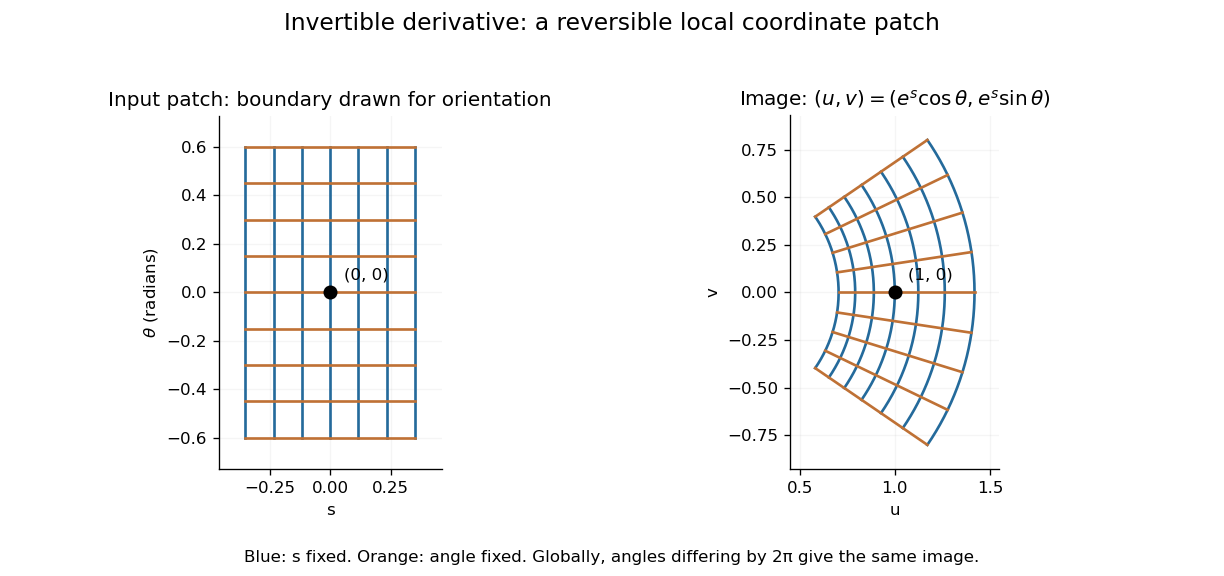
A small rectangular coordinate patch maps reversibly to a curved sector, despite global angle repetition
. Details. The short proof idea is to correct a guessed input using the inverse linear response. With , solving is equivalent to finding a fixed point ofAt , the derivative vanishes. Continuity makes a contraction mapping on a sufficiently small closed ball, which it maps into itself when is sufficiently close to . The contraction mapping theorem then gives existence and uniqueness there. Establishing the smooth dependence on completes the inverse theorem. This explains why the nonlinearity can be tolerated: its correction has a small local slope.[ref]
8.5 Inverse and implicit function theorems. §8.5: the contraction argument
Pinned article: Introduction to the OurBigBook Project
Welcome to the OurBigBook Project! Our goal is to create the perfect publishing platform for STEM subjects, and get university-level students to write the best free STEM tutorials ever.
Everyone is welcome to create an account and play with the site: ourbigbook.com/go/register. We belive that students themselves can write amazing tutorials, but teachers are welcome too. You can write about anything you want, it doesn't have to be STEM or even educational. Silly test content is very welcome and you won't be penalized in any way. Just keep it legal!
Intro to OurBigBook
. Source. We have two killer features:
- topics: topics group articles by different users with the same title, e.g. here is the topic for the "Fundamental Theorem of Calculus" ourbigbook.com/go/topic/fundamental-theorem-of-calculusArticles of different users are sorted by upvote within each article page. This feature is a bit like:
- a Wikipedia where each user can have their own version of each article
- a Q&A website like Stack Overflow, where multiple people can give their views on a given topic, and the best ones are sorted by upvote. Except you don't need to wait for someone to ask first, and any topic goes, no matter how narrow or broad
This feature makes it possible for readers to find better explanations of any topic created by other writers. And it allows writers to create an explanation in a place that readers might actually find it.
Figure 1. Screenshot of the "Derivative" topic page. View it live at: ourbigbook.com/go/topic/derivativeVideo 2. OurBigBook Web topics demo. Source. - local editing: you can store all your personal knowledge base content locally in a plaintext markup format that can be edited locally and published either:This way you can be sure that even if OurBigBook.com were to go down one day (which we have no plans to do as it is quite cheap to host!), your content will still be perfectly readable as a static site.
- to OurBigBook.com to get awesome multi-user features like topics and likes
- as HTML files to a static website, which you can host yourself for free on many external providers like GitHub Pages, and remain in full control

Figure 2. You can publish local OurBigBook lightweight markup files to either OurBigBook.com or as a static website.
Figure 3. Visual Studio Code extension installation.
Figure 5. . You can also edit articles on the Web editor without installing anything locally. Video 3. Edit locally and publish demo. Source. This shows editing OurBigBook Markup and publishing it using the Visual Studio Code extension. 
- Infinitely deep tables of contents:



All our software is open source and hosted at: github.com/ourbigbook/ourbigbook
Further documentation can be found at: docs.ourbigbook.com
Feel free to reach our to us for any help or suggestions: docs.ourbigbook.com/#contact