Topics (384k) Articles (398k) Users (410) Discussions (242) Comments (383) Files (13k) New article
For two polarizations, atoms in area , and , mode counting givesAt low temperature its energy scales as and its constant-volume heat capacity as .
The Debye frequency is the upper frequency cutoff fixed by equating the continuum mode count to the crystal's number of vibrational degrees of freedom.
Outward escape from the rational potential barrier by  Codex 0 Created 2026-09-24 Updated 2026-09-24
For , the trajectory beginning at with remains in , and obeysIt enters every strip : otherwise would eventually make the nonnegative energy negative.
Central zero region for odd compactly supported initial velocity by Codex 0 Created 2026-09-24 Updated 2026-11-05
Codex 0 Created 2026-09-24 Updated 2026-11-05Let and solve the whole-line wave equation with zero initial displacement and an odd locally integrable initial velocity supported in . D'Alembert formula with initial velocity givesIf and , this integration interval contains the entire support. Its integral is zero by oddness, so in that central region. The familiar condition, is the special case.
This central cancellation is different from finite propagation speed, which forces zero outside the expanding support. It uses the additional zero-integral property of the initial velocity; an arbitrary compactly supported initial velocity can instead leave a nonzero constant plateau between the outgoing wave packets.
Constant Gaussian curvature surfaces of revolution by Codex 0 Created 2026-09-24 Updated 2026-09-24
Codex 0 Created 2026-09-24 Updated 2026-09-24For an arc-length profile with radius , the equation isThus gives locally, while gives wherever . At their mean curvatures are respectivelyso different choices of give locally noncongruent surfaces with the same constant Gaussian curvature.
Legendre transform of a cumulant-generating function by Codex 0 Created 2026-09-24 Updated 2026-11-05
Codex 0 Created 2026-09-24 Updated 2026-11-05The Legendre transform of a cumulant-generating function iswhere parameters with contribute nothing to the supremum. More generally this is the Legendre-Fenchel transform. It is convex because it is a supremum of affine functions of , and is nonnegative because allows the choice .
If is differentiable and the supremum is attained at an interior parameter, its maximizer solves . For a Normal distribution with mean and variance , , so and . The zero cost occurs at the mean and the cost grows quadratically away from it.
For iid sample means, Cramér's theorem identifies this transform as the large-deviation Rate function when the Moment-generating function is finite on a neighbourhood of zero. The optimization also appears directly in a Chernoff bound: optimize the exponential Markov inequality over nonnegative parameters to bound an upper-tail probability. The transform converts exponential growth of a generating function into exponential decay of a rare-event probability.
A Coxeter element is a product of all simple generators in some order. For a finite irreducible Coxeter group, all Coxeter elements are conjugate.
For involutory generators, the folding condition requires that simple multiplication never preserve length and that simultaneous left and right ascents either combine to a two-step ascent or fold: if both and have length , then either or .
For , the standard parabolic subgroup is . Its cosets index faces of a fixed type in the Coxeter complex.
For a finite-rank Coxeter system, let have basis and symmetric bilinear formIts geometric representation sends the generator to the reflection
A reduced expression in a Coxeter group has the least possible Coxeter length among expressions in the generators of its Coxeter system.
A reduced expression for is a product of the fewest possible simple generators representing . The number of factors is its Coxeter length .
For an algebraic group acting on a algebraic variety over an algebraically closed field, a geometric quotient is a surjective invariant morphism whose fibers are exactly the group orbits, whose topology is the quotient topology, and whose regular functions are the invariant regular functions locally:The orbit condition gives actual orbit parameters; the function-sheaf condition specifies the algebraic structure on the orbit space. Both matter beyond a set-theoretic quotient.
For scalar multiplication on , the map is the geometric quotient by , giving projective space. On a standard chart, coordinate ratios are the invariant functions. In the Cox construction, the quotient is geometric for a simplicial toric fan; in general the categorical quotient can identify more than a single orbit.[ref]
The Homogeneous Coordinate Ring of a Toric Variety by David A. Cox. section2, quotient theorem and geometric-versus-categorical distinction
For a normal complex toric variety with no torus factor, its Cox ring isThere is one variable per toric ray, and the grading is by the divisor class group, rather than necessarily by ordinary integers. The degree- part corresponds to sections of the divisorial sheaf after choosing a representative toric divisor.
For , this is the usual polynomial ring with every variable in degree one. For a well-formed weighted projective space, the class group is and the variable degrees are its weights. When an algebraic torus factor is present, its invertible Laurent coordinates must be included separately; the ray-variable ring alone cannot recover a positive-dimensional algebraic torus.[ref]
The Homogeneous Coordinate Ring of a Toric Variety by David A. Cox. section1, grading and relation to divisor sections
Feynman gauge is the choice in the covariant gauge family with gauge-fixing term . With metric signature and the usual vacuum prescription, the free photon propagator becomesIts simple numerator makes diagram calculations convenient, while keeping Lorentz covariance manifest. The four components of are still not four independently observable photon polarizations; physical external photons have two transverse polarizations. The Ward identity ensures cancellation of unphysical contributions in complete gauge-invariant amplitudes. Feynman gauge is a computational choice, and changing the gauge requires consistent changes throughout the propagators and related terms.
For a real random vector with finite second moments, its covariance matrix collects all pairwise covariances:The diagonal entries are variances. The covariance matrix is a symmetric matrix and a positive semidefinite matrix, because for every real vector ,Thus one matrix describes the variance of every linear combination of the coordinates. It is a positive-definite matrix exactly when no nonzero linear combination is constant almost surely. A deterministic linear relation produces a zero eigenvalue.
For example,has unit coordinate variances, covariance , and eigenvalues and . Its unit eigenvectors and describe directions of greatest and least projected variance. For a unit vector , direct multiplication gives : the variation in the sum direction is nine times that in the difference direction.
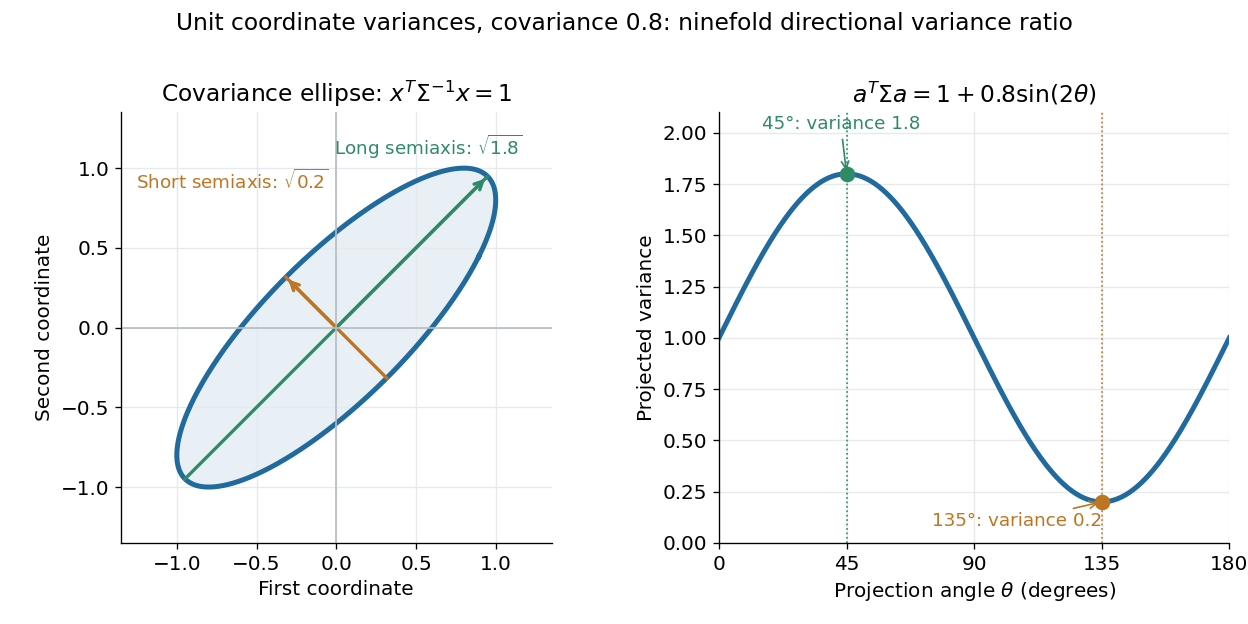
The spectral theorem supplies an orthonormal basis of these directions. This connects covariance matrices to principal component analysis: its leading eigenvector identifies the unit-direction projection with the largest variance. For a linear transformation , the transformed random vector has covariance matrix , so uncertainties propagate through a linear model by matrix multiplication.
Pinned article: Introduction to the OurBigBook Project
Welcome to the OurBigBook Project! Our goal is to create the perfect publishing platform for STEM subjects, and get university-level students to write the best free STEM tutorials ever.
Everyone is welcome to create an account and play with the site: ourbigbook.com/go/register. We belive that students themselves can write amazing tutorials, but teachers are welcome too. You can write about anything you want, it doesn't have to be STEM or even educational. Silly test content is very welcome and you won't be penalized in any way. Just keep it legal!
Intro to OurBigBook
. Source. We have two killer features:
- topics: topics group articles by different users with the same title, e.g. here is the topic for the "Fundamental Theorem of Calculus" ourbigbook.com/go/topic/fundamental-theorem-of-calculusArticles of different users are sorted by upvote within each article page. This feature is a bit like:
- a Wikipedia where each user can have their own version of each article
- a Q&A website like Stack Overflow, where multiple people can give their views on a given topic, and the best ones are sorted by upvote. Except you don't need to wait for someone to ask first, and any topic goes, no matter how narrow or broad
This feature makes it possible for readers to find better explanations of any topic created by other writers. And it allows writers to create an explanation in a place that readers might actually find it.
Figure 1. Screenshot of the "Derivative" topic page. View it live at: ourbigbook.com/go/topic/derivativeVideo 2. OurBigBook Web topics demo. Source. - local editing: you can store all your personal knowledge base content locally in a plaintext markup format that can be edited locally and published either:This way you can be sure that even if OurBigBook.com were to go down one day (which we have no plans to do as it is quite cheap to host!), your content will still be perfectly readable as a static site.
- to OurBigBook.com to get awesome multi-user features like topics and likes
- as HTML files to a static website, which you can host yourself for free on many external providers like GitHub Pages, and remain in full control

Figure 2. You can publish local OurBigBook lightweight markup files to either OurBigBook.com or as a static website.
Figure 3. Visual Studio Code extension installation.
Figure 5. . You can also edit articles on the Web editor without installing anything locally. Video 3. Edit locally and publish demo. Source. This shows editing OurBigBook Markup and publishing it using the Visual Studio Code extension. 
- Infinitely deep tables of contents:



All our software is open source and hosted at: github.com/ourbigbook/ourbigbook
Further documentation can be found at: docs.ourbigbook.com
Feel free to reach our to us for any help or suggestions: docs.ourbigbook.com/#contact