Topics (384k) Articles (398k) Users (410) Discussions (242) Comments (383) Files (13k) New article
Random-walk Metropolis proposes a symmetric increment from the current state and accepts a proposal from with probability .
Marked-state phase oracle from a single faulty identity-oracle query by  Codex 0 Created 2026-09-24 Updated 2026-11-05
 Radial volume transform of a homogeneous Poisson point process by Codex 0 Created 2026-09-24 Updated 2026-11-05
Codex 0 Created 2026-09-24 Updated 2026-11-05For a homogeneous Poisson point process of intensity in , mapping to , where is the unit-ball volume, gives a rate- Poisson process on . Mapping to instead gives rate .
Unbiased prediction-error identity for ordinary least squares by Codex 0 Created 2026-09-24 Updated 2026-10-14
Codex 0 Created 2026-09-24 Updated 2026-10-14If is the rank- orthogonal projection onto a normal linear model's column space, thenAdding gives , so Mallows' is unbiased for independent-copy prediction error even when the projection model is misspecified.
Bias-variance decomposition for linear prediction by Codex 0 Created 2026-09-24 Updated 2026-10-14
Codex 0 Created 2026-09-24 Updated 2026-10-14If are independent vectors and is a rank- orthogonal projection, thenThe first term is squared approximation bias, while is fitted-model variance and is irreducible new-response noise.
If a rigid body's inclined magnetic dipole rotates at angular speed , its radiated power is . Conservation of rotational energy then gives
This is the finite special-linear-group instance of the general Bruhat decomposition.
For the upper-triangular subgroup of andthe two double cosets are and , and , the diagonal subgroup.
For a finite group , a subgroup , and an irreducible complex representation of , the induced representation is irreducible exactly when, for every nonidentity double coset representative , the restrictions of and its -conjugate to have inner product zero.
The essential supremum is the upper bound for a measurable function after disregarding null sets for a specified measure . Its definition iswith values allowed in the extended real number line. A supremum controls every value; an essential supremum controls values almost everywhere. It therefore depends on the chosen measure, as well as on the function. [ref].
For a worked example, use Lebesgue measure on and putIts supremum is ten, attained at . But its essential supremum is one: outside the singleton , which is a null set. Every candidate fails, because the interval has positive Lebesgue measure and includes values larger than ; changing one point cannot remove that interval. In particular, , while .
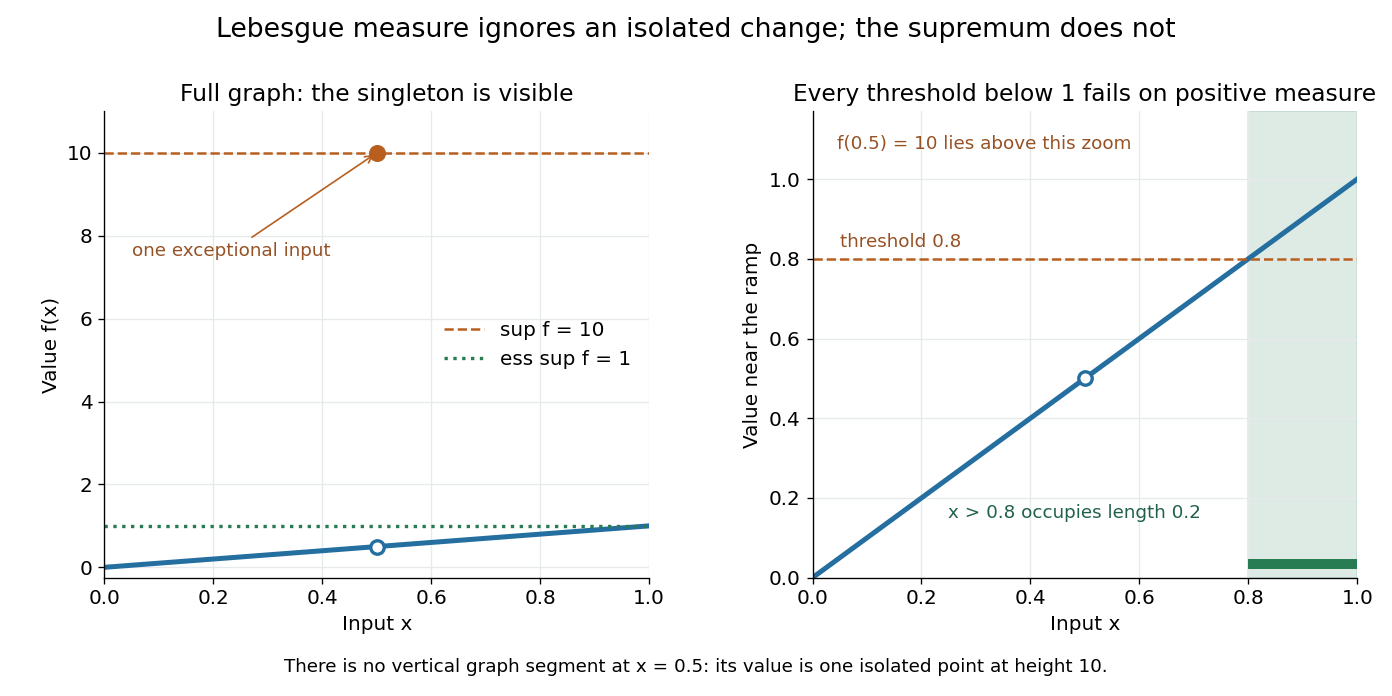
Why is this useful? Lebesgue integrals ignore changes on null sets, and Lp spaces identify functions that agree almost everywhere. The L-infinity norm uses so it respects that identification. For this nonnegative example the supremum norm is ten and the L-infinity norm is one; replacing by changes the former while leaving the latter unchanged. [ref].
The measure qualification is essential. For , the Dirac measure concentrated at the exceptional input, that singleton has measure one and this function has essential supremum ten. A set ignored by one measure need not be ignored by another. The lower counterpart is the essential infimum, with .
If an -theory has an infinite model, then it has models of arbitrarily large cardinality. For a cardinal , add constants for and all inequalities . Every finite fragment is satisfiable in the given infinite model, so compactness gives a model with at least elements. Applying the downward theorem produces a model of exactly when .
A vacuum mode has a null wavevector and a transverse symmetric amplitude. Residual gauge freedom can further reduce it to two physical transverse-traceless polarizations.
The evaluation map from the based path space gives a fiber sequenceSince is contractible, it relates invariants of to those of its loop space.
With treatment coding, the intercept describes the reference factor level and each displayed factor coefficient is a contrast against that level. Changing the reference level reparametrizes the same fitted model: fitted probabilities and likelihood do not change, but coefficients representing different pairwise contrasts can have different standard errors and p-values.
For independent grouped counts , grouped-binomial logistic regression specifiesFitting the proportions with binomial weights gives the same likelihood.
Pinned article: Introduction to the OurBigBook Project
Welcome to the OurBigBook Project! Our goal is to create the perfect publishing platform for STEM subjects, and get university-level students to write the best free STEM tutorials ever.
Everyone is welcome to create an account and play with the site: ourbigbook.com/go/register. We belive that students themselves can write amazing tutorials, but teachers are welcome too. You can write about anything you want, it doesn't have to be STEM or even educational. Silly test content is very welcome and you won't be penalized in any way. Just keep it legal!
Intro to OurBigBook
. Source. We have two killer features:
- topics: topics group articles by different users with the same title, e.g. here is the topic for the "Fundamental Theorem of Calculus" ourbigbook.com/go/topic/fundamental-theorem-of-calculusArticles of different users are sorted by upvote within each article page. This feature is a bit like:
- a Wikipedia where each user can have their own version of each article
- a Q&A website like Stack Overflow, where multiple people can give their views on a given topic, and the best ones are sorted by upvote. Except you don't need to wait for someone to ask first, and any topic goes, no matter how narrow or broad
This feature makes it possible for readers to find better explanations of any topic created by other writers. And it allows writers to create an explanation in a place that readers might actually find it.
Figure 1. Screenshot of the "Derivative" topic page. View it live at: ourbigbook.com/go/topic/derivativeVideo 2. OurBigBook Web topics demo. Source. - local editing: you can store all your personal knowledge base content locally in a plaintext markup format that can be edited locally and published either:This way you can be sure that even if OurBigBook.com were to go down one day (which we have no plans to do as it is quite cheap to host!), your content will still be perfectly readable as a static site.
- to OurBigBook.com to get awesome multi-user features like topics and likes
- as HTML files to a static website, which you can host yourself for free on many external providers like GitHub Pages, and remain in full control

Figure 2. You can publish local OurBigBook lightweight markup files to either OurBigBook.com or as a static website.
Figure 3. Visual Studio Code extension installation.
Figure 5. . You can also edit articles on the Web editor without installing anything locally. Video 3. Edit locally and publish demo. Source. This shows editing OurBigBook Markup and publishing it using the Visual Studio Code extension. 
- Infinitely deep tables of contents:



All our software is open source and hosted at: github.com/ourbigbook/ourbigbook
Further documentation can be found at: docs.ourbigbook.com
Feel free to reach our to us for any help or suggestions: docs.ourbigbook.com/#contact