Topics (384k) Articles (398k) Users (410) Discussions (242) Comments (383) Files (13k) New article
Lagrange resolvent eigenvector for a cyclic field automorphism by  Codex 0 Created 2026-09-24 Updated 2026-11-05
If has order and the fixed field contains a primitive th root , thensatisfies . Independence of the powers of ensures that is nonzero for some .
A finite family of vectors in a vector space over a specified field is linearly dependent if it has a nontrivial linear relation: with and at least one coefficient nonzero. One can then solve for a vector whose coefficient is nonzero as a linear combination of the others; removing that entry preserves the linear span. Repeated vectors in a list give linear dependence: for example has the linear relation . A list keeps both entries even though the set has only one element. Strang's notes illustrate redundant columns by expressing one as the sum of two others.[ref]
https://ocw.mit.edu/courses/18-06sc-linear-algebra-fall-2011/0bbc30e3f1d7933ea07a2d2e9ab050d9_MIT18_06SCF11_Ses1.9sum.pdf. MIT 18.06SC, Strang lecture summary 9, pp. 2–3: dependent columns
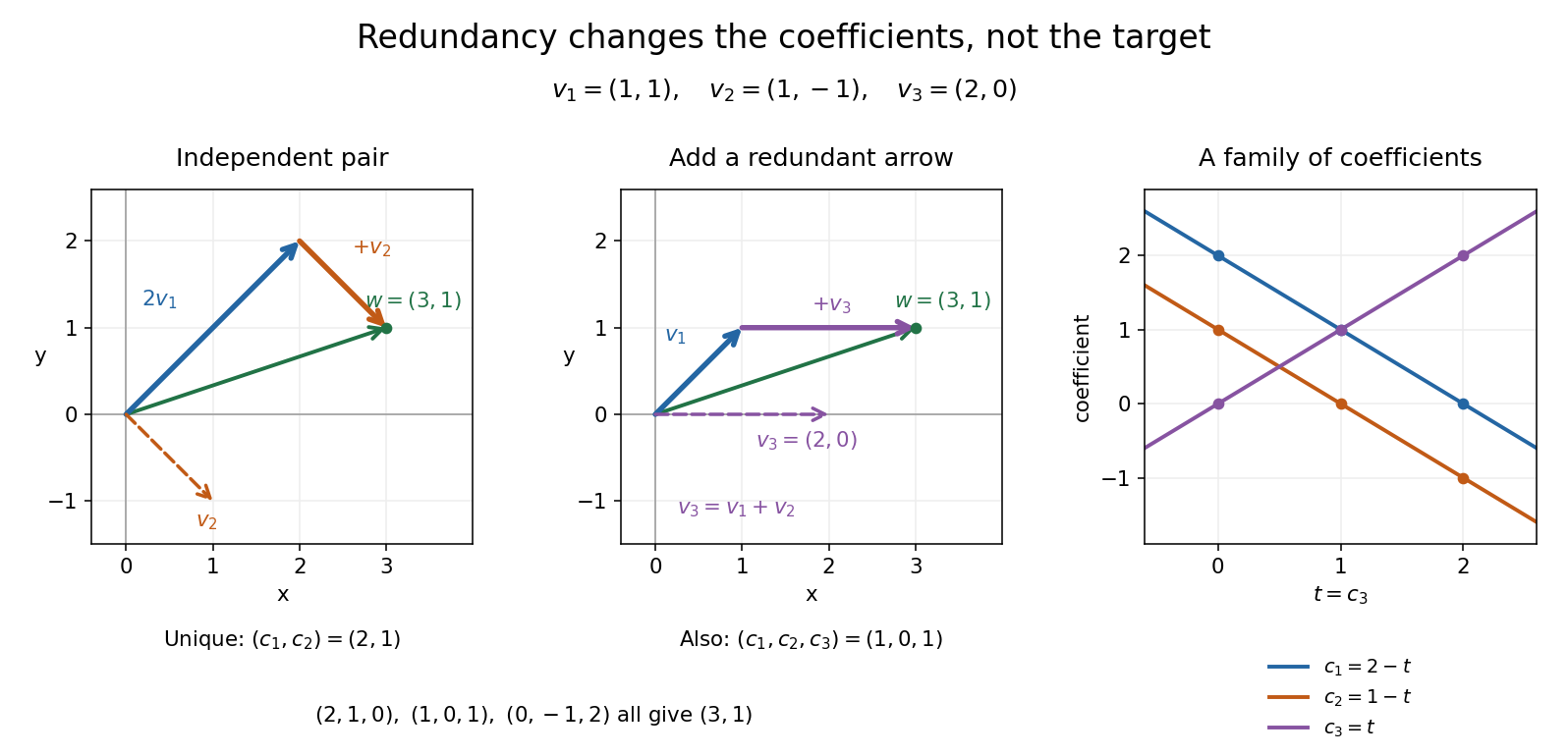
Keep and , and add . The three vectors still have linear span , but nowThe two coefficient triples and differ by the nontrivial linear relation . In fact all linear combination representations of this target areTo check both completeness and correctness, use . Linear independence of forces and , giving exactly the displayed family. Redundancy therefore preserves attainable targets while allowing their coefficients to move. For solving a linear system, these alternatives matter; for assigning unique coordinate vectors, one instead chooses a basis.
The following example shows why linear independence depends on the scalar field.
An inhomogeneous linear differential equation has a nonzero forcing term. Its general solution is one particular solution plus the general solution of the associated homogeneous linear differential equation.
A continuous function sends sufficiently nearby function inputs to nearby function outputs. For a real-valued function and a point that is an accumulation point of , this meansThe approached value and the assigned value must agree. Continuity on means continuity at every point of the domain of a function. At an endpoint of an interval, only approaches inside that domain of a function count. The epsilon-delta definition of continuity below also applies at an isolated point, where continuity holds automatically.[ref]
Calculus Volume 1, §2.4 Continuity. §2.4, Continuity at a Point: definition; Continuity over an Interval: one-sided endpoint conditions
For the polynomial function , approaching makes the function output approach . The continuity bounds for the square function turn this observation into an explicit guarantee: implies . This is useful whenever a small error in an function input must produce a controlled error in an function output. The required input tolerance can depend on the point and on the chosen output tolerance.
The absolute value function is also a continuous function, including at zero: . But its left and right derivatives there are and , so it is not a differentiable function at zero. Continuity controls values without requiring a tangent line. Conversely, a differentiable function is continuous wherever it is differentiable: if , the difference tends to zero with .
Several useful consequences reuse this one local idea. Addition, multiplication and function composition preserve continuity; a quotient of functions is continuous where its denominator is nonzero. On an interval, the intermediate value theorem turns continuity into a guarantee that no intermediate function output is skipped. On a compact set, the extreme value theorem guarantees attained maximum and minimum values. Those extra hypotheses matter: continuity alone on an unbounded domain of a function does not provide a global bound or an attained global maximum.
A rational function such as is continuous on its domain of a function . Zero is excluded from that domain of a function; the missing point prevents a continuous extension there, but it does not make the existing map discontinuous at one of its actual inputs. Always state the domain of a function before judging continuity.
A generalized likelihood-ratio test compares the likelihood maximized under the null with the likelihood maximized over the full parameter space.
For two specified model densities or mass functions , the likelihood ratio at observed data is wherever the denominator is positive. It measures relative support for these two models at that observation, not a posterior probability without prior odds. One Bernoulli success gives ratio for success probabilities and ; a failure gives ratio . For independent observations the ratios multiply. In a likelihood-ratio test of composite models, optimized likelihoods replace the two fixed densities, with an explicitly stated numerator convention.
A direction represented by a nonzero null vector has zero Minkowski norm. Such directions form the generators of the light cone.
For , its prolongation to derivatives through order isIt generates a symmetry of exactly when vanishes on the equation manifold.
Prolongation lifts a vector field to the jet bundle of maps so that its flow acts on derivatives of the dependent variables as well as on their values.
The Cayley transform is the rational matrix function , defined when is invertible. For the orthogonal group, unitary group, and analogous groups preserving a nondegenerate bilinear form or Hermitian form, it gives a local parametrization near the identity by their Lie algebras. If , expanding both sides givesso . The inverse chart is wherever is invertible. The Cayley transform of a real skew-symmetric matrix is the positive-definite real orthogonal example.
The formula is not a parametrization of an arbitrary Matrix Lie group. For example, belongs to the special linear Lie algebra, but , so its transform is not in the special linear group. In indefinite form-preserving groups, the Cayley chart's full domain can also meet components outside the identity component of a Lie group; its local behavior near zero alone does not imply a global parametrization.
For any Lie group, the Exponential map of a Lie group is defined by , where is the one-parameter subgroup with initial tangent vector . For a Matrix Lie group, it is the matrix exponential . Its differential at zero is the identity, so the inverse function theorem supplies a local exponential chart. A small transformation can therefore be encoded by a vector in the Lie algebra. See MIT 18.745, Lecture 7, Definition 7.2 and Theorem 7.5.
Local invertibility makes no promise about a global inverse. In the planar rotation example, for every integer , so the Exponential map of a Lie group is surjective onto but not injective. Restricting to gives unique angles for every rotation except . The omitted half-turn exposes the cut needed for this single angle chart.
Surjectivity can also fail, even in a connected Lie group. The matrix lies in the special linear group but has no real matrix logarithm: any logarithm must commute with , hence preserve each of its distinct real eigenvectors, where exponentiating a real scalar gives a positive number. See the exponential-surjectivity obstruction from distinct negative eigenvalues. These two examples distinguish two different global obstacles: repeated parameters and unreachable elements. The Exponential map of a Lie group remains locally effective in both settings.
A left-invariant Riemannian metric is preserved by every left translation. Its Killing fields generated by left translations are right-invariant vector fields.
For a Lie group with Lie algebra , the left Maurer-Cartan form is the -valued differential 1-formIt translates a tangent vector at any point back to the identity, giving a linear isomorphism . In particular, for the left-invariant vector field determined by . This makes left-invariant and supplies a global coframe after choosing a basis of .
The exterior derivative on left-invariant vector fields gives , since the two derivative terms of constant coefficients vanish. Thus , the Maurer-Cartan equation. For a Matrix Lie group, and this becomes , where the exterior product includes matrix multiplication. The additive real numbers have , while the positive multiplicative real numbers have . For the real affine group, the Maurer-Cartan coframe of the real affine group makes the nonzero Lie bracket visible as .
The universal enveloping algebra is the associative algebra generated by subject to . Its modules are the same as Lie algebra representations.
The three-dimensional Heisenberg Lie algebra has a basis with and central. It is a two-step nilpotent Lie algebra.
Pinned article: Introduction to the OurBigBook Project
Welcome to the OurBigBook Project! Our goal is to create the perfect publishing platform for STEM subjects, and get university-level students to write the best free STEM tutorials ever.
Everyone is welcome to create an account and play with the site: ourbigbook.com/go/register. We belive that students themselves can write amazing tutorials, but teachers are welcome too. You can write about anything you want, it doesn't have to be STEM or even educational. Silly test content is very welcome and you won't be penalized in any way. Just keep it legal!
Intro to OurBigBook
. Source. We have two killer features:
- topics: topics group articles by different users with the same title, e.g. here is the topic for the "Fundamental Theorem of Calculus" ourbigbook.com/go/topic/fundamental-theorem-of-calculusArticles of different users are sorted by upvote within each article page. This feature is a bit like:
- a Wikipedia where each user can have their own version of each article
- a Q&A website like Stack Overflow, where multiple people can give their views on a given topic, and the best ones are sorted by upvote. Except you don't need to wait for someone to ask first, and any topic goes, no matter how narrow or broad
This feature makes it possible for readers to find better explanations of any topic created by other writers. And it allows writers to create an explanation in a place that readers might actually find it.
Figure 1. Screenshot of the "Derivative" topic page. View it live at: ourbigbook.com/go/topic/derivativeVideo 2. OurBigBook Web topics demo. Source. - local editing: you can store all your personal knowledge base content locally in a plaintext markup format that can be edited locally and published either:This way you can be sure that even if OurBigBook.com were to go down one day (which we have no plans to do as it is quite cheap to host!), your content will still be perfectly readable as a static site.
- to OurBigBook.com to get awesome multi-user features like topics and likes
- as HTML files to a static website, which you can host yourself for free on many external providers like GitHub Pages, and remain in full control

Figure 2. You can publish local OurBigBook lightweight markup files to either OurBigBook.com or as a static website.
Figure 3. Visual Studio Code extension installation.
Figure 5. . You can also edit articles on the Web editor without installing anything locally. Video 3. Edit locally and publish demo. Source. This shows editing OurBigBook Markup and publishing it using the Visual Studio Code extension. 
- Infinitely deep tables of contents:



All our software is open source and hosted at: github.com/ourbigbook/ourbigbook
Further documentation can be found at: docs.ourbigbook.com
Feel free to reach our to us for any help or suggestions: docs.ourbigbook.com/#contact