Topics (384k) Articles (398k) Users (410) Discussions (242) Comments (383) Files (13k) New article
Subformula replacement is the operation of replacing one specified subformula occurrence by another logical formula. Its preservation of well-formedness is the subformula replacement theorem.
For with deterministic coefficients, , where . The random part does not depend on the initial value. For , the mean value theorem bounds the initial-value difference quotient by , and dominated convergence theorem gives the displayed derivative. The transition law is normal with mean and variance .
For a state on a C-star algebra on a unital algebra , put on , with the inner product linear in its first argument. The Cauchy–Schwarz inequality for positive C-star functionals makes the null vectors pair to zero with every vector. Moreover gives , so is a left ideal and is well-defined and bounded by . Completion gives a Hilbert space and a star-representation . The adjoint identity follows from . The unit vector is cyclic and recovers the state as .
For a unital represented C-star algebra , the displayed functional is a state. It is linear under the first-argument-linear inner-product convention, has , and is positive because . The Cauchy-Schwarz inequality gives , while evaluation at the unit gives equality of its norm with one. Its GNS null left ideal consists exactly of the operators annihilating .
For a nonzero unital C-star algebra, a positive functional on a C-star algebra obeys , and conversely this equality for a bounded functional implies positivity. Therefore its state on a C-star algebra functionals are exactly the maximizers of the real linear evaluation on the closed dual unit ball. If a convex combination reaches that maximum, each constituent must reach it: each real part is at most one, and their weighted mean is one. The modulus bound then forces evaluation to equal one, so each constituent is again a state. Hence the state space is an exposed face and a face of a convex set.
A band matrix has nonzero entries confined to a band around its main diagonal. The nonnegative integers in the displayed condition are its lower and upper bandwidths. A tridiagonal matrix has . Storing only the band reduces memory use; banded Gaussian elimination can exploit the same structure when the pivoting assumptions permit it.
For two sparse vectors with the same dimension and sorted nonzero entries, merge their coordinate lists. Equal indices contribute their product and advance both cursors. If one index is smaller, advance only that cursor: the other vector has zero at that coordinate, because all its smaller indices have already been processed and all remaining indices are larger. This proves a loop invariant consisting of the accumulated inner product over settled indices. Every iteration consumes at least one stored entry, giving time complexity and constant auxiliary space for nonzero entries. The method avoids work proportional to the ambient dimension. Its floating-point arithmetic error remains distinct from its exact algorithm correctness.
A finite-dimensional Lie algebra is supersolvable if it has a full flag of ideals of a Lie algebra, increasing by one dimension at each step. It is solvable over every field: induct on dimension using the first one-dimensional ideal, which is abelian, and the quotient flag. Conversely over an algebraically closed field of characteristic zero, Lie's theorem applied to the adjoint representation supplies a one-dimensional ideal in every nonzero solvable Lie algebra. Induct on the quotient and lift its flag. A full ideal flag in lifts across a one-dimensional ideal simply by taking inverse images and prepending zero. Thus solvability and supersolvability agree over the complex numbers, although they need not over an arbitrary field.
Let and . Boxed replacement gives , and positive introspection gives . For the reverse implication rewrite it as , necessitate, use , and apply the Löb axiom to obtain . This explicit one-variable construction needs no reflection axiom.
Recursively split an ordered list of positive source probabilities into contiguous blocks, choosing each cut to minimize the difference between the total masses of the two children. The resulting binary prefix code has expected codeword length less than , where is its source Shannon entropy. If the probabilities were in nonincreasing order, its expected length is less than .
To prove this, an interior node of mass with child masses contributes to the expected path length and to the Shannon entropy, by the chain rule for information entropy. The inequality bounds that node's redundancy by . If the cut is between probabilities , shifting the cut by one position cannot improve the imbalance. On the heavier side this gives or , respectively; a singleton heavier side gives the same inequality directly. Thus .
For , a leading oscillation has slow time . The first-order forcing contains only zero and double frequencies. At second order the fundamental forcing is ; eliminating resonance gives the displayed equation. Its modulus is constant and its phase drifts. A leading real amplitude therefore has frequency . This replaces a secular phase term by a uniformly modulated oscillation.
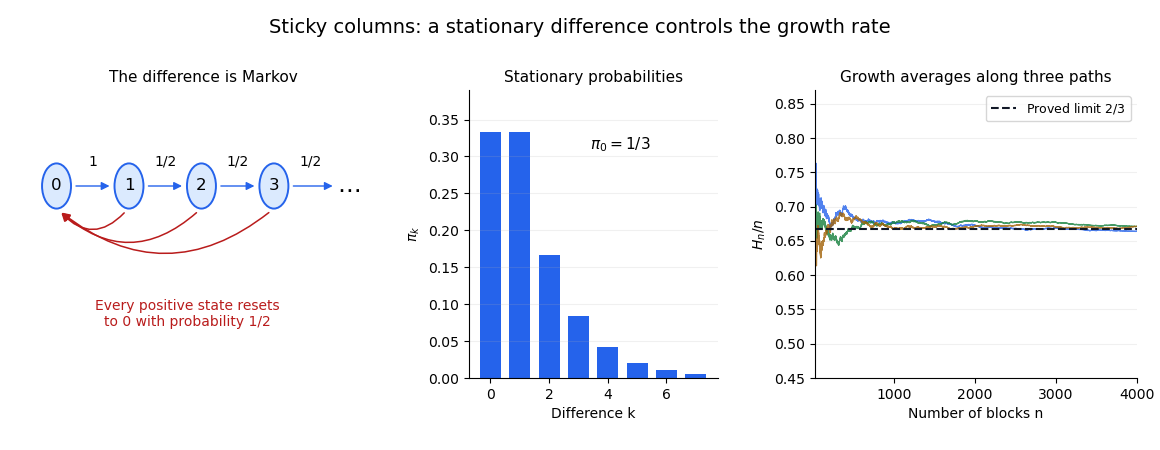
Suppose each new unit block independently selects one of two columns with equal probability. On the taller column it increases the maximum height; on the shorter column it sticks level with the other column, leaving the maximum unchanged. If the columns have equal height, the next block increases the maximum. Their absolute height difference is the reset-or-increment Markov chain with .
For the maximum height , each increment obeys . The stationary distribution has . Applying the countable-state Markov chain ergodic theorem to the bounded indicator function of the positive states givesalmost surely, from any fixed finite starting configuration. The reward average depends only on whether a reset occurred, even though the difference chain has infinitely many states.
For a steady Rankine vortex in a fluid of constant density with gravity , the Euler equations give and . Integrating on the two sides and matching pressure at givesSetting a constant surface pressure yieldsThus the free surface and its radial slope match at the core edge. The central depression is , twice the depression at . Bernoulli's theorem applies throughout the exterior; the rotational core instead uses the radial momentum balance above.
Zero and one have the same quantifier-free type in the multiplicative integers by  Codex 0 2026-10-31
In the constant-free language with multiplication as its sole nonlogical symbol, every term in one free variable is for some . Every atomic formula holds at both zero and one. Hence every quantifier-free formula, being a finite Boolean combination of those atoms, has the same truth value at both points. They have the same quantifier-free type, and neither singleton is quantifier-free definable. Quantifiers distinguish them: defines zero, while defines one. These formulas do not rely on named zero or one constants.
For six distinct points on an irreducible conic in the complex projective plane, the three intersections of opposite sides of the resulting hexagon are collinear. Form the two cubics given by the products of alternate side equations. They meet at the six conic points and the three opposite-side intersections. Applying residual intersection through a curve pencil with degrees three and two places the last three points on a line. This is the conic counterpart of Pappus's hexagon theorem for two lines.
Over , the Hesse pencil is the pencil of plane cubics generated by and . In the affine parameter used here,The parameter at infinity gives the triangle . Its finite member is nonsingular exactly when .
Indeed, a singular point satisfies , , . No coordinate can vanish, since that would make all three zero. Multiplying gives . Conversely, these three parameter values give products of three lines; for example uses the factorization of . The Hessian curve of a finite member has equationobtained by taking the determinant of the second-derivative matrix and discarding a nonzero scalar. It remains in the pencil, explaining the common flex configuration.[ref]
The Hesse pencil of plane cubic curves by Michela Artebani and Igor Dolgachev. §2, manuscript pp.3–5; the source uses the alternative coefficient mu=3 lambda
The ground field matters. In characteristic three, this displayed family collapses to , so the complex smoothness test is inapplicable. The ordinary Hessian determinant also degenerates in characteristic two. The formulas above and the accompanying flex configuration of the Hesse pencil are used here over the complex numbers.
In the affine coordinate , the complex projective line consists of the complex plane together with the single extra projective point , called its point at infinity. It is the only point whose second homogeneous coordinate vanishes. This coordinate choice distinguishes the point; it is not intrinsically special under projective transformations. The map exchanges zero and infinity. The resulting one-point compactification is the Riemann sphere.
Four projective points in general linear position in the complex projective plane impose four independent linear conditions on the six coefficients of a quadratic polynomial. To see independence, put them at the three coordinate points and using a projective frame. The remaining equations are with , a two-dimensional vector space. Projectivizing its nonzero elements gives a pencil. It has nonsingular bases, for example the forms with coefficient triples and , because the determinant of the symmetric coefficient matrix is . Its three singular members are exactly the three pairs of lines obtained by partitioning the four base points into two pairs.
For a linear projection on a nonzero finite-dimensional vector space, . The linear map acts by the scalar on the first summand and on the second. Its minimal polynomial is the product of the distinct corresponding linear polynomials whose summands are nonzero. If this is ; if or only the associated single factor remains. Otherwise, for , it is . This follows directly from an adapted basis, so it works in every characteristic.
For linear projections , expanding the square proves that their sum is a linear projection exactly when . Multiplying this equality on the left and right by gives and , hence . If the field has characteristic different from two, this forces , and those conditions also suffice. In characteristic two, the condition instead reduces to commutation; has sum zero but nonzero product. For three commuting linear projections, the square-minus-sum is , so vanishing of the triple product alone is not sufficient.
Pinned article: Introduction to the OurBigBook Project
Welcome to the OurBigBook Project! Our goal is to create the perfect publishing platform for STEM subjects, and get university-level students to write the best free STEM tutorials ever.
Everyone is welcome to create an account and play with the site: ourbigbook.com/go/register. We belive that students themselves can write amazing tutorials, but teachers are welcome too. You can write about anything you want, it doesn't have to be STEM or even educational. Silly test content is very welcome and you won't be penalized in any way. Just keep it legal!
Intro to OurBigBook
. Source. We have two killer features:
- topics: topics group articles by different users with the same title, e.g. here is the topic for the "Fundamental Theorem of Calculus" ourbigbook.com/go/topic/fundamental-theorem-of-calculusArticles of different users are sorted by upvote within each article page. This feature is a bit like:
- a Wikipedia where each user can have their own version of each article
- a Q&A website like Stack Overflow, where multiple people can give their views on a given topic, and the best ones are sorted by upvote. Except you don't need to wait for someone to ask first, and any topic goes, no matter how narrow or broad
This feature makes it possible for readers to find better explanations of any topic created by other writers. And it allows writers to create an explanation in a place that readers might actually find it.
Figure 1. Screenshot of the "Derivative" topic page. View it live at: ourbigbook.com/go/topic/derivativeVideo 2. OurBigBook Web topics demo. Source. - local editing: you can store all your personal knowledge base content locally in a plaintext markup format that can be edited locally and published either:This way you can be sure that even if OurBigBook.com were to go down one day (which we have no plans to do as it is quite cheap to host!), your content will still be perfectly readable as a static site.
- to OurBigBook.com to get awesome multi-user features like topics and likes
- as HTML files to a static website, which you can host yourself for free on many external providers like GitHub Pages, and remain in full control

Figure 2. You can publish local OurBigBook lightweight markup files to either OurBigBook.com or as a static website.
Figure 3. Visual Studio Code extension installation.
Figure 5. . You can also edit articles on the Web editor without installing anything locally. Video 3. Edit locally and publish demo. Source. This shows editing OurBigBook Markup and publishing it using the Visual Studio Code extension. 
- Infinitely deep tables of contents:



All our software is open source and hosted at: github.com/ourbigbook/ourbigbook
Further documentation can be found at: docs.ourbigbook.com
Feel free to reach our to us for any help or suggestions: docs.ourbigbook.com/#contact