Topics (384k) Articles (398k) Users (410) Discussions (242) Comments (383) Files (13k) New article

A construct combining mutual exclusion for operations on shared state with condition-based waiting. A waiting caller releases the monitor while asleep and must recheck its predicate after regaining access.
A permit-based synchronization object. A down operation waits until it can consume a permit; an up operation supplies one. Unlike ownership-based mutex use, signalling can pass between different software threads.
Many waiting software threads wake for a state change that can benefit only one or a few of them. Repeated monitor reacquisition, failed predicate checks and context switches add overhead; selective notification can reduce it.
The singular real symmetric matrices of size two form the double cone in these coordinates. Its complement has three connected components: is positive definite, is negative definite, and is indefinite. This follows also from the eigenvalues . The definite cones are convex. In the indefinite region, first move to zero, then move the nonzero planar vector within the punctured plane, proving path-connectedness. Continuous determinant and trace signs prevent joining different regions without crossing singular matrices.
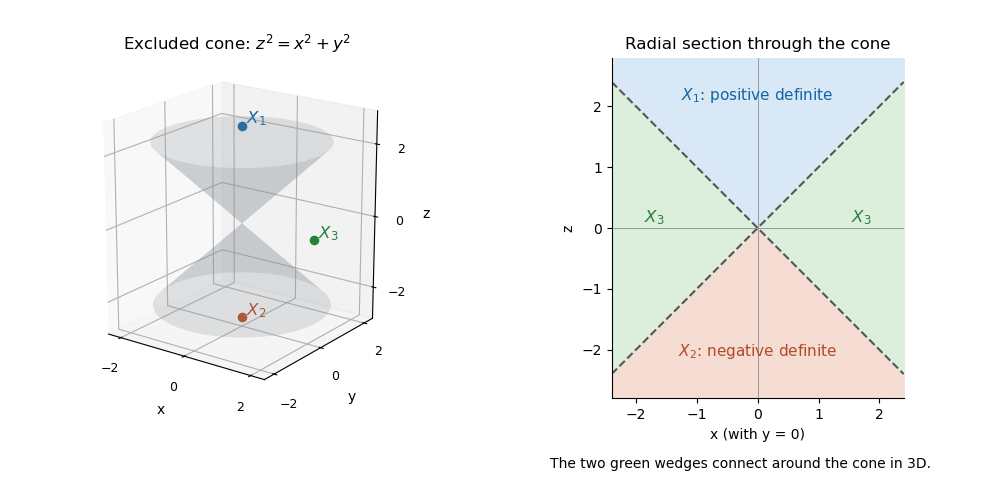
The determinant cone for real symmetric two-by-two matrices and a radial section
. The cone itself is excluded. The two indefinite wedges visible in the section belong to one connected region in the full three-dimensional space. Details.Sweat is fluid secreted onto the skin by sweat glands. Evaporation can remove heat, but fluid remaining on the surface does not provide the same cooling as fluid that evaporates. Composition and secretion rate also affect water and electrolyte losses.
The tractoid is the surface of revolution of a unit tractrix. For with , its coordinate tangent vectors are orthogonal and have squared lengths . The coordinates , transform this first fundamental form into , giving a local isometry to the hyperbolic plane. Thus its Gaussian curvature is minus one. The angular coordinate is periodic globally, while its unwrapped coordinate is a real variable; this distinguishes the local metric identification from a global embedding of the whole hyperbolic plane.
The trochlea of superior oblique is a pulley-like structure in the anterosuperomedial orbit. It redirects the tendon of the superior oblique muscle. The redirection explains why the muscle’s effective pull differs from a straight line between its belly and the eyeball.
A smoothed form of the summatory totient function satisfiesUse the Dirichlet series and the kernel to write the left side as a vertical contour integral. Move the line from real part greater than two to . The only crossed pole is at two, with residue ; the remaining vertical integral is by the standard zeta bounds in the half-strip. If and , positivity of the summands makes nondecreasing. The backward and forward difference quotients of bound . Insert , then let the relative difference-quotient step tend to zero, proving the displayed asymptotic. This monotone integral Tauberian lemma justifies the passage from a smoothed estimate to an unsmoothed one.
Suicidal ideation refers to thoughts about or consideration of suicide. Thoughts, intent and behavior are related but distinct measurements; the presence of one does not uniquely specify the others.[ref]
Effective pressure is ice-overburden pressure minus water pressure beneath the ice. It controls creep closure of channels and cavities; smaller positive weakens that closure and favors separation of ice from bed obstacles. It is therefore central to both basal sliding and subglacial drainage.
Frictional dissipation of water flow melts a channel's ice walls, while ice creep under effective pressure in subglacial drainage closes them. The resulting equilibrium has increasing effective pressure with discharge in the basic channel theory. A route gaining water can lower its water pressure and attract further discharge, widening at the expense of neighbors. This positive redistribution feedback produces arterial drainage.
Sliding opens water-filled cavities behind bed obstacles and ice creep closes them; narrow connections allow drainage between cavities. In a decreasing effective-pressure/discharge relation, a route carrying extra flux needs higher water pressure. That pressure diverts water to neighboring routes, favoring a distributed network instead of concentration into one channel.
At fixed total discharge , remove a small amount from a channel and send it through connected cavities. The equilibrium channel effective pressure drops by , while the cavity pressure difference drops by . Under the displayed inequality the cavity system leaves a common effective pressure higher than the reduced-flux channel can sustain. Excess creep closure then decreases channel discharge further, amplifying the perturbation.
A glacial lake outburst flood is rapid release of water stored in or behind glacial ice or its associated dam. Melt-driven enlargement of a subglacial channel can create positive feedback between discharge, frictional heating and further channel opening. Lake depletion and pressure-dependent material creep closure then alter the event. Channel models explain one mechanism and should not be taken as a universal description of every glacial flood.
The water pressure at a glacier-bed interface affects the effective normal pressure , the difference between ice overburden pressure and water pressure . Higher water pressure at fixed overburden reduces effective compression of the bed contact and can alter cavitation and basal resistance. It is not identical to basal shear stress, and a sliding law depending only on shear suppresses this independent hydraulic influence.
The left subclavian vein returns blood from the left upper limb and joins the left internal jugular vein. The neighboring jugulosubclavian region also receives major lymphatic return. Shared location connects distinct venous and lymphatic transport pathways.
A predicate on possibly partial lists is admissible when it holds at the limit of every increasing chain of finite approximations on which it holds. Increasing here means replacing a bottom value by more defined information while retaining already defined constructors and values. This closure condition permits a property established for finite approximations to pass to an infinite list. The predicate “the list is finite” lacks this closure: every finite prefix ending in an undefined tail is finite in extent, but their limit may have infinitely many constructors.
For an admissible predicate on lazy lists , prove and , and prove for every possibly partial head . Constructor induction then establishes on every finite partial approximation, and admissibility extends it to limits, including infinite lists. Without the bottom value case and the limit condition, ordinary finite structural induction does not justify a claim about infinite data.[ref]
https://ethz.ch/content/dam/ethz/special-interest/infk/inst-infsec/information-security-group-dam/people/andreloc/lochbihler14itps.pdf. Recursive Functions on Lazy Lists, ITP 2014 presentation, slide 7: admissibility restriction on induction over lazy lists
With fixed endpoint values on a finite interval, the displayed derivative coercivity makes a finite-energy strong local minimizer of a variational integral also a local minimizer in . Otherwise choose better competitors converging in . The upper energy bound controls their derivatives in , and a common endpoint controls their function norms. Compact Sobolev embedding gives a uniformly convergent subsequence; its limit is the limit. This contradicts strong local minimality. Convexity of the integrand is unnecessary for this neighborhood-transfer argument.
Pinned article: Introduction to the OurBigBook Project
Welcome to the OurBigBook Project! Our goal is to create the perfect publishing platform for STEM subjects, and get university-level students to write the best free STEM tutorials ever.
Everyone is welcome to create an account and play with the site: ourbigbook.com/go/register. We belive that students themselves can write amazing tutorials, but teachers are welcome too. You can write about anything you want, it doesn't have to be STEM or even educational. Silly test content is very welcome and you won't be penalized in any way. Just keep it legal!
Intro to OurBigBook
. Source. We have two killer features:
- topics: topics group articles by different users with the same title, e.g. here is the topic for the "Fundamental Theorem of Calculus" ourbigbook.com/go/topic/fundamental-theorem-of-calculusArticles of different users are sorted by upvote within each article page. This feature is a bit like:
- a Wikipedia where each user can have their own version of each article
- a Q&A website like Stack Overflow, where multiple people can give their views on a given topic, and the best ones are sorted by upvote. Except you don't need to wait for someone to ask first, and any topic goes, no matter how narrow or broad
This feature makes it possible for readers to find better explanations of any topic created by other writers. And it allows writers to create an explanation in a place that readers might actually find it.
Figure 1. Screenshot of the "Derivative" topic page. View it live at: ourbigbook.com/go/topic/derivativeVideo 2. OurBigBook Web topics demo. Source. - local editing: you can store all your personal knowledge base content locally in a plaintext markup format that can be edited locally and published either:This way you can be sure that even if OurBigBook.com were to go down one day (which we have no plans to do as it is quite cheap to host!), your content will still be perfectly readable as a static site.
- to OurBigBook.com to get awesome multi-user features like topics and likes
- as HTML files to a static website, which you can host yourself for free on many external providers like GitHub Pages, and remain in full control

Figure 2. You can publish local OurBigBook lightweight markup files to either OurBigBook.com or as a static website.
Figure 3. Visual Studio Code extension installation.
Figure 5. . You can also edit articles on the Web editor without installing anything locally. Video 3. Edit locally and publish demo. Source. This shows editing OurBigBook Markup and publishing it using the Visual Studio Code extension. 
- Infinitely deep tables of contents:



All our software is open source and hosted at: github.com/ourbigbook/ourbigbook
Further documentation can be found at: docs.ourbigbook.com
Feel free to reach our to us for any help or suggestions: docs.ourbigbook.com/#contact