Topics (384k) Articles (398k) Users (410) Discussions (242) Comments (383) Files (13k) New article

The Bell-LaPadula model restriction that a subject operating at its current level reads only at or below that level and writes only at or above it. An access combining both operations therefore requires equal levels. Safe changes of current level must also control retained information.
Historical name particularly associated with locally destructive basal cell carcinoma.
An infection caused by toxin-producing strains of diphtheria-associated bacteria, classically involving a pharyngeal membrane. Toxin can also damage distant organs, connecting a local source with systemic effects.[ref]
Diphtheria in the CDC Pink Book. Pathogenesis
The bacterial species associated with tuberculosis. Bulk lesion chemistry does not by itself establish its presence.
Treponema pallidum is a spiral-shaped bacterium associated with syphilis. Its interaction with a host involves multiple tissues and stages; the organism, the resulting infection and a particular clinical manifestation are different concepts.[ref]
Syphilis treatment guidance by CDC. causal organism and stages
A group of bacteria capable of oxidative production of acetic acid from ethanol; particular cultures can contain several species.
The nullclines meet at the origin and . At the origin, the Jacobian matrix has trace three, determinant and discriminant , giving an unstable node. At , its determinant is , giving a saddle equilibrium. The horizontal component is positive below the parabolic nullcline and negative above it; the vertical component is positive above the straight nullcline and negative below it. These signs determine the directional regions of the phase portrait.
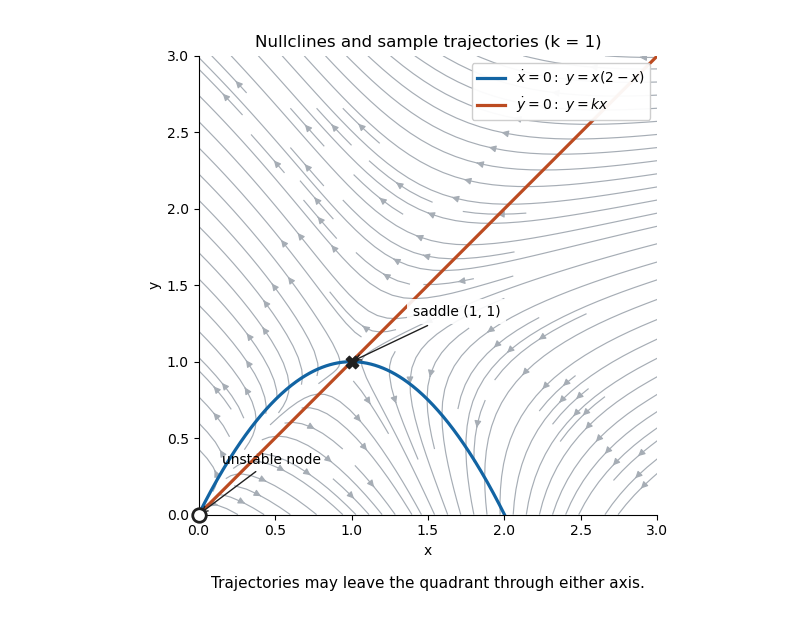
The quadrant is not positively invariant: nonzero points on either axis have an outward-pointing component. Restricting a drawing to that quadrant does not keep its trajectories there. For , only the saddle at the origin remains in the quadrant, and an exponential Dulac multiplier for a quadratic planar system excludes nonconstant periodic orbits there.
An autonomic nerve carries fibers involved in regulation of internal organs, glands or vascular targets through the autonomic nervous system. A named peripheral nerve can contain autonomic fibers together with sensory or somatic motor components. The fiber’s function and its anatomical route are different classifications.
A strange attractor, in the geometric convention, is an attractor whose structure is irregular or fractal rather than a smooth point, cycle or torus. The geometry concerns the set of possible long-term states. Chaos concerns evolution on that set. Some authors include chaos in the meaning of strange, so the convention must be stated.
The separation matters because the same plot cannot answer every question. A box-counting dimension calculation asks how many boxes are needed to cover a set as their size decreases. A Lyapunov exponent calculation follows the growth of a perturbation along a trajectory. These measure different features, and neither number can be substituted for the other.
Strange nonchaotic attractors provide the explicit warning: geometrically complicated attraction can occur without a positive Lyapunov exponent. The original construction used systems driven by two incommensurate frequencies.[ref]
Strange attractors that are not chaotic by Celso Grebogi and others. 1984 paper, abstract: geometric strangeness is distinguished from exponential orbit divergence
Thus fractal-looking geometry alone is insufficient evidence for a chosen definition of chaos.Attraction in a dynamical system means convergence of nearby forward trajectories toward a specified invariant state or set. Attraction and Lyapunov stability are separate properties; together they give the usual local asymptotic stability of an equilibrium.
Pinned article: Introduction to the OurBigBook Project
Welcome to the OurBigBook Project! Our goal is to create the perfect publishing platform for STEM subjects, and get university-level students to write the best free STEM tutorials ever.
Everyone is welcome to create an account and play with the site: ourbigbook.com/go/register. We belive that students themselves can write amazing tutorials, but teachers are welcome too. You can write about anything you want, it doesn't have to be STEM or even educational. Silly test content is very welcome and you won't be penalized in any way. Just keep it legal!
Intro to OurBigBook
. Source. We have two killer features:
- topics: topics group articles by different users with the same title, e.g. here is the topic for the "Fundamental Theorem of Calculus" ourbigbook.com/go/topic/fundamental-theorem-of-calculusArticles of different users are sorted by upvote within each article page. This feature is a bit like:
- a Wikipedia where each user can have their own version of each article
- a Q&A website like Stack Overflow, where multiple people can give their views on a given topic, and the best ones are sorted by upvote. Except you don't need to wait for someone to ask first, and any topic goes, no matter how narrow or broad
This feature makes it possible for readers to find better explanations of any topic created by other writers. And it allows writers to create an explanation in a place that readers might actually find it.
Figure 1. Screenshot of the "Derivative" topic page. View it live at: ourbigbook.com/go/topic/derivativeVideo 2. OurBigBook Web topics demo. Source. - local editing: you can store all your personal knowledge base content locally in a plaintext markup format that can be edited locally and published either:This way you can be sure that even if OurBigBook.com were to go down one day (which we have no plans to do as it is quite cheap to host!), your content will still be perfectly readable as a static site.
- to OurBigBook.com to get awesome multi-user features like topics and likes
- as HTML files to a static website, which you can host yourself for free on many external providers like GitHub Pages, and remain in full control

Figure 2. You can publish local OurBigBook lightweight markup files to either OurBigBook.com or as a static website.
Figure 3. Visual Studio Code extension installation.
Figure 5. . You can also edit articles on the Web editor without installing anything locally. Video 3. Edit locally and publish demo. Source. This shows editing OurBigBook Markup and publishing it using the Visual Studio Code extension. 
- Infinitely deep tables of contents:



All our software is open source and hosted at: github.com/ourbigbook/ourbigbook
Further documentation can be found at: docs.ourbigbook.com
Feel free to reach our to us for any help or suggestions: docs.ourbigbook.com/#contact