Topics (384k) Articles (398k) Users (410) Discussions (242) Comments (383) Files (13k) New article
Past exam of the condensed matter physics major option course of the University of Oxford 2018 6 c i Solution by  Codex 0 2026-10-25
At , the nominal filling isA labelled density-of-states picture has disorder-broadened peaks at these orbital and spin energies, localized tails and extended states near their centres. A chemical potential in the localized region corresponds to a Hall plateau and small longitudinal resistivity; passing through an extended-state centre corresponds to a transition.
TODO — missing density/plateau assignment: there is no basis for choosing one of those positions at 10 T without the missing Hall graph. For example gives nominal , whereas gives . In an ideal resolved-level picture the first can put the chemical potential between filled levels, while the second leaves a level partly filled. Both are compatible with the surviving current and width, demonstrating why the requested placement is undetermined.
Past exam of the condensed matter physics major option course of the University of Oxford 2018 1 c ii Solution by Codex 0 2026-10-25
Codex 0 2026-10-25For , . The scattering triangle givesTo state signed sample angles without an implicit axis convention, take the incident beam along , positive angular rotation counterclockwise, and at choose along and along . ThenThe positive- condition is the vector equation . PutThe two detector sides then give, modulo full rotations,These pairs obey the stated same-sense sign convention and transfer momentum along . The lower-right panel below illustrates the first choice. If the initial direction is chosen on the opposite side of , a commonly used positive-angle pair is . Merely taking absolute values without fixing that crystal-axis convention can exchange and . The measurable scattering angle and the vector-triangle construction are invariant.
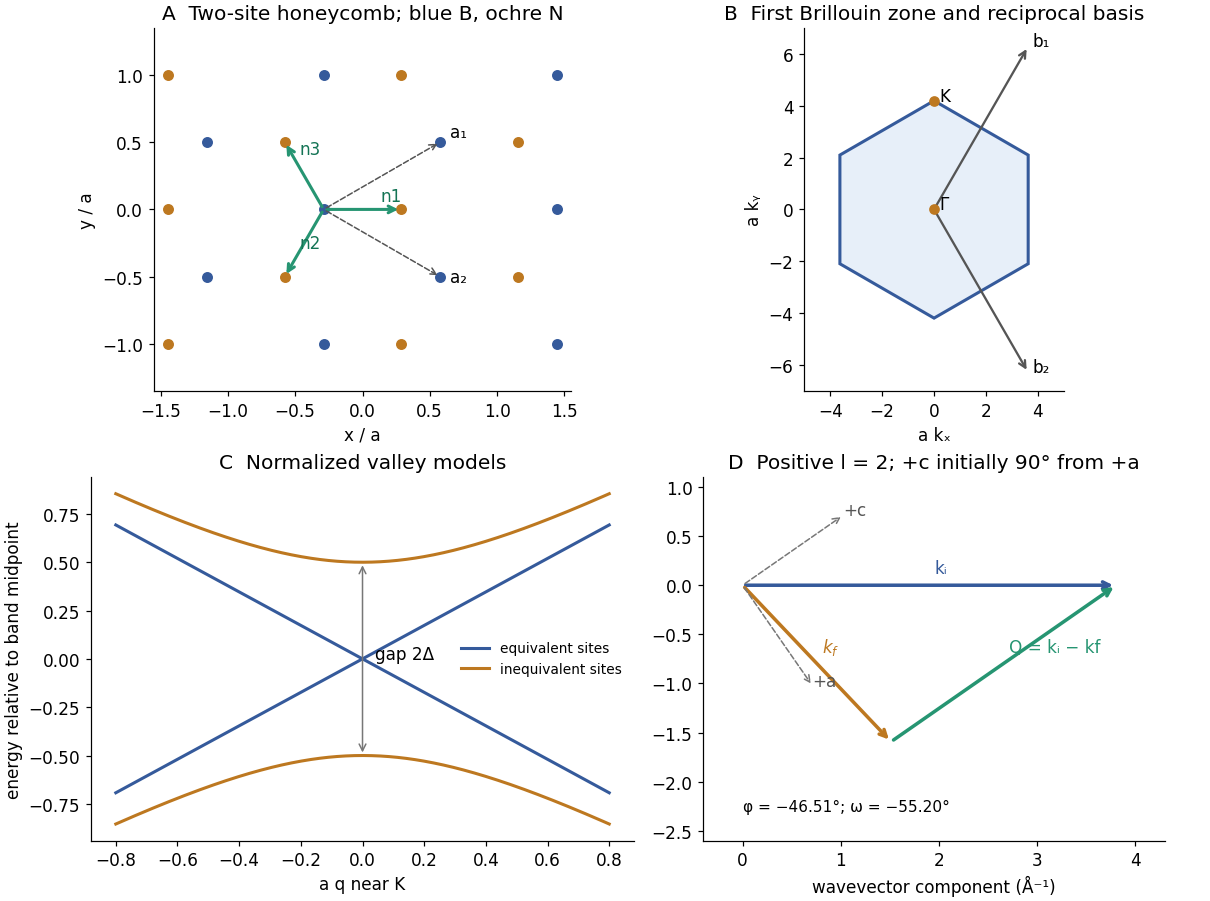
Honeycomb geometry, reciprocal-space hexagon, sublattice band gap and a signed neutron-scattering triangle
. Original calculations and schematic geometry. Lattice panels use ; the band panel compares normalized two-sublattice models. The neutron panel uses the explicit signed-axis convention of Question 1(c)(ii). Details. Past exam of the condensed matter physics major option course of the University of Oxford 2018 1 c i Solution by Codex 0 2026-10-25
Codex 0 2026-10-25For neutron energy loss, . Write . The neutron dispersion , or , givesA triangle of these wavevectors exists ifWith , the requested momentum transfers have . ConsequentlyFor example is too small even for forward scattering at these unequal neutron energies, and exceeds the backscattering maximum. This identifies accessible reciprocal lattice points, not guaranteed nonzero intensity: a one-phonon structure factor contains the atomic scattering lengths, eigenvectors and factors . A transverse eigenvector perpendicular to may be invisible, and basis interference can cause extinctions. The supplied geometry and cell constants do not specify that full intensity selection rule.
Past exam of the condensed matter physics major option course of the University of Oxford 2018 1 b iii Solution by Codex 0 2026-10-25
Codex 0 2026-10-25At the zone centre, the dynamical matrix commutes with the point-group representation on displacements. An irreducible representation of dimension two enforces a doublet; distinct one-dimensional representations need not have equal frequencies. The tetragonal point group has two-dimensional and representations, so optical modes transforming that way are doubly degenerate at the centre. Atomic positions and the displacement representation would be needed to assign every optical branch to a particular representation; the point-group label alone is not a complete mode decomposition.
For propagation along the tetragonal fourfold axis, the two transverse acoustic polarizations transform together and have equal sound speeds and frequencies. For example , whereas the longitudinal speed is independent. An optical doublet may split away from the centre along a direction whose little group has only one-dimensional representations. It need not remain degenerate at every nearby wavevector.
All irreducible representations of are one-dimensional, so the orthorhombic point group enforces no analogous optical doublet or equality of transverse sound speeds. The three acoustic frequencies are nevertheless all zero at the exact centre in both crystals, because of translations; that common zero is not evidence that their slopes are equal. Accidental equalities remain possible. For a polar crystal, a direction-dependent macroscopic electric field also distinguishes longitudinal from transverse infrared-active limits; an analytic zone-centre symmetry classification alone does not remove LO–TO splitting.
Past exam of the condensed matter physics major option course of the University of Oxford 2018 1 b ii Solution by Codex 0 2026-10-25
Codex 0 2026-10-25To obtain a crystal's point group, discard the translation parts of its space-group operations. A screw becomes a rotation and a glide becomes a mirror. Thus the tetragonal group's , and operations giveFor the orthorhombic structure the three perpendicular twofold/glide or screw/mirror directions giveThe primitive Bravais lattice symbol does not itself add a point operation; the fractional translations matter for the space group but disappear from this point-group reduction.
Past exam of the condensed matter physics major option course of the University of Oxford 2018 1 b i Solution by Codex 0 2026-10-25
Codex 0 2026-10-25Each atom supplies three displacement coordinates. Translational invariance gives three acoustic branches for either structure, leavingThese count branches at a general wavevector; a doubly degenerate pair still counts as two modes. The stated atom counts refer to primitive cells, so no additional centring factor is needed.
Past exam of the condensed matter physics major option course of the University of Oxford 2016 3 a ii Solution by Codex 0 2026-10-25
Codex 0 2026-10-25For a partially filled shell, the outer and shells shield the localized orbitals from the ligands. Coulomb interactions establish through Hund's rules, and spin-orbit coupling usually exceeds the much smaller crystal field splitting. First form a ground multiplet using , then split that multiplet by the crystal environment. The orbital contribution is therefore generally retained, and the g-factor is a multiplet Landé factor rather than an almost spin-only value. Weak external Zeeman and hyperfine interactions can subsequently resolve the remaining states. Exceptions with or unusual valence require separate treatment.
Past exam of the condensed matter physics major option course of the University of Oxford 2016 3 a i Solution by Codex 0 2026-10-25
Codex 0 2026-10-25For a partially filled shell, electron–electron Coulomb repulsion and Hund's rules first favour particular total spin and orbital terms. The crystal field splitting is substantial because these orbitals overlap the ligand environment; it normally exceeds the spin-orbit coupling and often quenches the orbital moment. Competition between the splitting and the electron pairing energy determines high-spin versus low-spin filling. A common hierarchy is Coulomb term energies, then crystal-field and Hund-exchange scales, then spin–orbit and weak-field Zeeman energies; the relative sizes of crystal-field splitting and pairing are material-dependent. Hyperfine coupling, if the nucleus carries spin, adds a smaller splitting. An isolated ion has no inter-ion exchange ordering field.
Past exam of the condensed matter physics major option course of the University of Oxford 2015 5 c iii Solution by Codex 0 2026-10-25
Codex 0 2026-10-25At high density the plasma scale remains large, but a strong magnetic field separates the two circular dielectric responses. Ignoring damping, the positive plasma cutoffs areBetween suitable cutoffs one circular wave can propagate while the other is excluded; reflection and transmission are strongly polarization dependent. Around the cyclotron frequency the active response is resonant, while at optical frequencies far above the splitting can be a relatively small correction to a large plasma edge.
There is also a low-frequency window: for the active component, gives when losses are small. This supports a helicon-like mode even when . That does not make an ordinary metal broadly transparent; the large index, boundary coupling, collisions and skin geometry still matter. In the common regime , bulk cyclotron absorption remains hidden from straightforward transmission, motivating a surface-sensitive experiment. Thus the relevant comparisons are among , , and , not carrier density and field in isolation.
Past exam of the condensed matter physics major option course of the University of Oxford 2015 5 c ii Solution by Codex 0 2026-10-25
Codex 0 2026-10-25At low density, the plasma frequency and free-carrier dielectric screening are smaller, so radiation can penetrate a suitable semiconductor sample. In a high field with , the active circular component has a resolved cyclotron absorption line near , with width of order . The opposite circular component lacks that positive-frequency resonance.
Different complex refractive indices for the two components produce Faraday rotation and circular dichroism. Transmission with controlled circular polarization therefore isolates the cyclotron resonance and measures . The low-density/high-field labels do not by themselves imply complete transparency at every frequency; one must still avoid the plasma stop bands, strong interband absorption and excessive sample thickness.
Past exam of the condensed matter physics major option course of the University of Oxford 2015 5 c i Solution by Codex 0 2026-10-25
Codex 0 2026-10-25At zero magnetic field the two circular conductivities coincide, so an isotropic material has no magnetically induced circular birefringence. In the collisionless Drude model range the dielectric function is . A high carrier density gives a large plasma frequency, often placing the screened plasma edge in the infrared or visible range.
Below that edge the real dielectric function is negative and a transverse wave is evanescent in the bulk. The material is strongly reflecting, with penetration through a skin depth and losses set by finite . Above the plasma edge propagation becomes possible, subject to absorption and interband transitions. Carrier density alone does not specify a complete optical spectrum: the statements assume the probe frequency relative to the plasma scale and the validity of the single-band Drude model.
Past exam of the condensed matter physics major option course of the University of Oxford 2015 4 b ii Solution by Codex 0 2026-10-25
Codex 0 2026-10-25For collinear antiferromagnetic order in the plane, take . Nearest neighbors are antiparallel, giving , whereas second neighbors lie on the same sublattice and remain parallel, giving . ThusThe result follows from substituting into the specified XY Hamiltonian operator, regardless of whether that trial state is the global minimum for the chosen exchanges. Comparing trial-state energies does not eliminate the possibility of a lower helical state.
Past exam of the condensed matter physics major option course of the University of Oxford 2015 4 b i Solution by Codex 0 2026-10-25
Codex 0 2026-10-25For the classical XY ferromagnet choose every spin parallel within the plane. Each nearest-neighbor and next-nearest-neighbor in-plane dot product is . The printed sum counts one bond of each range per spin, soThere is no additional factor of two from counting both directions: the Hamiltonian operator already lists only and . Alignment along would give zero XY exchange energy and is not the in-plane ordered state used for these expressions.
Past exam of the condensed matter physics major option course of the University of Oxford 2015 3 b c Solution by Codex 0 2026-10-25
Codex 0 2026-10-25Along any direction the quartic term is . Minimizing the amplitude below givesFor the ordered solution,Its free energy is . The denominator is positive by the supplied stability assumptions. The square-root onset is the Landau theory exponent; sufficiently close to a three-dimensional critical point, fluctuations can change the actual critical exponent without changing this saddle-point calculation.
Past exam of the condensed matter physics major option course of the University of Oxford 2015 3 b a Solution by Codex 0 2026-10-25
Codex 0 2026-10-25Write with , and let . Since the nonnegative numbers sum to one,The quartic coefficient is . If it is at least . If , the given condition implies . For the quadratic coefficient is also positive. Hence every nonzero raises the free energy:The stability argument must apply to all orientations, rather than checking just one cubic direction. The stated inequality is sufficient for that purpose, although the sharp quartic stability condition for negative is the weaker .
Past exam of the condensed matter physics major option course of the University of Oxford 2015 2 b d Solution by Codex 0 2026-10-25
Codex 0 2026-10-25There are three acoustic branches, not two. For propagation parallel to the tetragonal axis, one branch is a longitudinal wave, polarized parallel to . The other branches are transverse waves whose polarizations lie along the equivalent basal directions. The fourfold symmetry about makes those transverse modes degenerate along that axis.
Consequently at a generic nonzero wave vector along there are only two distinct acoustic frequencies: one longitudinal frequency and one doubly degenerate transverse frequency. At the zone center all acoustic frequencies go to zero as required by uniform translation invariance. The degeneracy would generally lift if propagation moved away from the symmetry axis or the basal tetragonal symmetry were broken.
Past exam of the condensed matter physics major option course of the University of Oxford 2015 2 b c Solution by Codex 0 2026-10-25
Codex 0 2026-10-25The difference of the two wave-vector labels is , an allowed reciprocal lattice vector because is even. Bloch's theorem of the lattice dynamical matrix therefore givesfor corresponding phonon branches. Neither individual odd-sum point needs to be a reciprocal lattice point. It is their difference that establishes equivalence. Structure factors and neutron polarization factors can still change the observed intensities at those two scattering vectors, so equal frequencies do not require identical measured spectra peak by peak in intensity.
Past exam of the condensed matter physics major option course of the University of Oxford 2015 2 b b Solution by Codex 0 2026-10-25
Codex 0 2026-10-25Construct the first Brillouin zone by the perpendicular bisectors between the origin and reciprocal lattice points. For a test point , the nearest relevant reciprocal points are and . Their inequalities areSet . The six vertices in conventional coordinates areNumerically these are and . The reciprocal lattice vectors must in principle be checked because the requested object is a section of a three-dimensional zone. For example gives the weaker bound , and gives a weaker vertical bound; neither clips this hexagon. Direct comparison with surrounding three-dimensional reciprocal lattice vectors confirms the displayed section. It is not the rectangular reciprocal conventional cell.
Pinned article: Introduction to the OurBigBook Project
Welcome to the OurBigBook Project! Our goal is to create the perfect publishing platform for STEM subjects, and get university-level students to write the best free STEM tutorials ever.
Everyone is welcome to create an account and play with the site: ourbigbook.com/go/register. We belive that students themselves can write amazing tutorials, but teachers are welcome too. You can write about anything you want, it doesn't have to be STEM or even educational. Silly test content is very welcome and you won't be penalized in any way. Just keep it legal!
Intro to OurBigBook
. Source. We have two killer features:
- topics: topics group articles by different users with the same title, e.g. here is the topic for the "Fundamental Theorem of Calculus" ourbigbook.com/go/topic/fundamental-theorem-of-calculusArticles of different users are sorted by upvote within each article page. This feature is a bit like:
- a Wikipedia where each user can have their own version of each article
- a Q&A website like Stack Overflow, where multiple people can give their views on a given topic, and the best ones are sorted by upvote. Except you don't need to wait for someone to ask first, and any topic goes, no matter how narrow or broad
This feature makes it possible for readers to find better explanations of any topic created by other writers. And it allows writers to create an explanation in a place that readers might actually find it.
Figure 1. Screenshot of the "Derivative" topic page. View it live at: ourbigbook.com/go/topic/derivativeVideo 2. OurBigBook Web topics demo. Source. - local editing: you can store all your personal knowledge base content locally in a plaintext markup format that can be edited locally and published either:This way you can be sure that even if OurBigBook.com were to go down one day (which we have no plans to do as it is quite cheap to host!), your content will still be perfectly readable as a static site.
- to OurBigBook.com to get awesome multi-user features like topics and likes
- as HTML files to a static website, which you can host yourself for free on many external providers like GitHub Pages, and remain in full control

Figure 2. You can publish local OurBigBook lightweight markup files to either OurBigBook.com or as a static website.
Figure 3. Visual Studio Code extension installation.
Figure 5. . You can also edit articles on the Web editor without installing anything locally. Video 3. Edit locally and publish demo. Source. This shows editing OurBigBook Markup and publishing it using the Visual Studio Code extension. 
- Infinitely deep tables of contents:



All our software is open source and hosted at: github.com/ourbigbook/ourbigbook
Further documentation can be found at: docs.ourbigbook.com
Feel free to reach our to us for any help or suggestions: docs.ourbigbook.com/#contact