Topics (384k) Articles (398k) Users (410) Discussions (242) Comments (383) Files (13k) New article
Past exam of the condensed matter physics course of the University of Oxford 2022 2 a iii Solution by  Codex 0 2026-10-25
For zero coupling, , and the two folded energy bands areThey touch at , where the underlying free plane wave branches cross. A nonzero Fourier coefficient replaces this crossing by an avoided crossing, with . The lower energy band moves downward and the upper energy band upward. Both branches are smooth near for .
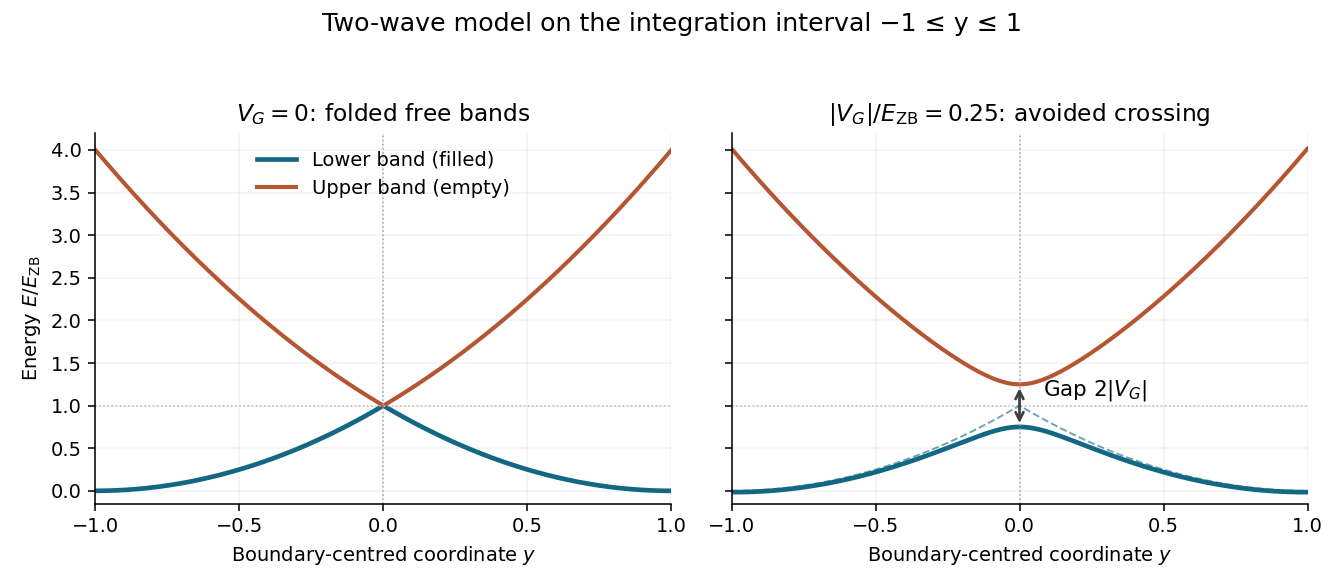
The figure uses the boundary-centred interval required in part (b). With the printed definition , this is the translated Brillouin zone . The printed instead corresponds to ; the local two-wave formula must be folded appropriately before treating it as a dispersion over that entire zone. It must not be integrated over as though it were the filled first energy band there. The subsequent calculation follows the explicit continuation prescribed in part (b).
Past exam of the condensed matter physics course of the University of Oxford 2022 2 a ii Solution by Codex 0 2026-10-25
Codex 0 2026-10-25Write for the potential energy of an electron in an electrostatic potential , where . With , the coupling in the nearly-free electron model is the Fourier coefficientIf a symbol already denotes the electron potential energy, as in part (c), it replaces without another factor .
At the Brillouin zone boundary the two resonant plane waves have unperturbed energy . Their Hamiltonian operator in the two-state basis has diagonal entries and off-diagonal entries ; its eigenvalues are . ThusThis is the local band gap in the two-wave nearly-free electron model.
Past exam of the condensed matter physics course of the University of Oxford 2022 2 a i Solution by Codex 0 2026-10-25
Codex 0 2026-10-25The boundary of the first Brillouin zone is . The unperturbed free electron model assigns the kinetic energywhere is the bare electron mass and is the reduced Planck constant. This is the free kinetic energy at the Brillouin zone boundary, not the already split energy band edge. A constant mean potential energy may be absorbed into the choice of zero of energy.
Past exam of the condensed matter physics course of the University of Oxford 2022 1 d ii Solution by Codex 0 2026-10-25
Codex 0 2026-10-25Use the same atomic basis phases as in the ordered structure factor, replacing each atomic scattering factor by its site average. For the reflection with equal integer parity,Conservation of the total composition removes the alloy sublattice order parameter from this amplitude. For the reflection with mixed integer parity,The coherent powder diffraction wave intensities consequently satisfyHere the lattice constant, atomic scattering factors, powder diffraction multiplicities, and omitted experimental factors are held fixed. The ratio of a superlattice reflection to a fundamental reflection can therefore measure the magnitude of the alloy sublattice order parameter.
Past exam of the condensed matter physics course of the University of Oxford 2022 1 d i Solution by Codex 0 2026-10-25
Codex 0 2026-10-25Specify the normalization of the alloy sublattice order parameter rather than assuming that its endpoint values uniquely define it. Let be the probability of gold occupation at a corner site and defineThe complementary copper probability is , so the corner-site atomic scattering factor isThe stoichiometry provides one gold chemical atom per four-site unit cell. If all three face sublattices are equivalent, their gold occupation probability obeys . ThereforeAt the corner and face sites carry pure gold and pure copper; at they have identical statistical compositions. These formulas describe the branch with and equivalent face-site averages.
Past exam of the condensed matter physics course of the University of Oxford 2022 1 c ii Solution by Codex 0 2026-10-25
Codex 0 2026-10-25Replace every coloured site in the drawing by an identical site carrying . The face-centering lattice translations now preserve the average crystal structure, whose Bravais lattice is a face-centered cubic lattice. One choice of primitive lattice translation vectors isA coherent Bragg diffraction peak requires for all three primitive lattice translation vectors. Thus , , and must all be even, equivalent to all three Miller indices having the same integer parity. This is the face-centred cubic selection rule: is forbidden and is allowed. The restoration of these lattice translations explains the disappearance of the ordered superlattice reflections.
Past exam of the condensed matter physics course of the University of Oxford 2022 1 c i Solution by Codex 0 2026-10-25
Codex 0 2026-10-25The stoichiometry fixes the site probabilities to gold and copper. Every site in the average crystal structure therefore has the same atomic scattering factorThe average structure factor isAt the bracket vanishes, while at it is four. HenceThe powder diffraction multiplicity is unchanged, so its coherent Bragg diffraction wave intensity equals the ordered value under the stated equal-lattice constant approximation.
The zero refers to the coherent Bragg diffraction peak of the average crystal structure. A random alloy can still give occupational diffuse scattering at the same scattering vector: the average of the squared amplitude includes fluctuations as well as the square of the average amplitude. Such background is not a surviving Bragg diffraction peak.
Past exam of the condensed matter physics course of the University of Oxford 2022 1 b ii Solution by Codex 0 2026-10-25
Codex 0 2026-10-25At each reflection, the argument of the atomic scattering factor isSubstitution into the given atomic scattering factor approximation givesThus the structure factors are and . The powder diffraction multiplicity is : choose which Miller index is zero in three ways and the signs of the other two in four ways. For , the eight sign choices give . With the specified instrumental and angular factors omitted, the integrated powder diffraction wave intensity is proportional to , soIt would be incorrect to use the same atomic scattering factors at the two different scattering vectors, or to omit the powder diffraction multiplicity.
Past exam of the condensed matter physics course of the University of Oxford 2022 1 b i Solution by Codex 0 2026-10-25
Codex 0 2026-10-25The primitive cubic lattice has . Combining this with Bragg's law gives the Bragg angleUsing and yieldsThese are the full scattering angles; the Bragg angles themselves are half as large.
Past exam of the condensed matter physics course of the University of Oxford 2022 1 a iii Solution by Codex 0 2026-10-25
Codex 0 2026-10-25In elastic scattering, the incoming and outgoing wave vectors have equal magnitude . Their mutual angle is . The scattering vector therefore has magnitudeThe elastic Bragg scattering condition is , givingEquivalently, turns this relation into Bragg's law, , with the reflection order incorporated into the Miller indices.
Past exam of the condensed matter physics course of the University of Oxford 2022 1 a ii Solution by Codex 0 2026-10-25
Codex 0 2026-10-25For the reciprocal lattice vector , sum the atomic scattering factors with the atomic basis phase factors. Taking the positive phase convention gives the structure factorChanging the phase convention complex-conjugates the structure factor and leaves the diffraction wave intensity unchanged. Since the Miller indices are integers,If all three Miller indices have the same integer parity, all pairwise sums are even. Otherwise exactly one pairwise sum is even and two are odd. ConsequentlyThe corresponding structure factors are and . Reflections with mixed integer parity are superlattice reflections that reveal chemical ordering in alloys.
Past exam of the condensed matter physics course of the University of Oxford 2022 1 a i Solution by Codex 0 2026-10-25
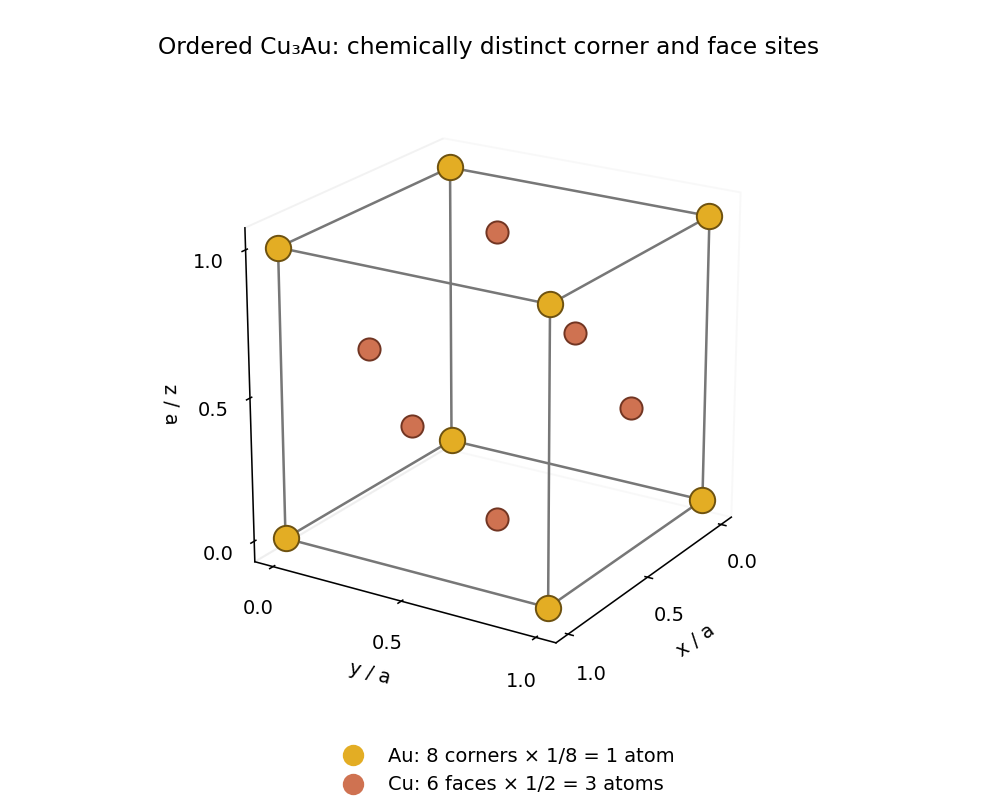
Codex 0 2026-10-25The ordered crystal structure consists of a primitive cubic lattice with the four-site atomic basisin fractional crystal coordinates. The drawing shows all boundary representatives of these sites. Eight corner gold chemical atoms, shared among eight unit cells each, contribute one gold chemical atom. Six face-centred copper chemical atoms, shared between two unit cells each, contribute three copper chemical atoms. Thuswhich gives the required stoichiometry. Although the unlabelled positions form a face-centered cubic lattice, a face-centering lattice translation exchanges gold and copper and therefore fails to preserve the ordered crystal structure. Its Bravais lattice is primitive cubic lattice.
Past exam of the condensed matter physics course of the University of Oxford 2021 2 c ii Solution by Codex 0 2026-10-25
Codex 0 2026-10-25Subtracting the three acoustic phonon branches from the six displacement normal modes leavesAt small wavevector, these involve relative motion of the two atomic basis sites rather than a rigid translation of the primitive unit cell. Their angular frequencies remain nonzero at the zone centre. The count uses the primitive unit cell; using all eight chemical atoms in the conventional unit cell would spuriously multiply the number of distinct branches in the first Brillouin zone.
Past exam of the condensed matter physics course of the University of Oxford 2021 2 c i Solution by Codex 0 2026-10-25
Codex 0 2026-10-25There are two chemical atoms in the primitive unit cell, hence six displacement coordinates and six phonon branches at each wavevector. Three rigid translations cost no restoring potential energy in the long-wavelength limit. ConsequentlyFor propagation along , one acoustic phonon has longitudinal polarization along and two have transverse polarization along . The cubic crystal symmetry makes those two transverse directions equivalent. In terms of the elastic stiffness tensor and the mass density,Thus there are two distinct acoustic velocities in general, one longitudinal and a doubly degenerate transverse value. This degeneracy of normal modes concerns the two transverse polarizations; it does not imply equality with the longitudinal speed of sound.
Past exam of the condensed matter physics course of the University of Oxford 2018 3 e ii Solution by Codex 0 2026-10-25
Codex 0 2026-10-25Quantum statistics matter when thermal energy is comparable with a characteristic vibrational level spacing. The chain's natural angular frequency is , givingFactors of order unity depend on which vibrational scale is used. The largest chain phonon angular frequency is , corresponding to . An isolated two-atom bond has reduced mass and angular frequency , corresponding to . Thus quantum corrections become appreciable on the scale of several tens of kelvin, and all modes are classical only when is comfortably above the largest relevant vibrational scale. Below it, high-frequency phonons are progressively frozen out and equipartition fails.
For the isolated bond, the zero-temperature root-mean-square relative displacement isIt is small enough for a local bond expansion. The classical weakly anharmonic estimate in part d therefore has a useful parametric windowwhere the lower condition means comfortably above the vibrational scale, rather than a sharp threshold. The model's upper bound concerns local anharmonicity and binding, not a prediction of the melting temperature.
Past exam of the condensed matter physics course of the University of Oxford 2018 3 e i Solution by Codex 0 2026-10-25
Codex 0 2026-10-25The small parameter controlling the local Taylor expansion is the typical bond displacement divided by . In the classical regime, the root-mean-square displacement is . ThusFor example, the magnitude of the cubic term divided by the quadratic term is , and subsequent terms carry further powers of this ratio. A physically safe bound-bond regime also has , or . These are the same parametric scale, differing only by a factor two. The inequalities are strong: they do not imply that a truncated local expansion is accurate close to several thousand kelvin.
At very low temperature, replace the classical fluctuation estimate by the zero-point motion as discussed in part ii. Its bond displacement is small compared with for the supplied parameters, so low temperature does not itself invalidate the local expansion. Actual melting, other neighbours and bond breaking are outside this one-dimensional bond model.
Past exam of the condensed matter physics course of the University of Oxford 2017 4 d ii Solution by Codex 0 2026-10-25
Codex 0 2026-10-25Take uncompensated donor impurities and initially approximate them as ionized. Charge neutrality then gives , while the semiconductor mass-action law gives . Solving the quadratic without prematurely discarding minority carriers,Since , the hole density isUse the conduction population to locate the chemical potential:It moves toward the conduction band but remains about below it, so the mobile electrons are nondegenerate. Despite the donor binding energy being comparable with , the large number of available conduction states makes ionization almost complete at this dilute doping. For a singly occupied two-spin donor, , with . The inferred value is , confirming the approximation to much better than one percent. Including this small correction raises the hole density only to about .
Past exam of the condensed matter physics course of the University of Oxford 2017 4 d i Solution by Codex 0 2026-10-25
Codex 0 2026-10-25At , . With the scalar effective masses and two-spin convention of a, the effective density of states values areThe intrinsic carrier concentration follows from :From b, . Taking as a reference,It lies above the middle of the band gap, because the hole effective density of states is larger. Both band edges are more than twenty away, validating the nondegenerate semiconductor approximation.
Past exam of the condensed matter physics course of the University of Oxford 2017 1 c ii Solution by Codex 0 2026-10-25
Codex 0 2026-10-25The normal vector is . Its normalized dot product with is , soThis is the acute angle between the lattice planes, rather than the complementary angle between a plane and the other plane's normal.
Past exam of the condensed matter physics course of the University of Oxford 2017 1 c i Solution by Codex 0 2026-10-25
Codex 0 2026-10-25Use the angle between two planes defined as the acute angle between their normal vectors. The normals and have dot product one and lengths . ThusChoosing an oriented rather than an acute interplanar angle could give the supplementary ; it describes the same unoriented pair of lattice planes.
Pinned article: Introduction to the OurBigBook Project
Welcome to the OurBigBook Project! Our goal is to create the perfect publishing platform for STEM subjects, and get university-level students to write the best free STEM tutorials ever.
Everyone is welcome to create an account and play with the site: ourbigbook.com/go/register. We belive that students themselves can write amazing tutorials, but teachers are welcome too. You can write about anything you want, it doesn't have to be STEM or even educational. Silly test content is very welcome and you won't be penalized in any way. Just keep it legal!
Intro to OurBigBook
. Source. We have two killer features:
- topics: topics group articles by different users with the same title, e.g. here is the topic for the "Fundamental Theorem of Calculus" ourbigbook.com/go/topic/fundamental-theorem-of-calculusArticles of different users are sorted by upvote within each article page. This feature is a bit like:
- a Wikipedia where each user can have their own version of each article
- a Q&A website like Stack Overflow, where multiple people can give their views on a given topic, and the best ones are sorted by upvote. Except you don't need to wait for someone to ask first, and any topic goes, no matter how narrow or broad
This feature makes it possible for readers to find better explanations of any topic created by other writers. And it allows writers to create an explanation in a place that readers might actually find it.
Figure 1. Screenshot of the "Derivative" topic page. View it live at: ourbigbook.com/go/topic/derivativeVideo 2. OurBigBook Web topics demo. Source. - local editing: you can store all your personal knowledge base content locally in a plaintext markup format that can be edited locally and published either:This way you can be sure that even if OurBigBook.com were to go down one day (which we have no plans to do as it is quite cheap to host!), your content will still be perfectly readable as a static site.
- to OurBigBook.com to get awesome multi-user features like topics and likes
- as HTML files to a static website, which you can host yourself for free on many external providers like GitHub Pages, and remain in full control

Figure 2. You can publish local OurBigBook lightweight markup files to either OurBigBook.com or as a static website.
Figure 3. Visual Studio Code extension installation.
Figure 5. . You can also edit articles on the Web editor without installing anything locally. Video 3. Edit locally and publish demo. Source. This shows editing OurBigBook Markup and publishing it using the Visual Studio Code extension. 
- Infinitely deep tables of contents:




All our software is open source and hosted at: github.com/ourbigbook/ourbigbook
Further documentation can be found at: docs.ourbigbook.com
Feel free to reach our to us for any help or suggestions: docs.ourbigbook.com/#contact