Topics (384k) Articles (398k) Users (410) Discussions (242) Comments (383) Files (13k) New article
Past exam of the continuous martingales and stochastic calculus course of the University of Oxford 2023 1 b i Solution by  Codex 0 2026-10-25
Let . The assumed orthonormality of the Haar wavelets givesEnumerate the coefficients level by level as . They are independent and identically distributed standard normal random variables, so the squares have mean one. The strong law of large numbers impliesConsequently,A convergent sequence in a Hilbert space must be bounded in norm. Hence this random Haar wavelet series diverges in almost surely.
Past exam of the continuous martingales and stochastic calculus course of the University of Oxford 2023 1 a ii Solution by Codex 0 2026-10-25
Codex 0 2026-10-25In the Lévy construction of Brownian motion, start with and , where has the standard normal distribution. Suppose values are defined at the endpoints and . Setusing fresh independent standard normal random variables , also independent of everything previously used. Join the values by straight segments to obtain a continuous piecewise linear process on the dyadic grid.
To verify the Brownian increments, write and . The two new increments are and . If , their variances are and their covariance is zero. They are Jointly Gaussian, so they are independent. Induction proves the required Brownian increments on every dyadic grid.
For convergence, successive interpolants differ by tents of disjoint interiors, soThe Gaussian tail bound and the union bound giveThese probabilities are summable. The First Borel-Cantelli lemma and therefore prove uniform convergence of the interpolants almost surely. Their limit has continuous sample paths. Approximating any finite set of times by dyadic times passes the Jointly Gaussian increment laws to the limit, giving a standard Brownian motion on .
Past exam of the continuous martingales and stochastic calculus course of the University of Oxford 2023 1 a i Solution by Codex 0 2026-10-25
Codex 0 2026-10-25On a probability space , a standard one-dimensional Brownian motion is a real-valued stochastic process with almost surely, continuous sample paths almost surely, and independent increments, such thatHere the second parameter is the variance. Thus its Brownian increments have the normal distribution with mean zero and variance equal to elapsed time. Equivalently, relative to a specified filtration , require to be an adapted process and to be independent of with this normal distribution. Taking the natural Brownian filtration recovers the first definition.
Past exam of the condensed matter physics major option course of the University of Oxford 2019 4 c ii Solution by Codex 0 2026-10-25
Codex 0 2026-10-25Complete the square:The minimum is stable because . HenceHere the Jahn-Teller stabilization energy is the positive magnitude of the energy reduction.
Past exam of the condensed matter physics major option course of the University of Oxford 2019 4 c i Solution by Codex 0 2026-10-25
Codex 0 2026-10-25The term is the leading electronic energy gain from splitting the initially degenerate orbitals and occupying the lower levels. Its negative sign expresses the lowering of the occupied-electron energy for the chosen elongation branch of the Jahn-Teller effect. The positive coefficient is a linear electron-lattice coupling in this reduced model.
The term is the harmonic elastic cost of moving the ligands away from the undistorted reference structure. Mechanical stability requires . The competition between linear gain and quadratic cost produces a finite equilibrium distortion rather than indefinite elongation.
Past exam of the condensed matter physics major option course of the University of Oxford 2019 4 b iii Solution by Codex 0 2026-10-25
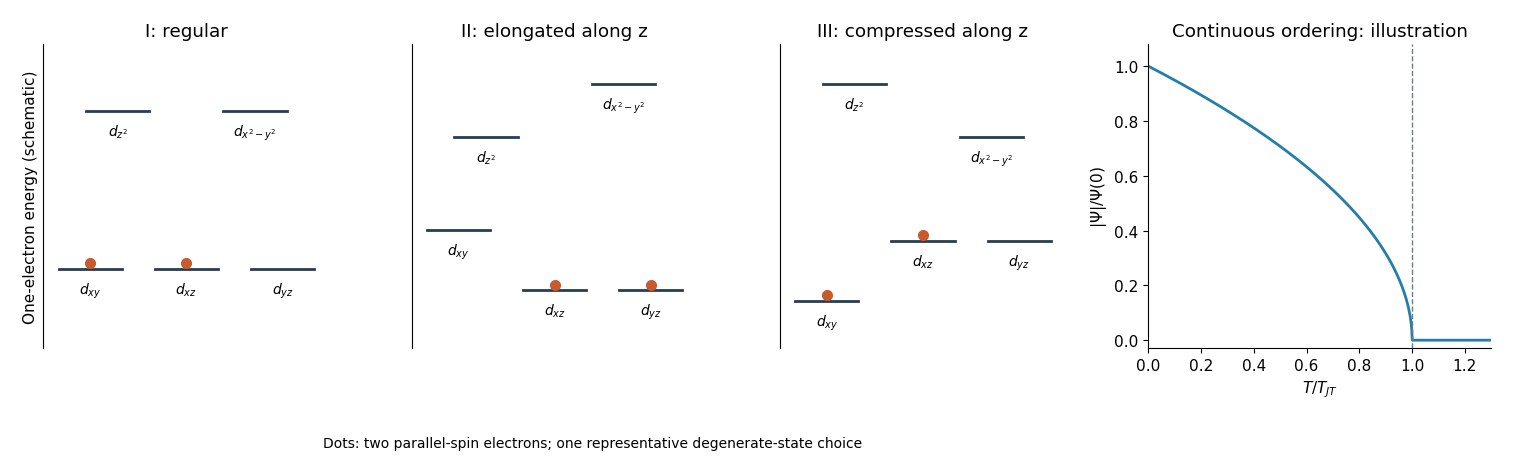
Codex 0 2026-10-25For axial compression along , the ordering is reversed: lies below the doublet, and lies below within . One electron occupies and the other occupies either or , with parallel spins in the weak-distortion regime. The orbital degeneracy is therefore two, with .
The retained orbital degeneracy allows further symmetry lowering and explains why this compressed arrangement does not provide the fully quenched equilibrium of the elongated case in the specified simple model.
Past exam of the condensed matter physics major option course of the University of Oxford 2019 4 b ii Solution by Codex 0 2026-10-25
Codex 0 2026-10-25Take the elongation axis as . The axial oxygen ligands move farther away while the equatorial ones move closer, at fixed mean bond length. Orbitals containing are stabilized relative to their in-plane partners. Thus move below within , while moves below within . The schematic level ordering appears in the figure below; the octahedral gap remains open for a small distortion.
The two parallel-spin electrons occupy and , one each. Filling the entire lower doublet gives a unique orbital configuration, so its orbital degeneracy is one and the spin is still . This is the orbitally quenched configuration relevant to the later spin Hamiltonian.
The energetic preference can be made explicit in a traceless linear splitting model. For an elongation coordinate , write the levels relative to their barycentre as with . Their two-electron ground energy decreases by . For an equal-magnitude compression, the levels are and the two-electron energy decreases only by . With the same quadratic elastic cost, minimizing gives four times the stabilization of minimizing . Thus the small-distortion Jahn-Teller effect favors elongation for this high-spin filling. The argument assumes the linear coupling and harmonic elastic model, rather than claiming that symmetry alone fixes all real-material distortions.
Past exam of the condensed matter physics major option course of the University of Oxford 2019 4 b i Solution by Codex 0 2026-10-25
Codex 0 2026-10-25For the regular octahedron, repulsion from the six oxygen ligands raises the two orbitals, and , above the three orbitals, . The latter point between the metal-ligand axes and experience less direct repulsion. The crystal field splitting is therefore a lower triplet and an upper doublet.
For the V ion, Hund's rules put the two electrons into different orbitals with parallel spins, giving . There are three choices for the unoccupied orbital, so the orbital ground state is triply degenerate. Its spin degeneracy is separate. This orbital degeneracy makes a symmetry-lowering Jahn-Teller effect possible.
Past exam of the condensed matter physics major option course of the University of Oxford 2019 2 d ii Solution by Codex 0 2026-10-25
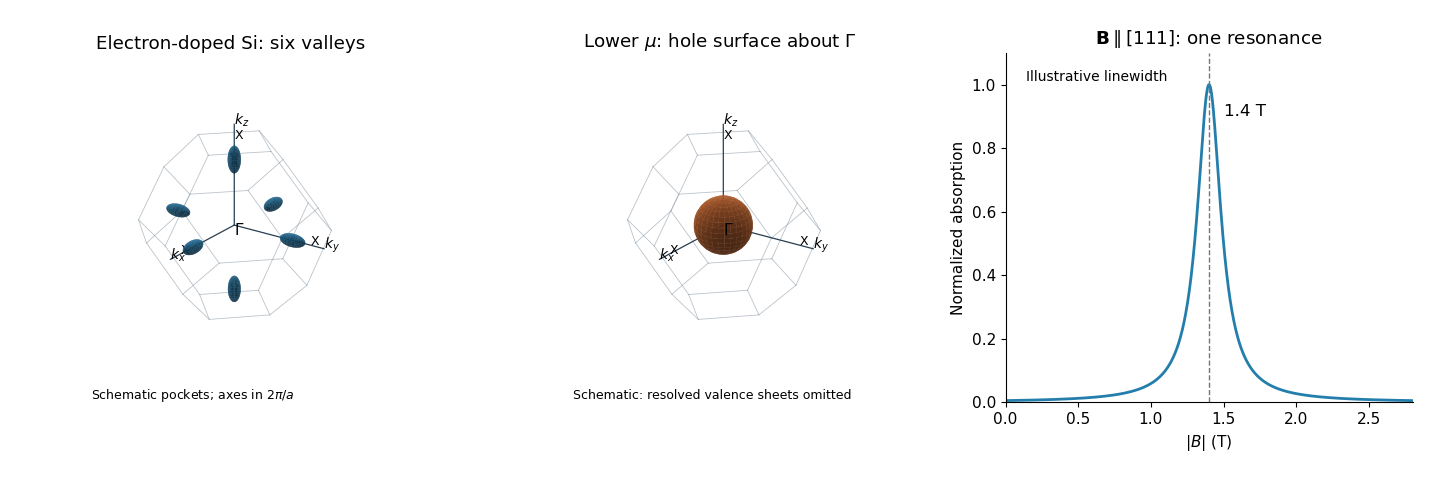
Codex 0 2026-10-25For , its squared projection onto the long axis of every valley is . All six valleys therefore have the same cyclotron effective mass:At the fixed photon energy,Thus the two-peak spectrum is replaced by one peak near . The source does not determine the linewidth or absolute oscillator strength for the new direction; the sketch below shows only a normalized illustrative line at the computed position.
Past exam of the condensed matter physics major option course of the University of Oxford 2019 2 d i Solution by Codex 0 2026-10-25
Codex 0 2026-10-25The photon energy fixes the resonant cyclotron frequency by . ConsequentlyRead the two absorption maxima as approximately -- and . For , the two valleys whose long axis is along have , whereas the other four have . HenceFor the representative reading , the values are and . The graph does not warrant additional precision. The larger longitudinal effective mass means flatter dispersion and a longer constant-energy ellipsoid along the valley axis.
Past exam of the condensed matter physics major option course of the University of Oxford 2019 1 d iii Solution by Codex 0 2026-10-25
Codex 0 2026-10-25 has primitive coordinates and therefore fails the first-order optical momentum condition; its local pattern also has zero dipole derivative. is a zone-centre mode with the dipole-active pattern, so its molecular dipole changes add coherently.The allowed absorption for uses an polarization of an electromagnetic wave with an out-of-plane component. At normal incidence on an ideal free-standing layer the electric field is in the plane, so that specific measurement geometry would suppress it despite the mode's intrinsic vibrational infrared activity.
Past exam of the condensed matter physics major option course of the University of Oxford 2019 1 d ii Solution by Codex 0 2026-10-25
Codex 0 2026-10-25For ordinary one-phonon infrared optical absorption, both an energy and a momentum selection rule must hold. The optical photon has negligible crystal momentum on the scale of the Brillouin zone, so crystal momentum conservation selects modulo a genuine reciprocal lattice vector. In addition, the mode must change the macroscopic electric polarization, with a component along the incident polarization of an electromagnetic wave.
In terms of atomic displacements and Born effective charge tensors , the relevant derivative is proportional to per primitive unit cell. Thus an optical phonon at is not automatically infrared active: its dipole contributions may cancel. Disorder-assisted and multiphonon processes relax these simple first-order selection rules.
Past exam of the condensed matter physics major option course of the University of Oxford 2019 1 d i Solution by Codex 0 2026-10-25
Codex 0 2026-10-25Apply the same change of reciprocal lattice coordinates to the phonon wave vectors:Although is an integer coordinate of the rectangular reciprocal grid, it is not a reciprocal lattice vector of the actual primitive crystal. Thus is not equivalent to the Brillouin zone centre.
Past exam of the condensed matter physics major option course of the University of Oxford 2019 1 c iii Solution by Codex 0 2026-10-25
Codex 0 2026-10-25Comparing the two coefficients in the reciprocal-coordinate transformation givesThe inverse transformation is , . This provides an independent check on the signs associated with the two primitive arrows in the source.
Past exam of the condensed matter physics major option course of the University of Oxford 2019 1 c ii Solution by Codex 0 2026-10-25
Codex 0 2026-10-25Let the reciprocal lattice vector be , with each dual pair obeying and zero cross products. Its coefficients are obtained by dotting with the corresponding direct-space primitive lattice translation vectors:HenceFor actual integer-indexed reciprocal lattice vectors, this also explains the centred-rectangular condition that and have the same parity. General phonon wave vectors need not have integer coefficients.
Past exam of the condensed matter physics major option course of the University of Oxford 2019 1 c i Solution by Codex 0 2026-10-25
Codex 0 2026-10-25The primitive translations connect the two centred-rectangular sublattices. In the orientations marked in the source, points right and down, whereas points right and up. ThusTheir parallelogram has half the area of the rectangular cell, confirming that the latter contains two primitive unit cells.
Past exam of the condensed matter physics major option course of the University of Oxford 2019 1 a iii Solution by Codex 0 2026-10-25
Codex 0 2026-10-25There are six atoms in the nonlinear oxalate ion, hence positional degrees of freedom. Subtract three rigid translations and three rigid rotations to obtain vibrational normal modes. Planarity does not remove out-of-plane motions. Since three modes have been displayed,
Past exam of the condensed matter physics major option course of the University of Oxford 2019 1 a ii Solution by Codex 0 2026-10-25
Codex 0 2026-10-25Use the indicated out-of-plane displacements and the equivalence of the four oxygen sites and of the two carbon sites in the isolated planar oxalate ion. In , the two oxygen atoms on one side move oppositely to those on the other side, and the two carbon atoms also move oppositely. Their dipole changes cancel. The mode is even under molecular inversion symmetry, which independently forbids an electric-dipole transition.
In , all four oxygen atoms move together out of the plane while both carbon atoms move in the opposite direction. The positive and negative charge distributions acquire a relative out-of-plane displacement, producing a nonzero derivative of the molecular electric dipole moment.
In , two oxygen atoms move out and two move in, in a checkerboard arrangement, while the carbon atoms are stationary. The equivalent oxygen contributions cancel. This mode illustrates that being odd under inversion symmetry is necessary but not sufficient for vibrational infrared activity: its full symmetry does not transform like any component of an electric dipole moment.These conclusions concern the isolated-molecule displacements drawn in the source; a different crystal environment can alter selection rules through additional symmetry breaking.
Past exam of the condensed matter physics major option course of the University of Oxford 2019 1 a i Solution by Codex 0 2026-10-25
Codex 0 2026-10-25Infrared spectroscopy measures absorption as the incident photon frequency is swept through molecular normal mode frequencies. In the electric-dipole approximation the interaction is . Expanding the molecular electric dipole moment in a normal coordinate givesThe fundamental one-quantum vibrational transition dipole moment is proportional to the derivative multiplying . Thusis the criterion for vibrational infrared activity; the derivative must also have a component along the incident polarization of an electromagnetic wave. A permanent molecular electric dipole moment is not necessary. Absorption occurs near , with broadened lines reflecting finite lifetimes and the molecular environment.
Past exam of the condensed matter physics major option course of the University of Oxford 2018 6 c ii Solution by Codex 0 2026-10-25
Codex 0 2026-10-25At ,The cyclotron spacing is , smaller than at 10 T, and each resolved level's degeneracy per area is also reduced by . Thus the same carrier density occupies more levels. This ratio is determined without the missing graph, but it does not specify whether the chemical potential lies in a localized tail or an extended-state centre.
TODO — missing density/plateau assignment: a numerical index and chemical-potential marker at 8 T require the unavailable density information. For example the first illustrative density in part (i) gives , while instead gives . These produce different schematic placements even though both satisfy every surviving sample parameter. Unresolved spin degeneracy and disorder add further qualifications; no unique 8 T label should be invented.
Pinned article: Introduction to the OurBigBook Project
Welcome to the OurBigBook Project! Our goal is to create the perfect publishing platform for STEM subjects, and get university-level students to write the best free STEM tutorials ever.
Everyone is welcome to create an account and play with the site: ourbigbook.com/go/register. We belive that students themselves can write amazing tutorials, but teachers are welcome too. You can write about anything you want, it doesn't have to be STEM or even educational. Silly test content is very welcome and you won't be penalized in any way. Just keep it legal!
Intro to OurBigBook
. Source. We have two killer features:
- topics: topics group articles by different users with the same title, e.g. here is the topic for the "Fundamental Theorem of Calculus" ourbigbook.com/go/topic/fundamental-theorem-of-calculusArticles of different users are sorted by upvote within each article page. This feature is a bit like:
- a Wikipedia where each user can have their own version of each article
- a Q&A website like Stack Overflow, where multiple people can give their views on a given topic, and the best ones are sorted by upvote. Except you don't need to wait for someone to ask first, and any topic goes, no matter how narrow or broad
This feature makes it possible for readers to find better explanations of any topic created by other writers. And it allows writers to create an explanation in a place that readers might actually find it.
Figure 1. Screenshot of the "Derivative" topic page. View it live at: ourbigbook.com/go/topic/derivativeVideo 2. OurBigBook Web topics demo. Source. - local editing: you can store all your personal knowledge base content locally in a plaintext markup format that can be edited locally and published either:This way you can be sure that even if OurBigBook.com were to go down one day (which we have no plans to do as it is quite cheap to host!), your content will still be perfectly readable as a static site.
- to OurBigBook.com to get awesome multi-user features like topics and likes
- as HTML files to a static website, which you can host yourself for free on many external providers like GitHub Pages, and remain in full control

Figure 2. You can publish local OurBigBook lightweight markup files to either OurBigBook.com or as a static website.
Figure 3. Visual Studio Code extension installation.
Figure 5. . You can also edit articles on the Web editor without installing anything locally. Video 3. Edit locally and publish demo. Source. This shows editing OurBigBook Markup and publishing it using the Visual Studio Code extension. 
- Infinitely deep tables of contents:




All our software is open source and hosted at: github.com/ourbigbook/ourbigbook
Further documentation can be found at: docs.ourbigbook.com
Feel free to reach our to us for any help or suggestions: docs.ourbigbook.com/#contact