Topics (384k) Articles (398k) Users (410) Discussions (242) Comments (383) Files (13k) New article
Past exam of the condensed matter physics major option course of the University of Oxford 2015 2 b a Solution by  Codex 0 2026-10-25
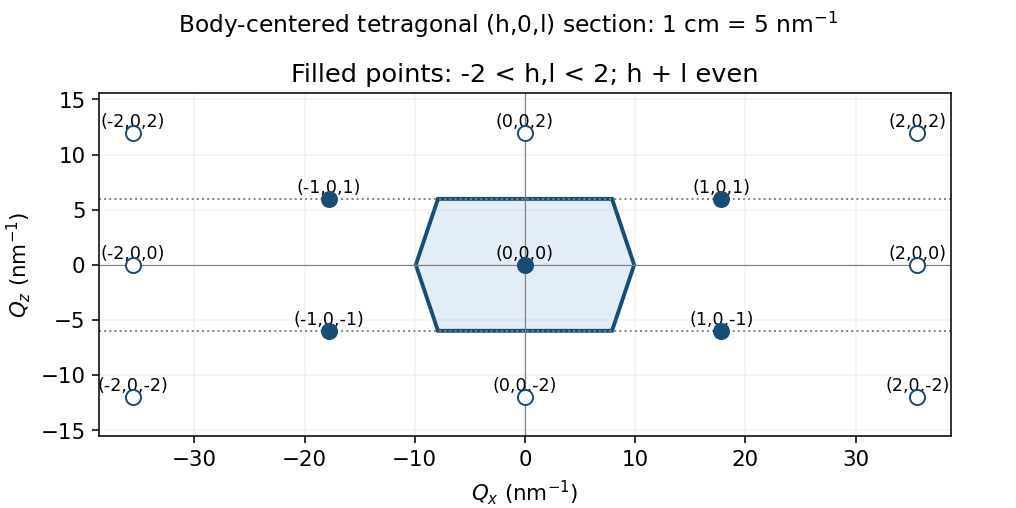
For the body-centered tetragonal direct lattice, conventional reciprocal labels are integer triples satisfying even. This follows because the extra translation must have phase one for a reciprocal lattice vector. In the section the condition is even. The reciprocal steps areWithin the strict index window , the reciprocal points are and . The neighboring and points lie on the excluded boundary but are useful for constructing the zone bisectors.
At the requested drawing scale, one conventional step in is cm and one step in is cm. Thus the four off-origin included points have drawing coordinates cm. Keeping these unequal physical scales avoids drawing a fictitious square reciprocal section.
Past exam of the condensed matter physics major option course of the University of Oxford 2015 1 c d Solution by Codex 0 2026-10-25
Codex 0 2026-10-25One crystallographic inversion center isThe inversion maps to ; it exchanges both the Fe pair and the Se pair modulo lattice translations.
A axis passes along through the Fe site , and likewise through . A representative rotoinversion isIt leaves the first Fe site fixed, maps the other Fe onto a translationally equivalent site, and exchanges the Se height classes. The operation includes a vertical reversal, so it must not be replaced by a pure -degree rotation about an Fe site. Such a pure rotation would put a selenium atom at the wrong height.
Past exam of the condensed matter physics major option course of the University of Oxford 2015 1 c c Solution by Codex 0 2026-10-25
Codex 0 2026-10-25At a point and its glide partner have equal scattering amplitudes and relative phase . Their joint contribution to the structure factor is proportional toIt vanishes for odd . Hence the allowed-condition statement isThis is a systematic absence: it follows independently of the numerical Fe and Se atomic scattering factors. Explicitly, the supplied basis givesand both braces vanish when is odd. When the sum is even a reflection is symmetry-allowed, but an accidental cancellation for particular scattering factors or experimental conditions can still make its intensity small. The glide alone does not promise that every allowed reflection has a nonzero measured intensity.
Past exam of the condensed matter physics major option course of the University of Oxford 2015 1 c b Solution by Codex 0 2026-10-25
Codex 0 2026-10-25Reflection through interchanges the two Se height classes but, by itself, leaves their projected positions wrong. The required parallel translation isFor example, maps to , equivalent to the second Se site. The two Fe sites are also interchanged. This is a diagonal, or , glide; adding an integer lattice vector gives the same fractional translation class. Its translation is expressed in the conventional primitive tetragonal lattice coordinates, not in a smaller Fe-only cell that would discard the selenium height pattern.
Past exam of the condensed matter physics major option course of the University of Oxford 2015 1 c a Solution by Codex 0 2026-10-25
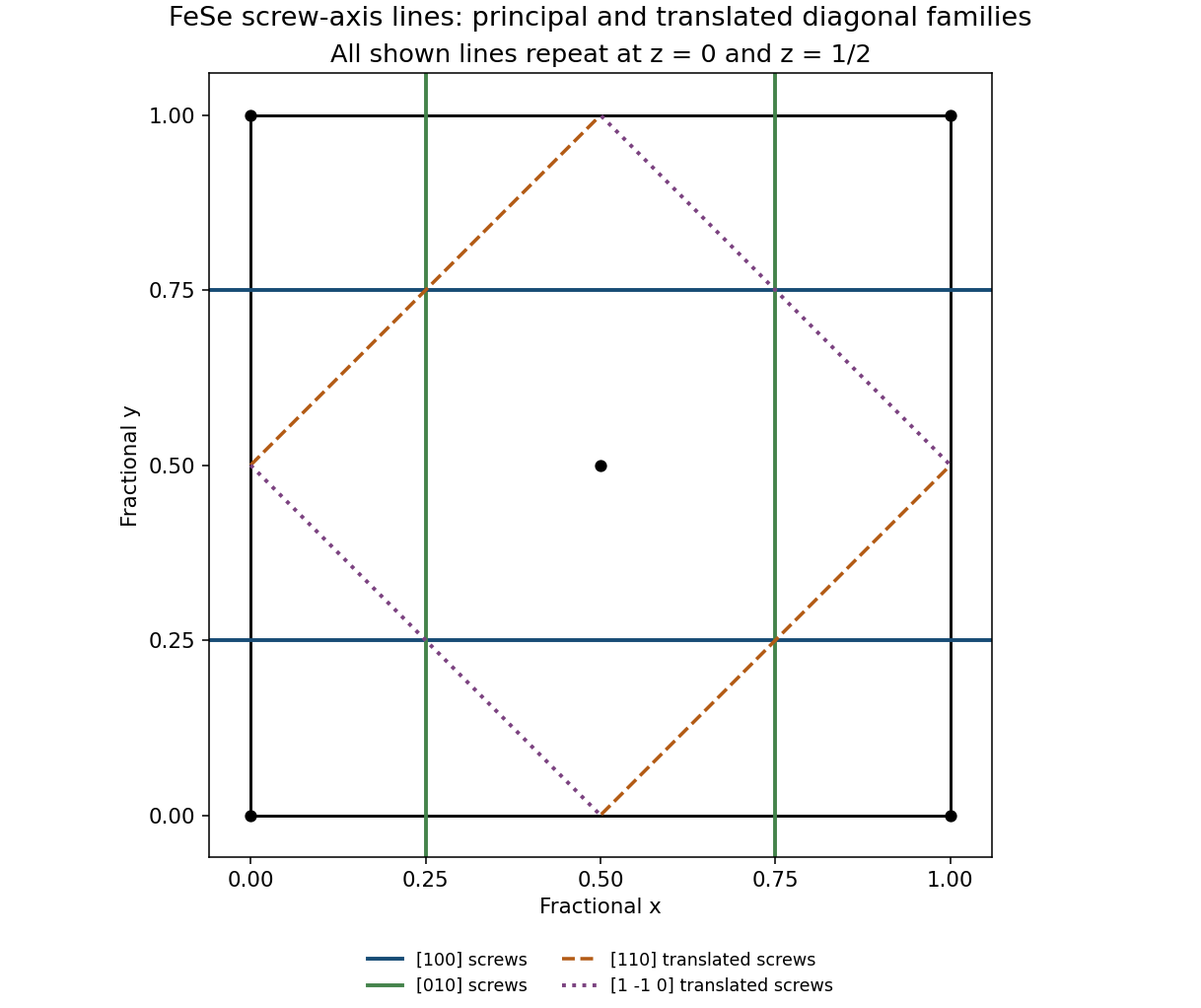
Codex 0 2026-10-25A representative half-turn-plus-translation operation about an axis parallel to isIt rotates about the line and translates by along . It exchanges the two Fe sites, and maps onto modulo a lattice translation. Likewise,is a screw about . Including translated equivalents gives the principal-axis screw linesThus the cell contains lines at the quarter and three-quarter coordinates, in both the and levels.
For completeness, translated diagonal twofold operations also produce diagonal screw lines. The operations and preserve the same basis. Their axial translations are and , half the primitive repeats along the corresponding diagonal directions. Their lines areDiagonal lines with integer instead support pure twofold rotations. Listing only rotational parts modulo primitive translations would hide these shifted screw lines. There is no fractional screw advance along : every Fe site has integer , so a symmetry taking the Fe layer into itself requires an integer vertical translation. Proper fourfold axes parallel to are therefore not , , or screws in this structure. All these statements can be checked directly on the four supplied coordinates without choosing an alternative tabulated origin.[ref]
Symmetry relations for space group 129 by International Union of Crystallography. P4/nmm, full Hermann-Mauguin symbol and origin-setting information; coordinate operations here are derived in the supplied origin
Past exam of the condensed matter physics course of the University of Oxford 2022 4 d ii Solution by Codex 0 2026-10-25
Codex 0 2026-10-25With , the measured effective paramagnetic moment gives the Landé g-factorFor the free-ion Hund's rules values , , , the stated formula yieldsThusThe source fit is consistent with the unquenched orbital magnetic moment of the free praseodymium ion, within graphical accuracy. Small deviations need not indicate a change of electron configuration: crystal field splitting, interactions and the fit range can affect a measured magnetic susceptibility.
Past exam of the condensed matter physics course of the University of Oxford 2022 4 d i Solution by Codex 0 2026-10-25
Codex 0 2026-10-25The given electron configuration has an inert closed core and two electrons. The Aufbau principle identifies the occupied subshells; the free-ion term within the open configuration is then selected by Hund's rules. A closed core contributes .
Each electron has orbital angular momentum quantum number . Place the two spins parallel, so . The Pauli exclusion principle then requires distinct orbital projections. The largest allowed total projection is , obtained from and , giving the maximum allowed . A larger would place two parallel-spin electrons in the same atomic orbital and is forbidden.
The subshell holds fourteen electrons; is less than half filled. The third of Hund's rules therefore selects . HenceThe term symbol uses and the spectroscopic letter for . The praseodymium ion retains an orbital contribution, so a spin-only estimate would be inappropriate.
Past exam of the condensed matter physics course of the University of Oxford 2022 4 b iii Solution by Codex 0 2026-10-25
Codex 0 2026-10-25The Weiss temperature is the extrapolated zero of in a Curie–Weiss law fit. It summarizes the leading high-temperature effect of interactions between magnetic moments. For the sign conventionwhere are dimensionless angular momentum operators, mean-field theory givesThus positive net exchange interaction in this convention favours parallel magnetic moments, giving and tendencies towards ferromagnetism; negative net exchange interaction favours antiparallel magnetic moments, giving and antiferromagnetic tendencies. Competing interactions can partially cancel in this sum. The Weiss temperature need not equal the actual ordering temperature, and its sign alone is not a complete determination of the low-temperature ordered structure.
Past exam of the condensed matter physics course of the University of Oxford 2022 4 b ii Solution by Codex 0 2026-10-25
Codex 0 2026-10-25The Curie constant measures the squared magnetic moment averaged over all orientations of the multiplet, givingFor the usual positive Landé g-factor of the ion here, the absolute-value sign can be omitted. This effective paramagnetic moment differs from the maximum projected or saturation magnetic moment, .
Past exam of the condensed matter physics course of the University of Oxford 2022 4 b i Solution by Codex 0 2026-10-25
Codex 0 2026-10-25In weak magnetic field and the regime of paramagnetism, localized magnetic moments with total angular momentum and Landé g-factor have SI volume magnetic susceptibilitywithin the Curie–Weiss law. Here counts magnetic ions per volume, is the vacuum permeability, is the Bohr magneton, and is the Weiss temperature. The factor is the zero-field average of the squared angular projection over .
For one magnetic ion per formula unit, a molar volume contains magnetic ions, where is the Avogadro constant. Consequently , and the molar magnetic susceptibility isDefining the dimensionless effective paramagnetic moment by , numerical substitution givesThe normalization is per mole of formula units, which here also means per mole of magnetic ions.
Past exam of the condensed matter physics course of the University of Oxford 2022 3 c ii Solution by Codex 0 2026-10-25
Codex 0 2026-10-25The plateau in both source plots is approximately , soThese are graphical estimates, not high-precision fitted material parameters. To extract activation energies consistently with part (a), retain the temperature powers in the effective density of states factors.
On the semiconductor carrier freeze-out tail, put . ThenFor example, the right-hand graph gives roughly at and at . Subtract the known prefactor contribution before interpreting the slope:Thus , to the accuracy of the drawing. Ignoring the weak prefactor gives about , a similar rough estimate.
For the intrinsic branch, useThe left-hand graph gives and , both far above . ThereforeHere . Omitting the prefactor over this wide temperature interval would instead give approximately , so it is not a negligible correction for the band-gap extraction from intrinsic carrier activation. The source graph warrants an approximate narrow band gap, rather than several significant figures.
Past exam of the condensed matter physics course of the University of Oxford 2022 3 c i Solution by Codex 0 2026-10-25
Codex 0 2026-10-25There are three regimes. At the lowest temperatures, most donor impurities retain their electrons; thermal ionization gives semiconductor carrier freeze-out. The result from part (b) isThis produces the approximately straight descending low-temperature tail on the logarithmic scale plot against . The activation energy in the exponential is , because the chemical potential adjusts with donor ionization.
At intermediate temperatures, the donor impurities are essentially fully ionized while intrinsic excitation remains small. Charge neutrality gives , producing the extrinsic plateau, roughly from to in the figure.
At higher temperatures, excitation from the valence band to the conduction band creates electron-hole pairs. The intrinsic carrier concentration grows as for constant parabolic band effective masses and constant band gap. With ionized donor impurities, charge neutrality and the semiconductor mass-action law giveThus when . This explains the renewed rapid rise and the eventual intrinsic branch; that branch is governed by the band gap, rather than the donor binding energy.
Past exam of the condensed matter physics course of the University of Oxford 2022 3 b ii Solution by Codex 0 2026-10-25
Codex 0 2026-10-25Assume uncompensated donor impurities, negligible intrinsic electron holes, and a nondegenerate conduction band. Then charge neutrality equates the conduction electron number density to the ionized-donor number density:The low-temperature condition relative to the band gap supports neglect of intrinsic carriers; one also needs and the Boltzmann approximation for the conduction electrons. Combining part (b)(i) with the effective density of states result givesEliminate the chemical potential by writing . With the donor binding energy ,Writing , the physical root of the resulting quadratic equation isThis lies between zero and . At semiconductor carrier freeze-out, , it becomes ; at essentially complete ionization, , it tends to . Including donor charge-state degeneracy would replace by .
Past exam of the condensed matter physics course of the University of Oxford 2022 3 b i Solution by Codex 0 2026-10-25
Codex 0 2026-10-25For a single impurity level in a crystal with allowed occupations zero and one and equal occupied/empty statistical weights, the Fermi-Dirac distribution givesSince and ,The same result follows from the two grand canonical ensemble weights and .
The equal-statistical-weight convention is necessary for the printed formula when and count whole donor impurities. More generally, donor charge-state degeneracy gives . An ordinary singly occupied donor with two spin orientations and a nondegenerate empty state has ratio ; at its occupied-to-empty ratio is two, a concrete counterexample to treating the printed expression as universal. The following part uses the paper's ratio-one convention.
Past exam of the condensed matter physics course of the University of Oxford 2022 2 c iii Solution by Codex 0 2026-10-25
Codex 0 2026-10-25Define the dimensionless coupling , so that . Substitution into the energy density from part (b) gives, within the prescribed continuation of the two-wave nearly-free electron model,Its value at is understood by continuity. For ,Both electrons per doubled unit cell have been included. The fixed harmonic affects the underlying energy bands beyond the two-wave approximation; the expression here is the energy density requested from part (b), rather than an exact solution for all harmonics of the full periodic potential.
Past exam of the condensed matter physics course of the University of Oxford 2022 2 c ii Solution by Codex 0 2026-10-25
Codex 0 2026-10-25Without the Peierls distortion, adjacent chemical atoms are separated by . The primitive unit cell contains one chemical atom and contributes one electron. A energy band with two spin states accommodates two electrons per primitive unit cell, so the first energy band is half filled. Its true first Brillouin zone extends to , while the Fermi points are at .
Describing the same chain with a doubled unit cell of length merely folds the half-filled energy band into two branches that touch at those Fermi points. The unbroken lattice translation by prevents an artificial band gap there. A Peierls distortion breaks that smaller lattice translation and supplies the missing Fourier coefficient at ; the lower folded energy band can then be completely filled and separated from the upper energy band. Thus the zero-band gap result at agrees with the original one-electron band filling.
Past exam of the condensed matter physics course of the University of Oxford 2022 2 c i Solution by Codex 0 2026-10-25
Codex 0 2026-10-25Regard as an electron potential energy, and take . Each cosine supplies half its coefficient to each of its two Fourier coefficients. The nonzero coefficients areThe Fourier coefficient connecting the two plane waves at is , so the two-wave band gap isAt the actual periodic potential has period and no Fourier harmonic at . The crossing at the artificially halved Brillouin zone boundary then has zero band gap. Higher-order weak-potential corrections can change the proportionality coefficient at nonzero ; the displayed coefficient belongs to the given two-wave approximation.
There is also a small-displacement qualification in the source: the claimed positions of the potential energy minima are correct to first order in , not exactly. Put . ThenAt and , this equals approximately , rather than zero. For , expanding about and gives minima at and . This does not alter the leading Fourier coefficient or the linear opening of the band gap.
Past exam of the condensed matter physics course of the University of Oxford 2022 2 b iii Solution by Codex 0 2026-10-25
Codex 0 2026-10-25For , the Taylor expansions needed in the exact energy density areSubstitution yieldsThereforeHere Big O notation describes the neglected small-coupling terms, and the logarithm is natural. The nonanalytic term comes from the formerly degenerate quantum states near the Brillouin zone boundary; a uniform nondegenerate perturbation theory expansion of the integrand would fail there. This is the same mechanism as the Peierls energy gain.
Past exam of the condensed matter physics course of the University of Oxford 2022 2 b ii Solution by Codex 0 2026-10-25
Codex 0 2026-10-25At every and every ,so the lower energy band lies strictly below its zero-coupling counterpart. Its state counting in a Bloch band and complete occupation are unchanged. Subtracting the two energy densities directly givesThusEquality holds at . This is the downward displacement of the filled lower energy band in the sketch. The upward displacement of the empty upper energy band contributes nothing to the zero-temperature electronic energy density.
Past exam of the condensed matter physics course of the University of Oxford 2022 2 b i Solution by Codex 0 2026-10-25
Codex 0 2026-10-25For a long chain of length with periodic boundary conditions, each spin has quantum states in a wavenumber interval . Including two spin states, a full energy band contains electrons. The state counting in a Bloch band therefore gives the energy densityThe integral of is . For , the even square-root integral isFor example, this follows by setting , applying the supplied antiderivative, and evaluating both endpoints; the lower-end logarithm contributes . HenceThe continuous zero-coupling limit is . This agrees with directly integrating the one-dimensional free electron model up to at two electrons per unit cell.
Pinned article: Introduction to the OurBigBook Project
Welcome to the OurBigBook Project! Our goal is to create the perfect publishing platform for STEM subjects, and get university-level students to write the best free STEM tutorials ever.
Everyone is welcome to create an account and play with the site: ourbigbook.com/go/register. We belive that students themselves can write amazing tutorials, but teachers are welcome too. You can write about anything you want, it doesn't have to be STEM or even educational. Silly test content is very welcome and you won't be penalized in any way. Just keep it legal!
Intro to OurBigBook
. Source. We have two killer features:
- topics: topics group articles by different users with the same title, e.g. here is the topic for the "Fundamental Theorem of Calculus" ourbigbook.com/go/topic/fundamental-theorem-of-calculusArticles of different users are sorted by upvote within each article page. This feature is a bit like:
- a Wikipedia where each user can have their own version of each article
- a Q&A website like Stack Overflow, where multiple people can give their views on a given topic, and the best ones are sorted by upvote. Except you don't need to wait for someone to ask first, and any topic goes, no matter how narrow or broad
This feature makes it possible for readers to find better explanations of any topic created by other writers. And it allows writers to create an explanation in a place that readers might actually find it.
Figure 1. Screenshot of the "Derivative" topic page. View it live at: ourbigbook.com/go/topic/derivativeVideo 2. OurBigBook Web topics demo. Source. - local editing: you can store all your personal knowledge base content locally in a plaintext markup format that can be edited locally and published either:This way you can be sure that even if OurBigBook.com were to go down one day (which we have no plans to do as it is quite cheap to host!), your content will still be perfectly readable as a static site.
- to OurBigBook.com to get awesome multi-user features like topics and likes
- as HTML files to a static website, which you can host yourself for free on many external providers like GitHub Pages, and remain in full control

Figure 2. You can publish local OurBigBook lightweight markup files to either OurBigBook.com or as a static website.
Figure 3. Visual Studio Code extension installation.
Figure 5. . You can also edit articles on the Web editor without installing anything locally. Video 3. Edit locally and publish demo. Source. This shows editing OurBigBook Markup and publishing it using the Visual Studio Code extension. 
- Infinitely deep tables of contents:




All our software is open source and hosted at: github.com/ourbigbook/ourbigbook
Further documentation can be found at: docs.ourbigbook.com
Feel free to reach our to us for any help or suggestions: docs.ourbigbook.com/#contact