Topics (384k) Articles (398k) Users (410) Discussions (242) Comments (383) Files (13k) New article
Past exam of the year 2 of the earth sciences (geology) course of the University of Oxford 2022 Paper 1 8 i Solution by  Codex 0 2026-10-25
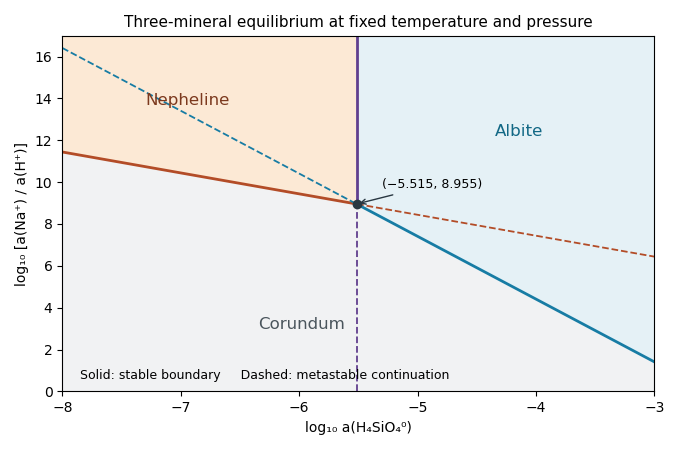
Set and , treating the supplied concentration notation as an ideal-dilute activity approximation. For pure solids and unit water activity, the first chemical equilibrium relation gives and the second gives . Thus plotTheir slopes are and respectively. They intersect at . Both the relevant silica activities and the intersection lie at negative , as expected for a dilute aqueous silica species.
Past exam of the year 2 of the earth sciences (geology) course of the University of Oxford 2022 Paper 1 7 d Solution by Codex 0 2026-10-25
Codex 0 2026-10-25With water fugacity coefficient , use bar. Retain the same ideal mineral-site activities, givingHenceThe lower fluid chemical fugacity stabilizes the water-bearing products of the forward dehydration relative to the ideal-gas calculation and lowers the required temperature by about K. Here the stated fugacity coefficient is treated as a given constant for evaluating the equilibrium.
Past exam of the year 2 of the earth sciences (geology) course of the University of Oxford 2022 Paper 1 7 c Solution by Codex 0 2026-10-25
Codex 0 2026-10-25An activity model is required in addition to the two compositions. Use ideal multisite mineral activity: independent ideal Fe–Mg mixing on the three relevant sites per formula unit givesThe garnet/biotite activity ratio is . All other solids are pure, so the dimensionless reaction quotient isWith the same pressure-corrected numerator as in part b,Diluting the magnesian product endmember more strongly than the reactant favors the forward dehydration and lowers its equilibrium temperature. The powers of three count Fe–Mg mixing sites, not three formula units of either mineral. Nonideal site interactions or site partitioning would change these activities. If ideal mixing of whole formula units rather than sites were intended, activities would instead be and ; composition alone does not select that different model. The calculation explicitly adopts the conventional ideal-site interpretation.
Past exam of the year 2 of the earth sciences (geology) course of the University of Oxford 2022 Paper 1 7 b Solution by Codex 0 2026-10-25
Codex 0 2026-10-25Integrate the solids’ molar volume contribution from bar and use ideal-gas water chemical fugacity . For pure solids,The logarithm is dimensionless, and can be multiplied directly by pressure in bars. Therefore the dehydration equilibrium with ideal-gas fluid givesHence K, or C. Do not also add a constant gas-volume pressure term: the water contribution has already been integrated through . Ideal-gas behavior at kbar is a prescribed model approximation, not a realistic equation of state. The solid volume correction is distinct from it.
Past exam of the year 2 of the earth sciences (geology) course of the University of Oxford 2022 Paper 1 7 a Solution by Codex 0 2026-10-25
Codex 0 2026-10-25 Past exam of the year 2 of the earth sciences (geology) course of the University of Oxford 2022 Paper 1 6 f Solution by Codex 0 2026-10-25
Codex 0 2026-10-25Choose using target depth, scale, expected contrasts, overburden, noise and required result. A seismic reflection survey uses reflected travel times and amplitudes to image interfaces; it needs useful acoustic impedance contrasts, sufficient bandwidth, suitable offsets and dense coverage for moveout correction, stacking and seismic migration. A large clay-cap/igneous contrast gives a potentially strong reflection here, but fractures, scattering and attenuation can obscure coherent events. At Hz the nominal quarter-wavelength vertical seismic resolution is about m in the claystone and m in the igneous rock, if that frequency reaches the target.
A seismic refraction survey uses first arrivals and critically refracted waves to estimate velocities and interface structure. The increase from to is favorable for a cap-base head-wave branch, provided the spread reaches sufficient offsets. Refraction/tomography may better constrain lateral velocity variations and fractures, but simple head-wave inversion can miss a low-velocity layer or a thin hidden layer and often has poorer boundary detail.
Use expected reflector continuity, velocity inversions, required aperture, access, near-surface complexity and cost to choose or combine the surveys. A pilot gather and travel-time modelling can test which phases will be measurable; the supplied velocities alone do not specify the reservoir depth or the best acquisition geometry.
Past exam of the year 2 of the earth sciences (geology) course of the University of Oxford 2022 Paper 1 6 a Solution by Codex 0 2026-10-25
Codex 0 2026-10-25For an approximately isotropic elastic solid,where is bulk modulus, is shear modulus and is mass density. Five relevant controls are:
- Mineral composition and texture: different elastic moduli and densities give different seismic velocities; compliant clay-rich material generally differs from crystalline igneous framework rock.
- Porosity, cracks and fractures: compliant voids reduce the effective moduli and usually reduce both speeds; aligned fractures produce seismic anisotropy.
- Effective confinement: increasing effective stress closes compliant cracks and tends to raise speeds. Higher pore fluid pressure at fixed total confinement can reopen or preserve cracks and lower the effective stiffness.
- Fluid saturation and phase: replacing gas by liquid commonly increases the saturated bulk modulus and ; fluids have no static shear rigidity, so changes through the frame, density and frequency-dependent interactions rather than a direct fluid shear modulus.
- Temperature and alteration: heating commonly reduces elastic moduli and may create thermal cracks; hydrothermal alteration can replace strong minerals by clay or other weaker phases. The sign depends on alteration products and crack sealing, so reservoir-specific measurements are needed.
These controls interact: a dense rock is not automatically faster if its moduli are also different.
Pinned article: Introduction to the OurBigBook Project
Welcome to the OurBigBook Project! Our goal is to create the perfect publishing platform for STEM subjects, and get university-level students to write the best free STEM tutorials ever.
Everyone is welcome to create an account and play with the site: ourbigbook.com/go/register. We belive that students themselves can write amazing tutorials, but teachers are welcome too. You can write about anything you want, it doesn't have to be STEM or even educational. Silly test content is very welcome and you won't be penalized in any way. Just keep it legal!
Intro to OurBigBook
. Source. We have two killer features:
- topics: topics group articles by different users with the same title, e.g. here is the topic for the "Fundamental Theorem of Calculus" ourbigbook.com/go/topic/fundamental-theorem-of-calculusArticles of different users are sorted by upvote within each article page. This feature is a bit like:
- a Wikipedia where each user can have their own version of each article
- a Q&A website like Stack Overflow, where multiple people can give their views on a given topic, and the best ones are sorted by upvote. Except you don't need to wait for someone to ask first, and any topic goes, no matter how narrow or broad
This feature makes it possible for readers to find better explanations of any topic created by other writers. And it allows writers to create an explanation in a place that readers might actually find it.
Figure 1. Screenshot of the "Derivative" topic page. View it live at: ourbigbook.com/go/topic/derivativeVideo 2. OurBigBook Web topics demo. Source. - local editing: you can store all your personal knowledge base content locally in a plaintext markup format that can be edited locally and published either:This way you can be sure that even if OurBigBook.com were to go down one day (which we have no plans to do as it is quite cheap to host!), your content will still be perfectly readable as a static site.
- to OurBigBook.com to get awesome multi-user features like topics and likes
- as HTML files to a static website, which you can host yourself for free on many external providers like GitHub Pages, and remain in full control

Figure 2. You can publish local OurBigBook lightweight markup files to either OurBigBook.com or as a static website.
Figure 3. Visual Studio Code extension installation.
Figure 5. . You can also edit articles on the Web editor without installing anything locally. Video 3. Edit locally and publish demo. Source. This shows editing OurBigBook Markup and publishing it using the Visual Studio Code extension. 
- Infinitely deep tables of contents:



All our software is open source and hosted at: github.com/ourbigbook/ourbigbook
Further documentation can be found at: docs.ourbigbook.com
Feel free to reach our to us for any help or suggestions: docs.ourbigbook.com/#contact