Topics (384k) Articles (398k) Users (410) Discussions (242) Comments (383) Files (13k) New article
Past exam of the year 2 of the earth sciences (geology) course of the University of Oxford 2023 Paper 1 12 a Solution by  Codex 0 2026-10-25
A mass extinction is a geologically brief, geographically widespread loss of a large fraction of species across multiple major groups, substantially exceeding background extinction rates. Severity, global extent and rapidity distinguish it from the disappearance of a local population or the ordinary loss of individual lineages. A threshold near of species is often used operationally, but the qualitative definition does not depend on one universal numerical cutoff. The duration is short on geological timescales, and need not mean that every species disappeared simultaneously in a single day.
Past exam of the year 2 of the earth sciences (geology) course of the University of Oxford 2023 Paper 1 11 c Solution by Codex 0 2026-10-25
Codex 0 2026-10-25Allopatric speciation begins when a geographic barrier divides a population and reduces gene flow. Independent mutation, genetic drift and divergent natural selection can then build reproductive isolation; if populations later meet, they remain distinct when isolation is sufficiently strong. Sister lineages of snapping shrimp in the genus Alpheus on opposite sides of the Isthmus of Panama illustrate the role of separated marine populations. Their divergences are not all synchronous with the final closure: genetic data indicate several separation histories, so one barrier date should not be assigned indiscriminately to every pair.[ref]
New dates and new rates for divergence across the Isthmus of Panama by Nancy Knowlton and others. Abstract: comparisons of 15 trans-isthmian pairs and heterogeneous divergence
Sympatric speciation develops without a geographic barrier separating the initial population. Divergent ecological selection combined with assortative mating, habitat-associated mating, different reproductive times or a chromosomal change can reduce gene flow within a shared area. The palms Howea forsteriana and Howea belmoreana on Lord Howe Island provide a documented candidate: different soil associations and substantially different flowering times contribute to reproductive isolation, and their sister relationship and timing support divergence on the island.[ref]
Sympatric speciation in palms on an oceanic island by Vincent Savolainen and others. Abstract and Figures 2–3: flowering-time and soil associations
The distinction concerns the geography of divergence, not whether present-day ranges overlap. Present coexistence alone cannot distinguish sympatric speciation from earlier allopatric speciation followed by range expansion. Parapatric speciation describes divergence between adjacent populations with limited exchange and provides an intermediate geographical category; the two main modes requested are the allopatric and sympatric endpoints.
Past exam of the year 2 of the earth sciences (geology) course of the University of Oxford 2023 Paper 1 11 b Solution by Codex 0 2026-10-25
Codex 0 2026-10-25The biological species concept groups natural populations that actually or potentially interbreed and are reproductively isolated from other such groups. Its central criterion is reproductive isolation and gene flow, rather than visible similarity. It is hard to apply directly to fossils, organisms reproducing strictly by asexual reproduction, and geographically separated populations whose potential interbreeding cannot be tested.
The phenetic species concept groups organisms by overall similarity in measured phenotypic traits. A practical morphological species concept uses anatomical form as its main evidence; strict phenetic classification can combine many kinds of measured traits. This makes such approaches usable for preserved specimens and much of the fossil record, but the decision depends on which traits are measured and how similarities are weighted.
At least four difficulties arise. Cryptic species may be reproductively isolated while looking nearly identical, so similarity can lump separate lineages. Conversely, sexual dimorphism, juvenile/adult differences and phenotypic plasticity can make one interbreeding species look like several, causing over-splitting. Convergent evolution can make distantly related organisms resemble one another in ecologically selected traits. Finally, continuous geographic or temporal variation supplies no unique gap at which to place a boundary: character choice, sample size, preservation and similarity thresholds can alter the inferred species delimitation. These are distinct from the biological concept's practical difficulty of testing actual interbreeding.
Past exam of the year 2 of the earth sciences (geology) course of the University of Oxford 2023 Paper 1 11 a Solution by Codex 0 2026-10-25
Codex 0 2026-10-25Gregor Mendel's first law is Mendelian segregation: the two alleles at a genetic locus in a diploid individual separate into different gametes, so each gamete receives one. In ordinary meiosis, separation of homologous chromosomes at meiosis I provides the chromosomal mechanism; their sister chromatids separate at meiosis II.
The second law is independent assortment: segregation at one genetic locus is independent of segregation at another when the loci are unlinked. Random orientation of different pairs of homologous chromosomes at meiosis I supplies the mechanism for genes on different chromosomes. Genetic linkage is an essential qualification: nearby loci on one chromosome do not generally assort independently, although sufficiently frequent genetic recombination can make their observed combinations approach independence. Genetic dominance concerns the phenotype of a heterozygote and is not one of these two segregation laws.
Past exam of the year 2 of the earth sciences (geology) course of the University of Oxford 2023 Paper 1 10 e Solution by Codex 0 2026-10-25
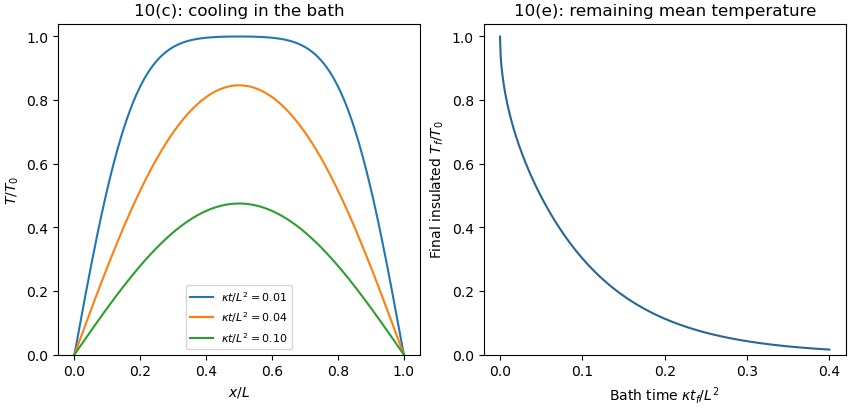
Codex 0 2026-10-25After bath cooling followed by insulated equilibration, the remaining mean temperature is conserved: integrating the insulated heat equation givesFor constant density, specific heat capacity and cross-section, this is conservation of energy. Its Fourier cosine series has a constant mode equal to the initial integral average; every nonconstant mode decays. Therefore the eventual uniform temperature isFor each mode with an odd integer index in part (c), . Integrating the bath-cooled series yieldsFor , uniform convergence justifies termwise integration; the result also follows by dominated convergence of the summable positive coefficients. As a check, gives for zero bath time, and as . More bath time strictly lowers the retained average temperature when and .
Past exam of the year 2 of the earth sciences (geology) course of the University of Oxford 2023 Paper 1 10 d Solution by Codex 0 2026-10-25
Codex 0 2026-10-25Write after removal, with . Neglecting heat loss to air means thermal insulation, rather than an end to internal thermal conduction. The evolution and conditions areHere is the nonuniform bath-cooled profile derived in part (c). At the switching instant it need not have zero endpoint derivatives: the sudden replacement of Dirichlet boundary conditions by Neumann boundary conditions can produce another initial-boundary corner incompatibility. The insulated heat equation nevertheless recovers the given profile and satisfies its new boundary conditions for .
Past exam of the year 2 of the earth sciences (geology) course of the University of Oxford 2023 Paper 1 10 c Solution by Codex 0 2026-10-25
Codex 0 2026-10-25The reference to part “(c)(i)” in the source is circular; the relevant modes are those verified in part (b)(i). Linearity of the heat equation and its homogeneous Dirichlet boundary conditions allows superposition of those modes:Match the initial uniform interior temperature using the orthogonality of the Fourier sine series:Thus for even integers and for odd integers , givingFor every , the exponential factor makes the series and the derivatives needed in the heat equation converge uniformly on later time intervals. At , the Fourier sine series equals at interior points but zero at the endpoints: the instantaneous cooling boundary condition is incompatible with the pre-immersion endpoint values. This corner mismatch is physically the idealization of an instantaneous bath contact and does not invalidate the solution for .
Past exam of the year 2 of the earth sciences (geology) course of the University of Oxford 2023 Paper 1 1 e Solution by Codex 0 2026-10-25
Codex 0 2026-10-25The star is near the southwestern end of the main fault slip patch, so a much longer part of the finite-source rupture propagates northeastward. For comparable distances, ground conditions and buildings, the northeastern site receives the stronger, shorter direct pulse; the southwestern site receives the weaker, longer direct shaking. This is rupture directivity.[ref]
What is Directivity by United States Geological Survey. Explanation of focusing by successive rupture elements
For a segment of length , rupture velocity and seismic wave speed , successive arrival times span approximatelyForward arrivals overlap and concentrate energy into a shorter pulse. Backward arrivals spread out. The supplied finite-source rupture is not perfectly unilateral, so the prediction concerns the dominant contribution. Seismic radiation patterns, seismic attenuation, sediment amplification and building response can alter the ranking of actual damage or total coda duration.
Past exam of the year 2 of the earth sciences (geology) course of the University of Oxford 2023 Paper 1 1 d Solution by Codex 0 2026-10-25
Codex 0 2026-10-25Effective stress and frictional strength generally increase with depth through the shallow crust undergoing brittle fracture. At , small overburden and often weak, fractured near-surface materials limit the shear stress and elastic energy that can accumulate. Some shallow materials also undergo stable sliding rather than unstable earthquake nucleation. Near , a locked fault prone to brittle fracture can sustain a much larger differential stress before frictional instability releases stored elastic energy.
This depth is plausibly near the lower, strong part of the seismogenic layer: below it, increasing temperature eventually promotes material creep across the brittle-ductile transition. Once nucleated at depth, a dynamic finite-source rupture can propagate into shallow regions that could not independently nucleate the same event. Depth alone does not determine the nucleation point: local pore pressure, frictional stability and stress heterogeneity also matter.
Past exam of the year 2 of the earth sciences (geology) course of the University of Oxford 2023 Paper 1 1 c Solution by Codex 0 2026-10-25
Codex 0 2026-10-25For a heterogeneous fault slip distribution, seismic moment iswhere is the shear modulus, the fault plane area, and the area-averaged fault slip. The peak colour cannot be used as : most of the illustrated fault plane has much smaller fault slip.
One reproducible graphical estimate divides the approximately long and down-dip panel into seven strips and a final strip. Reading area averages from the colour scale, from southwest to northeast, gives roughly . This includes the pale, nearly unslipped lower part of each strip. Henceand . A reasonable graphical range is approximately –, dominated by colour averaging and the down-dip extent of small fault slip. The corresponding moment magnitude is about , using . This is an estimate from the supplied distribution, rather than a substitution of a catalogued earthquake magnitude.
Past exam of the year 2 of the earth sciences (geology) course of the University of Oxford 2023 Paper 1 1 b Solution by Codex 0 2026-10-25
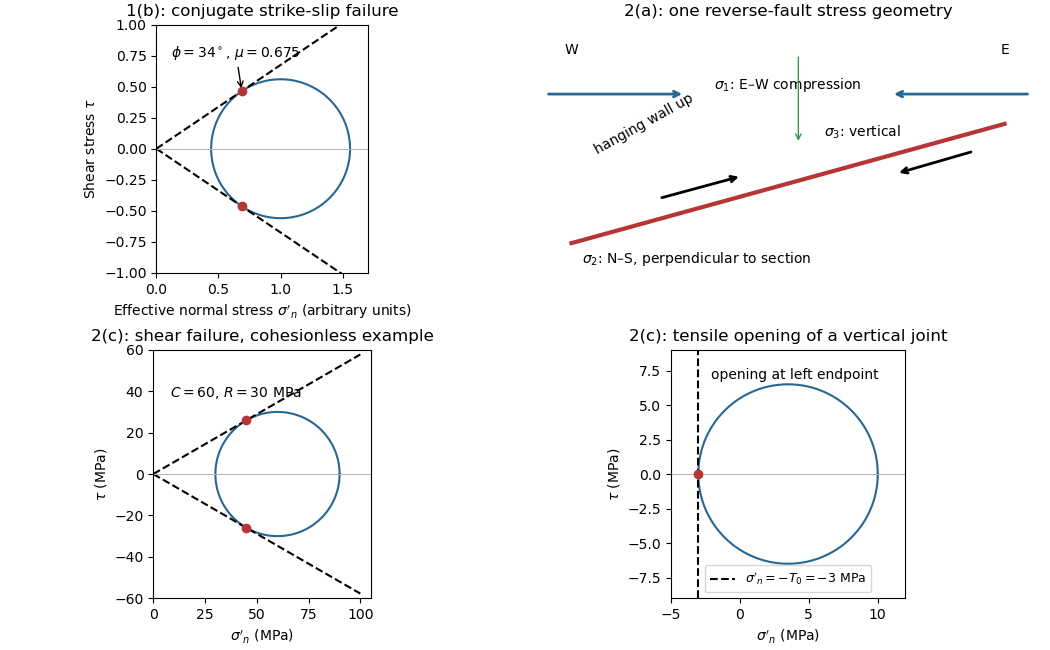
Codex 0 2026-10-25Treat the two strands as newly formed conjugate faults obeying the same Mohr-Coulomb failure criterion, rather than merely inherited faults reactivated in a later stress field. A fault strike is an unoriented line, so is equivalent to . The acute angle between the fault strikes is therefore . The formal compressive acute bisector puts at azimuth and at . This orientation must also be checked against the mapped senses of strike-slip faulting, as discussed below.
Let be the angle between either fault plane and . Tangency of Mohr's circle to , where is effective stress normal to the plane and is cohesion, gives and . ThusIn the Mohr circle, the fault planes are apart around the circle, because a physical plane rotation is doubled. The figure uses to display both tangencies; a common nonzero cohesion changes the intercept, not the inferred friction angle. The inference of requires optimally oriented conjugate faults at formation: the two fault strikes alone cannot measure a friction coefficient for arbitrarily reactivated faults.
Consistency limitation: the mapped westward motion of the Anatolian block corresponds to left-lateral strike-slip faulting on the East Anatolian strand and right-lateral strike-slip faulting on the North Anatolian strand. East–west maximum compression for the acute-bisector construction instead predicts the opposite pair. The stress orientation compatible with the mapped senses lies near the north–south, obtuse bisector; the planes are then about from , which would give in the optimal-formation formula. A negative friction angle is inadmissible for ordinary frictional strength. Thus is the formal magnitude inferred from unoriented angles, while the full map does not support a self-consistent positive-friction, optimally formed conjugate pair. The common-stress assumption can still describe inherited or anisotropically controlled faults, but then their orientations no longer determine a unique coefficient.
Past exam of the year 2 of the earth sciences (geology) course of the University of Oxford 2023 Paper 1 1 a Solution by Codex 0 2026-10-25
Codex 0 2026-10-25The fault dips are approximately . The mapped senses of fault slip are predominantly strike-slip faulting. In an Andersonian faulting regime, the intermediate principal stress is vertical and the maximum and minimum principal stresses are horizontal, so the preferred fault planes are vertical. Local bends can introduce oblique-slip faulting without changing this first-order interpretation.
Past exam of the year 2 of the earth sciences (geology) course of the University of Oxford 2022 Paper 1 8 v Solution by Codex 0 2026-10-25
Codex 0 2026-10-25The stable fields areThus corundum occupies the low- field, nepheline the upper-left field and albite the upper-right field. Pairwise coexistence applies on the indicated stable boundaries, and all three coexist at . These are stability statements within the three-mineral chemical system, not a claim that other possible minerals have been excluded in nature.
Past exam of the year 2 of the earth sciences (geology) course of the University of Oxford 2022 Paper 1 8 iv Solution by Codex 0 2026-10-25
Codex 0 2026-10-25Let and . The common-potential test for a three-mineral activity diagram gives relative potentials, in one positive energy unit,The stable phase minimizes these potentials. Consequently the stable nepheline–corundum branch has , the stable albite–corundum branch has , and the stable nepheline–albite branch has , . Draw them solid.
The other halves of each line are metastable: a third mineral has lower potential there. In particular, below the triple point the vertical equality describes two phases both less stable than corundum. Extend those halves as dashed lines. This thermodynamic comparison prevents the incorrect use of all three complete pairwise lines as stable field boundaries.
Past exam of the year 2 of the earth sciences (geology) course of the University of Oxford 2022 Paper 1 8 iii Solution by Codex 0 2026-10-25
Codex 0 2026-10-25For the reaction direction in part ii, pure solids and unit water activity give . ThereforePlot a vertical line through the common intersection, independent of . Increasing dissolved silica favors albite, consistently with its larger Si/Al ratio. The vertical line’s stable and metastable portions are selected by comparison with corundum, not by its own mass-action equation alone.
Past exam of the year 2 of the earth sciences (geology) course of the University of Oxford 2022 Paper 1 8 ii Solution by Codex 0 2026-10-25
Codex 0 2026-10-25Subtract reaction (b) from reaction (a) and divide by two. In the direction chosen here, the resulting balanced conversion isThus nepheline plus dissolved silica converts to albite. Additivity of the Gibbs energy of reaction, equivalently Hess's law, givesFor the reverse reaction the answer is ; the reaction direction must accompany the equilibrium constant.
Pinned article: Introduction to the OurBigBook Project
Welcome to the OurBigBook Project! Our goal is to create the perfect publishing platform for STEM subjects, and get university-level students to write the best free STEM tutorials ever.
Everyone is welcome to create an account and play with the site: ourbigbook.com/go/register. We belive that students themselves can write amazing tutorials, but teachers are welcome too. You can write about anything you want, it doesn't have to be STEM or even educational. Silly test content is very welcome and you won't be penalized in any way. Just keep it legal!
Intro to OurBigBook
. Source. We have two killer features:
- topics: topics group articles by different users with the same title, e.g. here is the topic for the "Fundamental Theorem of Calculus" ourbigbook.com/go/topic/fundamental-theorem-of-calculusArticles of different users are sorted by upvote within each article page. This feature is a bit like:
- a Wikipedia where each user can have their own version of each article
- a Q&A website like Stack Overflow, where multiple people can give their views on a given topic, and the best ones are sorted by upvote. Except you don't need to wait for someone to ask first, and any topic goes, no matter how narrow or broad
This feature makes it possible for readers to find better explanations of any topic created by other writers. And it allows writers to create an explanation in a place that readers might actually find it.
Figure 1. Screenshot of the "Derivative" topic page. View it live at: ourbigbook.com/go/topic/derivativeVideo 2. OurBigBook Web topics demo. Source. - local editing: you can store all your personal knowledge base content locally in a plaintext markup format that can be edited locally and published either:This way you can be sure that even if OurBigBook.com were to go down one day (which we have no plans to do as it is quite cheap to host!), your content will still be perfectly readable as a static site.
- to OurBigBook.com to get awesome multi-user features like topics and likes
- as HTML files to a static website, which you can host yourself for free on many external providers like GitHub Pages, and remain in full control

Figure 2. You can publish local OurBigBook lightweight markup files to either OurBigBook.com or as a static website.
Figure 3. Visual Studio Code extension installation.
Figure 5. . You can also edit articles on the Web editor without installing anything locally. Video 3. Edit locally and publish demo. Source. This shows editing OurBigBook Markup and publishing it using the Visual Studio Code extension. 
- Infinitely deep tables of contents:




All our software is open source and hosted at: github.com/ourbigbook/ourbigbook
Further documentation can be found at: docs.ourbigbook.com
Feel free to reach our to us for any help or suggestions: docs.ourbigbook.com/#contact