Topics (384k) Articles (398k) Users (410) Discussions (242) Comments (383) Files (13k) New article
Past exam of the psychological disorders: risk and resilience course of the University of Oxford 2022 3 Solution by  Codex 0 2026-10-25
A risk factor is a cause when an appropriate change in that factor would change the relevant psychological outcome, under specified conditions. Prediction and causation are different: a variable can forecast disorder because it is a marker, a consequence of emerging illness, or correlated with an unmeasured cause. Confidence comes from designs that address different alternative explanations and from convergence on a clearly defined exposure, population and outcome.
A cross-sectional study can establish an association and suggest hypotheses, but timing is ambiguous. A depressed respondent may recall more adversity, and family disadvantage may influence both exposure and symptoms. A case–control study is efficient for uncommon disorders but remains sensitive to recall, control selection and exposure misclassification. Adjusting for many measured variables is not automatically an improvement: controlling a consequence of exposure can block a real pathway, while conditioning on a common consequence of exposure and outcome can induce collider bias.
Prospective longitudinal studies improve temporal ordering. In Constance Hammen and colleagues' two-year follow-up, childhood-adversity histories predicted depressive reactions at lower subsequent psychological stress levels. Measuring events and symptoms over time made this more informative than asking affected people retrospectively why they became ill. Yet adversity was not randomized, and histories may be measured imperfectly. Temporal precedence is necessary for the proposed direction of influence, but does not remove familial liability, prior symptoms or unmeasured social circumstances as competing explanations.[ref]
Depression and sensitization to stressors among young women as a function of childhood adversity by Constance Hammen and others. 2000, two-year follow-up and sensitization hypothesis
Stronger observational designs make their counterfactual comparison explicit. A natural experiment exploits an external change that alters exposure without being produced by the same individual characteristics that usually determine it. E. Jane Costello and colleagues observed children before and after an income supplement associated with a casino opening. Comparing developmental changes across differently affected families strengthened the social-causation interpretation for particular behavioral outcomes. It did not randomize poverty, and concurrent community changes or selection into an income-defined subgroup remain possible alternatives.[ref]
Relationships between poverty and psychopathology by E. Jane Costello and others. 2003, longitudinal quasi-experimental comparison
A difference-in-differences analysis formalizes such reasoning as the exposed group's change minus the comparison group's change. Its causal interpretation requires a credible untreated trend comparison, no differential concurrent change that explains the effect, and careful attention to anticipation and changes in sample composition. Merely measuring before and after a policy is not sufficient. Examining pre-intervention trends can expose some problems but cannot prove that every counterfactual assumption is true.
A randomized controlled trial offers another route by breaking systematic baseline links between allocation and measured or unmeasured causes. The foster-care offer in the Bucharest Early Intervention Project is an example of ethically intervening to improve a harmful setting, rather than deliberately assigning children to initial deprivation. Under suitable follow-up and analysis, differences between allocated groups estimate the effect of offering that intervention. Nonadherence, placement changes and attrition still matter. An intention-to-treat analysis retains the allocation comparison; simply regrouping children by the care they eventually received can reintroduce selection.[ref]
Attachment security as a mechanism linking foster care placement to improved mental health outcomes in previously institutionalized children by Katie A. McLaughlin and others. 2012, random allocation and subsequent mental-health assessment
Even a successful trial does not identify the causal contribution of every component. A foster-care package changes several experiences simultaneously. A coping course may alter attention, expectations, peer contact and behavior. To identify a mediator, it is necessary to consider confounding of the mediator–outcome relationship and its temporal ordering, not only whether the treatment changes both mediator and outcome. Conversely, a null intervention can reflect inadequate delivery, insufficient contrast or the wrong developmental timing; it need not prove that the proposed risk factor is irrelevant under every possible intervention.
Genetically informed studies address another set of alternatives. Comparing differently exposed identical twins can reduce confounding by inherited sequence and shared family background. However, exposure differences can arise from nonshared antecedents that also affect disorder, and within-pair measurement error can be substantial. Family and adoption designs are similarly informative without making every remaining environmental association causal. Molecular associations can indicate inherited liability, but linkage disequilibrium and population stratification separate an associated marker from a demonstrated mechanism.
Mendelian randomization uses genetic variants as instruments for an exposure, requiring relevant instruments, independence from exposure–outcome confounders and an exclusion restriction. The design can be useful when its assumptions are credible. It is not a shortcut for every social risk factor: horizontal pleiotropy, parental genetic effects and ancestry structure can create misleading estimates. A genetic score associated with stressful experiences does not necessarily act only through those experiences. This is a methodological distinction, not evidence that any particular untested exposure is causal.
Animal experiments can manipulate mechanisms and timing more tightly. Karen J. Parker and colleagues randomized young squirrel monkeys to intermittent separation experiences or a comparison condition and later tested responses in a novel setting. This supports causal conclusions about that rearing contrast and those measured responses. It does not directly estimate the effect of childhood adversity on human psychiatric diagnoses: species, development, psychological stressor meaning and outcomes differ.[ref]
Prospective Investigation of Stress Inoculation in Young Monkeys by Karen J. Parker and others. 2004, randomized rearing contrast and later behavioral/endocrine tests
The strongest conclusion is obtained when these designs converge despite their different weaknesses, with sensitivity analyses and transparent outcome definitions. A causal claim should specify the contrast it establishes and the alternatives it has not excluded. Prospective timing, externally driven exposure changes, randomization, within-family controls and mechanistic experiments together can provide much stronger evidence than any isolated risk correlation, while still leaving uncertainty about transport to another population or developmental stage.
Past exam of the psychological disorders: risk and resilience course of the University of Oxford 2022 2 Solution by Codex 0 2026-10-25
Codex 0 2026-10-25Psychological resilience research has redirected prevention toward strengthening modifiable adaptive systems and reducing avoidable adversity, rather than identifying unusually invulnerable people. Its contribution is a set of hypotheses about protective processes and developmental opportunities. Whether an intervention actually promotes adaptation must then be established through appropriate comparisons and meaningful follow-up outcomes; the word “psychological resilience” in a program title is not evidence of effectiveness.
Early longitudinal work, including Emmy E. Werner's Kauai research, showed that high-risk developmental histories did not imply uniformly poor outcomes. Later synthesis by Ann S. Masten argued that adaptation often relies on ordinary systems such as effective caregiving, self-regulation and learning. This suggests three broad intervention routes: reduce exposure, preserve external supports and strengthen relevant coping or regulatory skills. The implication is ecological: a child's capacities operate through relationships and opportunities, not in isolation from them.[ref]
Risk, resilience, and recovery by Emmy E. Werner. 1993, developmental follow-up and protective processes
[ref]Ordinary magic by Ann S. Masten. 2001, adaptive systems and implications for intervention
A protective correlate is not automatically a causal target. Good parenting may accompany unmeasured resources, and a child's behavior may affect parenting. Intervention development therefore needs a proposed mechanism, a feasible procedure and a test of whether changing it improves subsequent functioning. It also needs to distinguish a promotive factor, beneficial across adversity levels, from a stress-buffering interaction, whose effect depends on exposure. Both can be useful; neither is established by simply correlating a questionnaire with current well-being.
The Penn Resiliency Program illustrates efforts to teach coping and cognitive skills in schools. Jane E. Gillham and colleagues randomized 697 children across three middle schools to the program, an alternative program controlling nonspecific ingredients, or a control condition. There was no overall reduction in average depressive symptoms across the full sample, although benefits appeared in two schools and not the third. The active comparison improved the test of specificity. The variation cautions against assuming that a curriculum transfers unchanged across settings or that a symptom effect establishes prevention of first-onset disorder.[ref]
School-Based Prevention of Depressive Symptoms by Jane E. Gillham and others. 2007, three-arm trial, school variation and three-year follow-up
Family interventions put supportive relationships closer to the proposed mechanism. The Family Bereavement Program uses caregiver and youth groups to develop parenting, coping and communication after parental death. Its randomized follow-up found benefits in several symptom and functioning domains six years later, while diagnostic effects varied with baseline problems. This is consistent with strengthening adaptation after a defined adversity, rather than treating ordinary grief as illness. A literature-control comparison, however, does not separate the specific skills from all benefits of group attention and support.[ref]
Six-year follow-up of a preventive intervention for parentally bereaved youths by Irwin Sandler and others. 2010, intervention components, comparison condition and outcome-specific follow-up
Environmental intervention can be still more direct. In the Bucharest Early Intervention Project, institutionalized young children were randomized to a supported foster-care offer or care as usual. Katie A. McLaughlin and colleagues assessed attachment security at 42 months and internalizing outcomes at 54 months. The foster-care intervention reduced internalizing disorders among girls, with attachment findings consistent with a protective pathway; a comparable statistically demonstrated intervention effect was not found in boys. A significant result in one sex and a nonsignificant result in the other do not alone establish an interaction. This supports changing a caregiving environment while preserving the sex- and outcome-specific limits of the result.[ref]
Attachment security as a mechanism linking foster care placement to improved mental health outcomes in previously institutionalized children by Katie A. McLaughlin and others. 2012, randomized foster-care offer, attachment assessment and internalizing outcomes
The mediator claim deserves separate evaluation. Placement was randomized; attachment security was not. Attachment may mark other changes in caregiving, and mediator–outcome confounding can survive randomization of the overall intervention. The trial therefore provides stronger causal evidence for the foster-care package than for attachment as its unique active ingredient. This distinction turns psychological resilience theory into a research program: assess whether proposed processes change before outcomes, examine alternatives and test components where ethical and feasible.
Structural resources also matter. E. Jane Costello and colleagues exploited a casino-related income supplement during a longitudinal study. Children in families lifted out of poverty showed improvements particularly in conduct and oppositional symptoms, while anxiety and depression symptoms did not show the same benefit. Although not a randomized cash trial, the externally generated change offered stronger leverage than a cross-sectional poverty–symptom correlation. It shows why prevention need not consist solely of training a person to tolerate an unchanged environment.[ref]
Relationships between poverty and psychopathology by E. Jane Costello and others. 2003, natural experiment and outcome-specific effects
Targeting can be universal, selective or indicated, according to population risk and early symptoms. Judy Garber and colleagues' depression-prevention trial found an overall benefit from a cognitive-behavioral program in high-risk adolescents but no demonstrated benefit when the parent was currently depressed. Because eligibility also included previous episodes, the study mixes first-onset and recurrence-related questions. Its relevance is that individual skills can depend on family context; it does not justify a universal exclusion rule based on one subgroup analysis.[ref]
Prevention of Depression in At-Risk Adolescents by Judy Garber and others. 2009, eligibility and baseline parental-depression moderation
Finally, evaluation should assess actual exposure, disorder onset, functioning, harms, implementation and durability, not merely improvement on the same psychological resilience questionnaire used to teach the course. Reach and material inequalities affect who can benefit. The strongest influence of psychological resilience research is a move toward developmentally timed, multilevel prevention, evaluated with the same causal rigor as treatment. Protecting ordinary relationships and resources can be as relevant as teaching coping; successful adaptation should remain an outcome to demonstrate rather than a trait attributed to those a program happens to help.
Past exam of the psychological disorders: risk and resilience course of the University of Oxford 2022 1 Solution by Codex 0 2026-10-25
Codex 0 2026-10-25Psychological resilience is best defined as successful adaptation in the context of significant adversity, specified by outcome, developmental context and time. It is inferred from an adversity–adaptation relationship, not established merely by a high personality score or the absence of a diagnosis at one assessment. The definition needs both credible exposure and an explicit criterion of adaptation: an unexposed person with good mental health has not thereby demonstrated resistance to that particular challenge.
Suniya S. Luthar and colleagues emphasized this dual requirement and the danger of treating success in one domain as success in all domains. A young person might maintain academic performance while experiencing substantial depression, or recover emotionally while material circumstances remain difficult. An investigation should therefore state whether it concerns symptoms, social relationships, school functioning or several outcomes. It should not define psychological resilience as every desirable attribute simultaneously, because that makes meaningful measurement and explanation nearly impossible.[ref]
The Construct of Resilience by Suniya S. Luthar and others. 2000, definition, multidimensionality and operational criteria
Time is equally important. Stable low disturbance, initial disturbance followed by recovery after adversity, chronic difficulty and delayed deterioration are different trajectories. A single post-event score can confuse them, especially without a pre-event baseline. George A. Bonanno and colleagues assessed 205 people before spousal bereavement and again at six and eighteen months afterward. They identified several patterns, including relatively stable adaptation, chronic difficulties and improvement from pre-existing depression. The prospective baseline made distinctions possible that a retrospective “how well did you cope?” question could not establish.[ref]
Resilience to loss and chronic grief by George A. Bonanno and others. 2002, preloss assessment, follow-up and five observed patterns
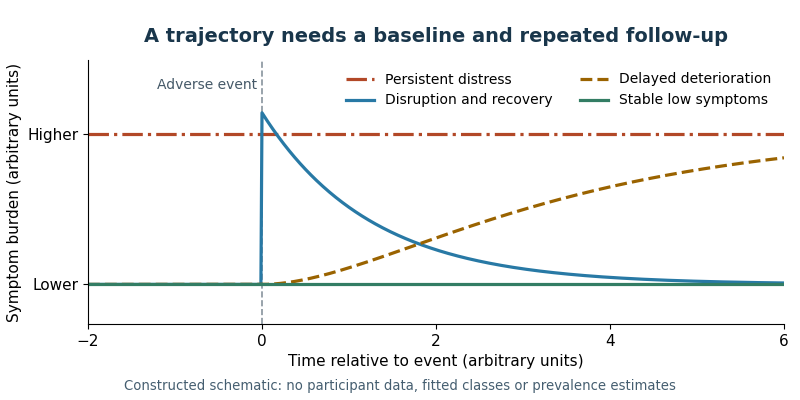
Different histories of adaptation can share the same score at one follow-up
. Original schematic trajectories around an adverse event. Curves are constructed illustrations, not fitted classes or data from the cited bereavement study. They distinguish stable low symptoms, recovery, persistent distress and delayed deterioration without asserting universal population proportions. Details.Trajectory methods need their own scrutiny. A growth mixture model can describe heterogeneous longitudinal patterns, but the number and size of classes depend on assumptions about within-class variation and error. Frank J. Infurna and colleagues reanalyzed responses to bereavement, divorce and unemployment. Relaxing restrictions on class variances and within-class change substantially altered the apparent prevalence of a resilient class. This demonstrates model dependence, not that every earlier low-distress trajectory was fictitious. Researchers should compare plausible models, report uncertainty in class assignment and avoid treating a convenient latent class as a naturally discrete kind of person.[ref]
Resilience to Major Life Stressors Is Not as Common as Thought by Frank J. Infurna and Suniya S. Luthar. 2016, reanalysis and alternative growth-mixture specifications
Exposure measurement must characterize what happened, its severity, duration, developmental timing and relevant context. Counting heterogeneous events as equivalent can conceal very different experiences. Subjective appraisal matters, but using the same distressed respondent to report both adversity and symptoms can create common method variance. Independent records, contextual interviews and repeated assessments improve inference, while still potentially missing chronic insecurity or unrecorded events. Exposure groups also need comparable follow-up opportunities: selective loss of the most impaired participants can make adaptation appear better than it was.
Adaptation should be measured with reliable, culturally appropriate instruments and, where feasible, several informants. Absence of disorder and positive functioning are related but distinct outcomes. Cutoffs need justification and sensitivity analysis; moving a threshold should not silently redefine a large group as resilient. Measurement invariance matters when comparing ages, languages or social groups. Biological measures of psychological stress may clarify a mechanism, but a low cortisol response alone is not a complete assessment of psychological functioning or evidence of a universally optimal response.
Self-report capacity measures have a useful but narrower role. The original Connor-Davidson Resilience Scale, developed by Kathryn M. Connor and Jonathan R. T. Davidson, contains 25 items rating perceived coping-related qualities. Its original validation examined community and clinical samples and sensitivity to treatment-associated change. These findings support a measurable self-reported construct; they do not prove that the scale independently identifies successful adaptation to a documented adversity. Concurrent symptoms can influence perceived competence, so prospective prediction beyond baseline distress is a stronger test than a concurrent correlation.[ref]
Development of a new resilience scale by Kathryn M. Connor and Jonathan R. T. Davidson. 2003, original 25-item scale, validation samples and treatment-associated change
Another approach measures better-than-expected outcomes conditional on exposure. With distress and adversity , one possible score is , where predicts distress. Higher then means less distress than the selected model predicts. Ananda B. Amstadter and colleagues used a regression residual-based approach in longitudinal twin research. Its advantage is explicit conditioning on exposure; its limitations are dependence on the reference sample, exposure measurement and prediction model. An in-sample regression residual is not a new independent biological capacity.[ref]
Psychiatric resilience: longitudinal twin study by Ananda B. Amstadter and others. 2014, exposure-conditioned symptom residual phenotype
The best design combines prospective adversity measurement, pre-event functioning and repeated, multidomain outcomes, with an operational definition registered before outcome selection. Capacity scales, trajectories and regression residual scores can answer complementary questions if their differences are preserved. Psychological resilience should be treated as a context-dependent pattern of adaptation that can change, while proposed capacities and protective mechanisms are tested as predictors of that pattern. Otherwise the explanation becomes circular: calling someone resilient because they did well cannot itself explain why they did well.
Past exam of the probability, measure and martingales course of the University of Oxford 2023 3 a by Codex 0 2026-10-25
Codex 0 2026-10-25Write for the conserved total number of tokens. The main case has positive integer initial holdings. If an initial holding is zero, take ; the formulas below still hold when . If , the stochastic process is constant and .
Past exam of the probability, measure and martingales course of the University of Oxford 2023 2 b by Codex 0 2026-10-25
Codex 0 2026-10-25For this part and part (c), take to be -valued everywhere. The uniform distribution gives , but the paper's expression for is undefined there because . Define on . Keep exactly as printed, including on that null set; this preserves the exact sigma-algebra equality in part (ii). Every slope formula below is asserted on , hence almost surely.
Pinned article: Introduction to the OurBigBook Project
Welcome to the OurBigBook Project! Our goal is to create the perfect publishing platform for STEM subjects, and get university-level students to write the best free STEM tutorials ever.
Everyone is welcome to create an account and play with the site: ourbigbook.com/go/register. We belive that students themselves can write amazing tutorials, but teachers are welcome too. You can write about anything you want, it doesn't have to be STEM or even educational. Silly test content is very welcome and you won't be penalized in any way. Just keep it legal!
Intro to OurBigBook
. Source. We have two killer features:
- topics: topics group articles by different users with the same title, e.g. here is the topic for the "Fundamental Theorem of Calculus" ourbigbook.com/go/topic/fundamental-theorem-of-calculusArticles of different users are sorted by upvote within each article page. This feature is a bit like:
- a Wikipedia where each user can have their own version of each article
- a Q&A website like Stack Overflow, where multiple people can give their views on a given topic, and the best ones are sorted by upvote. Except you don't need to wait for someone to ask first, and any topic goes, no matter how narrow or broad
This feature makes it possible for readers to find better explanations of any topic created by other writers. And it allows writers to create an explanation in a place that readers might actually find it.
Figure 1. Screenshot of the "Derivative" topic page. View it live at: ourbigbook.com/go/topic/derivativeVideo 2. OurBigBook Web topics demo. Source. - local editing: you can store all your personal knowledge base content locally in a plaintext markup format that can be edited locally and published either:This way you can be sure that even if OurBigBook.com were to go down one day (which we have no plans to do as it is quite cheap to host!), your content will still be perfectly readable as a static site.
- to OurBigBook.com to get awesome multi-user features like topics and likes
- as HTML files to a static website, which you can host yourself for free on many external providers like GitHub Pages, and remain in full control

Figure 2. You can publish local OurBigBook lightweight markup files to either OurBigBook.com or as a static website.
Figure 3. Visual Studio Code extension installation.
Figure 5. . You can also edit articles on the Web editor without installing anything locally. Video 3. Edit locally and publish demo. Source. This shows editing OurBigBook Markup and publishing it using the Visual Studio Code extension. 
- Infinitely deep tables of contents:



All our software is open source and hosted at: github.com/ourbigbook/ourbigbook
Further documentation can be found at: docs.ourbigbook.com
Feel free to reach our to us for any help or suggestions: docs.ourbigbook.com/#contact