Topics (384k) Articles (398k) Users (410) Discussions (242) Comments (383) Files (13k) New article
Past exam of the physics 2 paper of the University of Oxford 2018 4 Solution by  Codex 0 2026-10-25
The intensity of an isotropic radiator at distance is the radiated power divided by spherical area: . For a locally plane far-field electromagnetic wave in air, its mean Poynting flux is , where the vacuum wave impedance is . ThusandBoth conventions are given because “field strength” alone does not specify RMS or peak. This estimate treats the stated transmitter power as radiated power and ignores ground reflection and absorption.
Past exam of the physics 2 paper of the University of Oxford 2018 3 Solution by Codex 0 2026-10-25
Codex 0 2026-10-25The continuity equation for electric charge is . Taking the divergence of the magnetostatic Ampère's law would instead require . The displacement current repairs this conflict: using Gauss's law, , so the Ampère-Maxwell equation isIn the parallel-plate capacitor, neglect fringing fields and take . A circular Ampère loop of radius encloses displacement current . Therefore the magnetic field between circular capacitor plates has phasor and amplitudeIt is zero on the axis, grows linearly with radius, and is azimuthal by the right-hand rule. This is a quasistatic approximation: in addition to , the uniform-field model requires and excludes the edge region. The answer gives the oscillation amplitude, rather than a time-independent instantaneous magnitude.
Past exam of the physics 2 paper of the University of Oxford 2018 2 Solution by Codex 0 2026-10-25
Codex 0 2026-10-25For steady currents in vacuum, Ampère's circuital law isHere is an oriented closed curve, its tangent line element, and the signed electric current through a spanning surface oriented by the right-hand rule. A circular contour about a straight infinite wire has constant tangential magnetic field, so . The Lorentz force on a length of the other wire is . ThereforeThe right-hand rule makes the force on each parallel, same-direction current point toward the other wire.
Past exam of the physics 2 paper of the University of Oxford 2018 10 Solution by Codex 0 2026-10-25
Codex 0 2026-10-25The Huygens-Fresnel principle constructs a later wavefront as the envelope of secondary wavelets emitted from the earlier one. At a planar interface, take a time interval during which one point on the incoming front travels distance before reaching the interface, while the point that reached it first generates a wavelet of radius . The two right triangles share the interface segment, giving . Since the refractive index is , this yields Snell's law:The angles are measured from the interface normal. This geometric construction assumes homogeneous media and uses the propagation speeds at the given frequency.
Past exam of the physics 2 paper of the University of Oxford 2018 1 Solution by Codex 0 2026-10-25
Codex 0 2026-10-25The electric field of a signed point electric charge in vacuum follows Coulomb's law:For the conducting plane, the method of images replaces each charge at height by an image charge at height . The real and image electric fields have cancelling tangential components and equal normal components at the surface. Thus the electric field at a conducting plane from axial point charges, just above the point directly below them, isNumerically,The surface value means the air-side limit. Inside the ideal conductor the electrostatic electric field is zero; its discontinuity across the surface is supported by induced surface charge. Omitting the image charges would give half the external answer.
Past exam of the physics 2 paper of the University of Oxford 2017 7 Solution by Codex 0 2026-10-25
Codex 0 2026-10-25The original circuit has and in series between the input and the inverting node, with providing feedback and the noninverting node grounded. An ideal operational amplifier in stable linear negative feedback draws no input electric current and holds the inverting node at virtual ground. For phasors proportional to , the input complex impedance is . Kirchhoff's current law gives , henceThis is an inverting high-pass filter. Its phase can be chosen continuously asThus . The ratio above is a phasor ratio, not an instantaneous ratio at input zero crossings. Setting does not remove the capacitor's phase: the output lags by , between and . At the lag is ; only for does it approach . Being within the amplifier's own bandwidth does not specify the external RC corner frequency.
Past exam of the physics 2 paper of the University of Oxford 2017 6 Solution by Codex 0 2026-10-25
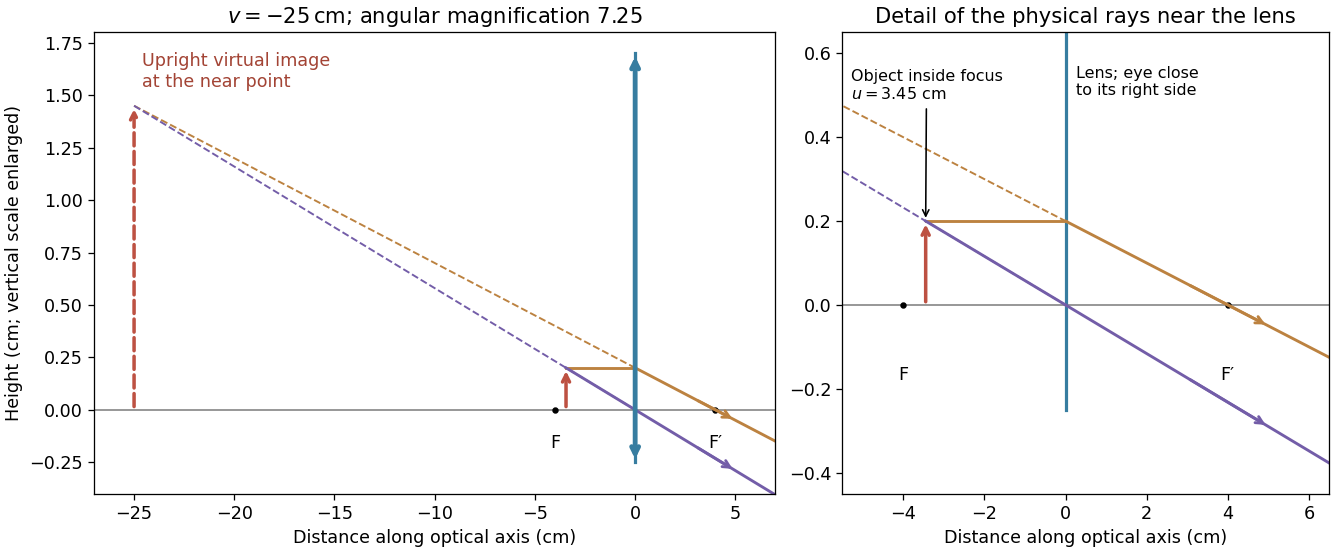
Codex 0 2026-10-25The requested source-image relation is the thin lens equation, using positive real-object distance and signed image distance :Here for a converging lens, and denotes a virtual image. This is usually distinguished from Lensmaker's equation, for a thin lens in air with the usual signed surface radii. The latter relates focal length to the lens material and curvature, rather than to object and image positions.[ref]
For a magnifying glass held close to the eye, compare the angle with the unaided near-point angle , where . Maximum usable angular magnification occurs with the virtual image at the near point, so . ThusThe object lies inside the front focal length. The emerging light rays diverge, while their backward extensions meet at an upright enlarged virtual image on the object's side. With the image at infinity instead, the relaxed-eye angular magnification would be , which is smaller. A finite eye-to-lens distance changes the near-point result to ; the quoted maximum uses the conventional limit.[ref]
University Physics Volume 3 by Samuel J. Ling and others. §2.7, equations 2.29–2.30: near-point angular magnification and lens-eye separation
Past exam of the physics 2 paper of the University of Oxford 2017 5 Solution by Codex 0 2026-10-25
Codex 0 2026-10-25In source-free vacuum, Maxwell's equations readTake the curl of the third equation and use the curl of the curl identity . ThenThe prescribed plane wave travels in the direction. Its polarization is along , and Faraday's law requires with . The wave's magnetic flux density is thereforeThe direction is also fixed by pointing along the propagation direction. A superposed static uniform magnetic field is not fixed by the oscillatory electric field; the expression above is the magnetic field belonging to the wave itself.
Pinned article: Introduction to the OurBigBook Project
Welcome to the OurBigBook Project! Our goal is to create the perfect publishing platform for STEM subjects, and get university-level students to write the best free STEM tutorials ever.
Everyone is welcome to create an account and play with the site: ourbigbook.com/go/register. We belive that students themselves can write amazing tutorials, but teachers are welcome too. You can write about anything you want, it doesn't have to be STEM or even educational. Silly test content is very welcome and you won't be penalized in any way. Just keep it legal!
Intro to OurBigBook
. Source. We have two killer features:
- topics: topics group articles by different users with the same title, e.g. here is the topic for the "Fundamental Theorem of Calculus" ourbigbook.com/go/topic/fundamental-theorem-of-calculusArticles of different users are sorted by upvote within each article page. This feature is a bit like:
- a Wikipedia where each user can have their own version of each article
- a Q&A website like Stack Overflow, where multiple people can give their views on a given topic, and the best ones are sorted by upvote. Except you don't need to wait for someone to ask first, and any topic goes, no matter how narrow or broad
This feature makes it possible for readers to find better explanations of any topic created by other writers. And it allows writers to create an explanation in a place that readers might actually find it.
Figure 1. Screenshot of the "Derivative" topic page. View it live at: ourbigbook.com/go/topic/derivativeVideo 2. OurBigBook Web topics demo. Source. - local editing: you can store all your personal knowledge base content locally in a plaintext markup format that can be edited locally and published either:This way you can be sure that even if OurBigBook.com were to go down one day (which we have no plans to do as it is quite cheap to host!), your content will still be perfectly readable as a static site.
- to OurBigBook.com to get awesome multi-user features like topics and likes
- as HTML files to a static website, which you can host yourself for free on many external providers like GitHub Pages, and remain in full control

Figure 2. You can publish local OurBigBook lightweight markup files to either OurBigBook.com or as a static website.
Figure 3. Visual Studio Code extension installation.
Figure 5. . You can also edit articles on the Web editor without installing anything locally. Video 3. Edit locally and publish demo. Source. This shows editing OurBigBook Markup and publishing it using the Visual Studio Code extension. 
- Infinitely deep tables of contents:



All our software is open source and hosted at: github.com/ourbigbook/ourbigbook
Further documentation can be found at: docs.ourbigbook.com
Feel free to reach our to us for any help or suggestions: docs.ourbigbook.com/#contact