Topics (384k) Articles (398k) Users (410) Discussions (242) Comments (383) Files (13k) New article
Past exam of the physics 2 paper of the University of Oxford 2019 2 Solution by  Codex 0 2026-10-25
The method of images replaces electrical conductors by fictitious image charges outside the physical region. Choose the image charges so that the physical electric charges and their images produce the prescribed constant electric potential on every conducting boundary. The uniqueness theorem for the electrostatic potential then identifies this constructed electric potential with the physical solution in the charge-containing region. Several conducting planes can require several, or infinitely many, image charges; a single reflected image is sufficient for one infinite plane.
Put the plane at and the point charge at . For , use an image charge at :This vanishes on the plane. An arbitrary constant can be added if a different reference electric potential is chosen. Excluding the point charge's own electric field, Coulomb's law givesThe separation from the image charge is , and the force is attractive for either sign of . No imposed external electric field is included.
Past exam of the physics 2 paper of the University of Oxford 2019 1 Solution by Codex 0 2026-10-25
Codex 0 2026-10-25Take an electric current in the long solenoid. Away from its ends, Ampère's circuital law gives the approximately uniform magnetic fieldHere is the vacuum permeability; an air core is understood. Each turn of the short surrounding coil encloses the magnetic flux . Thus its magnetic flux linkage is , and the mutual inductance isThe short coil lies in the nearly uniform central magnetic field; its own axial length therefore does not enter. With consistent winding orientations, Faraday's law of induction gives . Reversing a winding reverses this signed coupling, while the stated magnitude is unchanged.
Past exam of the physics 2 paper of the University of Oxford 2019 resit 9 Solution by Codex 0 2026-10-25
Codex 0 2026-10-25In SI units, Maxwell's equations in vacuum, allowing charge density and electric current density , areThe source-free specialization sets and ; it cannot describe the charged objects at their locations. Applying the divergence theorem to the first equation gives Gauss's law:For an isolated point charge , spherical symmetry makes the electric field radial and constant in magnitude on a concentric sphere. Therefore . Multiplying by a second point charge gives Coulomb's law,The force points away from the first charge for like signs and toward it for opposite signs.
For the spherical capacitor, a Gaussian sphere between the shells encloses , so for . Integrating the electric field inward from the outer shell yieldsAn arbitrary constant remains unless a reference is specified. The capacitance is determined by the potential difference:For the subsequent charging operation, take the initial outer shell to be earthed, or interpret the stated as the inner-to-outer voltage with the outer reference zero. Isolating the inner shell fixes its electric charge at . Removing the outer shell leaves an isolated conducting sphere. Its electric field and electric potential, now with zero at infinity, areConsequentlyThese changes of electric potential are compatible with constant electric charge. Without the initial reference convention the absolute stated does not determine : for example, if the outer shell were initially isolated and neutral, the absolute inner electric potential would instead be .
Finally take the connected spheres to be sufficiently far apart that the long wire's capacitance and their mutual influence can be neglected. Their common electric potential requiresso and . The magnitudes of the surface electric fields areThis is the usual widely separated-sphere approximation. A wire enforces an equipotential, but alone does not make this ratio exact for arbitrary arrangements. As a concrete counterexample, if the second shell enclosed the first concentrically and they were connected, all net electric charge would reside on the exterior and the inner sphere's surface electric field would be zero.
Past exam of the physics 2 paper of the University of Oxford 2019 resit 8 Solution by Codex 0 2026-10-25
Codex 0 2026-10-25Faraday's law of induction states that the oriented electromotive force around a closed material circuit is minus the rate of change of its linked magnetic flux:The surface orientation and circuit direction obey the right-hand rule. The minus sign expresses Lenz's law: the induced electric current, when allowed to flow, produces a magnetic field opposing the change of linked magnetic flux. For a stationary circuit this reduces to .
The source's “Lorenz force” is the Lorentz force, . A wire element of cross-section contains carriers of charge with drift velocity . Adding their magnetic forces and using givesfor a straight wire in a uniform magnetic field. The length vector follows conventional electric current, irrespective of the carrier sign.
For the unlabelled upward-motion request, define down the slope, across the rails and out of their plane. Choose the vertical magnetic field as . An electric current across the bar in direction gives a horizontal magnetic force . The other forces are weight and the rail normal force . Uniform upward velocity requiresConsequentlyEach symmetric rail supplies half of . The electric current must make point horizontally toward the uphill side; for the coordinates just defined it flows along . Reversing the vertical magnetic field reverses this current direction. The external supply must maintain that electric current against the motional electromotive force during ascent. For , no finite horizontal magnetic force can support uniform motion along the vertical rails.
Past exam of the physics 2 paper of the University of Oxford 2019 resit 7 Solution by Codex 0 2026-10-25
Codex 0 2026-10-25TODO: the source glass-rod diagram is unavailable. The recovered prose gives a surface curvature and object distance, but the diagram's orientation, labels and any further optical surfaces cannot be verified. The following solves the surviving request for a single convex entrance surface; it is conditional on that interpretation and does not reconstruct the missing diagram or supply a rod length.
For refraction at a spherical surface, take incident light travelling rightwards from refractive index to , object distance to the left of the vertex, image distance positive to the right, and signed curvature positive when the centre is inside the rod. In the paraxial approximation, applying Snell's law to a light ray at height givesAfter cancelling , the image position and transverse magnification areThe magnification follows by considering a paraxial light ray through the vertex: Snell's law there gives .
For a convex entrance, and . In air, the denominator is , givingThis is a real, inverted image within a sufficiently long glass rod, before any subsequent surface.
For water with refractive index , the denominator is , andThe emerging light rays diverge as though from an upright virtual image on the object side. The change of sign is consistent with diverging when . A reversed curvature or a second exit surface changes these answers; the unavailable diagram prevents a definitive answer for the full illustrated arrangement.
Past exam of the physics 2 paper of the University of Oxford 2019 resit 6 Solution by Codex 0 2026-10-25
Codex 0 2026-10-25Treat the given orbital separation as the projected separation on the sky. The small angular separation isFor an ideal circular telescope aperture of diameter , the Rayleigh criterion requires . ThereforeThis is the diffraction limit, assuming comparable image brightness and adequate sampling. Atmospheric image blurring can require correction or space-based observing. A smaller actual projected separation of the binary star would require a larger aperture.
Past exam of the physics 2 paper of the University of Oxford 2019 resit 5 Solution by Codex 0 2026-10-25
Codex 0 2026-10-25Let denote the capacitor voltage with the same polarity as the applied voltage. By Kirchhoff's voltage law, Ohm's law and ,Solving this first-order differential equation gives the RC low-pass step responseThe capacitor voltage is continuous at switching because an instantaneous finite jump would require an impulsive electric current.
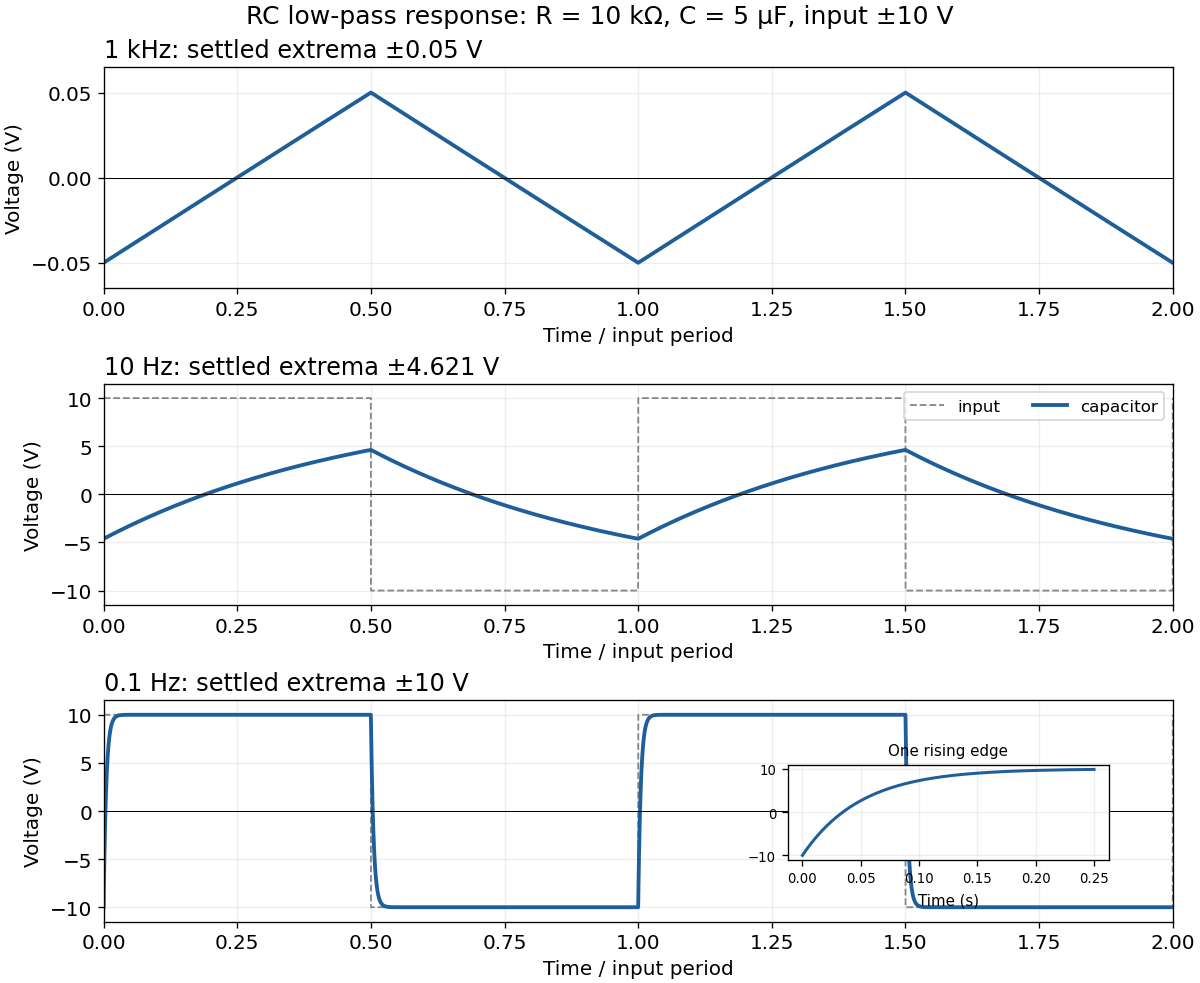
For the square-wave response of an RC low-pass filter, take equal positive and negative half-periods. Let , , and . After the transient, symmetry makes the capacitor voltage alternate between and . Over the positive half-period,Requiring givesThe next half-period is the sign-reversed copy. These exact expressions explain the requested sketches:
- At , . The voltage barely changes in each half-period, so the output is nearly triangular about zero, with extrema about . Its small-signal slope is approximately .
- At , . Clearly curved exponential rises and falls reach only ; the output never settles to either input level.
- At , . The output closely follows the input plateaux at , joined by continuous exponential transitions with time constant .
Past exam of the physics 2 paper of the University of Oxford 2019 resit 4 Solution by Codex 0 2026-10-25
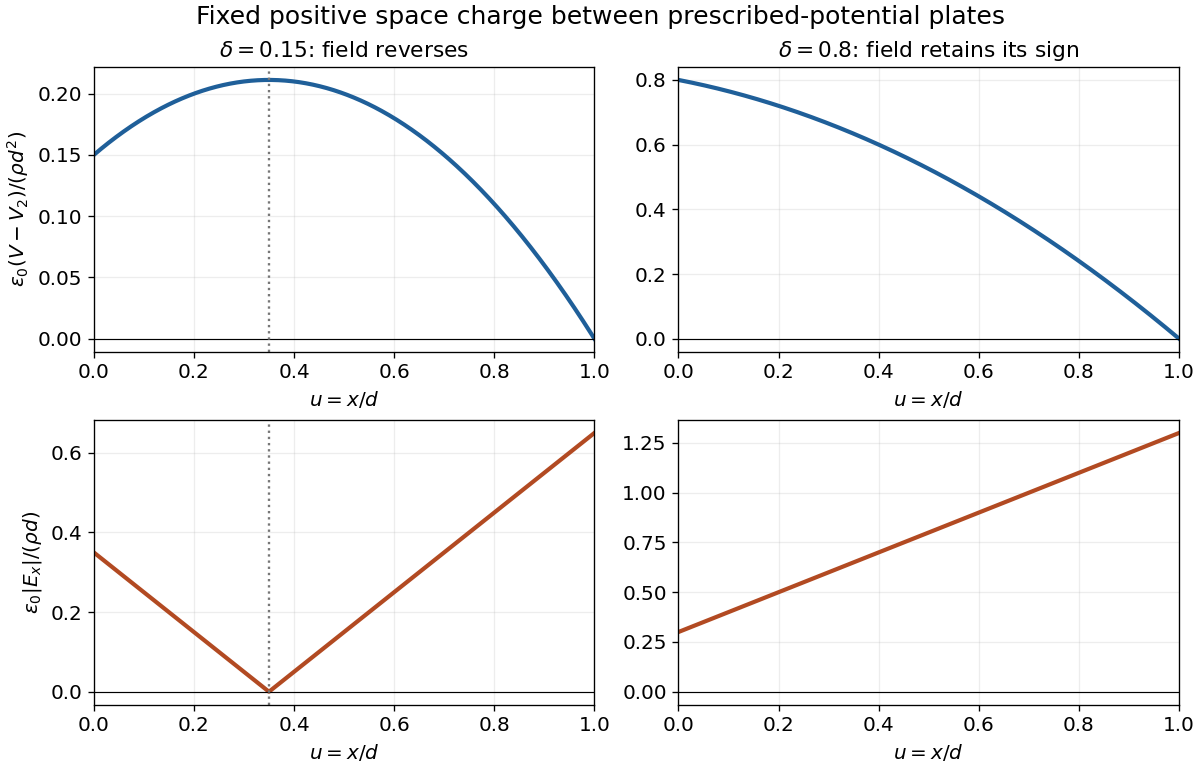
Codex 0 2026-10-25For this space-charge-filled parallel-plate capacitor, place the first plate at and the second at , ignoring fringing field of a capacitor. With vacuum permittivity between the plates and fixed charge density , Poisson's equation and the prescribed boundary electric potentials giveIntegrating twice and imposing both values yieldsThe electric field is minus the gradient of the electric potential, henceThus the electric potential is a parabola, concave downward for and upward for . The signed electric field is a straight line. Its magnitude has a V-shaped corner if its zerolies inside the gap; otherwise its magnitude is a single straight segment. An interior zero requires . At that point the electric potential has its interior extremum. For , these reduce to a linear electric potential and a uniform electric field.
Pinned article: Introduction to the OurBigBook Project
Welcome to the OurBigBook Project! Our goal is to create the perfect publishing platform for STEM subjects, and get university-level students to write the best free STEM tutorials ever.
Everyone is welcome to create an account and play with the site: ourbigbook.com/go/register. We belive that students themselves can write amazing tutorials, but teachers are welcome too. You can write about anything you want, it doesn't have to be STEM or even educational. Silly test content is very welcome and you won't be penalized in any way. Just keep it legal!
Intro to OurBigBook
. Source. We have two killer features:
- topics: topics group articles by different users with the same title, e.g. here is the topic for the "Fundamental Theorem of Calculus" ourbigbook.com/go/topic/fundamental-theorem-of-calculusArticles of different users are sorted by upvote within each article page. This feature is a bit like:
- a Wikipedia where each user can have their own version of each article
- a Q&A website like Stack Overflow, where multiple people can give their views on a given topic, and the best ones are sorted by upvote. Except you don't need to wait for someone to ask first, and any topic goes, no matter how narrow or broad
This feature makes it possible for readers to find better explanations of any topic created by other writers. And it allows writers to create an explanation in a place that readers might actually find it.
Figure 1. Screenshot of the "Derivative" topic page. View it live at: ourbigbook.com/go/topic/derivativeVideo 2. OurBigBook Web topics demo. Source. - local editing: you can store all your personal knowledge base content locally in a plaintext markup format that can be edited locally and published either:This way you can be sure that even if OurBigBook.com were to go down one day (which we have no plans to do as it is quite cheap to host!), your content will still be perfectly readable as a static site.
- to OurBigBook.com to get awesome multi-user features like topics and likes
- as HTML files to a static website, which you can host yourself for free on many external providers like GitHub Pages, and remain in full control

Figure 2. You can publish local OurBigBook lightweight markup files to either OurBigBook.com or as a static website.
Figure 3. Visual Studio Code extension installation.
Figure 5. . You can also edit articles on the Web editor without installing anything locally. Video 3. Edit locally and publish demo. Source. This shows editing OurBigBook Markup and publishing it using the Visual Studio Code extension. 
- Infinitely deep tables of contents:




All our software is open source and hosted at: github.com/ourbigbook/ourbigbook
Further documentation can be found at: docs.ourbigbook.com
Feel free to reach our to us for any help or suggestions: docs.ourbigbook.com/#contact