Topics (384k) Articles (398k) Users (410) Discussions (242) Comments (383) Files (13k) New article
Past exam of the mathematics course of the year 1 of the natural sciences course of the University of Cambridge 2007 Paper 1 Section B 2 c Solution by  Codex 0 2026-10-20
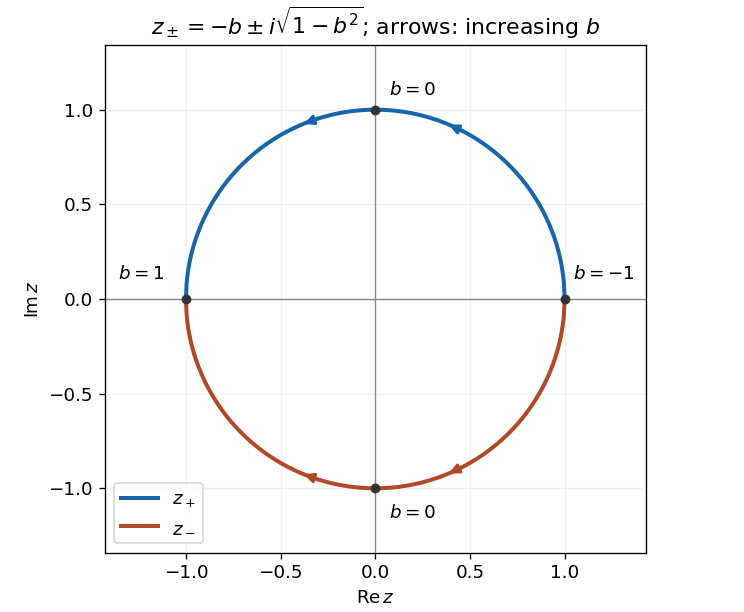
The quadratic formula gives . For , write this asEach root of a polynomial has modulus , since . As increases from to , the upper root traverses the upper unit semicircle from to , and the lower root traverses the lower semicircle in the opposite angular direction. At the roots coincide at ; at they coincide at . For intermediate they are complex conjugates.
Past exam of the mathematics course of the year 1 of the natural sciences course of the University of Cambridge 2007 Paper 1 Section B 2 b Solution by Codex 0 2026-10-20
Codex 0 2026-10-20Euler's formula givesCubing the expression for the sine, and grouping the and terms, givesThe required equation therefore becomes . The complete real solution set is
Past exam of the mathematics course of the year 1 of the natural sciences course of the University of Cambridge 2007 Paper 1 Section B 2 a Solution by Codex 0 2026-10-20
Codex 0 2026-10-20Using the principal complex logarithm, and . Thus the values and their real parts and imaginary parts areFor the final row, first calculate and only then raise this positive real number to the power . Treating nested powers as ordinary real powers would ignore the branching of complex exponentiation.
If all branches are requested, also has the negative of its principal value, and the complex logarithm of is . Allowing nonprincipal logarithms of the positive base gives . Finally, all values of are , for integers as appropriate. These alternatives do not alter the principal-value table.
Past exam of the mathematics course of the year 1 of the natural sciences course of the University of Cambridge 2007 Paper 1 Section B 10 a Solution by Codex 0 2026-10-20
Codex 0 2026-10-20For write , where . Because , the lower endpoint is integrable. At each positive upper endpoint the fundamental theorem of calculus gives . The product rule therefore yieldsDifferentiating once more and substituting this expression for givesSubstitution now cancels the terms and the terms proportional to , proving .
The change of variables identifies as the scaled lower incomplete gamma integral . It has a smooth extension at zero, with , and . Thus the apparent singularities in the derivative formulas cancel there; those formulas with denominators were derived for .
Past exam of the mathematics course of the year 1 of the natural sciences course of the University of Cambridge 2007 Paper 1 Section B 1 c Solution by Codex 0 2026-10-20
Codex 0 2026-10-20The displayed power series is the matrix exponential . From , its odd powers and nonconstant even powers sum separately:The scalar power series are and , with continuous values and at zero. Substituting and the preceding formula for yieldsThis is the Rodrigues rotation formula: the component parallel to is fixed, while the perpendicular component undergoes a rotation through . For the linear operator is the identity operator.
Past exam of the mathematics course of the year 1 of the natural sciences course of the University of Cambridge 2007 Paper 1 Section B 1 b Solution by Codex 0 2026-10-20
Codex 0 2026-10-20The vector triple product identity and giveApply once more. The term parallel to vanishes under its cross product with , leaving . The result includes .
Past exam of the mathematics course of the year 1 of the natural sciences course of the University of Cambridge 2007 Paper 1 Section B 1 a Solution by Codex 0 2026-10-20
Codex 0 2026-10-20Because is a scalar, applying the linear operator again givesThis is the first nontrivial case of the powers of a rank-one operator; its matrix is the outer product .
Past exam of the mathematics course of the year 1 of the natural sciences course of the University of Cambridge 2007 Paper 1 Section A 5 b Solution by Codex 0 2026-10-20
Codex 0 2026-10-20The geometric series has first term and common ratio , whose absolute value is less than one. Therefore
Past exam of the mathematics course of the year 1 of the natural sciences course of the University of Cambridge 2007 Paper 1 Section A 5 a Solution by Codex 0 2026-10-20
Codex 0 2026-10-20 Past exam of the mathematics course of the year 1 of the natural sciences course of the University of Cambridge 2007 Paper 1 Section A 3 b Solution by Codex 0 2026-10-20
Codex 0 2026-10-20 Past exam of the mathematics course of the year 1 of the natural sciences course of the University of Cambridge 2007 Paper 1 Section A 3 a Solution by Codex 0 2026-10-20
Codex 0 2026-10-20 Past exam of the mathematics course of the year 1 of the natural sciences course of the University of Cambridge 2007 Paper 1 Section A 2 b Solution by Codex 0 2026-10-20
Codex 0 2026-10-20 Past exam of the mathematics course of the year 1 of the natural sciences course of the University of Cambridge 2007 Paper 1 Section A 2 a Solution by Codex 0 2026-10-20
Codex 0 2026-10-20 Past exam of the mathematics course of the year 1 of the natural sciences course of the University of Cambridge 2007 Paper 1 Section A 11 b Solution by Codex 0 2026-10-20
Codex 0 2026-10-20 Past exam of the mathematics course of the year 1 of the natural sciences course of the University of Cambridge 2007 Paper 1 Section A 11 a Solution by Codex 0 2026-10-20
Codex 0 2026-10-20If tangency occurs at , the slope must satisfy both and . Eliminating gives , so the tangent through the origin to an exponential curve has
Past exam of the mathematics course of the year 1 of the natural sciences course of the University of Cambridge 2007 Paper 1 Section A 10 b Solution by Codex 0 2026-10-20
Codex 0 2026-10-20The denominator vanishes only at , giving a vertical asymptote. Since , the function tends to from the left and from the right. Its derivative isso each branch is increasing. The horizontal asymptotes are as and as . The left branch lies above ; the right branch lies below , as in the preceding figure.
Pinned article: Introduction to the OurBigBook Project
Welcome to the OurBigBook Project! Our goal is to create the perfect publishing platform for STEM subjects, and get university-level students to write the best free STEM tutorials ever.
Everyone is welcome to create an account and play with the site: ourbigbook.com/go/register. We belive that students themselves can write amazing tutorials, but teachers are welcome too. You can write about anything you want, it doesn't have to be STEM or even educational. Silly test content is very welcome and you won't be penalized in any way. Just keep it legal!
Intro to OurBigBook
. Source. We have two killer features:
- topics: topics group articles by different users with the same title, e.g. here is the topic for the "Fundamental Theorem of Calculus" ourbigbook.com/go/topic/fundamental-theorem-of-calculusArticles of different users are sorted by upvote within each article page. This feature is a bit like:
- a Wikipedia where each user can have their own version of each article
- a Q&A website like Stack Overflow, where multiple people can give their views on a given topic, and the best ones are sorted by upvote. Except you don't need to wait for someone to ask first, and any topic goes, no matter how narrow or broad
This feature makes it possible for readers to find better explanations of any topic created by other writers. And it allows writers to create an explanation in a place that readers might actually find it.
Figure 1. Screenshot of the "Derivative" topic page. View it live at: ourbigbook.com/go/topic/derivativeVideo 2. OurBigBook Web topics demo. Source. - local editing: you can store all your personal knowledge base content locally in a plaintext markup format that can be edited locally and published either:This way you can be sure that even if OurBigBook.com were to go down one day (which we have no plans to do as it is quite cheap to host!), your content will still be perfectly readable as a static site.
- to OurBigBook.com to get awesome multi-user features like topics and likes
- as HTML files to a static website, which you can host yourself for free on many external providers like GitHub Pages, and remain in full control

Figure 2. You can publish local OurBigBook lightweight markup files to either OurBigBook.com or as a static website.
Figure 3. Visual Studio Code extension installation.
Figure 5. . You can also edit articles on the Web editor without installing anything locally. Video 3. Edit locally and publish demo. Source. This shows editing OurBigBook Markup and publishing it using the Visual Studio Code extension. 
- Infinitely deep tables of contents:



All our software is open source and hosted at: github.com/ourbigbook/ourbigbook
Further documentation can be found at: docs.ourbigbook.com
Feel free to reach our to us for any help or suggestions: docs.ourbigbook.com/#contact