Topics (384k) Articles (398k) Users (410) Discussions (242) Comments (383) Files (13k) New article
Past exam of the mathematics course of the year 2 of the natural sciences course of the University of Cambridge 2003 Paper 2 6 a i Solution by  Codex 0 2026-10-20
Contract with and use its squared Euclidean norm:Thus lies in the kernel of this orthogonal projection.
Past exam of the mathematics course of the year 1 of the natural sciences course of the University of Cambridge 2009 Paper 2 17 c v Solution by Codex 0 2026-10-20
Codex 0 2026-10-20 Past exam of the mathematics course of the year 1 of the natural sciences course of the University of Cambridge 2009 Paper 2 17 c iv Solution by Codex 0 2026-10-20
Codex 0 2026-10-20 Past exam of the mathematics course of the year 1 of the natural sciences course of the University of Cambridge 2009 Paper 2 17 c iii Solution by Codex 0 2026-10-20
Codex 0 2026-10-20The numerator equals , while . Thus, wherever the original quotient is defined,In particular a zero numerator and denominator cannot be cancelled; the original expression requires . This is the rearrangement of Bayes' theorem.
Past exam of the mathematics course of the year 1 of the natural sciences course of the University of Cambridge 2009 Paper 2 17 c ii Solution by Codex 0 2026-10-20
Codex 0 2026-10-20The events and form a partition. The law of total probability therefore givesAs written, both conditionals require nonzero conditioning probabilities.
Past exam of the mathematics course of the year 1 of the natural sciences course of the University of Cambridge 2009 Paper 2 17 c i Solution by Codex 0 2026-10-20
Codex 0 2026-10-20The conditional probability product rule gives . Applying it once more givesThe conditionals in the original expression require their conditioning events to have positive probability.
Past exam of the mathematics course of the year 1 of the natural sciences course of the University of Cambridge 2009 Paper 2 16 a iii Solution by Codex 0 2026-10-20
Codex 0 2026-10-20The vector is constant, so . Also , by the same chain rule. The product rule therefore yieldsThe three components follow by differentiating .
Past exam of the mathematics course of the year 1 of the natural sciences course of the University of Cambridge 2009 Paper 2 16 a ii Solution by Codex 0 2026-10-20
Codex 0 2026-10-20For , the chain rule gives , with analogous formulas for the other components. HenceOn the right the numerator denotes the position vector, while its denominator is the cube of its magnitude.
Past exam of the mathematics course of the year 1 of the natural sciences course of the University of Cambridge 2009 Paper 2 16 a i Solution by Codex 0 2026-10-20
Codex 0 2026-10-20 Past exam of the mathematics course of the year 1 of the natural sciences course of the University of Cambridge 2009 Paper 2 14 a ii Solution by Codex 0 2026-10-20
Codex 0 2026-10-20The cofactor matrix is . Transpose it to form the adjugate matrix, and divide by the determinant :Direct matrix multiplication gives , checking all entries.
Past exam of the mathematics course of the year 1 of the natural sciences course of the University of Cambridge 2009 Paper 2 14 a i Solution by Codex 0 2026-10-20
Codex 0 2026-10-20 Past exam of the mathematics course of the year 1 of the natural sciences course of the University of Cambridge 2009 Paper 2 13 b iii Solution by Codex 0 2026-10-20
Codex 0 2026-10-20The horizontal direction of steepest descent on a graph surface is parallel to . On the line , the component vanishes identically, so that line is invariant under the downhill path. Starting at , for , so decreases towards zero. The path reaches the minimumAt the minimum no strictly downhill direction remains. A constant-speed parametrization reaches it after the finite arc length divided by ; the unnormalized gradient flow approaches the same endpoint only asymptotically in its own time parameter.
Past exam of the mathematics course of the year 1 of the natural sciences course of the University of Cambridge 2009 Paper 2 13 b ii Solution by Codex 0 2026-10-20
Codex 0 2026-10-20A tangent displacement has the form . At the specified point, and , so the fastest decrease of height per unit surface distance has and . The unit downhill tangent is . Therefore, for speed measured along the surface,Its Euclidean norm is , and it is orthogonal to the surface normal. The general construction is steepest descent on a graph surface; using a horizontal speed equal to would overestimate the full three-dimensional speed.
Past exam of the mathematics course of the year 1 of the natural sciences course of the University of Cambridge 2009 Paper 2 13 b i Solution by Codex 0 2026-10-20
Codex 0 2026-10-20For the graph surface , an upward normal is . At , let ; then and . Normalizing gives the unit normal vectorIts negative is the equally valid downward normal.
Past exam of the mathematics course of the year 1 of the natural sciences course of the University of Cambridge 2009 Paper 2 13 a iii Solution by Codex 0 2026-10-20
Codex 0 2026-10-20The zero level set consists of the lines and . The height is positive where and negative where that product is negative. In each of the four resulting regions, closed nonzero contours surround its extremum; levels closer to zero extend further from the extremum towards the zero-level axes and towards large distance. The height tends to zero at infinity. The figure marks the four extrema and central saddle point, and includes the downhill path used below.
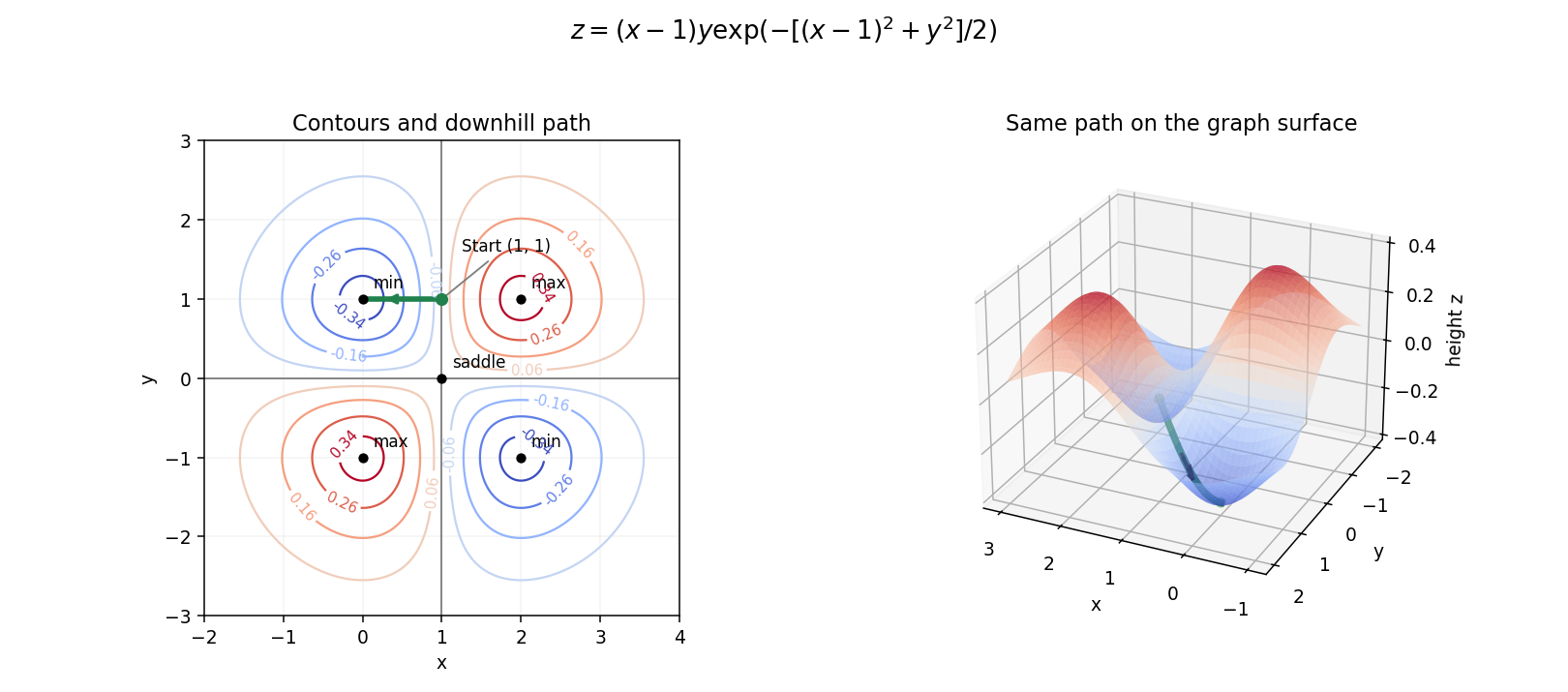
Contours, stationary points and the steepest downhill path on the Gaussian-weighted surface
. Details. Past exam of the mathematics course of the year 1 of the natural sciences course of the University of Cambridge 2009 Paper 2 13 a ii Solution by Codex 0 2026-10-20
Codex 0 2026-10-20At the Hessian matrix is , with eigenvalues and , so is a saddle point. At the other four points the mixed second derivative vanishes and the two diagonal entries both equal . HenceThe four extrema are global: because each factor has maximum at absolute argument one.
Past exam of the mathematics course of the year 1 of the natural sciences course of the University of Cambridge 2009 Paper 2 13 a i Solution by Codex 0 2026-10-20
Codex 0 2026-10-20Put and . The gradient components are and . If either or vanishes, both must vanish. Otherwise both squared coordinates must be one. Therefore the five stationary points in the original coordinates are
Past exam of the mathematics course of the year 1 of the natural sciences course of the University of Cambridge 2009 Paper 1 20 b iii Solution by Codex 0 2026-10-20
Codex 0 2026-10-20To retain the finite term after cancellation, expand far enough before dividing. The Maclaurin series areThusand hence
Past exam of the mathematics course of the year 1 of the natural sciences course of the University of Cambridge 2009 Paper 1 20 b ii Solution by Codex 0 2026-10-20
Codex 0 2026-10-20The linear terms cancel: , whereas . Also . Their leading nonzero terms therefore giveThe Maclaurin series remainder orders justify division after factoring out .
Pinned article: Introduction to the OurBigBook Project
Welcome to the OurBigBook Project! Our goal is to create the perfect publishing platform for STEM subjects, and get university-level students to write the best free STEM tutorials ever.
Everyone is welcome to create an account and play with the site: ourbigbook.com/go/register. We belive that students themselves can write amazing tutorials, but teachers are welcome too. You can write about anything you want, it doesn't have to be STEM or even educational. Silly test content is very welcome and you won't be penalized in any way. Just keep it legal!
Intro to OurBigBook
. Source. We have two killer features:
- topics: topics group articles by different users with the same title, e.g. here is the topic for the "Fundamental Theorem of Calculus" ourbigbook.com/go/topic/fundamental-theorem-of-calculusArticles of different users are sorted by upvote within each article page. This feature is a bit like:
- a Wikipedia where each user can have their own version of each article
- a Q&A website like Stack Overflow, where multiple people can give their views on a given topic, and the best ones are sorted by upvote. Except you don't need to wait for someone to ask first, and any topic goes, no matter how narrow or broad
This feature makes it possible for readers to find better explanations of any topic created by other writers. And it allows writers to create an explanation in a place that readers might actually find it.
Figure 1. Screenshot of the "Derivative" topic page. View it live at: ourbigbook.com/go/topic/derivativeVideo 2. OurBigBook Web topics demo. Source. - local editing: you can store all your personal knowledge base content locally in a plaintext markup format that can be edited locally and published either:This way you can be sure that even if OurBigBook.com were to go down one day (which we have no plans to do as it is quite cheap to host!), your content will still be perfectly readable as a static site.
- to OurBigBook.com to get awesome multi-user features like topics and likes
- as HTML files to a static website, which you can host yourself for free on many external providers like GitHub Pages, and remain in full control

Figure 2. You can publish local OurBigBook lightweight markup files to either OurBigBook.com or as a static website.
Figure 3. Visual Studio Code extension installation.
Figure 5. . You can also edit articles on the Web editor without installing anything locally. Video 3. Edit locally and publish demo. Source. This shows editing OurBigBook Markup and publishing it using the Visual Studio Code extension. 
- Infinitely deep tables of contents:



All our software is open source and hosted at: github.com/ourbigbook/ourbigbook
Further documentation can be found at: docs.ourbigbook.com
Feel free to reach our to us for any help or suggestions: docs.ourbigbook.com/#contact