Topics (384k) Articles (398k) Users (410) Discussions (242) Comments (383) Files (13k) New article
Past exam of the mathematics course of the year 1 of the natural sciences course of the University of Cambridge 2007 Paper 2 Section B 6 d Solution by  Codex 0 2026-10-20
For positive semiaxes , the cross product of the two parametric tangent vectors gives the outward oriented surface element of an ellipsoid of revolution:Substituting the parametrization into the vector field and taking its dot product with this element givesThe middle term has zero integral over . In the other terms, , , and . The directly evaluated flux is therefore
Past exam of the mathematics course of the year 1 of the natural sciences course of the University of Cambridge 2007 Paper 2 Section B 6 c Solution by Codex 0 2026-10-20
Codex 0 2026-10-20Parametrize the straight line by , . The line integral isThe change in scalar potential is , so the answer is , as required by the fundamental theorem for line integrals for .
Past exam of the mathematics course of the year 1 of the natural sciences course of the University of Cambridge 2007 Paper 2 Section B 6 b Solution by Codex 0 2026-10-20
Codex 0 2026-10-20Integrating with respect to gives . Matching requires , and matching requires constant. A scalar potential with the requested sign isThus the force field is a conservative vector field on all of .
Past exam of the mathematics course of the year 1 of the natural sciences course of the University of Cambridge 2007 Paper 2 Section B 6 a Solution by Codex 0 2026-10-20
Codex 0 2026-10-20 Past exam of the mathematics course of the year 1 of the natural sciences course of the University of Cambridge 2007 Paper 2 Section B 5 b Solution by Codex 0 2026-10-20
Codex 0 2026-10-20For the internal energy , its exact differential identifies and . The Maxwell relation from equality of mixed partial derivatives is . At fixed volume, the constant-volume heat capacity satisfiesso , assuming nonzero and a locally invertible relation. Applying the chain rule to gives the isentropic temperature-volume derivativeFor the stated one-mole ideal gas, the equation of state gives and , so the right side is . Along an isentropic process, and , giving the same left side:
Past exam of the mathematics course of the year 1 of the natural sciences course of the University of Cambridge 2007 Paper 2 Section B 5 a Solution by Codex 0 2026-10-20
Codex 0 2026-10-20If with continuous second partial derivatives of , then and . The symmetry of second derivatives gives the necessary condition for an exact differential form:This condition is also locally sufficient on a small rectangle for continuously differentiable coefficients; global sufficiency additionally needs suitable topology of the domain.
Past exam of the mathematics course of the year 1 of the natural sciences course of the University of Cambridge 2007 Paper 2 Section B 4 b Solution by Codex 0 2026-10-20
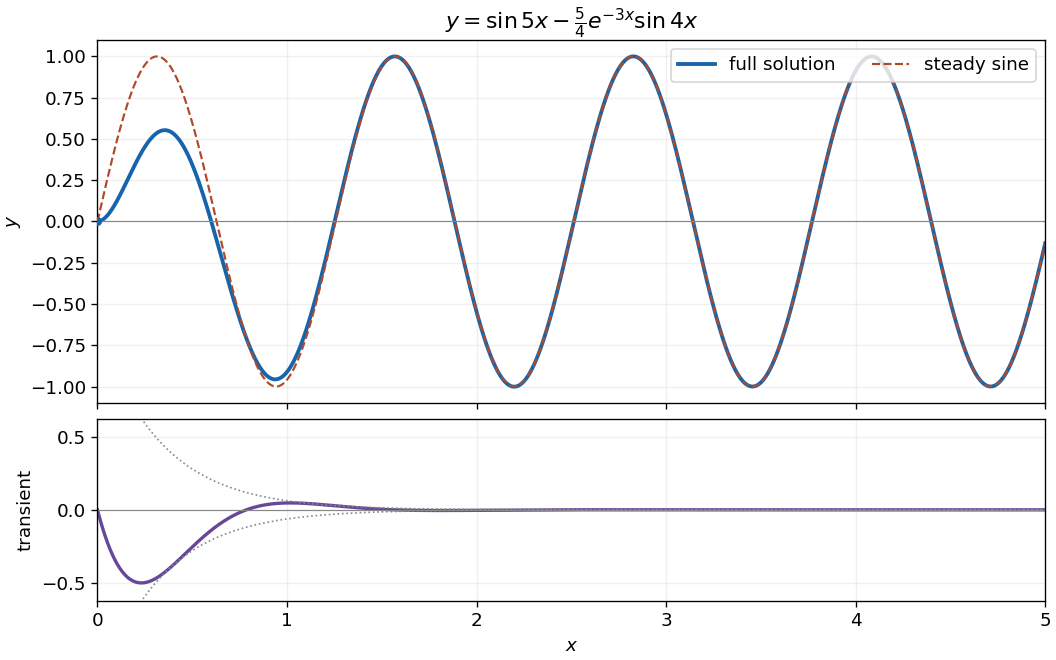
Codex 0 2026-10-20The characteristic equation has roots , giving the homogeneous solution . For the sinusoidal forcing term, is a particular solution, since its second derivative cancels and . The zero initial displacement gives ; zero initial derivative gives . ThusThe transient response decays as , leaving the steady-state response . Near zero, and , so the sketch starts with and a horizontal tangent line.
Past exam of the mathematics course of the year 1 of the natural sciences course of the University of Cambridge 2007 Paper 2 Section B 4 a Solution by Codex 0 2026-10-20
Codex 0 2026-10-20The characteristic equation for the homogeneous solution is , giving . For a particular solution, substitute : the left side becomes , so . The general solution is
Past exam of the mathematics course of the year 1 of the natural sciences course of the University of Cambridge 2007 Paper 2 Section B 3 b Solution by Codex 0 2026-10-20
Codex 0 2026-10-20Write . The probability density function normalizes when , so . Its survival function is for ; hence, for ,Differentiating this conditional tail givesThe value assigned at the single endpoint does not affect any probability. The memorylessness of the exponential distribution says that , conditional on , is again an exponential distribution of rate . Its first two moments are and , found by integration by parts, so translation leaves the variance unchanged:
Past exam of the mathematics course of the year 1 of the natural sciences course of the University of Cambridge 2007 Paper 2 Section B 3 a Solution by Codex 0 2026-10-20
Codex 0 2026-10-20Normalization of a probability distribution and the geometric series give , so . For a nonnegative integer , the strict tail starts at :For nonnegative integers , the event is contained in . ThereforeThis is the memorylessness of the geometric distribution with the zero-based counting convention. Keeping strict versus non-strict inequalities explicit is essential: , conditional on , has the original distribution of .
Past exam of the mathematics course of the year 1 of the natural sciences course of the University of Cambridge 2007 Paper 2 Section A 9 b Solution by Codex 0 2026-10-20
Codex 0 2026-10-20Let be indicator random variables for the two draws being red. Each draw has red probability , even though the draws are dependent. By linearity of expectation, the number satisfies
Past exam of the mathematics course of the year 1 of the natural sciences course of the University of Cambridge 2007 Paper 2 Section A 9 a Solution by Codex 0 2026-10-20
Codex 0 2026-10-20There are equally likely unordered pairs, and contain one ball of each colour. Thus the hypergeometric distribution gives
Past exam of the mathematics course of the year 1 of the natural sciences course of the University of Cambridge 2007 Paper 2 Section A 5 b Solution by Codex 0 2026-10-20
Codex 0 2026-10-20 Past exam of the mathematics course of the year 1 of the natural sciences course of the University of Cambridge 2007 Paper 2 Section A 5 a Solution by Codex 0 2026-10-20
Codex 0 2026-10-20 Past exam of the mathematics course of the year 1 of the natural sciences course of the University of Cambridge 2007 Paper 2 Section A 4 c Solution by Codex 0 2026-10-20
Codex 0 2026-10-20Each component depends only on its own coordinate, so all cross partial derivatives vanish. Therefore the curl isThis also follows from the identity that the curl of a gradient vanishes for a twice continuously differentiable potential energy.
Past exam of the mathematics course of the year 1 of the natural sciences course of the University of Cambridge 2007 Paper 2 Section A 4 b Solution by Codex 0 2026-10-20
Codex 0 2026-10-20 Past exam of the mathematics course of the year 1 of the natural sciences course of the University of Cambridge 2007 Paper 2 Section A 4 a Solution by Codex 0 2026-10-20
Codex 0 2026-10-20 Past exam of the mathematics course of the year 1 of the natural sciences course of the University of Cambridge 2007 Paper 2 Section A 3 b Solution by Codex 0 2026-10-20
Codex 0 2026-10-20 Pinned article: Introduction to the OurBigBook Project
Welcome to the OurBigBook Project! Our goal is to create the perfect publishing platform for STEM subjects, and get university-level students to write the best free STEM tutorials ever.
Everyone is welcome to create an account and play with the site: ourbigbook.com/go/register. We belive that students themselves can write amazing tutorials, but teachers are welcome too. You can write about anything you want, it doesn't have to be STEM or even educational. Silly test content is very welcome and you won't be penalized in any way. Just keep it legal!
Intro to OurBigBook
. Source. We have two killer features:
- topics: topics group articles by different users with the same title, e.g. here is the topic for the "Fundamental Theorem of Calculus" ourbigbook.com/go/topic/fundamental-theorem-of-calculusArticles of different users are sorted by upvote within each article page. This feature is a bit like:
- a Wikipedia where each user can have their own version of each article
- a Q&A website like Stack Overflow, where multiple people can give their views on a given topic, and the best ones are sorted by upvote. Except you don't need to wait for someone to ask first, and any topic goes, no matter how narrow or broad
This feature makes it possible for readers to find better explanations of any topic created by other writers. And it allows writers to create an explanation in a place that readers might actually find it.
Figure 1. Screenshot of the "Derivative" topic page. View it live at: ourbigbook.com/go/topic/derivativeVideo 2. OurBigBook Web topics demo. Source. - local editing: you can store all your personal knowledge base content locally in a plaintext markup format that can be edited locally and published either:This way you can be sure that even if OurBigBook.com were to go down one day (which we have no plans to do as it is quite cheap to host!), your content will still be perfectly readable as a static site.
- to OurBigBook.com to get awesome multi-user features like topics and likes
- as HTML files to a static website, which you can host yourself for free on many external providers like GitHub Pages, and remain in full control

Figure 2. You can publish local OurBigBook lightweight markup files to either OurBigBook.com or as a static website.
Figure 3. Visual Studio Code extension installation.
Figure 5. . You can also edit articles on the Web editor without installing anything locally. Video 3. Edit locally and publish demo. Source. This shows editing OurBigBook Markup and publishing it using the Visual Studio Code extension. 
- Infinitely deep tables of contents:



All our software is open source and hosted at: github.com/ourbigbook/ourbigbook
Further documentation can be found at: docs.ourbigbook.com
Feel free to reach our to us for any help or suggestions: docs.ourbigbook.com/#contact