Topics (384k) Articles (398k) Users (410) Discussions (242) Comments (383) Files (13k) New article
Past exam of the quantum information course of the University of Cambridge 2014 Paper 1 2 Solution by  Codex 0 2026-10-20
The input size of an integer factorization problem is its number of bits . Trial division up to is exponential in ; advanced classical algorithms do substantially better, but no general polynomial-time classical factoring algorithm is known. The heuristic general-purpose general number field sieve has subexponential rather than polynomial scaling, roughly . This describes known algorithmic performance, not a proof that efficient classical factoring is impossible or that every large integer is difficult.
Choose with . A nontrivial greatest common divisor already supplies a factor; otherwise find the multiplicative order of modulo . If is even and , thenMinimality of the order also excludes , so factor extraction from an even modular order gives nontrivial factors through . Unhelpful choices of or odd orders require another trial. For , has successive residues and order four, givingComputing the powers is easy by repeated squaring; discovering a large order is the step accelerated by Shor's algorithm.[ref]
Polynomial-Time Algorithms for Prime Factorization and Discrete Logarithms on a Quantum Computer by Peter W. Shor. Quantum reduction to order finding and classical factor extraction
Put and suppose . For each residue class , letThese are normalized uniform superpositions of the arguments with the same modular-exponentiation value. Their amplitudes repeat at separation within the finite register window. Exact cyclic periodicity requires . The correctly normalized entangled register state isThe equal prefactor in the displayed algorithm is exact when , for then every . It is not generally exact for an arbitrary unknown order. A physical implementation uses quantum modular exponentiation as a reversible map; its specified action on second-register input zero is extended to a unitary operator on the whole register space.
For the illustrative , and , the four first-register states areApplying the positive-sign quantum Fourier transform to the general state givesThe bracket is a finite geometric Fourier amplitude. If , it vanishes unless for , when it equals . HenceThe second-register states are orthogonal, so their different phases do not change the marginal first-register probabilities. Measurement givesIn the example the possible outcomes are . A nonzero observed ratio estimates , not a prime factor directly. Reducing it gives denominator ; repeating avoids uninformative outcomes or recovers missing order factors. For example, or gives denominator four, whereas alone gives only two.
When , the Fourier probabilities have narrow peaks near instead of support only on an exact reciprocal grid. The general marginal distribution isChoosing supplies the usual precision for continued-fraction recovery in quantum order finding: a nearest grid sample differs from the target rational by at most . Candidate denominators and extracted divisors are checked classically, and repetitions provide useful samples. The small example works exactly because its order divides the register size; it is not a general precision guarantee for factoring every four-bit integer.
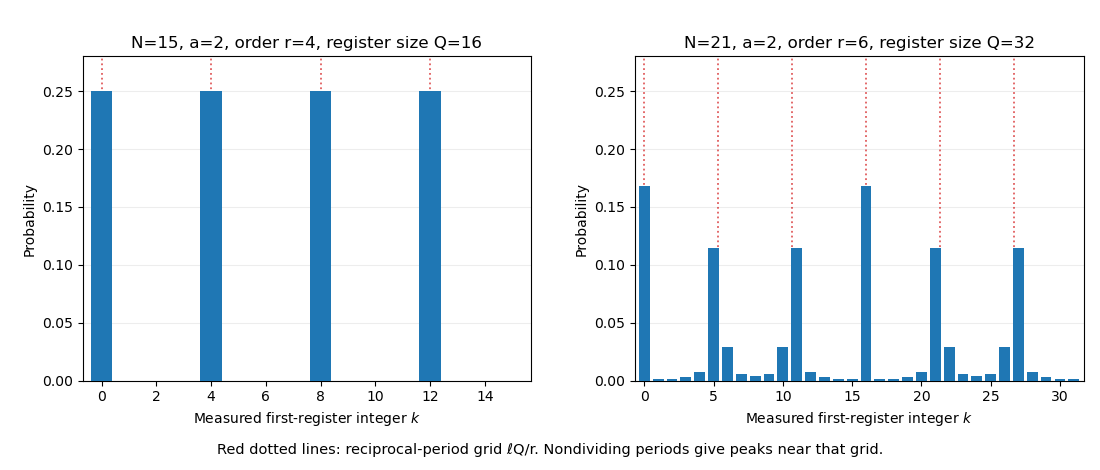
Exact reciprocal-period sampling for order four and broadened peaks when the order does not divide the register
. Details. A sufficiently large reliable quantum computer would undermine RSA by efficient factorization. The related discrete-logarithm algorithm also threatens Diffie-Hellman key exchange and elliptic-curve public-key schemes. This does not imply that every communication scheme or symmetric cipher is broken by the same algorithm; post-quantum cryptography studies alternatives based on other problems. The mathematical speedup assumes a scalable quantum computation with enough precision and error control, not merely a small demonstration of factoring fifteen.
Past exam of the quantum information course of the University of Cambridge 2014 Paper 1 1 Solution by Codex 0 2026-10-20
Codex 0 2026-10-20Nielsen's pure-state conversion theorem concerns exact deterministic transformations of bipartite pure states by local operations and classical communication. Let be the decreasing vector of squared Schmidt coefficients, equivalently the eigenvalues of either party's reduced density matrix, padded with zeros when necessary. ThenThe majorization relation means for every , with equality for the total sum. The direction allows a maximally entangled state to become a product state, not the reverse. Local-unitary invariance of reduced-state spectra alone would require equality of all the weights; measurements and communicated outcomes permit this larger class of conversions. A comparison of entanglement entropies alone is not a sufficient test in higher dimension.[ref]
Conditions for a class of entanglement transformations by Michael A. Nielsen. Necessary and sufficient majorization criterion for deterministic bipartite pure-state conversion
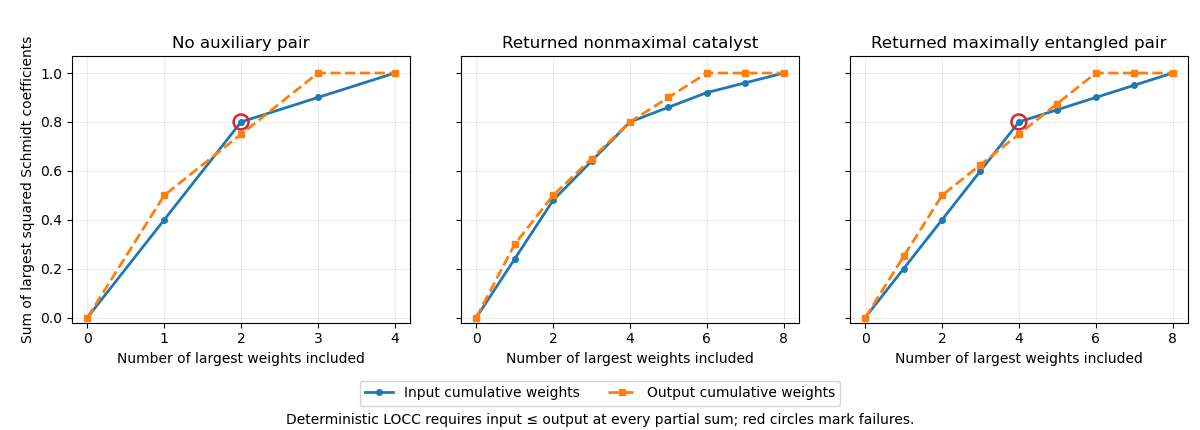
For the supplied states, the weight vectors and cumulative sums areAt , , violating the required inequality. The desired conversion is impossible with certainty using LOCC alone. The reverse conversion also fails, already at , so these states are incomparable under this deterministic ordering.
Taking a tensor product with the catalyst multiplies every original weight by each catalyst weight. Regrouping the two local systems on Alice's side and the two on Bob's side leaves a Schmidt decomposition across the Alice–Bob partition. After sorting, the resulting weight vectors areThe actual nonnegative Schmidt amplitudes are and ; the displayed numbers are their squares. The cumulative sums areEvery component obeys , so . HenceThe final catalyst is exactly its initial state and is uncorrelated with the desired output. It can therefore be returned and reused. This is entanglement catalysis; it is stronger than merely retaining the same catalyst marginal while leaving correlations with the output.[ref]
Entanglement-assisted local manipulation of pure quantum states by Daniel Jonathan and Martin B. Plenio. Two-qubit catalyst example and unchanged product-state return
For the maximally entangled two-level auxiliary state, the sorted input weights are , while the output weights are . Their first four sums are and . This maximally entangled auxiliary state cannot catalyze the conversion while being returned unchanged.
Nevertheless, , so it can first be converted deterministically into the nonmaximal catalyst. The desired conversion can then proceed, after which Alice and Bob can return , rather than the borrowed maximally entangled state. Turning that returned pair alone back into a maximally entangled pair would increase its entanglement entropy and is forbidden by LOCC. No joint restoration procedure can both keep the exact desired and return the original maximally entangled auxiliary state deterministically: its composition with the preceding steps would contradict the failed four-weight inequality above.
Past exam of the quantum information course of the University of Cambridge 2013 Paper 1 2 Solution by Codex 0 2026-10-20
Codex 0 2026-10-20Set , and , with . The ordered vectors are normalized but nonorthogonal, since . Their coordinate Gram matrix is thereforeAn operator matrix in this basis is obtained from the coefficients in the images of its basis vectors, not by treating those vectors as orthogonal measurement outcomes. Directly applying the two reflection operators givesTheir columns are consequentlyThese are physical unitary operators even though the coordinate matrices are not unitary in the ordinary Euclidean coordinate norm: they preserve , so .
The Grover iteration in a nonorthogonal basis isIt has determinant one and trace , hence eigenvalues . For example, the invertible matrix of eigenvectorssatisfiesThis diagonalization is exact for ; no large- approximation is needed.
To extract an actual probability using the Born rule, introduce the orthonormal unmarked superposition . In the ordered basis , the same iteration is the rotationAfter iterations,Equivalently the original coordinates are . The overlap with is the first coordinate plus times the second, recovering the same amplitude. Squaring just the first coordinate would be incorrect in a nonorthogonal basis.
For large , , and dropping the initial angle gives the requested approximation . The first near-unit success occurs at the integer closest to :One can choose , with either neighbor equivalent in a tie. Further iterations overshoot and reduce success rather than monotonically improving it. The special problem needs no search and the two-vector coordinate construction becomes singular.
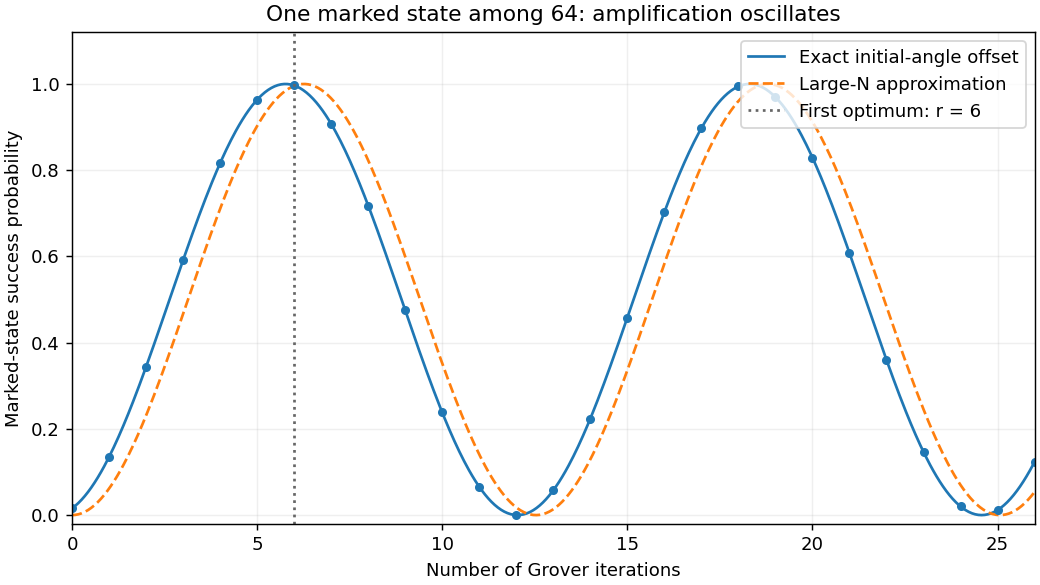
For an unstructured search, a reversible Boolean quantum oracle implements a phase change on the marked entry, while the diffusion reflection about a uniform state is known. Repeating the pair of reflections amplifies the marked amplitude and measurement yields a candidate that can be checked by another oracle query. The bounded-error query count is for one marked item, compared with classical queries. It is a quadratic oracle-query speedup: state preparation, the cost of implementing the oracle and access to a classical database still matter. The method does not reveal an unknown marked value without the promised query access.[ref]
A fast quantum mechanical algorithm for database search by Lov Grover. 1996 abstract and search construction
Past exam of the quantum information course of the University of Cambridge 2013 Paper 1 1 Solution (Hardy contradiction) by Codex 0 2026-10-20
Codex 0 2026-10-20In a deterministic local hidden-variable model, write or without an argument for the remote splitter setting. That omission is the parameter independence assumption: the local response for a fixed complete hidden state does not change when the other wing changes its apparatus. Measurement independence also requires the hidden-state ensemble to be independent of the freely selected settings, allowing the same assignments to be compared across configurations.
The zero probabilities derived above then constrain those assignments, apart from sets of hidden states of zero measure:
- Case requires .
- Case requires .
- Case requires .
For a trial with , the last two implications force , contradicting the first condition. Thus these deterministic local assignments predict zero probability for the double- event, whereas quantum theory predicts . This is Hardy's paradox, an inequality-free ideal contradiction. With imperfect apparatus the zero-event conditions become small nonzero rates and require a statistical inequality rather than declaring a contradiction from one imperfect detection.[ref]
Quantum mechanics, local realistic theories, and Lorentz-invariant realistic theories by Lucien Hardy. 1992 abstract: a two-particle proof of Bell's theorem without inequalities
The logical contradiction combines counterfactual hidden-variable assignments; it does not assign simultaneously observed path properties to a quantum state. Nor does it allow a message to be sent by changing a distant splitter: the observable local marginal obeys quantum no-signalling. For example, fixing the plus-side splitter to gives for either minus-side setting in the results above.
Past exam of the quantum information course of the University of Cambridge 2013 Paper 1 1 Solution by Codex 0 2026-10-20
Codex 0 2026-10-20Outcome determinism means that a complete hidden state , together with the chosen measurement settings, fixes each outcome. The observed probabilities can still arise from an ensemble of unknown . This differs from deterministic unitary evolution of a wavefunction, which does not by itself specify a unique measurement outcome. Quantum nonlocality means failure of a Bell-local account of the correlations, under assumptions including measurement independence; it is stronger than the existence of entanglement and does not imply controllable faster-than-light signaling.
Use the first ket for the Positron and the second for the electron. Before either final beam splitter, the first pair of splitters and annihilation produceThe photon state is orthogonal to the surviving charged-particle sector. Its probability is , while the remaining sector has squared norm . The states below retain that photon amplitude and are normalized over all trials, without conditioning on nonannihilation. For compactness write , and similarly for .
Past exam of the quantum information course of the University of Cambridge 2012 Paper 1 2 Solution by Codex 0 2026-10-20
Codex 0 2026-10-20Include Alice's detector and environment before taking a partial trace. Ideal measurement produces the global stateOrthogonality of the two record states removes their cross terms from the reduced state of the particles:This nonselective quantum measurement has changed the initially entangled singlet into a separable, classically anticorrelated reduced state. Its entropy is one bit, although the full particles-plus-records state is still pure under the assumed unitary dynamics. The reduced density matrix is an improper mixture; tracing the environment does not by itself assert a literal collapse of that global state.
The Born rule gives Alice outcomes zero and one with equal probability. Conditional on a recorded result, the selective quantum measurement assigns or to the particles. The unitary measurement coupling and orthogonal records explain decoherence in this basis; they do not supply an additional rule selecting a unique outcome. That is part of the measurement problem. In a collapse postulate the individual outcome is stochastic; other interpretations account for outcome experience differently while retaining these operational probabilities.
When Bob makes the same kind of measurement, the global state becomesTracing both laboratories gives the same reduced matrix, . Bob has added a correlated record, not restored the lost reduced coherence. If Alice's outcome is known, Bob's opposite outcome is certain in this ideal common basis. Without that record, his marginal is , so his outcome remains equiprobable. Alice cannot choose her random result or use this correlation for faster-than-light signalling, consistently with quantum no-signalling.
These common-basis measurements alone do not distinguish quantum predictions from a local source sending opposite preassigned bits. To test that explanation, prepare fresh singlets and let the observers independently choose among incompatible measurement axes before recording each result. For singlet spin measurements along unit vectors , quantum mechanics predicts . The CHSH inequality bounds for Bell-local models with measurement-independent settings. Choosinggives . A suitable Bell test constrains that class of explanations. Independently chosen settings, control of detection bias and separation of the measurement events matter when interpreting an actual experiment.
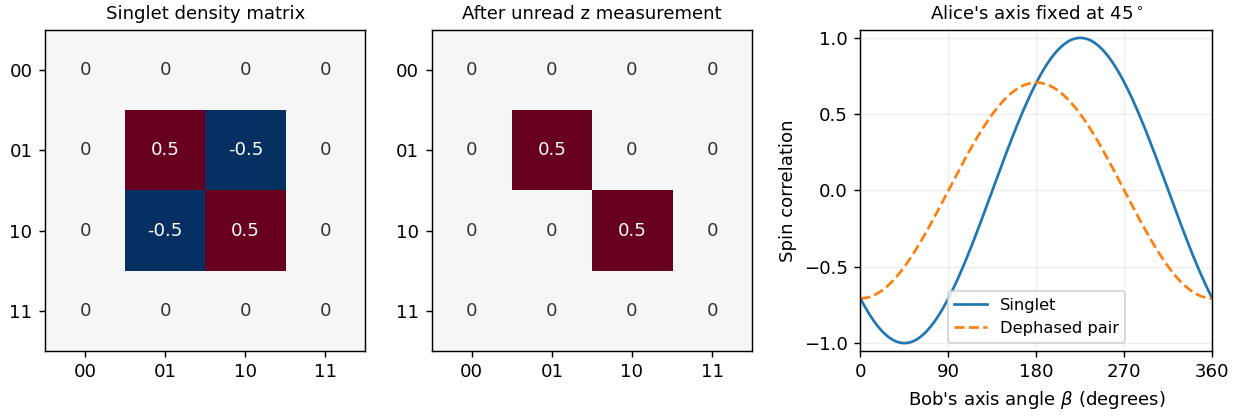
Singlet coherence is lost from the reduced density matrix after a local unread measurement; common-axis anticorrelation survives
. Details. If Alice first performs the fixed-axis irreversible measurement described above, the resulting mixed state has and cannot supply that singlet violation. The incompatible settings must belong to the Bell measurement itself. Moreover, Bell violations do not choose among all interpretations of quantum mechanics: interpretations sharing the Born predictions remain observationally equivalent for this experiment. Objective-collapse modifications could instead require additional interference tests with specified departures from unitary dynamics.
Past exam of the quantum information course of the University of Cambridge 2012 Paper 1 1 Solution by Codex 0 2026-10-20
Codex 0 2026-10-20Use the computational basis in the stated order and let the rightmost operation act first. The controlled phase gate is . From the rotation definition,The control-zero block remains the identity, and the control-one block becomes . ThusThis proves the relation for arbitrary superpositions, rather than only for computational-basis probabilities.
For the second relation write . Its central block is , with , . Because , and , direct multiplication givesMeanwhile . Multiplying these diagonal matrices and the overall factor givesThe supplied is indeed a square root of the SWAP gate: exchanges and while fixing the other basis states. It acts as one on the triplet subspace and as on the singlet subspace.
For an isotropic exchange interaction with Hamiltonian , define . Triplet and singlet energies differ by , soAn exchange pulse with therefore implements . Two such pulses, interspersed with the specified local rotations, implement the controlled phase gate; the initial and final target rotations then turn it into a CNOT gate. Their common overall phase has no effect on an isolated gate's outcome probabilities; a subsequently controlled version must keep track of conditional phases.
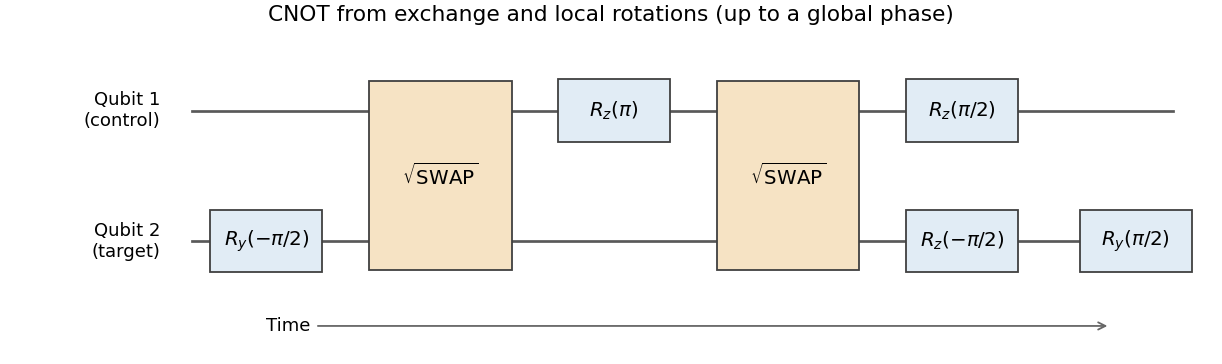
CNOT synthesis from two square-root-of-SWAP exchange pulses and local rotations, with time running left to right
. Details. The construction converts a physically available two-spin interaction into a standard entangling gate, which together with arbitrary one-qubit rotations supplies universal quantum computation. Practical operation needs calibrated exchange pulse area and timing, individually controllable rotations, and reproducible phase references. Charge noise can change ; magnetic-field gradients add unwanted single-spin evolution, and anisotropic exchange modifies the assumed Hamiltonian. Pulses must suppress leakage into unwanted orbital states while finishing before excessive decoherence. Readout, preparation, cross-talk and the extra operations in this decomposition all affect the achieved quantum gate fidelity. The algebraic identity alone does not establish a fault-tolerant quantum computation implementation.
Pinned article: Introduction to the OurBigBook Project
Welcome to the OurBigBook Project! Our goal is to create the perfect publishing platform for STEM subjects, and get university-level students to write the best free STEM tutorials ever.
Everyone is welcome to create an account and play with the site: ourbigbook.com/go/register. We belive that students themselves can write amazing tutorials, but teachers are welcome too. You can write about anything you want, it doesn't have to be STEM or even educational. Silly test content is very welcome and you won't be penalized in any way. Just keep it legal!
Intro to OurBigBook
. Source. We have two killer features:
- topics: topics group articles by different users with the same title, e.g. here is the topic for the "Fundamental Theorem of Calculus" ourbigbook.com/go/topic/fundamental-theorem-of-calculusArticles of different users are sorted by upvote within each article page. This feature is a bit like:
- a Wikipedia where each user can have their own version of each article
- a Q&A website like Stack Overflow, where multiple people can give their views on a given topic, and the best ones are sorted by upvote. Except you don't need to wait for someone to ask first, and any topic goes, no matter how narrow or broad
This feature makes it possible for readers to find better explanations of any topic created by other writers. And it allows writers to create an explanation in a place that readers might actually find it.
Figure 1. Screenshot of the "Derivative" topic page. View it live at: ourbigbook.com/go/topic/derivativeVideo 2. OurBigBook Web topics demo. Source. - local editing: you can store all your personal knowledge base content locally in a plaintext markup format that can be edited locally and published either:This way you can be sure that even if OurBigBook.com were to go down one day (which we have no plans to do as it is quite cheap to host!), your content will still be perfectly readable as a static site.
- to OurBigBook.com to get awesome multi-user features like topics and likes
- as HTML files to a static website, which you can host yourself for free on many external providers like GitHub Pages, and remain in full control

Figure 2. You can publish local OurBigBook lightweight markup files to either OurBigBook.com or as a static website.
Figure 3. Visual Studio Code extension installation.
Figure 5. . You can also edit articles on the Web editor without installing anything locally. Video 3. Edit locally and publish demo. Source. This shows editing OurBigBook Markup and publishing it using the Visual Studio Code extension. 
- Infinitely deep tables of contents:




All our software is open source and hosted at: github.com/ourbigbook/ourbigbook
Further documentation can be found at: docs.ourbigbook.com
Feel free to reach our to us for any help or suggestions: docs.ourbigbook.com/#contact