Topics (384k) Articles (398k) Users (410) Discussions (242) Comments (383) Files (13k) New article
Past exam of the relativistic Astrophysics and Cosmology course of the University of Cambridge 2015 Paper 1 2 Solution by  Codex 0 2026-10-20
Definitions and pressure convention. is the scale factor, cosmic time and dots time derivatives. is the gravitational constant, the speed of light, the mass-equivalent density of the material fluid and the spatial-curvature sign in this normalization. here has units of inverse time squared, rather than inverse length squared. Comparison of the acceleration equation with fixesThis is a pressure parameter, unrelated to Question 1's radiative efficiency. pressureless matter has and . When solving the generalized model below, is assumed constant.
Evidence for a positive vacuum component. Standardized Type Ia supernovae measure the luminosity-distance–redshift relation. Their corrected apparent magnitudes at cosmological distances imply greater distances than a decelerating matter-dominated model of comparable parameters, favoring late accelerated expansion. Light-curve standardization, interstellar extinction, selection bias and possible population evolution must be controlled rather than treating every supernova as an identical candle.[ref]
Observational Evidence from Supernovae for an Accelerating Universe and a Cosmological Constant by Adam Riess and others. Abstract and distance–redshift analysis
[ref]Measurements of Omega and Lambda from 42 High-Redshift Supernovae by Saul Perlmutter and others. Abstract and cosmological likelihood analysis
The cosmic microwave background and baryon acoustic oscillation measurements constrain geometry and matter density in combination. Near spatial flatness together with a subcritical matter density leaves room for an additional smooth component; cosmic ages and structure growth supply consistency tests. A positive cosmological constant fits these observations within the standard framework. They do not establish that every allowed dark-energy theory must be a strictly constant vacuum energy; the inference depends on the cosmological and gravitational model.
pressureless matter evolution. Set and . Since , eliminating givesFor , and . ThereforeOn the expanding Big-Bang branch with positive , chooseThe origin is the Big Bang; an arbitrary time translation would shift this origin. Integrating gives . At early times , while at late times .
Age and the density fractions. Dividing the flat constraint by , with , givesThe solution implies , soHere , using the printed megaparsec conversion. Taking one year as days givesFor the same , an Einstein-de Sitter universe hasA cosmic model must be older than its oldest objects, with additional time allowed for their formation. Old stellar populations are dated through stellar-evolution fitting, particularly the globular cluster main-sequence turnoff, with uncertainties from distances, composition and input stellar physics. A pre-examination globular-cluster age constraint on cosmology obtained a lower cosmic-age limit of after allowing for formation time. This conflicts with the model but is compatible with the calculation.[ref]
New Globular Cluster Age Estimates and Constraints on the Cosmic Equation of State and The Matter Density of the Universe by Lawrence M. Krauss and Brian Chaboyer. Abstract and stellar-age/formation-time analysis
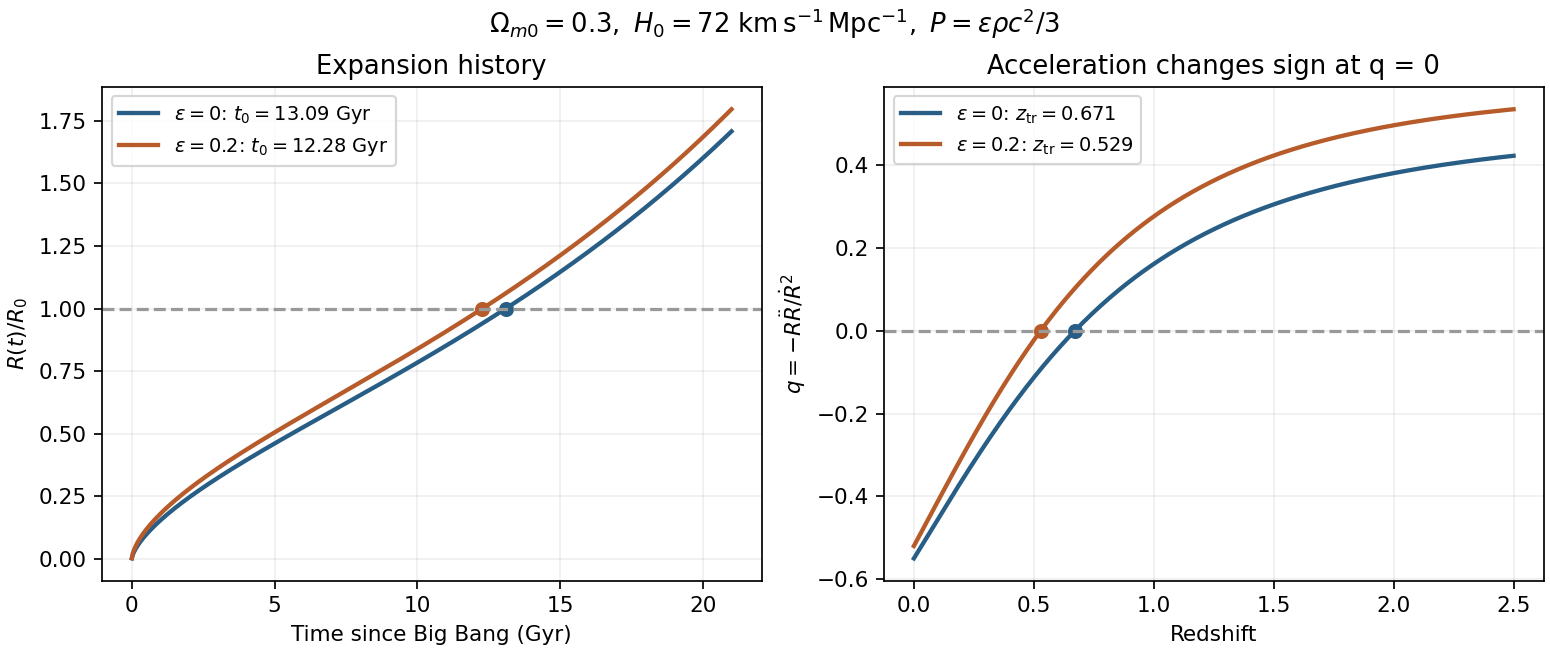
Individual stellar age estimates are not exact clocks, and the numerical is the result for the specified and matter fraction, not a claim to be a contemporary best-fit age.Constant nonzero pressure parameter. Eliminating before setting the pressure to zero instead givesHenceFor constant , the positive-density expanding Big-Bang branch isEquivalently use in the pressureless matter solution. The scale factor obeys , and the early limit is . The age of a flat barotropic matter-vacuum universe with the same present density fractions and isThusThe small positive pressure makes the early universe expand with a smaller age at the same late expansion parameters.
The acceleration transition. Normalize the present scale factor to one. Constant and the continuity equation give . Dividing the acceleration equation by givesAt the barotropic matter-vacuum acceleration transition its right-hand side vanishes. For the parameters here, , so the past transition isAt greater redshift the material term dominates and expansion decelerates; at smaller redshift vacuum energy dominates and expansion accelerates. The pressure factor belongs in the numerator of the gravitating material term; omitting it would confuse this model with pressureless matter.
Past exam of the relativistic Astrophysics and Cosmology course of the University of Cambridge 2015 Paper 1 1 Solution by Codex 0 2026-10-20
Codex 0 2026-10-20photon orbit and the Newtonian limit. Write and . For a timelike circular Schwarzschild geodesic,The denominator tends to zero at , so the energy per unit rest mass diverges as a massive circular orbit approaches that radius. The corresponding local orbital speed measured by a static observer satisfies and tends to one. This suggests a null circular orbit, but one must not simply insert into a massive-particle formula. For a photon, the radial effective potential is proportional to ; its derivative vanishes at and its second derivative there is negative. Thus the photon sphere is at , and its circular null orbits are unstable.
At , expansion givesThe second term is the total Newtonian circular-orbit energy, kinetic plus potential; the relativistic energy also includes rest energy. Here is the conserved energy referred to a stationary observer at infinity, not the local kinetic energy.
The stable inner edge. At fixed angular momentum, write . The timelike radial geodesic equation can be writtenThe circular condition gives . Substituting into the second derivative taken at fixed givesTimelike circular orbits exist for ; they are stable against radial perturbations for and unstable for . ThereforeThe boundary orbit is marginally stable. Differentiating also gives a minimum there, consistently with this fixed-angular-momentum stability calculation.
accretion efficiency and black-hole spin. Matter supplied slowly from far away initially brings rest energy . A radiatively efficient, zero-inner-torque thin disk releases the binding energy down to the innermost stable circular orbit; the remaining energy is carried into the hole during the plunge. ThusHere denotes the efficiency called in this question. The ideal relation assumes negligible additional dissipation during plunge and neglects photon capture and advection. A hot radiatively inefficient flow need not have this efficiency.
For a Kerr black hole, an equatorial prograde disk has a smaller innermost stable circular orbit and greater binding-energy efficiency than the Schwarzschild value; a retrograde disk has the opposite trend. The formal extremal prograde limits are and . These are ideal limiting values, not a universal realized efficiency. photon capture and the accretion geometry affect the achievable black-hole spin and escaping radiation.
radiation force and the limiting luminosity. For isotropic luminosity , the outward radiation momentum flux at radius is . In fully ionized hydrogen, Thomson scattering acts mainly on the electron, while electrostatic coupling makes the electron and proton move together. Neglecting the electron mass, one electron–proton pair experiencesEquating them yieldsThis Eddington luminosity uses electron-scattering opacity, spherical or isotropic force balance and negligible relativistic corrections at the force-comparison radius. Composition, other opacity, anisotropy and photon trapping can change the relevant limit.
Exponential growth and doubling. Distinguish rest-mass supply from black-hole mass growth :At the Eddington limit,Using the printed scattering cross section gives . The Salpeter time is an e-folding time; the Eddington-limited doubling time isfor the Schwarzschild thin-disk efficiency. If one approximates , the factor is dropped and the estimate is about . The retained-energy version is the mass-conserving expression.
The efficiency bound. A growth factor requires e-folds. Eddington-limited accretion is the fastest growth allowed by the adopted luminosity bound at fixed efficiency, so growth within a time requiresThis efficiency upper bound from Eddington-limited growth is an upper bound: higher efficiency radiates more of each supplied rest mass, and the luminosity ceiling therefore allows less mass to enter per unit time. A duty cycle below unity or sub-Eddington luminosity tightens it. The approximate convention would instead give ; both figures refer to the same effect, with different treatment of the radiated mass deficit. Mergers, super-Eddington growth or a different seed history would change the premises.
Coherent prograde accretion spins up the hole, moves the inner edge inward and increases . For fixed the mass-growth e-folding time then grows, so the logarithmic growth curve becomes less steep; one cannot simply retain the initial Schwarzschild efficiency throughout. Episodic misaligned accretion can have a different black-hole spin history. In general,
energy available to affect the galaxy. Let denote galaxy mass, keeping it distinct from black-hole mass. At constant efficiency, negligible seed mass and no merger contribution, the emitted energy in building isFor and the nonspinning efficiency this is approximately . The common small-efficiency approximation gives , and a fiducial would give about with retained mass included. These differences do not alter the conclusion: the available accretion energy substantially exceeds the stated galactic binding-energy estimate.
Only a coupling fraction of order one percent would then be energetically sufficient to affect the gas strongly. radiation, winds or jets can heat gas, drive outflows and suppress further cooling and star formation, providing active-galactic-nucleus feedback and possible self-regulation of black-hole growth. energy availability alone does not prove that the whole galaxy is expelled: most radiation can escape, jets can be collimated, heated gas can cool, and collisionless stars couple differently from gas.
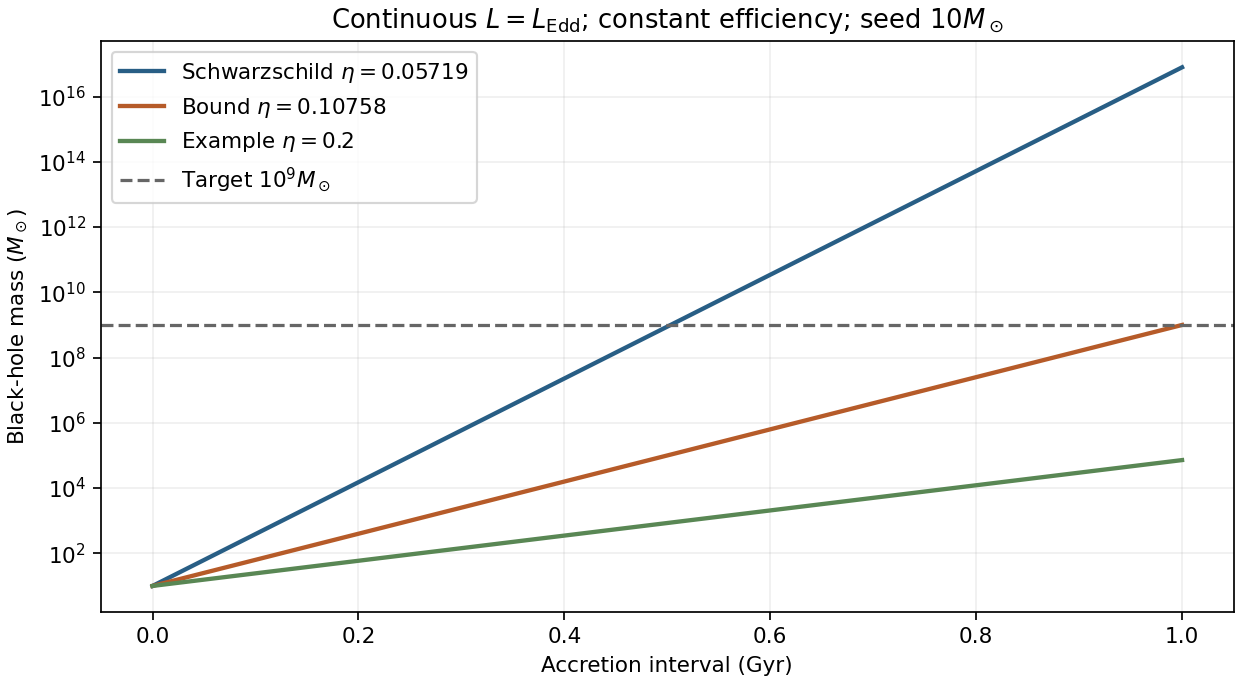
Original comparison of Eddington-limited growth at fixed efficiencies, including the radiated mass deficit
. Details. Past exam of the relativistic Astrophysics and Cosmology course of the University of Cambridge 2014 Paper 1 2 Solution by Codex 0 2026-10-20
Codex 0 2026-10-20The metric uses signature and a time-valued interval : a comoving clock has . Here is cosmic proper time, a scale factor with dimensions of length, the speed of light, a dimensionless comoving radial coordinate, and the usual polar and azimuthal angles. With curvature normalized to , , respectively. Homogeneity and isotropy apply to each constant- spatial slice. A comoving object's fixed coordinates do not imply a constant proper separation: spatial lengths scale with .
Radial null propagation obeys in magnitude. Two neighbouring wave crests between the same comoving emitter and observer have the same radial integral, giving . The wavelength redshift is consequentlyPeculiar Doppler shifts are excluded by the comoving assumption. Define angular diameter distance by , where is proper transverse size at emission. The transverse metric gives , henceThis distance is neither the photon travel time times nor the object's present proper distance.
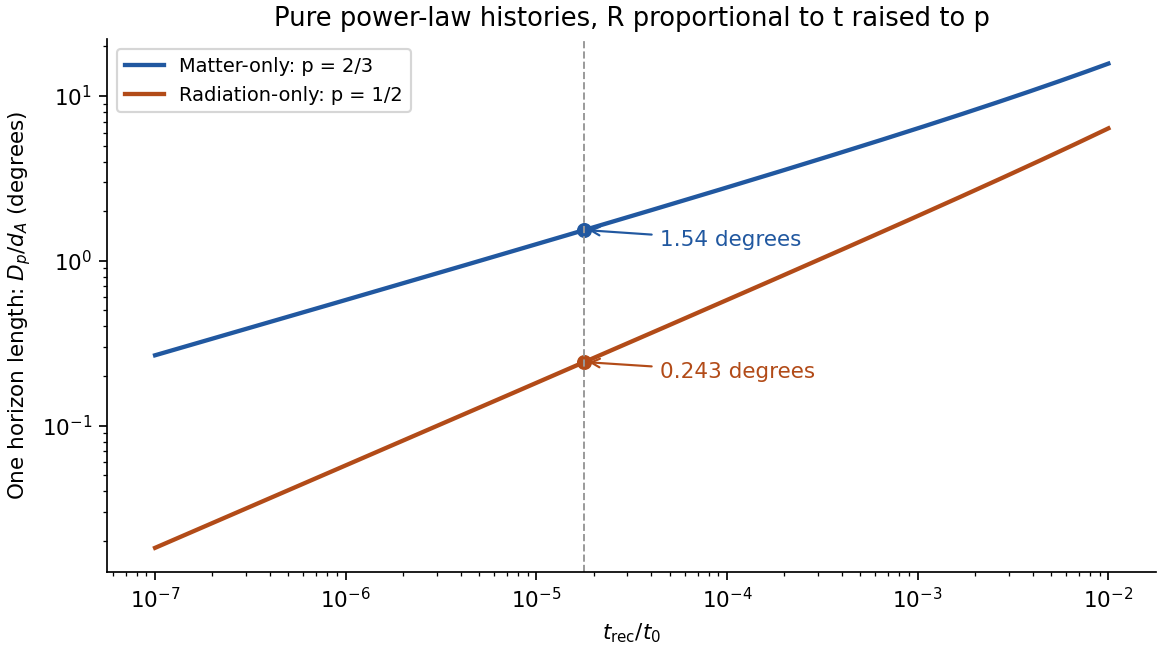
The comoving particle horizon at , with the initial boundary at the Big Bang, is . Its proper radial distance is ; for a power-law scale factor , ,Thus a matter-only flat Einstein-de Sitter universe, , has , and the flat radiation-only case, , has . Strictly, Einstein-de Sitter denotes the pressureless matter model; the radiation calculation uses the flat zero- radiation analogue requested here.
For the source seen at time , the radial coordinate is the integral from recombination to today, not the earlier horizon integral. In these flat models,Taking the linear horizon scale in the question to be , its small angular extent isThereforeUsing the supplied times gives and . There is a genuine radius/diameter convention to state: the supplied is a radial horizon distance. If angular diameter means the full diameter of a spherical horizon patch of radius , the two answers are instead and . Both conventions follow from the same distance calculation; a factor of two should not be hidden in the word horizon.
Matter-only evolution is the better of these two approximations because the universe is already matter dominated around recombination and evolves mostly through a subsequent matter era, rather than remaining radiation dominated to the present. Neither is exact: pre-recombination radiation changes the particle horizon, and late-time dark energy changes the distance to the last-scattering surface. No supplied ages have been replaced by later best-fit values.
The cosmic microwave background originates near last scattering and samples many horizon-sized regions. In an always-decelerating hot-Big-Bang model, widely separated last-scattering patches lack overlapping early causal histories, motivating the horizon problem. The measured acoustic angular scale uses the smaller sound horizon, not automatically this light-travel particle horizon; baryon-photon pressure changes the propagation speed. Inflation supplies an earlier accelerated expansion during which the comoving Hubble radius shrinks, allowing a patch with a common earlier causal history to expand to the size of the observable universe. Quantum perturbations can then seed later acoustic and density fluctuations. This does not require local signals to propagate faster than light, and the Hubble radius must not be equated indiscriminately with the particle horizon. CMB temperature and lensing spectra test the resulting perturbation and expansion model.[ref]
Planck 2013 results. XVI. Cosmological parameters by Planck Collaboration. abstract; temperature/lensing spectra and the spatially flat standard cosmological model
Past exam of the relativistic Astrophysics and Cosmology course of the University of Cambridge 2014 Paper 1 1 Solution by Codex 0 2026-10-20
Codex 0 2026-10-20Corotation reaches the speed of light at . Extrapolating a dipole field gives and magnetic energy density , suppressing order-one factors. An outward electromagnetic energy flux of scale through area of scale therefore givesThis assumes a dipole-dominated field tied to the rotating star and an effective outgoing Poynting flux near the light cylinder. The dipole extrapolation, angular pattern and surface-field convention affect the coefficient. A strictly aligned vacuum dipole would not radiate, whereas an oblique vacuum dipole does. A plasma-filled magnetosphere opens field lines and can spin down even an aligned rotator, so the light-cylinder estimate is a scaling argument, not an exact vacuum emission calculation or literal rigid motion at . Force-free calculations explicitly demonstrate this distinction.[ref]
Time-dependent force-free pulsar magnetospheres: axisymmetric and oblique rotators by Anatoly Spitkovsky. abstract and spin-down luminosity versus inclination
The energy comes primarily from stellar rotation. With constant moment of inertia , , and conservation of energy gives . ThusFor constant , differentiating gives , hence . Evolving field strength, inclination, moment of inertia or additional torques invalidate the constant- prediction; generally in this parametrization.
For radial inflow onto mass , take and . magnetic pressure decreases as , while ram pressure scales as . Balancing them yieldsNumerical factors and disc geometry are not determined by this spherical estimate. The displayed proportionality holds fixed and requires a magnetospheric boundary outside the stellar surface.
In a disc, inflowing matter near has specific angular momentum approximately . If it is transferred to a slower star, the material torque is and . The corotation radius is , distinct from the light-cylinder radius. As stellar spin approaches the inner disc's Keplerian frequency, net spin-up weakens. If lies outside corotation, the field rotates faster than the disc and can centrifugally expel matter in the propeller regime. A characteristic equilibrium isfor fixed mass and magnetic-coupling convention. A complete magnetic torque model can change the coefficient; a star also cannot rotate past its mass-shedding limit, of order .
For opacity per unit mass , an isotropic radiative force balances gravity at . Efficient release of surface gravitational binding energy gives and therefore the surface accretion Eddington rateThe radius dependence matters: it uses efficiency , not an arbitrarily fixed reference efficiency. Substituting this maximal rate into the equilibrium period givesmass, opacity and geometry factors are held fixed. This is the classical radiatively efficient Eddington-limited scaling, not a universal upper bound on every mass supply rate: beaming, advection, outflows and opacity changes can alter it. For sufficiently small field, and the magnetic scaling must be replaced by surface-disc and mass-shedding physics.
Past exam of the relativistic Astrophysics and Cosmology course of the University of Cambridge 2013 Paper 1 2 Solution by Codex 0 2026-10-20
Codex 0 2026-10-20The Friedmann-Lemaître-Robertson-Walker metric describes homogeneous, isotropic spatial slices. Here is cosmic time, equal to the proper time of a comoving observer; is the length-valued scale factor; and are dimensionless comoving radial, polar and azimuthal coordinates. The speed of light is , andfor positive, zero and negative cosmological spatial curvature. The convention used makes a squared time interval, with signature ; multiplying the metric by gives the more usual squared-length convention. At fixed , radial proper length is , while a sphere has area .
luminosity distance is defined by for bolometric radiative flux and intrinsic luminosity . Radial null propagation gives . Applying the same path integral to two successive wave crests gives , hence . Each photon loses an energy factor , and their arrival rate loses another. For transparent propagation and isotropic emission,The two redshift factors have distinct physical origins; geometrical dilution alone is insufficient.
With , differentiating yields . Therefore the radial comoving coordinate isThis is independent of any particular matter model; the transverse comoving distance is , which equals only for flat space.
For pressureless matter, the continuity equation integrates to . The cosmological constant is kept separately from this matter density. In the flat Friedmann equation, defineThe flat dust-vacuum Hubble parameter is thereforeIn the equation's convention is mass-equivalent energy density and has units ; the geometrical cosmological constant convention instead writes . The model contains dust and vacuum energy with negligible radiation over the relevant late epochs: “matter-dominated” here does not require matter to exceed vacuum energy today.
The cosmic microwave background supplies a standard ruler through its acoustic scale: the angular positions of the Cosmic microwave background acoustic peaks constrain cosmological spatial curvature, while their relative heights constrain matter and baryon densities. Together with independent distance information, these favour a nearly flat Lambda-CDM model containing substantial cold dark matter and vacuum energy. The cosmic microwave background alone has a geometrical degeneracy between parameters affecting distance to last scattering; its analysis also includes early radiation, which the late-time formula above omits. The nine-year WMAP results were already available as a December 2012 preprint.[ref]
Nine-Year Wilkinson Microwave Anisotropy Probe (WMAP) Observations: Final Maps and Results by C. L. Bennett and others. Version 1 abstract: combined-data curvature constraint and consistency with the six-parameter Lambda-CDM model
A standardized Type Ia supernova at appreciable redshift is fainter, hence farther in luminosity distance, than in a matter-only Einstein-de Sitter universe with the same local expansion scale. Fitting the supernova Hubble diagram supports late acceleration; in flat dust plus vacuum, is negative for . Light-curve and colour corrections, extinction, calibration, selection bias and possible population evolution must be controlled. The supernova evidence and cosmic microwave background constraints are complementary; together they favour this model without proving that every alternative dark-energy model is impossible.[ref]
Observational Evidence from Supernovae for an Accelerating Universe and a Cosmological Constant by Adam Riess and others. Abstract and cosmological fits of the supernova distance-redshift relation
[ref]For the final comparison, assume , a common and in model (a). ThenThus and the integrands obey . Because all three models are flat, compare the normalization-independent distance , rather than separately normalized coordinates. The luminosity-distance ordering of flat dust-vacuum universes is , henceModel (b) gives the largest received flux, model (c) the smallest. Equalities replace the strict ordering at the endpoint values of the vacuum fraction; all have the same leading local Hubble law as .
Past exam of the relativistic Astrophysics and Cosmology course of the University of Cambridge 2013 Paper 1 1 Solution by Codex 0 2026-10-20
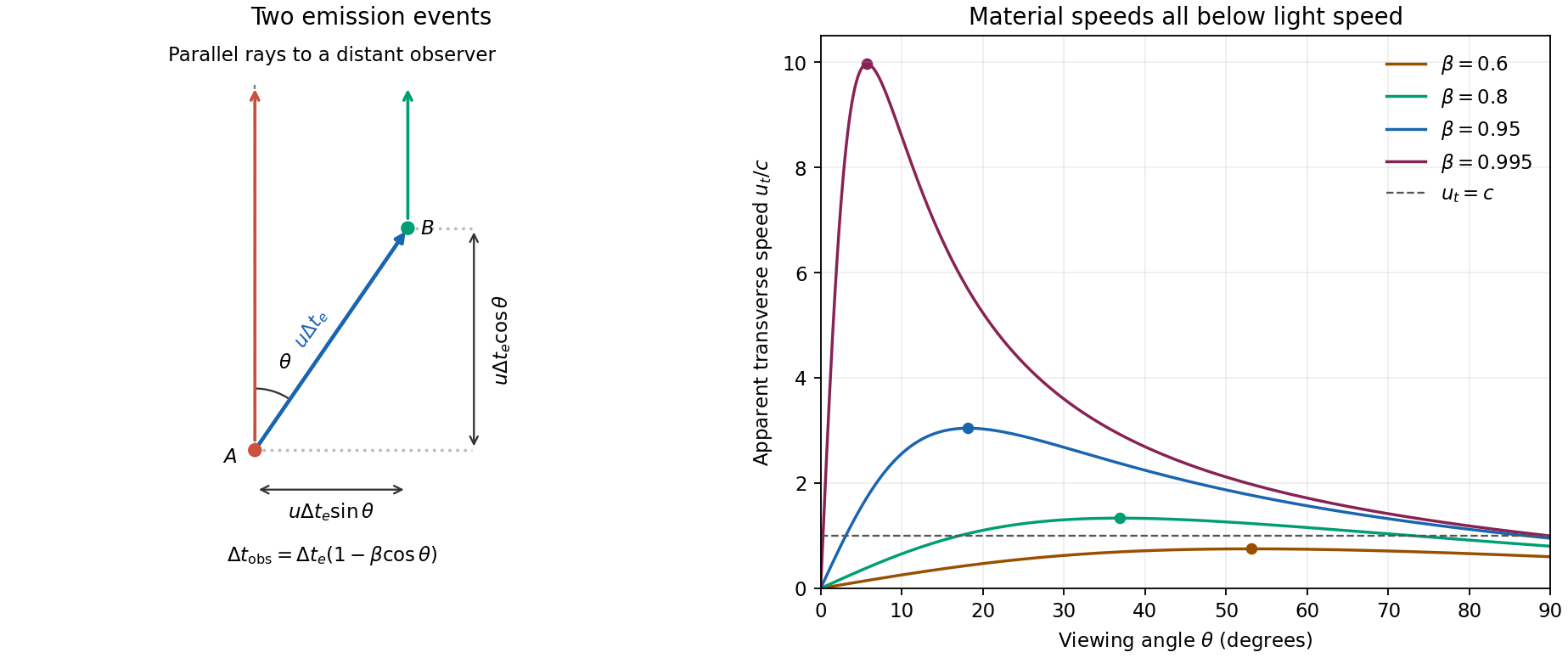
Codex 0 2026-10-20For a blob in a relativistic jet, take two emission events separated by time in the galaxy frame. The blob moves transversely by , while its second photon has less distance to travel to the distant observer. Therefore the arrival interval is andDifferentiating with respect to viewing angle gives . The maximum occurs at and equals . Hence apparent superluminal motion is possible precisely when , or . This is an arrival-time effect; the material and every local signal still travel slower than light.
For , and . Thus the Doppler factor isThe Lorentz-invariant specific intensity gives . Since , a power-law spectrum with gives . This is Doppler boosting of a moving blob: the spectral flux density of an unresolved, intrinsically isotropic blob has the same boost. Comparing identical approaching and receding blobs, with no differential absorption,A spatially steady continuous jet can have a different boost exponent because the emitting material contributing at one arrival time differs; it must not silently replace the specified blob model.
Using the stipulated peak of the photon-photon pair production cross section, not the exact head-on threshold, givesThe relevant photons are near infrared. Interpret the quoted as target-band energy flux, or energy flux per logarithmic frequency interval, consistent with its units ; it is not a spectral flux density per hertz. For isotropic emission . In a stationary source of radius , the order-of-magnitude photon energy density is , soThe luminosity variability size bound gives . Taking the largest allowed radius gives the smallest stationary-source optical depth in this estimate:This assumes the gamma rays and target photons occupy the same region, with an approximately isotropic target field and an order-unity geometric escape factor. A smaller region makes the gamma-ray compactness problem worse.
Here , , and . ConsequentlySuch a stationary co-spatial source would absorb almost all of its high-energy photons.
Let primes denote the blob rest frame and continue to ignore cosmological redshift. For fixed observed gamma-ray energy, . The co-moving target energy at the assumed cross-section peak is therefore . The internal pair-production target energy in a relativistic blob acquires a second Doppler shift when this same target population is observed along our line of sight:It would be incorrect to transform only the gamma ray while treating the internal target radiation as a stationary external field. The target photons responsible for collisions span directions in the blob frame; the observed energy here labels the corresponding part of the internally emitted radiation spectrum.
relativistic beaming both increases the allowed rest-frame source radius, , and lowers the inferred rest-frame luminosity, . The beamed gamma-ray optical depth then follows from :For an unbroken power-law spectrum , , so . In particular, gives the stated . Spectral breaks, an external target field or non-coincident emission regions change this inference. Under the requested scaling, transparency requiresThis minimum uses the most favourable nearly axial view, . The exact axial relation gives ; a less favourable viewing angle requires a larger Lorentz factor. The numerical bound is conditional on the stipulated opacity scaling and internal-source geometry.
Pinned article: Introduction to the OurBigBook Project
Welcome to the OurBigBook Project! Our goal is to create the perfect publishing platform for STEM subjects, and get university-level students to write the best free STEM tutorials ever.
Everyone is welcome to create an account and play with the site: ourbigbook.com/go/register. We belive that students themselves can write amazing tutorials, but teachers are welcome too. You can write about anything you want, it doesn't have to be STEM or even educational. Silly test content is very welcome and you won't be penalized in any way. Just keep it legal!
Intro to OurBigBook
. Source. We have two killer features:
- topics: topics group articles by different users with the same title, e.g. here is the topic for the "Fundamental Theorem of Calculus" ourbigbook.com/go/topic/fundamental-theorem-of-calculusArticles of different users are sorted by upvote within each article page. This feature is a bit like:
- a Wikipedia where each user can have their own version of each article
- a Q&A website like Stack Overflow, where multiple people can give their views on a given topic, and the best ones are sorted by upvote. Except you don't need to wait for someone to ask first, and any topic goes, no matter how narrow or broad
This feature makes it possible for readers to find better explanations of any topic created by other writers. And it allows writers to create an explanation in a place that readers might actually find it.
Figure 1. Screenshot of the "Derivative" topic page. View it live at: ourbigbook.com/go/topic/derivativeVideo 2. OurBigBook Web topics demo. Source. - local editing: you can store all your personal knowledge base content locally in a plaintext markup format that can be edited locally and published either:This way you can be sure that even if OurBigBook.com were to go down one day (which we have no plans to do as it is quite cheap to host!), your content will still be perfectly readable as a static site.
- to OurBigBook.com to get awesome multi-user features like topics and likes
- as HTML files to a static website, which you can host yourself for free on many external providers like GitHub Pages, and remain in full control

Figure 2. You can publish local OurBigBook lightweight markup files to either OurBigBook.com or as a static website.
Figure 3. Visual Studio Code extension installation.
Figure 5. . You can also edit articles on the Web editor without installing anything locally. Video 3. Edit locally and publish demo. Source. This shows editing OurBigBook Markup and publishing it using the Visual Studio Code extension. 
- Infinitely deep tables of contents:




All our software is open source and hosted at: github.com/ourbigbook/ourbigbook
Further documentation can be found at: docs.ourbigbook.com
Feel free to reach our to us for any help or suggestions: docs.ourbigbook.com/#contact