Topics (384k) Articles (398k) Users (410) Discussions (242) Comments (383) Files (13k) New article
Past exam of the nonlinear Optics and Quantum States of Light course of the University of Cambridge 2015 Paper 1 1 Solution by  Codex 0 2026-10-20
The polarization generated by the relevant third-order nonlinear optical susceptibility is proportional to . Multiplication of its temporal and spatial wave phase factors givesThe two opposing pump arrows in the original diagram mean . Thus the mixing source points along , and its conjugate signal amplitude drives a backward field. This is counterpropagating-pump phase matching in four-wave mixing.
There is a phase matching qualification to the initial frequency statement. In the stipulated nondispersive isotropic medium, . Exact equality of the backward free-wave vector to therefore requires , hence . For unequal frequencies the backward direction remains the geometry suggested by the source, but the longitudinal phase mismatch has magnitude . Efficient generation over a finite length requires that mismatch times be small; a sinc function factor suppresses conversion otherwise. Nondispersion does not remove the magnitude mismatch. The remainder of the calculation is explicitly degenerate four-wave mixing, so this difficulty disappears.
At the pump frequency, for the strong field , self-phase modulation and cross-phase modulation by dominate the weak signal's influence. They change its propagation wave phase through its own intensity and the other pump's intensity. With continuous uniform plane waves, these are nonlinear wave phase shifts; finite pulses acquire temporal chirp, and finite transverse beams can acquire a lens. No universal factor of two should be assigned between the two shifts without specifying their polarization contraction and the field-amplitude convention.
Write and . Differentiating the exponential substitutions cancels the terms proportional to :Consequently and . Conjugate the latter before eliminating a field: , so . The backward four-wave-mixing boundary problem requires opposite-end boundary conditions: , where , and . The transfer matrix isAt , , so . Substitution givesThe printed target expression for has the opposite overall sign. This is present in the original PDF, not just the transcription. With its stated first-order equations, the derivative at the far face must be . The boxed result has that derivative; the printed expression has its negative. Reversing the convention for the mixing coefficient could reverse the generated phase, but would also change the coupled equations. The result above satisfies the equations and both boundary conditions together.
At the entrance, , so the returned amplitude is proportional to the complex conjugate of the signal. An ordinary ideal mirror gives , with a fixed reflection coefficient , rather than . The mixing pumps supply both the extra energy and a wave phase reference. The ideal conjugate reflectivity and signal transmission areThe constancy of along the medium is another direct check. The relation between the incoming signal and outgoing waves allows net output energy to come from the pumps. As , the undepleted-pump approximation fails: the predicted fields would extract an appreciable pump fraction. This is the ideal four-wave-mixing oscillation threshold; saturation, pump depletion and noise seeding replace the divergent linearized solution. It is not an unlimited source of reflected power. Amplified phase-conjugated propagation and parametric oscillation are also the effects identified in the primary analysis by Amnon Yariv and David M. Pepper.[ref]
Amplified reflection, phase conjugation, and oscillation in degenerate four-wave mixing by Amnon Yariv and David M. Pepper. abstract, amplified conjugate propagation and parametric oscillation
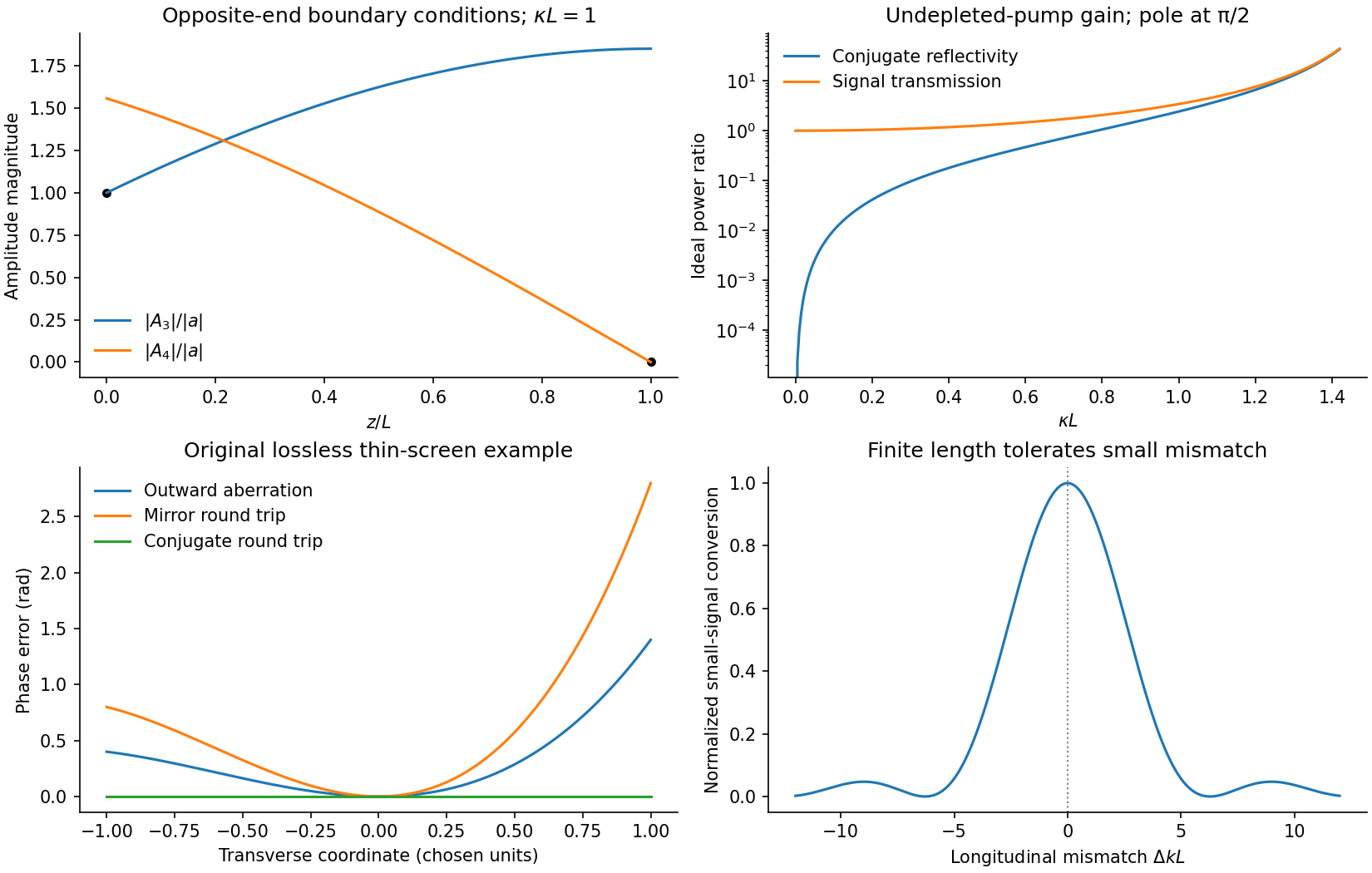
For the aberrating linear medium, assume its permittivity is real and stationary at this frequency. Taking the complex conjugate of the forward-envelope equation givesThis is the backward-envelope equation with carrier . Launching the conjugate boundary field therefore permits retracing of the distorted wave. In a transverse lossless phase screen model, let transmission be . A return proportional to acquires on its second passage and becomes . Thus the aberration phase cancels. A mirror instead gives , adding the aberration twice; merely reversing the central propagation direction does not reverse the wavefront phase.
The one-dimensional printed equation describes longitudinal variation; genuine transverse aberrations require the corresponding transverse Helmholtz equation or paraxial operator, for which the same real-coefficient conjugation argument applies. Exact reconstruction requires adequate aperture, the correct conjugate amplitude and polarization, uniform pump-product phase, and an unchanged reciprocal lossless medium. Absorption, missing scattered modes or a changed aberrator prevent a universal reconstruction. This is phase conjugation and thin phase-plate cancellation by phase conjugation under specified conditions, rather than reversal of every possible propagation loss.
Past exam of the nonlinear Optics and Quantum States of Light course of the University of Cambridge 2014 Paper 1 2 Solution by Codex 0 2026-10-20
Codex 0 2026-10-20A degenerate optical parametric amplifier sends a strong pump at through a phase-matched second-order nonlinear medium, creating pairs in a selected mode near . With the pump treated classically and undepleted, the effective interaction is quadratic in the mode's creation and annihilation operators. Vacuum input evolves into an optical squeezed vacuum; the pump phase fixes the quiet optical quadrature. A cavity enhances the interaction below oscillation threshold. balanced homodyne detection compares this optical quadrature's noise with the blocked-signal vacuum reference; phase locking, detector balance, electronic-noise measurement and loss calibration distinguish squeezing from an instrumental noise reduction. A primary cavity experiment observed below-vacuum noise by degenerate down conversion and balanced homodyne readout.[ref]
Generation of Squeezed States by Parametric Down Conversion by Ling-An Wu and others. 1986, abstract: cavity down conversion and homodyne noise reduction
Use , so . Write , and . Vacuum expectations then givePair creation makes the mean field zero while the mean photon number is positive. Expanding the transformed ladder operators in the vacuum gives the squeezed-vacuum photon-number moments: and ; equivalently .
The vectors produced by photon addition and photon subtraction in the paper are not normalized. Their squared norms are and , respectively. A particularly direct evaluation isBoth successful operations therefore prepare the same squeezed one-photon state, up to an overall phase, whenever subtraction has nonzero probability. Since , the unnormalized moments areThe printed photon-added formula equals , not a normalized mean. With its literal unnormalized convention, the corresponding subtraction result is andThis difference tends to one as and grows as for large positive . Keeping this convention recovers the paper's requested expression without misidentifying it as a physical conditional mean.
For the normalization of photon-added and photon-subtracted states, divide by the squared norms to obtain actual conditional means:These equalities for subtraction require . As the normalized successful subtraction tends to , but its success probability vanishes; exactly at , gives no conditional state. At large , both normalized means grow as , while their difference remains zero.
For the photon statistics of a squeezed vacuum, the even-number probabilities areAfter subtraction the normalized distribution is . It has only odd occupation and no vacuum component. photon addition gives , identical here to . The diagram uses normalized distributions with an explicitly chosen , rather than treating the unnormalized moments as means.
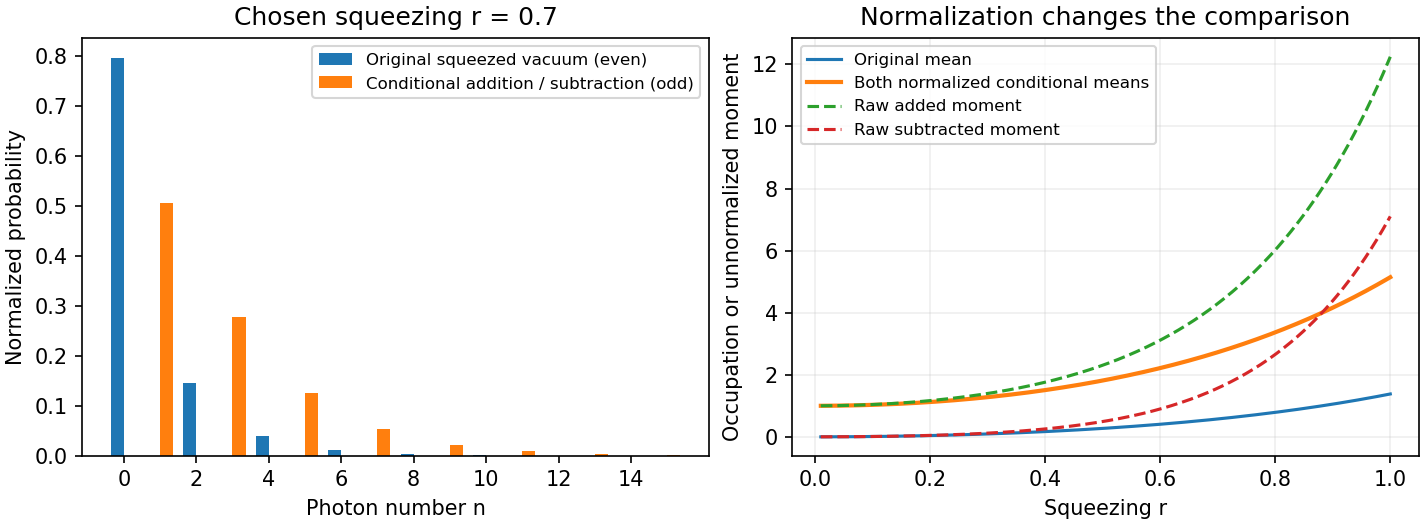
Original normalized even squeezed-vacuum and odd conditional photon-number distributions, with raw-moment and mean conventions distinguished
. Details. A subtraction event samples initial occupation with weight , preferentially selecting the larger components before removing one photon. In general . Here the large variance gives . This conditional photon-number bias does not create energy by removing a photon: the unconditional ensemble also includes the runs without a heralded event.
Past exam of the nonlinear Optics and Quantum States of Light course of the University of Cambridge 2014 Paper 1 1 Solution by Codex 0 2026-10-20
Codex 0 2026-10-20Put . For a temporally uniform envelope, and , so the propagation equation reduces to . Thus the power stays and the accumulated nonlinear wave phase is . The optical Kerr effect gives an intensity-dependent refractive index, and hence self-phase modulation. For the usual power normalization , with effective guided-mode area . Losslessness preserves the background power; it does not remove the self-phase modulation. The carrier wave phase has already been factored out.
Write . To first order,Cancelling the background and its phase derivative leavesThe last term couples a perturbation to its complex conjugate: the pump can transfer energy into a pair of sidebands. It is not an independent wave phase of each Fourier component. This sideband coupling is the linear origin of fibre modulational instability.
For real , put . Matching the two exponential coefficients givesA nonzero pair requires a zero determinant, henceFor unstable complex , the real-coefficient assumption is too restrictive. The consistent pair is , with complex . Its equations give the same determinant and allow the growing and decaying branches. Merely inserting imaginary while treating the two original coefficients as real would not respect complex conjugation.
For and nonzero , exponential growth requires andFor ordinary positive Kerr nonlinearity this means anomalous group velocity dispersion, . Define . The growing branch is , with amplitude growth rateSideband power grows at rate , rather than . The cutoff and zero-frequency modes have no exponential growth; in a degenerate zero-frequency sector a secular phase response can remain. Positive dispersion with positive gives real and oscillatory perturbations.
Initially small ripples grow into pronounced intensity peaks and deplete the uniform background. Dispersion and self-phase modulation can then support localized bright pulses. A fundamental temporal bright soliton obeys , so its width is comparable to when its peak power is comparable to the original power. The dominant ripple spacing is , not simply . Propagation distance is the evolution variable; measures time within the envelope. An ideal conservative fibre need not settle permanently into a unique pulse train: nonlinear compression, interactions and recurrence depend on the seed and boundary conditions.
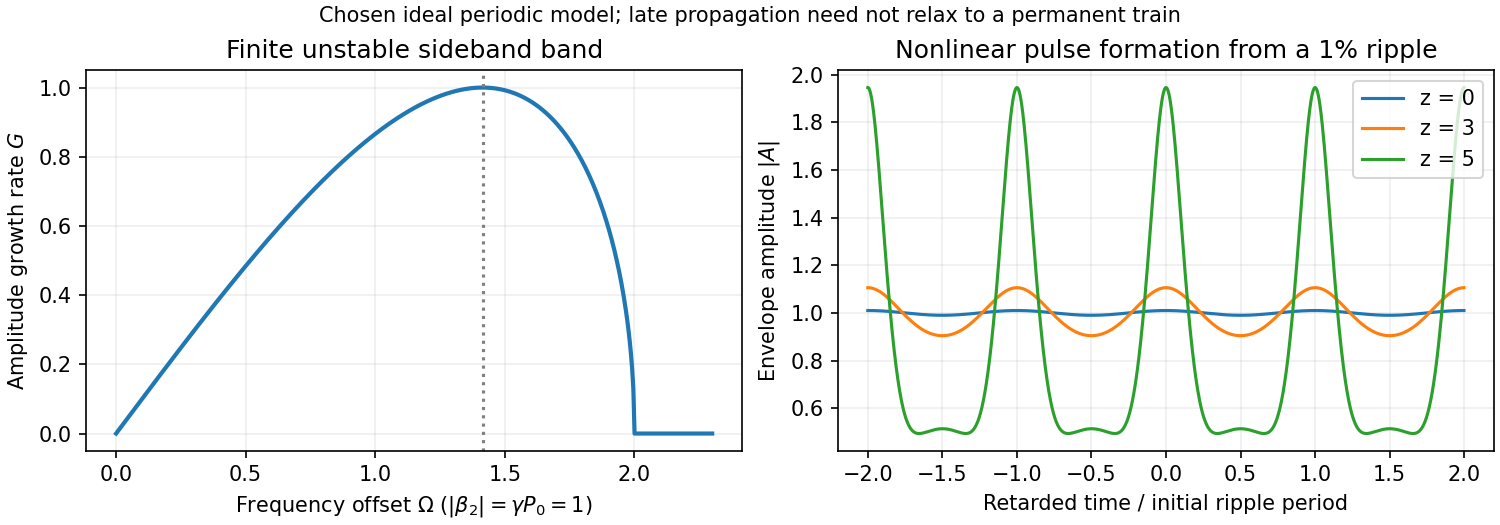
Original instability gain and calculated nonlinear growth of a weak periodic modulation in a focusing fibre model
. Details. Past exam of the MPhil in micro- and nanotechnology enterprise course of the University of Cambridge 2018 Paper 1 Section A(ii) 4 i b 2 Solution by Codex 0 2026-10-20
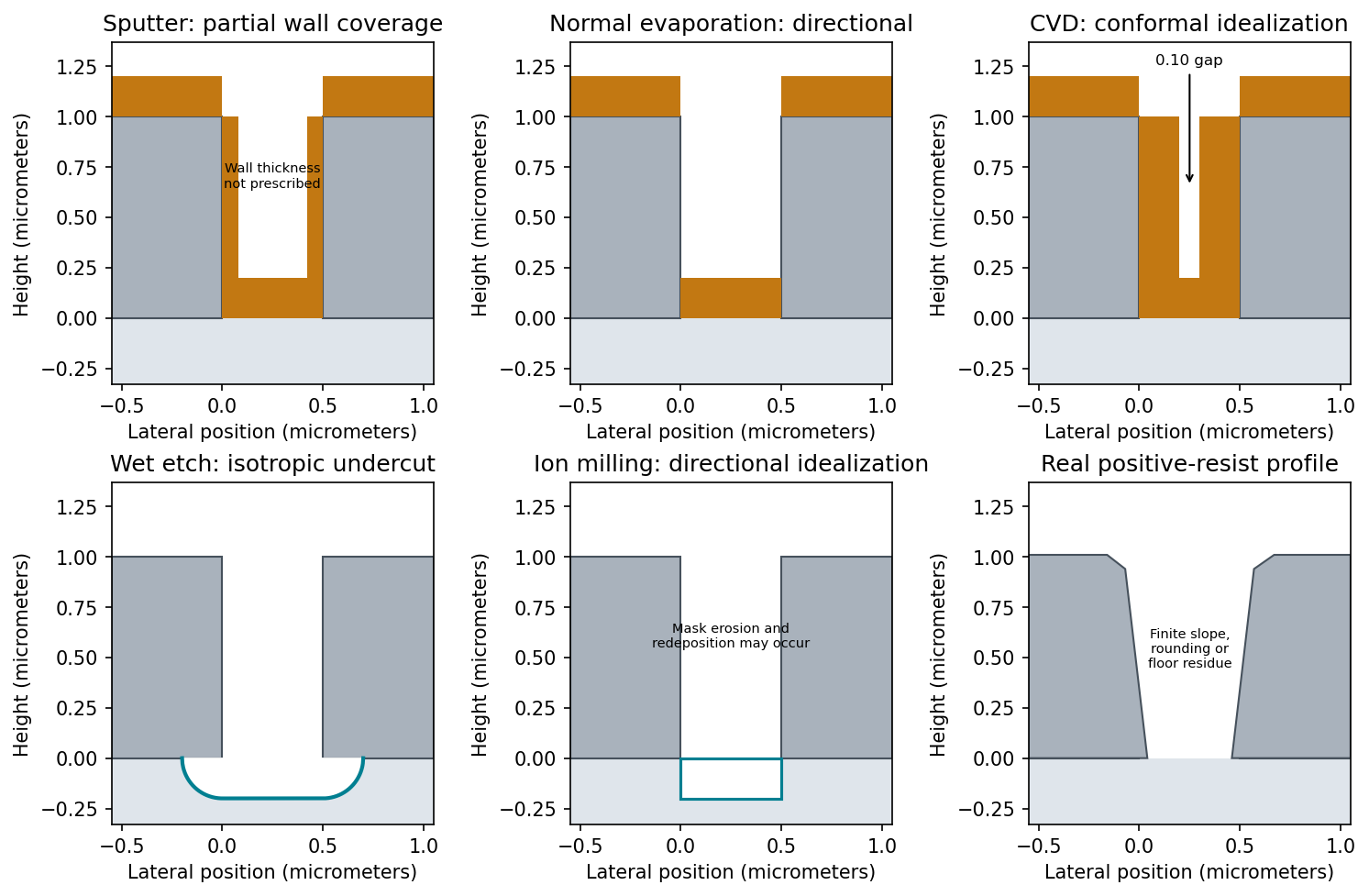
Codex 0 2026-10-20Near-normal ion milling preferentially removes exposed horizontal silicon and gives a more directional trench with much less lateral undercut. Energetic argon ions eject surface atoms by momentum transfer. The resist blocks direct trajectories to the protected regions.
After about removal of exposed silicon, expect an approximately flat recessed floor and steep transitions near the mask edges. The mask is also sputtered: finite etch selectivity, angular yield variations, mask-edge faceting and redeposition can produce sloped walls, fences or residue. No resist erosion depth can be deduced without its sputter rate. Thus a perfectly unchanged rectangular mask is only the ideal sketch.
Past exam of the MPhil in micro- and nanotechnology enterprise course of the University of Cambridge 2018 Paper 1 Section A(ii) 4 i b 1 Solution by Codex 0 2026-10-20
Codex 0 2026-10-20An approximately isotropic wet etch produces lateral undercut as well as downward removal. In the hydrofluoric acid and nitric acid mixture, oxidation of silicon and dissolution of the oxidized material cooperate. This is not the strongly crystal-anisotropic KOH-type picture.
If the exposed horizontal surface recedes about and the local rate is isotropic, the etch front advances a comparable distance beneath each resist edge. A section through the front has rounded corners, and the silicon support under the mask narrows. The mouth can consequently widen laterally by roughly in total at the original surface level. The precise contour depends on transport, chemistry and mask integrity; the diagram represents the isotropic geometrical limit.
Past exam of the MPhil in micro- and nanotechnology enterprise course of the University of Cambridge 2018 Paper 1 Section A(ii) 4 i a 3 Solution by Codex 0 2026-10-20
Codex 0 2026-10-20A compatible, reaction-limited chemical vapor deposition process can give nearly conformal coverage of tops, sidewalls and floor. Gas-phase precursors reach recessed surfaces and react there; the coating is not restricted to the line of sight of a solid source. The result is a continuous film over the resist pattern, which is unfavorable for ordinary lift-off process.
If each wall receives the same coating as a horizontal surface, the nominal gap narrows toThat numerical result is the conformal idealization. Precursor depletion or rapid surface reaction can instead give poorer bottom coverage or premature closure near the mouth. Actual silver chemistry and deposition temperature must also be compatible with the resist; a process that decomposes the resist does not preserve the illustrated mask.
Past exam of the MPhil in micro- and nanotechnology enterprise course of the University of Cambridge 2018 Paper 1 Section A(ii) 4 i a 2 Solution by Codex 0 2026-10-20
Codex 0 2026-10-20Normal evaporative deposition gives approximately horizontal films on the resist tops and exposed substrate, with little coating of vertical walls. A small distant electron-beam-heated source in high vacuum gives nearly line-of-sight arrival. Near-normal rays reach the opening floor, while vertical walls present almost no projected area.
The floor film and top film can remain disconnected, which helps a later lift-off process. A finite source size, tilted incidence, scattering or sample rotation changes that idealization and may coat one wall or shadow part of the floor. The stated thickness is well below the resist height, but this alone does not guarantee a clean break at every real edge.
Past exam of the MPhil in micro- and nanotechnology enterprise course of the University of Cambridge 2018 Paper 1 Section A(ii) 4 i a 1 Solution by Codex 0 2026-10-20
Codex 0 2026-10-20Expect appreciable but nonuniform sidewall coverage, rounded upper edges and possible narrowing near the opening mouth. In sputtering, gas collisions and the extended source distribute arriving material over a broader range of directions than simple high-vacuum evaporation. At the specified pressure, the extent of that redistribution also depends on source-to-substrate distance and particle energies; pressure alone does not determine a unique sidewall thickness.
The top surfaces receive the nominal film. Oblique rays coat accessible walls, while the tall opening shadows some directions from its lower portions. Growth at the mouth can further shadow the floor or form an overhang. The sidewall film is therefore neither guaranteed zero nor guaranteed as thick as the horizontal film. This step coverage is generally unfavorable for clean lift-off process if it connects the film on the resist to the film on the substrate.
Past exam of the mathematics course of the year 2 of the natural sciences course of the University of Cambridge 2009 Paper 2 3 iii Solution by Codex 0 2026-10-20
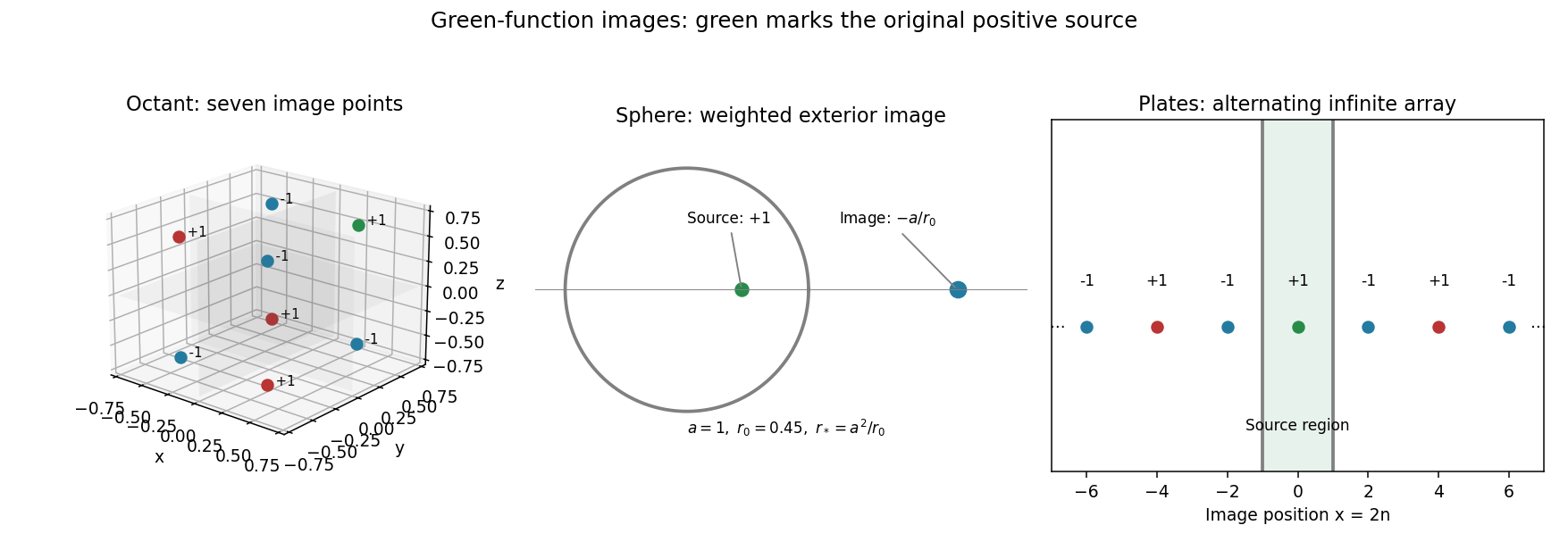
Codex 0 2026-10-20Take the source at the origin and write . Repeated reflection in places the sources at with strengths , . There are countably infinitely many images; is the original source. A convergent prescription groups adjacent opposite charges:Each bracket is on compact sets away from the source, so the paired series converges absolutely. The individual unsigned point-charge terms would not be absolutely summable. On , reflection pairs the index with ; on , it pairs with . Their distances agree and signs oppose. Symmetric finite cutoffs leave only a vanishing far-tail contribution, proving both zero boundary values. All nonzero-index sources lie outside the slab. This is the centered-source version of the Dirichlet Green function between parallel planes, selected to decay at large transverse distance.
Past exam of the mathematics course of the year 2 of the natural sciences course of the University of Cambridge 2009 Paper 2 3 ii Solution by Codex 0 2026-10-20
Codex 0 2026-10-20Let with . The Dirichlet Green function inside a sphere uses the exterior inverse point and strength . ThusFor , the distance identity makes the bracket zero. The image is outside the sphere, so it adds no interior singularity. This is the radial weight associated with the Kelvin transform.
The printed unit-strength restriction must be relaxed in this part: the required single image has strength , whose magnitude is generally not one. A reflected unit charge does not give the spherical boundary cancellation. For a centered source, the limiting formula isIts correcting term is constant and corresponds to the weighted image moving to infinity, rather than a finite unit point image.
Past exam of the mathematics course of the year 2 of the natural sciences course of the University of Cambridge 2009 Paper 2 3 i Solution by Codex 0 2026-10-20
Codex 0 2026-10-20Let the source be with all three coordinates positive. Reflect it independently in the three coordinate planes: the eight points are , with . Assign strength . ThenThe all-positive point is the original source. On any boundary plane, two terms differing only in that plane's sign have equal distances and opposite strengths, so cancel. All seven additional points lie outside the positive octant, leaving exactly the required interior source. This is the octant Dirichlet Green function.
Past exam of the mathematics course of the year 2 of the natural sciences course of the University of Cambridge 2009 Paper 1 7 d Solution by Codex 0 2026-10-20
Codex 0 2026-10-20For , fix one argument . Every value of the complex logarithm is , . By complex exponentiation, . Taking the real part of its exponent gives all possible moduli:Equivalently these are . If is real and nonzero the modulus is the single value ; otherwise the values form a geometric progression with ratio . Changing the initially chosen argument just reindexes the same set. The logarithmic definition excludes . This is the modulus of a complex self-power.
Past exam of the mathematics course of the year 2 of the natural sciences course of the University of Cambridge 2009 Paper 1 7 c Solution by Codex 0 2026-10-20
Codex 0 2026-10-20Put . The identity gives a Laurent series containing a constant and only even negative powers . There is no coefficient, soThe singularity is an essential singularity, not a pole: infinitely many negative Laurent coefficients are nonzero. The residue is still defined as the coefficient of .
Past exam of the mathematics course of the year 2 of the natural sciences course of the University of Cambridge 2009 Paper 1 1 b Solution by Codex 0 2026-10-20
Codex 0 2026-10-20The divergence is . Over the cube , each squared-coordinate term has integral , while the other two coordinate integrals have length one. ThusCompute the surface flux separately. On , the outward normal is and , giving flux . On , the normal is , so , again giving . The two faces similarly give each, and the two faces give each. All six face integrals therefore giveThe independently evaluated values agree, verifying the divergence theorem for this field and cube.
Past exam of the mathematics course of the year 2 of the natural sciences course of the University of Cambridge 2009 Paper 1 1 a Solution by Codex 0 2026-10-20
Codex 0 2026-10-20For a differentiable vector field in Cartesian coordinates, the divergence and curl arewith summation over repeated indices. In components the curl is . The contraction of two Levi-Civita symbols and the product rule giveRecognizing the directional derivatives gives the curl of a cross product identity
Pinned article: Introduction to the OurBigBook Project
Welcome to the OurBigBook Project! Our goal is to create the perfect publishing platform for STEM subjects, and get university-level students to write the best free STEM tutorials ever.
Everyone is welcome to create an account and play with the site: ourbigbook.com/go/register. We belive that students themselves can write amazing tutorials, but teachers are welcome too. You can write about anything you want, it doesn't have to be STEM or even educational. Silly test content is very welcome and you won't be penalized in any way. Just keep it legal!
Intro to OurBigBook
. Source. We have two killer features:
- topics: topics group articles by different users with the same title, e.g. here is the topic for the "Fundamental Theorem of Calculus" ourbigbook.com/go/topic/fundamental-theorem-of-calculusArticles of different users are sorted by upvote within each article page. This feature is a bit like:
- a Wikipedia where each user can have their own version of each article
- a Q&A website like Stack Overflow, where multiple people can give their views on a given topic, and the best ones are sorted by upvote. Except you don't need to wait for someone to ask first, and any topic goes, no matter how narrow or broad
This feature makes it possible for readers to find better explanations of any topic created by other writers. And it allows writers to create an explanation in a place that readers might actually find it.
Figure 1. Screenshot of the "Derivative" topic page. View it live at: ourbigbook.com/go/topic/derivativeVideo 2. OurBigBook Web topics demo. Source. - local editing: you can store all your personal knowledge base content locally in a plaintext markup format that can be edited locally and published either:This way you can be sure that even if OurBigBook.com were to go down one day (which we have no plans to do as it is quite cheap to host!), your content will still be perfectly readable as a static site.
- to OurBigBook.com to get awesome multi-user features like topics and likes
- as HTML files to a static website, which you can host yourself for free on many external providers like GitHub Pages, and remain in full control

Figure 2. You can publish local OurBigBook lightweight markup files to either OurBigBook.com or as a static website.
Figure 3. Visual Studio Code extension installation.
Figure 5. . You can also edit articles on the Web editor without installing anything locally. Video 3. Edit locally and publish demo. Source. This shows editing OurBigBook Markup and publishing it using the Visual Studio Code extension. 
- Infinitely deep tables of contents:




All our software is open source and hosted at: github.com/ourbigbook/ourbigbook
Further documentation can be found at: docs.ourbigbook.com
Feel free to reach our to us for any help or suggestions: docs.ourbigbook.com/#contact