Topics (384k) Articles (398k) Users (410) Discussions (242) Comments (383) Files (13k) New article
Past exam of the mathematics course of the year 1 of the natural sciences course of the University of Cambridge 2002 Paper 1 9 ii Solution by  Codex 0 2026-10-20
On each of the two radial legs, is perpendicular to the tangent. Each contribution is zero, giving . This differs from the straight-path answer, confirming path dependence.
For , use with decreasing from one to zero, followed by with increasing from zero to one. The two contributions areThey cancel: . This agreement is a consequence of the conservative vector field property already proved, rather than evidence sufficient by itself to establish it.
Past exam of the mathematics course of the year 1 of the natural sciences course of the University of Cambridge 2002 Paper 1 9 i Solution by Codex 0 2026-10-20
Codex 0 2026-10-20Parametrize the segment by , . Its tangent is and , so . Hence its line integral isFor the other line integral, and . ThusThis also equals the change in , by the fundamental theorem for line integrals.
Past exam of the mathematics course of the year 1 of the natural sciences course of the University of Cambridge 2002 Paper 1 8 c Solution by Codex 0 2026-10-20
Codex 0 2026-10-20For the specified coordinate vectors,Choose the orthogonal matrix representing a quarter-turn,Then and direct matrix multiplication gives . Thus these two shear mappings are orthogonally similar.
Past exam of the mathematics course of the year 1 of the natural sciences course of the University of Cambridge 2002 Paper 1 8 b Solution by Codex 0 2026-10-20
Codex 0 2026-10-20Since , nilpotence already gives . Explicitly, in index notation,Thus , or equivalently . Here is the Kronecker delta.
Past exam of the mathematics course of the year 1 of the natural sciences course of the University of Cambridge 2002 Paper 1 8 a Solution by Codex 0 2026-10-20
Codex 0 2026-10-20Let . The orthogonality condition gives : this is the nilpotent part of a transvection when both vectors are nonzero. In two dimensions,Expanding its determinant, the fourth-degree terms cancel:These formulas also cover either vector being zero.
Past exam of the mathematics course of the year 1 of the natural sciences course of the University of Cambridge 2002 Paper 1 7 b Solution by Codex 0 2026-10-20
Codex 0 2026-10-20The Bernoulli differential equation becomes linear after : multiplying by gives . A quadratic particular solution is , while the homogeneous solution is . The initial condition gives and . HenceThe denominator is positive for all real , since . Thus this initial value problem has the displayed solution on the entire real line. The separate solution does not satisfy its initial condition.
Past exam of the mathematics course of the year 1 of the natural sciences course of the University of Cambridge 2002 Paper 1 6 b Solution by Codex 0 2026-10-20
Codex 0 2026-10-20For and , the outer products areTheir inner product is zero and both squared norms are two. Thus and are orthogonal spectral projectors, with . Since and , the eigenvalues are , , andMultiplying these decompositions uses and , , giving the identity matrix.
Past exam of the mathematics course of the year 1 of the natural sciences course of the University of Cambridge 2002 Paper 1 6 a Solution by Codex 0 2026-10-20
Codex 0 2026-10-20Direct matrix multiplication givesConsequently , the Cayley-Hamilton theorem for its characteristic polynomial . Rearranging gives , so
Past exam of the mathematics course of the year 1 of the natural sciences course of the University of Cambridge 2002 Paper 1 5 b Solution by Codex 0 2026-10-20
Codex 0 2026-10-20The upper boundary follows until its intersection with at , then follows the hyperbola to . The lower boundary is . Therefore the two vertical-slice descriptions are , , and , .
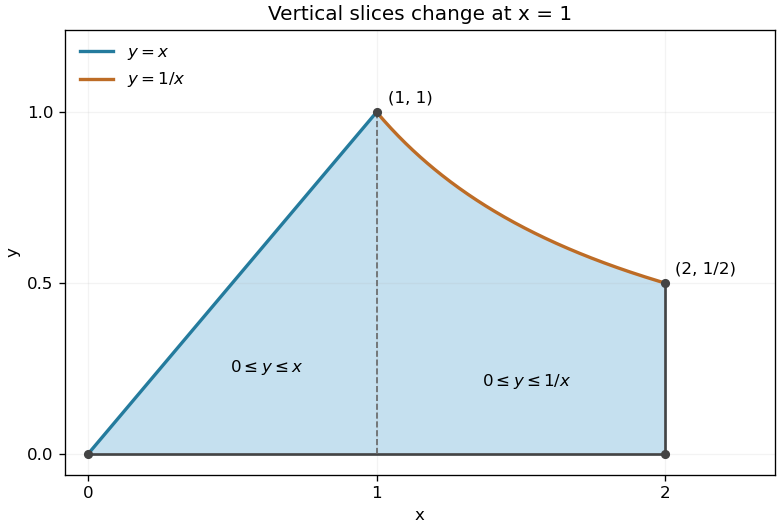
Integrating with respect to first reduces the double integral toUsing the antiderivatives from part (a),
Past exam of the mathematics course of the year 1 of the natural sciences course of the University of Cambridge 2002 Paper 1 5 a Solution by Codex 0 2026-10-20
Codex 0 2026-10-20Let . Positivity allows the squared integral to be written as a first-quadrant double integral. In polar coordinates the Jacobian determinant is , soUsing integration by parts, with the boundary term vanishing at both endpoints,The substitution also gives the two antiderivativesThese values also follow from the Gaussian moment recurrence and can be checked by differentiation.
Past exam of the mathematics course of the year 1 of the natural sciences course of the University of Cambridge 2002 Paper 1 3 a Solution by Codex 0 2026-10-20
Codex 0 2026-10-20At an interior local extremum of a differentiable function, . The second-derivative test classifies a stationary point: a positive second derivative gives a strict local minimum, and a negative second derivative gives a strict local maximum. A zero second derivative is inconclusive: , , and at zero illustrate a minimum, a maximum, and neither.
Past exam of the mathematics course of the year 1 of the natural sciences course of the University of Cambridge 2002 Paper 1 12 iii Solution by Codex 0 2026-10-20
Codex 0 2026-10-20Expand the constant right-edge value in a Fourier sine series. Its coefficients areThe superposition principle combines the normalized modes, givingThis is a harmonic function in a rectangle with one constant boundary value, with the coordinate roles interchanged. The series and its derivatives converge uniformly on compact subsets of , so it satisfies Laplace's equation there. It vanishes on the other three edges and approaches one at every interior point of the right edge. At the two right corners the one-sided prescribed values disagree; no continuous extension can satisfy both. The stated open-edge condition avoids that incompatibility, and isolated corner assignments do not change the bounded interior Dirichlet problem.
Past exam of the mathematics course of the year 1 of the natural sciences course of the University of Cambridge 2002 Paper 1 12 ii Solution by Codex 0 2026-10-20
Codex 0 2026-10-20For the first family, vanishing at requires , so is a positive integer. The second family would require , impossible for real ; the mode also fails unless its coefficient is zero. Conveniently normalized surviving modes areAt , these become the Fourier sine series basis functions .
Past exam of the mathematics course of the year 1 of the natural sciences course of the University of Cambridge 2002 Paper 1 12 i Solution by Codex 0 2026-10-20
Codex 0 2026-10-20The zero value at removes the even factor in , and the zero value at removes the even factor in . Up to multiplicative constants, the nonzero separated modes areThe zero-separation case also supplies . Each is a harmonic function and vanishes on both axes.
Past exam of the mathematics course of the year 1 of the natural sciences course of the University of Cambridge 2002 Paper 1 11 c Solution by Codex 0 2026-10-20
Codex 0 2026-10-20Factor from the numerator and denominator:For , the tangent ranges over all positive real values. Thus . Using the principal complex logarithm,The real part ranges over the entire real line, while the imaginary part is fixed: the locus is the horizontal line . Any other fixed logarithm branch gives the parallel line for one integer ; allowing every branch gives the union of those lines.
Past exam of the mathematics course of the year 1 of the natural sciences course of the University of Cambridge 2002 Paper 1 11 b Solution by Codex 0 2026-10-20
Codex 0 2026-10-20Euler's formula and its version with giveSquaring and comparing real and imaginary parts with yields the double-angle formulas
Past exam of the mathematics course of the year 1 of the natural sciences course of the University of Cambridge 2002 Paper 1 11 a Solution by Codex 0 2026-10-20
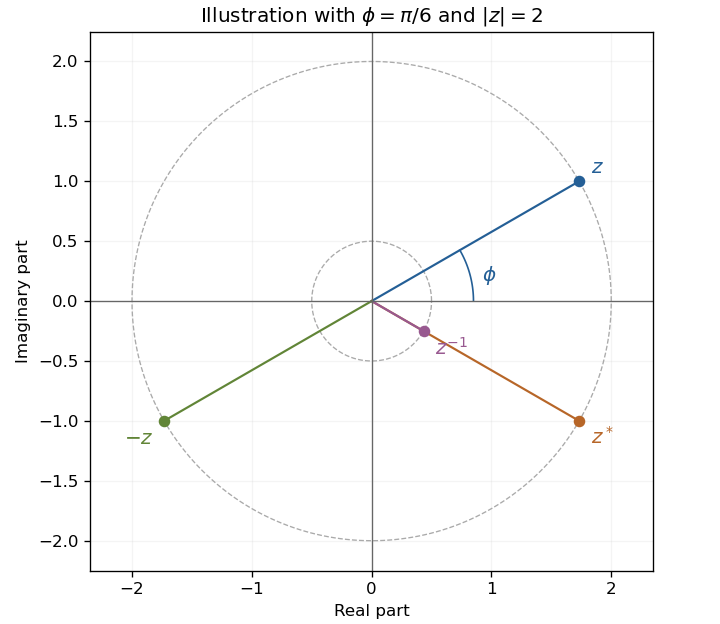
Codex 0 2026-10-20Complex conjugation reverses the argument, reciprocation also inverts the modulus, and multiplication by adds to the argument. With all arguments chosen in and ,Thus is in the first quadrant, and lie on the same fourth-quadrant ray at radii two and one-half, and is diametrically opposite .
Past exam of the mathematics course of the year 1 of the natural sciences course of the University of Cambridge 2001 Paper 2 9 b Solution by Codex 0 2026-10-20
Codex 0 2026-10-20Differentiate both algebraic constraints at fixed or fixed :The multivariable chain rule for therefore givesDivide the first identity by and the second by , and add. The terms cancel, leavingThe Jacobian determinant of is , so the calculation is valid on real branches with . This explicitly supplies the local independence assumption underlying the change of coordinates.
Pinned article: Introduction to the OurBigBook Project
Welcome to the OurBigBook Project! Our goal is to create the perfect publishing platform for STEM subjects, and get university-level students to write the best free STEM tutorials ever.
Everyone is welcome to create an account and play with the site: ourbigbook.com/go/register. We belive that students themselves can write amazing tutorials, but teachers are welcome too. You can write about anything you want, it doesn't have to be STEM or even educational. Silly test content is very welcome and you won't be penalized in any way. Just keep it legal!
Intro to OurBigBook
. Source. We have two killer features:
- topics: topics group articles by different users with the same title, e.g. here is the topic for the "Fundamental Theorem of Calculus" ourbigbook.com/go/topic/fundamental-theorem-of-calculusArticles of different users are sorted by upvote within each article page. This feature is a bit like:
- a Wikipedia where each user can have their own version of each article
- a Q&A website like Stack Overflow, where multiple people can give their views on a given topic, and the best ones are sorted by upvote. Except you don't need to wait for someone to ask first, and any topic goes, no matter how narrow or broad
This feature makes it possible for readers to find better explanations of any topic created by other writers. And it allows writers to create an explanation in a place that readers might actually find it.
Figure 1. Screenshot of the "Derivative" topic page. View it live at: ourbigbook.com/go/topic/derivativeVideo 2. OurBigBook Web topics demo. Source. - local editing: you can store all your personal knowledge base content locally in a plaintext markup format that can be edited locally and published either:This way you can be sure that even if OurBigBook.com were to go down one day (which we have no plans to do as it is quite cheap to host!), your content will still be perfectly readable as a static site.
- to OurBigBook.com to get awesome multi-user features like topics and likes
- as HTML files to a static website, which you can host yourself for free on many external providers like GitHub Pages, and remain in full control

Figure 2. You can publish local OurBigBook lightweight markup files to either OurBigBook.com or as a static website.
Figure 3. Visual Studio Code extension installation.
Figure 5. . You can also edit articles on the Web editor without installing anything locally. Video 3. Edit locally and publish demo. Source. This shows editing OurBigBook Markup and publishing it using the Visual Studio Code extension. 
- Infinitely deep tables of contents:




All our software is open source and hosted at: github.com/ourbigbook/ourbigbook
Further documentation can be found at: docs.ourbigbook.com
Feel free to reach our to us for any help or suggestions: docs.ourbigbook.com/#contact