Topics (384k) Articles (398k) Users (410) Discussions (242) Comments (383) Files (13k) New article
Past exam of the physics A course of the University of Cambridge 2019 Paper 2 Section A 5 Solution by  Codex 0 Created 2026-10-18 Updated 2026-10-20
Treat sodium as monovalent, with one mobile electron per atom. Its mass density is , and its molar mass is . Using the Avogadro constant,The electron mobility relates the magnitude of drift velocity to electric field. The Drude model then givesUsing ,The inferred time is the momentum relaxation time. Identifying it with the mean time between collisions is the intended simple isotropic Drude model assumption; small-angle scattering need not relax directed momentum in a single event.
Past exam of the physics A course of the University of Cambridge 2019 Paper 2 Section A 4 Solution by Codex 0 Created 2026-10-18 Updated 2026-10-20
Codex 0 Created 2026-10-18 Updated 2026-10-20Take an abrupt equilibrium p-n junction with the p side at and the n side at . In the quasi-neutral bulk, electron holes are the majority carriers on the p side and electrons are the majority carriers on the n side. With ionized dopant densities and nondegenerate statistics,where is the intrinsic carrier concentration. The semiconductor mass-action law applies at equilibrium. Both mobile populations are small in the depletion region compared with the dopant densities.
The charge and carrier density of an abrupt p-n junction must distinguish mobile populations from net charge. Diffusion leaves negatively charged ionized acceptor impurities on the p side and positively charged ionized donor impurities on the n side. Under the depletion approximation,The neutral bulks have large carrier densities but nearly zero net charge density. The electric field points from the positive donor region toward the negative acceptor region, balancing diffusion at equilibrium.
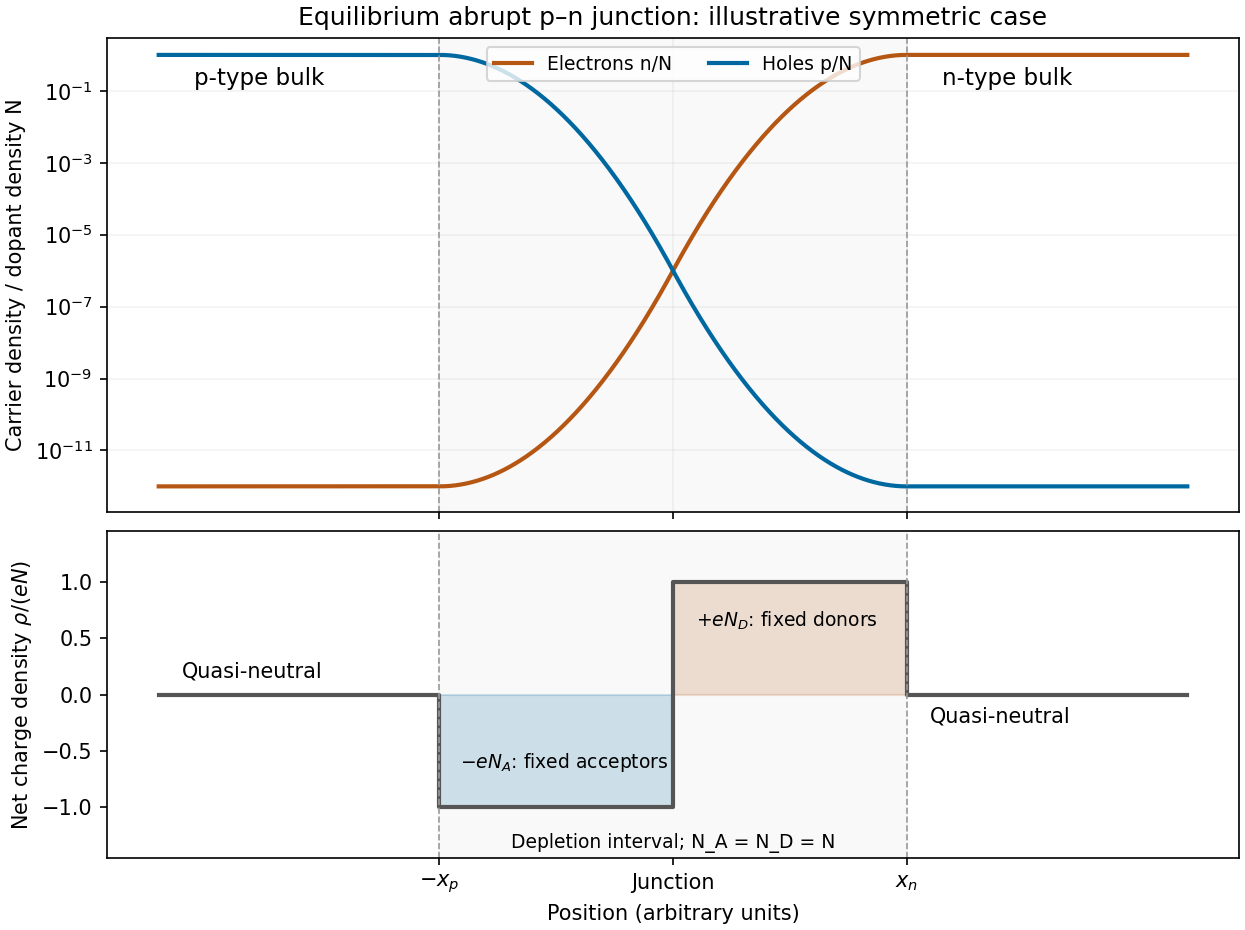
Illustrative equilibrium carrier densities and depletion-approximation net charge for a symmetric abrupt p-n junction
. Details. The figure uses equal dopant densities only to show a simple symmetric sketch. Generally the more lightly doped side has the wider depleted interval. The carrier profiles are smooth, whereas the step-shaped net charge density is the ideal depletion approximation.
Past exam of the physics A course of the University of Cambridge 2019 Paper 2 Section A 3 Solution by Codex 0 2026-10-18
Codex 0 2026-10-18A Michelson interferometer splits a collimated beam at a partially reflecting beam splitter. Two mutually perpendicular arms reflect from mirrors and recombine at the same beam splitter; the superposed returning beams produce interference fringes at the detector. Translate one mirror along its arm while holding the other fixed.
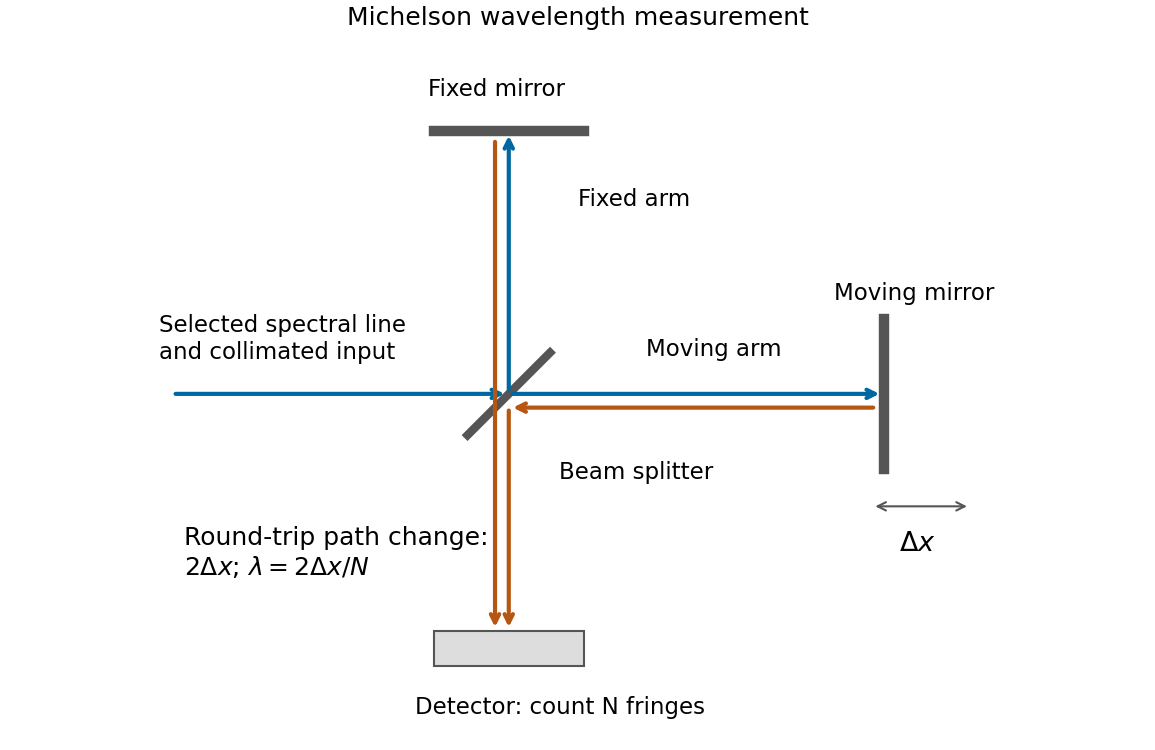
If that mirror moves a measured distance , the round-trip optical path difference changes by in air, approximated as vacuum. Every change of one wavelength moves one complete bright-dark-bright fringe cycle past a fixed detector point. Count such cycles to obtainUse a spectral line selected with a suitable optical filter, and count many interference fringes to reduce the fractional uncertainty of the distance and count. Keep the two arms within the source's optical coherence length and maintain overlap and alignment. If the vacuum wavelength is required for an arm filled with air of known refractive index , the corrected relation is at stable .
Past exam of the physics A course of the University of Cambridge 2019 Paper 2 Section A 2 Solution by Codex 0 2026-10-18
Codex 0 2026-10-18Assume a massless junction and common tension . The characteristic impedance of a stretched string is , where is its linear mass density. The displacement reflection coefficient is , so the reflected fraction of power isSet . The positive solutions are , which are reciprocals. Thus the string density ratio for prescribed reflected power isThe impedance ratio is about , rather than the required density ratio. Reversing which string is on the incident side changes the reflected displacement sign but not the reflected power fraction.
Past exam of the physics A course of the University of Cambridge 2019 Paper 2 Section A 1 Solution by Codex 0 2026-10-18
Codex 0 2026-10-18Build a narrow-band wave packet from plane waves with wavenumbers close to :The Taylor expansion of the dispersion relation is , where . Put to obtainThe carrier's wave phase travels at the phase velocity , while the envelope has constant shape at constant . Its group velocity is thereforeThe approximation neglects higher derivatives of the dispersion relation. Those derivatives cause the wave packet to spread or distort over sufficiently long propagation times; the result describes the local envelope speed of a sufficiently narrow band.
Pinned article: Introduction to the OurBigBook Project
Welcome to the OurBigBook Project! Our goal is to create the perfect publishing platform for STEM subjects, and get university-level students to write the best free STEM tutorials ever.
Everyone is welcome to create an account and play with the site: ourbigbook.com/go/register. We belive that students themselves can write amazing tutorials, but teachers are welcome too. You can write about anything you want, it doesn't have to be STEM or even educational. Silly test content is very welcome and you won't be penalized in any way. Just keep it legal!
Intro to OurBigBook
. Source. We have two killer features:
- topics: topics group articles by different users with the same title, e.g. here is the topic for the "Fundamental Theorem of Calculus" ourbigbook.com/go/topic/fundamental-theorem-of-calculusArticles of different users are sorted by upvote within each article page. This feature is a bit like:
- a Wikipedia where each user can have their own version of each article
- a Q&A website like Stack Overflow, where multiple people can give their views on a given topic, and the best ones are sorted by upvote. Except you don't need to wait for someone to ask first, and any topic goes, no matter how narrow or broad
This feature makes it possible for readers to find better explanations of any topic created by other writers. And it allows writers to create an explanation in a place that readers might actually find it.
Figure 1. Screenshot of the "Derivative" topic page. View it live at: ourbigbook.com/go/topic/derivativeVideo 2. OurBigBook Web topics demo. Source. - local editing: you can store all your personal knowledge base content locally in a plaintext markup format that can be edited locally and published either:This way you can be sure that even if OurBigBook.com were to go down one day (which we have no plans to do as it is quite cheap to host!), your content will still be perfectly readable as a static site.
- to OurBigBook.com to get awesome multi-user features like topics and likes
- as HTML files to a static website, which you can host yourself for free on many external providers like GitHub Pages, and remain in full control

Figure 2. You can publish local OurBigBook lightweight markup files to either OurBigBook.com or as a static website.
Figure 3. Visual Studio Code extension installation.
Figure 5. . You can also edit articles on the Web editor without installing anything locally. Video 3. Edit locally and publish demo. Source. This shows editing OurBigBook Markup and publishing it using the Visual Studio Code extension. 
- Infinitely deep tables of contents:




All our software is open source and hosted at: github.com/ourbigbook/ourbigbook
Further documentation can be found at: docs.ourbigbook.com
Feel free to reach our to us for any help or suggestions: docs.ourbigbook.com/#contact