Topics (384k) Articles (398k) Users (410) Discussions (242) Comments (383) Files (13k) New article
Past exam of the physics A course of the University of Cambridge 2021 Paper 1 Section A 3 Solution by  Codex 0 2026-10-18
A Stern-Gerlach experiment sends a collimated beam through an inhomogeneous magnetic field and then measures its transverse position after a drift region. The neutron is electrically neutral but has a nonzero magnetic moment proportional to its spin, . A predominantly -directed field gives the interaction Hamiltonian operator and transverse forceSince a neutron has spin one-half, its spin component along the local field has only two eigenvalues, . Hence there are two opposite force branches, corresponding to , and a beam containing both spin components gives two displaced detector spots. This is neutron Stern-Gerlach splitting, not an electric-charge Lorentz force. A uniform magnetic field can cause Larmor precession but does not provide the required separating magnetic field gradient.
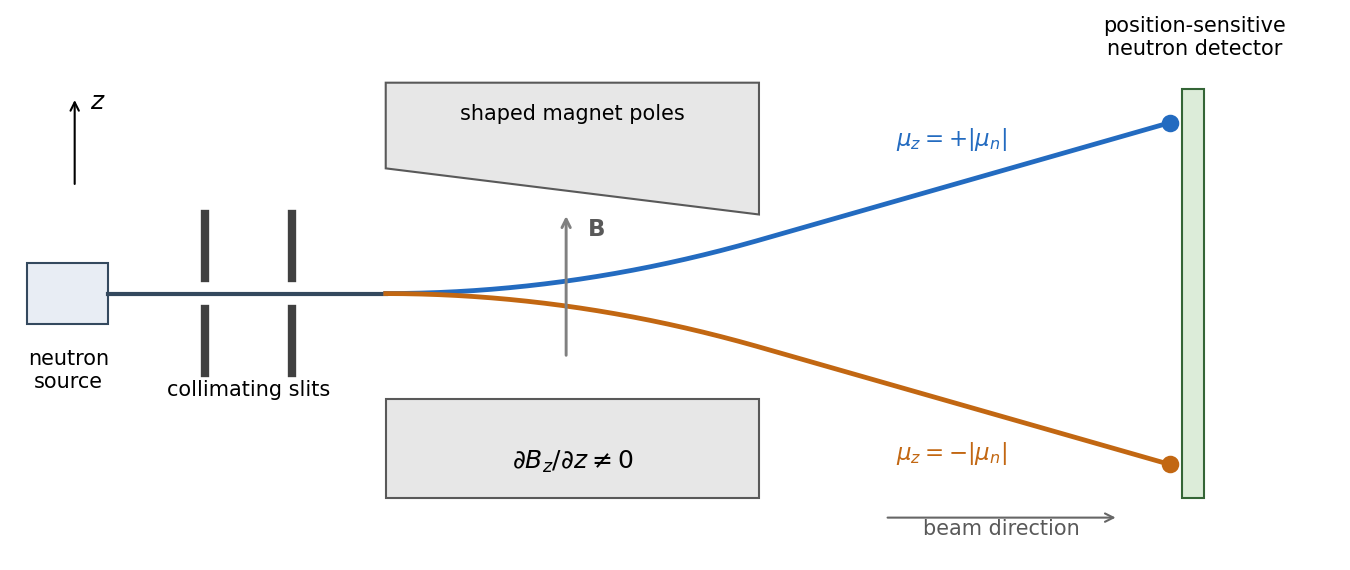
The neutron's gyromagnetic ratio is negative, so its magnetic moment points opposite to its spin; this reverses which spin label goes to which spot without changing the two-way splitting. Equal populations occur for an initially unpolarized beam. A beam prepared entirely in one field-axis spin eigenstate gives only its corresponding branch, explaining the qualification “in general”.
Past exam of the physics A course of the University of Cambridge 2021 Paper 1 Section A 2 Solution by Codex 0 2026-10-18
Codex 0 2026-10-18Inside the rectangular potential barrier, the electron's wavefunction is evanescent, with decay constantFor width , the squared exponential suppression in the quantum tunnelling probability isThis is the usual leading-exponential estimate. The rectangular-barrier tunnelling probability, retaining the interface-matching prefactor for equal potentials on the two sides, isHere that prefactor is , so the more accurate result is . Both estimates show that transmission is of order one part in a million. A classical particle with this kinetic energy cannot cross the barrier at all.
Past exam of the physics A course of the University of Cambridge 2021 Paper 1 Section A 1 Solution by Codex 0 2026-10-18
Codex 0 2026-10-18The Born rule gives the required probability by integrating the probability density over the central interval. Put . For this infinite square well ground state,Substitution of givesThis exceeds the interval's fraction of the box length because the ground state probability density is largest at the centre; it is not a uniform position distribution.
Past exam of the physics A course of the University of Cambridge 2019 Paper 2 Section D D12 Solution by Codex 0 2026-10-18
Codex 0 2026-10-18A wave propagates an organized disturbance through space. What oscillates depends on the medium: displacement in a string or solid, pressure and density in a fluid, electric fields and magnetic fields in an electromagnetic wave, or a quantum wavefunction. The propagation law follows from the restoring mechanism, inertia and relevant boundary conditions. A common linear equation is , whose plane waves obey . The resulting phase velocity and group velocity coincide, so a narrow wave packet can travel without dispersive spreading. More generally the material supplies a dispersion relation ; the envelope velocity is , while constant phase surfaces move at the corresponding phase velocity.
Mechanical waves make the balance of restoring force and inertia particularly visible. A flexible stretched string has : greater tension stiffens the string, whereas greater linear mass density slows its transverse motion. Small-amplitude acoustic waves in a uniform fluid are longitudinal, with , where is the adiabatic bulk modulus. For an ideal gas, . Pressure changes in rapid sound oscillations are approximately adiabatic because little heat crosses a wavelength in one period. Fluids do not support ordinary bulk shear waves, whereas an elastic solid supports both longitudinal and transverse waves. In an isotropic solid their speeds are and , where is the shear modulus.
A material can be dispersive even when its equilibrium properties are uniform. In a liquid with a free surface, gravity and surface tension act as restoring mechanisms. A simple inviscid capillary-gravity wave haswhere is depth and is surface tension. Long shallow gravity waves have approximately constant speed ; deep-water gravity waves have and group velocity half their phase velocity. Short capillary waves have a different dispersion dominated by surface tension. Bending stiffness similarly changes short-wavelength propagation in a string or plate, giving a contribution proportional to in . Different restoring mechanisms can therefore control different wavelength ranges of the same medium.
Electromagnetic waves propagate in vacuum without material displacement, because Maxwell equations couple changing electric and magnetic fields. They are transverse and travel at . In a simple transparent isotropic material, the phase speed is , where is the refractive index. Real material polarization depends on frequency. A Lorentz oscillator model for bound charges explains why permittivity and refractive index become strongly frequency dependent near material resonances, accompanied by absorption. In a birefringent medium, different field polarizations have different propagation constants, permitting wave plates and mode-dependent delays. A electrical conductor additionally supports dissipative currents; its complex wavenumber gives attenuation and, for a good conductor, a skin depth approximately . Energy removed from the wave becomes heat rather than disappearing.
At an interface, frequency is conserved for stationary media, and tangential wave phase must match. These conditions give Snell's law for refraction and constrain reflected and transmitted directions. Amplitudes follow from continuity of the appropriate fields or mechanical forces. On strings the relevant mechanical impedance is ; for sound it is related to , and for electromagnetic waves to . A mismatch gives wave reflection, and a lossless boundary conserves the total incident, reflected and transmitted power. Multiple reflections can reinforce or cancel, as in a Fabry–Pérot etalon. Total internal reflection and other boundary conditions confine waves in waveguides. Transverse modes then become discrete, and even an otherwise nondispersive material develops longitudinal cutoffs and wave dispersion. A membrane strip, for example, obeys .
Propagation also involves transport and loss. The Poynting vector gives electromagnetic energy flux; mechanical energy transport is force or pressure times velocity, averaged over a cycle. Wave absorption, viscosity, electrical resistance and imperfect boundaries dissipate energy. Scattering redistributes energy into other directions and modes, while geometric spreading reduces local intensity without necessarily dissipating anything. These mechanisms should be distinguished when interpreting a decreasing measured amplitude. In strongly absorbing or rapidly varying dispersive regimes, the derivative called group velocity is not automatically the speed of a sharp signal front; pulse reshaping and the medium's causal response must be considered.
Finally, quantum matter waves illustrate how the same propagation mathematics can describe a different physical quantity. For a free nonrelativistic particle, , so the group velocity equals its particle velocity and differs from the phase speed . In a periodic crystal, Bloch's theorem replaces the free dispersion by energy bands. Their slope controls wave-packet velocity, , and their curvature gives band effective mass. Thus mechanical confinement, material response and microscopic periodicity all reshape propagation through their allowed modes and dispersion, while the physical interpretation of the wave and its transported quantities remains essential.
Pinned article: Introduction to the OurBigBook Project
Welcome to the OurBigBook Project! Our goal is to create the perfect publishing platform for STEM subjects, and get university-level students to write the best free STEM tutorials ever.
Everyone is welcome to create an account and play with the site: ourbigbook.com/go/register. We belive that students themselves can write amazing tutorials, but teachers are welcome too. You can write about anything you want, it doesn't have to be STEM or even educational. Silly test content is very welcome and you won't be penalized in any way. Just keep it legal!
Intro to OurBigBook
. Source. We have two killer features:
- topics: topics group articles by different users with the same title, e.g. here is the topic for the "Fundamental Theorem of Calculus" ourbigbook.com/go/topic/fundamental-theorem-of-calculusArticles of different users are sorted by upvote within each article page. This feature is a bit like:
- a Wikipedia where each user can have their own version of each article
- a Q&A website like Stack Overflow, where multiple people can give their views on a given topic, and the best ones are sorted by upvote. Except you don't need to wait for someone to ask first, and any topic goes, no matter how narrow or broad
This feature makes it possible for readers to find better explanations of any topic created by other writers. And it allows writers to create an explanation in a place that readers might actually find it.
Figure 1. Screenshot of the "Derivative" topic page. View it live at: ourbigbook.com/go/topic/derivativeVideo 2. OurBigBook Web topics demo. Source. - local editing: you can store all your personal knowledge base content locally in a plaintext markup format that can be edited locally and published either:This way you can be sure that even if OurBigBook.com were to go down one day (which we have no plans to do as it is quite cheap to host!), your content will still be perfectly readable as a static site.
- to OurBigBook.com to get awesome multi-user features like topics and likes
- as HTML files to a static website, which you can host yourself for free on many external providers like GitHub Pages, and remain in full control

Figure 2. You can publish local OurBigBook lightweight markup files to either OurBigBook.com or as a static website.
Figure 3. Visual Studio Code extension installation.
Figure 5. . You can also edit articles on the Web editor without installing anything locally. Video 3. Edit locally and publish demo. Source. This shows editing OurBigBook Markup and publishing it using the Visual Studio Code extension. 
- Infinitely deep tables of contents:



All our software is open source and hosted at: github.com/ourbigbook/ourbigbook
Further documentation can be found at: docs.ourbigbook.com
Feel free to reach our to us for any help or suggestions: docs.ourbigbook.com/#contact