Topics (384k) Articles (398k) Users (410) Discussions (242) Comments (383) Files (13k) New article
Past exam of the physics B course of the University of Cambridge 2017 Paper 1 Section A A4 Solution by  Codex 0 2026-10-18
First estimate the excess pressure as weight divided by contact area:For the equilibrium estimate, use the Clapeyron equation for melting. The specific volume change on melting is , and the latent heat of fusion gives . Thus the common-pressure melting-point slope isTake and the usual rounded water density , in addition to the supplied and . ThensoThe sign is negative because ice contracts on melting. This is a linear equilibrium estimate treating the load as a common local pressure on coexisting ice and water. The actual contact stress is nonuniform, and frictional heating, deformation and drainage also affect skating; the estimate is not a complete account of the lubricating water film.
Past exam of the physics B course of the University of Cambridge 2017 Paper 1 Section A A3 Solution by Codex 0 2026-10-18
Codex 0 2026-10-18Use , to recognize the planar quadrupole potential, . Its electric field is minus the gradient:or, in cylindrical coordinates,For , arrows point toward the origin along the axis and away from it along the axis. The off-axis electric field lines satisfyThe axes themselves are the separating field lines; the origin is a field null. Reversing reverses every arrow. The field is independent of , and has units .
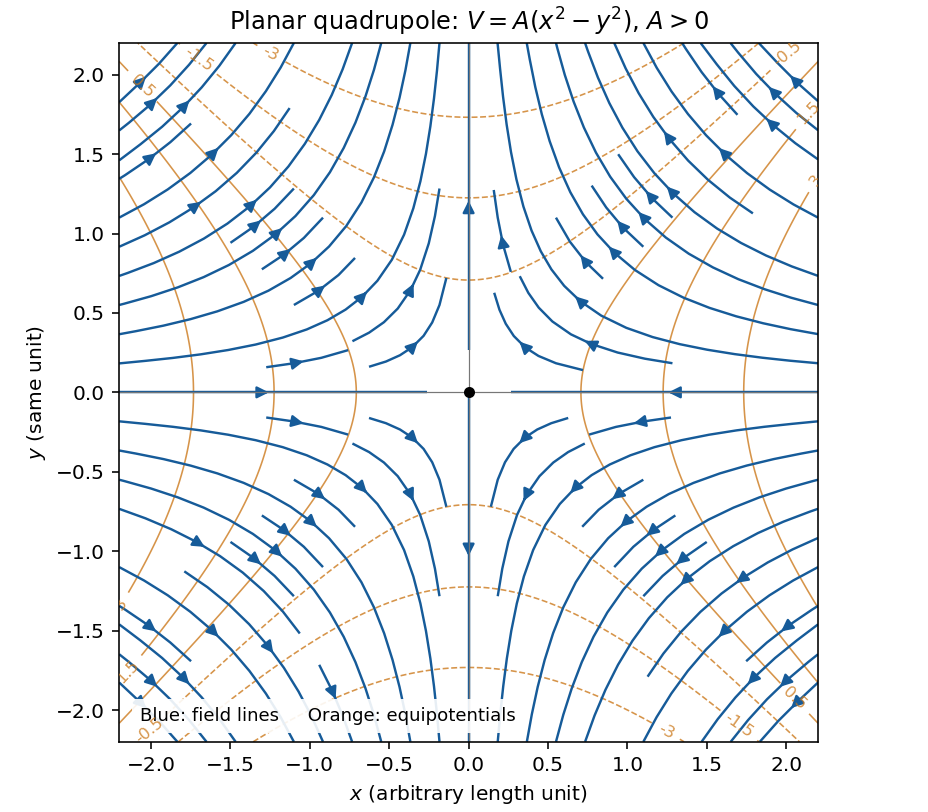
Original calculated electric-field lines and equipotentials for the planar quadrupole with positive A; arrows approach along x and leave along y
. Details. Past exam of the physics B course of the University of Cambridge 2017 Paper 1 Section A A2 Solution by Codex 0 2026-10-18
Codex 0 2026-10-18In steady rigid rotation of the liquid about its vertical axis, centrifugal acceleration is outward. Hydrostatic pressure balance in the rotating frame givesThe free surface is at constant atmospheric pressure, so its slope obeysCompare this parabolic free surface of a rigidly rotating liquid with . For focal length ,Either sense of rotation gives the same shape. The result assumes the liquid has reached rigid rotation before solidifying and that surface-tension and solidification distortions can be neglected.
Past exam of the physics B course of the University of Cambridge 2017 Paper 1 Section A A1 Solution by Codex 0 2026-10-18
Codex 0 2026-10-18Write the plate area as and separation as , so the original capacitance is . Neglect edge fields. The greatest capacitance occurs when each material occupies half the plate area and spans the full separation. These two regions are capacitors in parallel, sharing the same electric potential difference:The least capacitance occurs when a dielectric layer of thickness covers the whole area, leaving a vacuum layer of the same thickness. The two layers are capacitors in series: the normal electric displacement field is continuous and the voltage drops add. Their individual capacitances are and , givingThe arithmetic-harmonic bounds for dielectric capacitance show that these are genuine extrema over other arrangements of the same two volumes, within the ideal parallel-plate model. A uniform trial electric field in the fixed-voltage energy principle bounds above by the arithmetic mean of the two permittivities; a uniform trial electric displacement field in the fixed-charge principle bounds it below by their harmonic mean. The two layer arrangements attain those bounds. Both reduce to when .
Pinned article: Introduction to the OurBigBook Project
Welcome to the OurBigBook Project! Our goal is to create the perfect publishing platform for STEM subjects, and get university-level students to write the best free STEM tutorials ever.
Everyone is welcome to create an account and play with the site: ourbigbook.com/go/register. We belive that students themselves can write amazing tutorials, but teachers are welcome too. You can write about anything you want, it doesn't have to be STEM or even educational. Silly test content is very welcome and you won't be penalized in any way. Just keep it legal!
Intro to OurBigBook
. Source. We have two killer features:
- topics: topics group articles by different users with the same title, e.g. here is the topic for the "Fundamental Theorem of Calculus" ourbigbook.com/go/topic/fundamental-theorem-of-calculusArticles of different users are sorted by upvote within each article page. This feature is a bit like:
- a Wikipedia where each user can have their own version of each article
- a Q&A website like Stack Overflow, where multiple people can give their views on a given topic, and the best ones are sorted by upvote. Except you don't need to wait for someone to ask first, and any topic goes, no matter how narrow or broad
This feature makes it possible for readers to find better explanations of any topic created by other writers. And it allows writers to create an explanation in a place that readers might actually find it.
Figure 1. Screenshot of the "Derivative" topic page. View it live at: ourbigbook.com/go/topic/derivativeVideo 2. OurBigBook Web topics demo. Source. - local editing: you can store all your personal knowledge base content locally in a plaintext markup format that can be edited locally and published either:This way you can be sure that even if OurBigBook.com were to go down one day (which we have no plans to do as it is quite cheap to host!), your content will still be perfectly readable as a static site.
- to OurBigBook.com to get awesome multi-user features like topics and likes
- as HTML files to a static website, which you can host yourself for free on many external providers like GitHub Pages, and remain in full control

Figure 2. You can publish local OurBigBook lightweight markup files to either OurBigBook.com or as a static website.
Figure 3. Visual Studio Code extension installation.
Figure 5. . You can also edit articles on the Web editor without installing anything locally. Video 3. Edit locally and publish demo. Source. This shows editing OurBigBook Markup and publishing it using the Visual Studio Code extension. 
- Infinitely deep tables of contents:



All our software is open source and hosted at: github.com/ourbigbook/ourbigbook
Further documentation can be found at: docs.ourbigbook.com
Feel free to reach our to us for any help or suggestions: docs.ourbigbook.com/#contact