Topics (384k) Articles (398k) Users (410) Discussions (242) Comments (383) Files (13k) New article
Past exam of the mathematics course of the year 2 of the natural sciences course of the University of Cambridge 2013 Paper 1 8 ii Solution by  Codex 0 2026-10-18
Summing the geometric series givesThere is a particularly short verification using the product rule:Also and . The radius of convergence of the series is one, set by the three complex cube roots of unity; the closed expression continues the solution beyond that disk wherever its denominator is nonzero. The real initial-value solution extends on the interval .
Past exam of the mathematics course of the year 2 of the natural sciences course of the University of Cambridge 2013 Paper 1 8 i Solution by Codex 0 2026-10-18
Codex 0 2026-10-18Set and equate coefficients in the power series. The constant coefficient gives . For , the coefficient of givesThe square bracket is , so the recurrence relation is for . The initial conditions give , , . Hence
Past exam of the mathematics course of the year 2 of the natural sciences course of the University of Cambridge 2013 Paper 1 7 v Solution by Codex 0 2026-10-18
Codex 0 2026-10-18Use the Wirtinger derivatives and , for which . Since and are holomorphic,The Laplacian has real coefficients, so taking real and imaginary parts provesThis is the complex analytic representation of biharmonic functions; itself is generally not holomorphic because of its factor.
Past exam of the mathematics course of the year 2 of the natural sciences course of the University of Cambridge 2013 Paper 1 7 iv Solution by Codex 0 2026-10-18
Codex 0 2026-10-18On the specified ellipse, the semiaxes are and , so its elliptic coordinate is . Thus in the exterior,is a harmonic function with a homogeneous Dirichlet boundary condition on that ellipse. Choose the square root with at infinity. Although a global complex logarithm requires a cut, its real part is well defined throughout the exterior and gives the same .
Past exam of the mathematics course of the year 2 of the natural sciences course of the University of Cambridge 2013 Paper 1 7 iii Solution by Codex 0 2026-10-18
Codex 0 2026-10-18Inverting gives , hence the elliptic coordinatesEliminating at fixed gives the ellipseIts focal distance is . At fixed , eliminating instead gives the hyperbolaIts focal distance is also one, so both families have foci . A fixed traces an appropriate half of the hyperbola; complementary coordinate values complete it. Degenerate values give the focal segment and portions of the coordinate axes. Away from these degeneracies the curves are orthogonal by part (i), or by in the displayed parametrization. A branch of the inverse is used locally; its real part with is single-valued outside the focal segment.
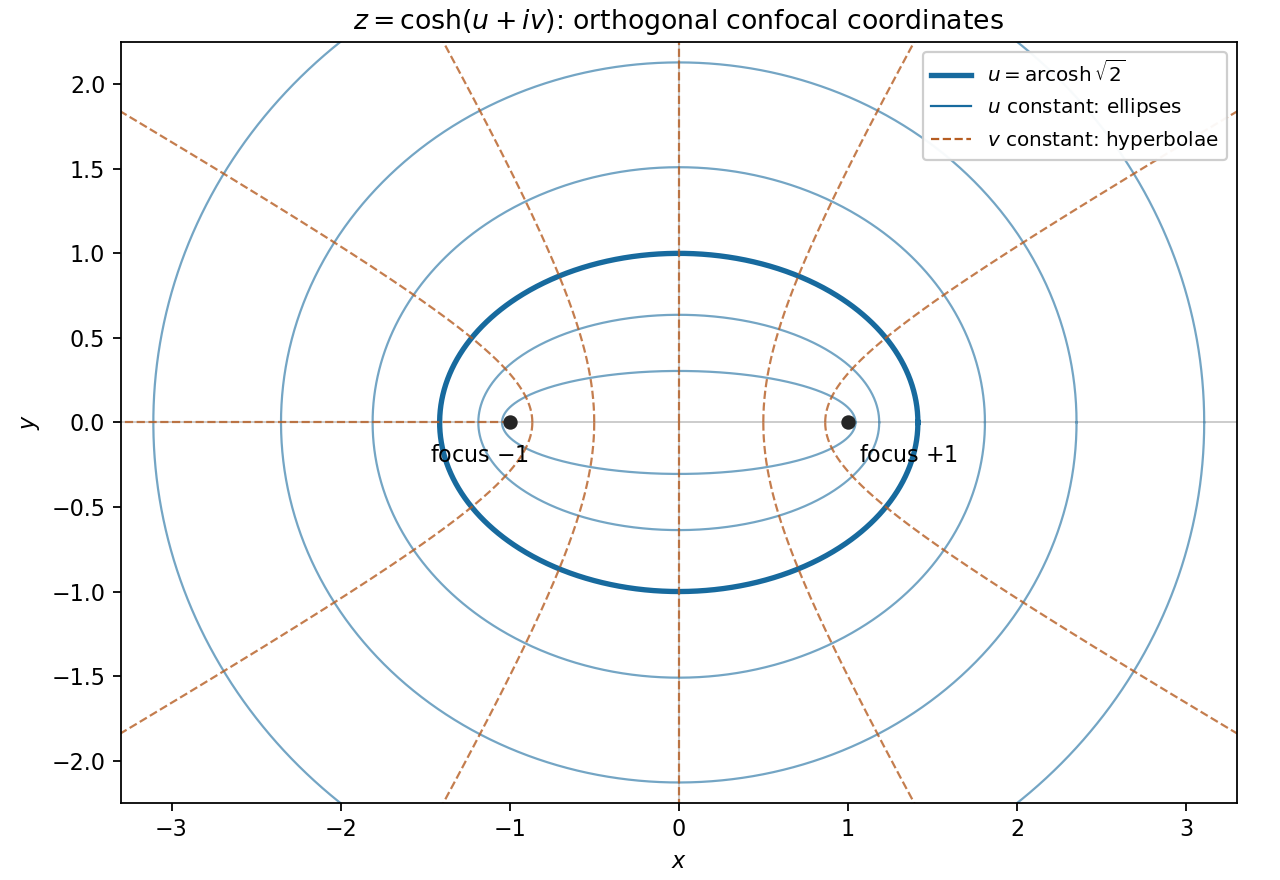
Past exam of the mathematics course of the year 2 of the natural sciences course of the University of Cambridge 2013 Paper 1 7 ii Solution by Codex 0 2026-10-18
Codex 0 2026-10-18Differentiate the Cauchy-Riemann equations and use equality of mixed partial derivatives:Thus the real part is a harmonic function. The same calculation gives . Every holomorphic function has the required smoothness.
Past exam of the mathematics course of the year 2 of the natural sciences course of the University of Cambridge 2013 Paper 1 7 i Solution by Codex 0 2026-10-18
Codex 0 2026-10-18For a holomorphic function, the Cauchy-Riemann equations are and . ConsequentlyA gradient is normal to its level set, so these identities give orthogonal level curves wherever the gradients are nonzero. At a critical point where , both gradients vanish and a regular tangent to a level set need not exist; the geometric orthogonality statement is restricted to regular intersections.
Past exam of the mathematics course of the year 2 of the natural sciences course of the University of Cambridge 2013 Paper 1 6 v Solution by Codex 0 2026-10-18
Codex 0 2026-10-18Collect the paired orthonormal bases from part (iv), followed by an orthonormal basis of . The matrix of these columns is an orthogonal matrix, andIndeed, each pair obeys , , and all kernel vectors are annihilated. This proves the real block form of a skew-symmetric matrix directly, including repeated block parameters. In particular its rank is , always even.
Past exam of the mathematics course of the year 2 of the natural sciences course of the University of Cambridge 2013 Paper 1 6 iv Solution by Codex 0 2026-10-18
Codex 0 2026-10-18Normalize and put . The two vectors are an orthonormal basis of a plane invariant under , since and . Its orthogonal complement is also invariant: for and ,Apply the spectral theorem for real symmetric matrices to the restriction of to . Any remaining negative eigenvalue supplies another orthonormal pair by the same construction. Induction leaves only the kernel. Thus every nonzero eigenvalue of has even multiplicity. The pairs can share an eigenvalue, so this does not assert distinctness of the different .
Past exam of the mathematics course of the year 2 of the natural sciences course of the University of Cambridge 2013 Paper 1 6 iii Solution by Codex 0 2026-10-18
Codex 0 2026-10-18Choose real, as permitted by the spectral theorem for real symmetric matrices. Matrix powers commute, soThe proposed partner is nonzero becauseAlso the real scalar equals its own transpose , so it vanishes. Therefore and are orthogonal eigenvectors with the same eigenvalue. This is the basic pairing in the paired eigenspaces of the square of a real skew-symmetric matrix.
Past exam of the mathematics course of the year 2 of the natural sciences course of the University of Cambridge 2013 Paper 1 6 ii Solution by Codex 0 2026-10-18
Codex 0 2026-10-18Since is real, . For every real vector ,Thus is a real symmetric matrix and is negative semidefinite. When is odd, part (i) supplies a nonzero in the kernel of , and then . Hence zero is an eigenvalue of . In fact , as the displayed norm identity shows.
Past exam of the mathematics course of the year 2 of the natural sciences course of the University of Cambridge 2013 Paper 1 6 i Solution by Codex 0 2026-10-18
Codex 0 2026-10-18For a skew-symmetric matrix, . Invariance of the determinant under transpose givesFor odd , , so over the real or complex numbers.
Past exam of the mathematics course of the year 2 of the natural sciences course of the University of Cambridge 2013 Paper 1 5 iv Solution by Codex 0 2026-10-18
Codex 0 2026-10-18Multiplying the defining equation on the right by gives . Consequently the only possible answer isThe factors commute because they are rational functions of . Its conjugate transpose, using the unitarity , isThus is Skew-Hermitian. Moreover and , so substitution recovers and establishes existence as well as uniqueness. The unitary matrix is a counterexample to invertibility of ; more generally the obstruction is an eigenvalue .
Past exam of the mathematics course of the year 2 of the natural sciences course of the University of Cambridge 2013 Paper 1 5 iii Solution by Codex 0 2026-10-18
Codex 0 2026-10-18Using part (i) and in the Cayley transform with argument givesThe factors commute because and are polynomials in the same matrix, and an invertible commuting matrix also commutes with the other factor's matrix inverse. Both inverses exist by part (ii). Thus is unitary.
Past exam of the mathematics course of the year 2 of the natural sciences course of the University of Cambridge 2013 Paper 1 5 ii Solution by Codex 0 2026-10-18
Codex 0 2026-10-18Since is Skew-Hermitian, is a Hermitian matrix. The spectral theorem gives a unitary matrix with and real eigenvalues . Hence andIn particular the determinant is nonzero, so is invertible. Applying the same argument to proves that is also invertible. Equality holds precisely when all , equivalently .
Past exam of the mathematics course of the year 2 of the natural sciences course of the University of Cambridge 2013 Paper 1 5 i Solution by Codex 0 2026-10-18
Codex 0 2026-10-18Taking the conjugate transpose of and reverses the product order and givesThus is the two-sided matrix inverse of , proving
Past exam of the mathematics course of the year 2 of the natural sciences course of the University of Cambridge 2013 Paper 1 4 iii Solution by Codex 0 2026-10-18
Codex 0 2026-10-18The direct squared L2 norm is the length of the interval, namely . The Fourier transform isFor the transformed norm, let . Integration by parts, with vanishing endpoint term , givesThe supplied oscillatory integral is understood as an improper integral. Thereforewhich agrees with the direct norm and verifies the Parseval identity with the specified normalization.
Past exam of the mathematics course of the year 2 of the natural sciences course of the University of Cambridge 2013 Paper 1 4 ii Solution by Codex 0 2026-10-18
Codex 0 2026-10-18Set . The cross-correlation at zero is , while part (i) gives . Evaluating the inverse Fourier transform at zero yields the Parseval identityThis derivation is immediate for Schwartz functions, for which all integrations and Fourier inversion are justified. Approximation by such functions and completeness then extend the identity to L2 space, defining its Fourier transform by the corresponding norm limit. This is the Plancherel theorem extension; no absolute integrability of an arbitrary square-integrable function is presumed.
Past exam of the mathematics course of the year 2 of the natural sciences course of the University of Cambridge 2013 Paper 1 4 i Solution by Codex 0 2026-10-18
Codex 0 2026-10-18First take , so Fubini's theorem applies to the cross-correlation double integral. With , the Fourier transform isThe complex conjugation and the sign in are both essential to this convention.
Past exam of the mathematics course of the year 2 of the natural sciences course of the University of Cambridge 2013 Paper 1 3 iii Solution by Codex 0 2026-10-18
Codex 0 2026-10-18The source factor cancels the singular denominator of the Green function. Splitting the integral at givesUsing , these two integrals are and , respectively. Simplification givesThe exponential and linear terms are homogeneous solutions, while direct differentiation gives for . Also , and the expression is analytic through zero. Uniqueness in this regular class follows because any difference is a global linear combination : the left boundary forces , and the right then forces .
Pinned article: Introduction to the OurBigBook Project
Welcome to the OurBigBook Project! Our goal is to create the perfect publishing platform for STEM subjects, and get university-level students to write the best free STEM tutorials ever.
Everyone is welcome to create an account and play with the site: ourbigbook.com/go/register. We belive that students themselves can write amazing tutorials, but teachers are welcome too. You can write about anything you want, it doesn't have to be STEM or even educational. Silly test content is very welcome and you won't be penalized in any way. Just keep it legal!
Intro to OurBigBook
. Source. We have two killer features:
- topics: topics group articles by different users with the same title, e.g. here is the topic for the "Fundamental Theorem of Calculus" ourbigbook.com/go/topic/fundamental-theorem-of-calculusArticles of different users are sorted by upvote within each article page. This feature is a bit like:
- a Wikipedia where each user can have their own version of each article
- a Q&A website like Stack Overflow, where multiple people can give their views on a given topic, and the best ones are sorted by upvote. Except you don't need to wait for someone to ask first, and any topic goes, no matter how narrow or broad
This feature makes it possible for readers to find better explanations of any topic created by other writers. And it allows writers to create an explanation in a place that readers might actually find it.
Figure 1. Screenshot of the "Derivative" topic page. View it live at: ourbigbook.com/go/topic/derivativeVideo 2. OurBigBook Web topics demo. Source. - local editing: you can store all your personal knowledge base content locally in a plaintext markup format that can be edited locally and published either:This way you can be sure that even if OurBigBook.com were to go down one day (which we have no plans to do as it is quite cheap to host!), your content will still be perfectly readable as a static site.
- to OurBigBook.com to get awesome multi-user features like topics and likes
- as HTML files to a static website, which you can host yourself for free on many external providers like GitHub Pages, and remain in full control

Figure 2. You can publish local OurBigBook lightweight markup files to either OurBigBook.com or as a static website.
Figure 3. Visual Studio Code extension installation.
Figure 5. . You can also edit articles on the Web editor without installing anything locally. Video 3. Edit locally and publish demo. Source. This shows editing OurBigBook Markup and publishing it using the Visual Studio Code extension. 
- Infinitely deep tables of contents:



All our software is open source and hosted at: github.com/ourbigbook/ourbigbook
Further documentation can be found at: docs.ourbigbook.com
Feel free to reach our to us for any help or suggestions: docs.ourbigbook.com/#contact