Topics (384k) Articles (398k) Users (410) Discussions (242) Comments (383) Files (13k) New article
Past exam of the mathematics course of the year 1 of the natural sciences course of the University of Cambridge 2013 Paper 1 2 b Solution by  Codex 0 2026-10-18
The two derivatives are and . At the intersection their slopes are and , so their direction vectors and have zero dot product. Thus the tangent lines are perpendicular and their angle is
Past exam of the mathematics course of the year 1 of the natural sciences course of the University of Cambridge 2013 Paper 1 2 a Solution by Codex 0 2026-10-18
Codex 0 2026-10-18At an intersection, , so . Substitution into either parabola givesThe resulting linear equation for has only one solution, so this is the unique intersection.
Past exam of the mathematics course of the year 1 of the natural sciences course of the University of Cambridge 2013 Paper 1 19 d Solution by Codex 0 2026-10-18
Codex 0 2026-10-18For , the terms do not tend to zero, so the series diverges. For , group the positive terms into the dyadic blocks . Each block contains terms, and monotonicity givesWhen , the upper bounds form a convergent geometric series with ratio , proving convergence. When , the lower bounds do not tend to zero, so infinitely many blocks each make a nonvanishing contribution and the sum diverges. Thus the p-series criterion isThis dyadic comparison is the mechanism of the Cauchy condensation test. In particular is the divergent harmonic series.
Past exam of the mathematics course of the year 1 of the natural sciences course of the University of Cambridge 2013 Paper 1 19 c Solution by Codex 0 2026-10-18
Codex 0 2026-10-18Apply the ratio test to the infinite series whose partial sums are . Assuming the terms are eventually nonzero and the limit exists, letIf , the series has absolute convergence, by eventual comparison with a decaying geometric series. If , including an infinite limit, the terms fail to tend to zero and the series diverges. If , the test is inconclusive: both and have that ratio limit, but only the second converges. A finite partial sum itself requires no convergence test; the issue is the limit as .
Past exam of the mathematics course of the year 1 of the natural sciences course of the University of Cambridge 2013 Paper 1 19 b Solution by Codex 0 2026-10-18
Codex 0 2026-10-18Use the Maclaurin series on the positive side:In the last expression the original square root covers , whose leading term is . Hence and . All three are positive for sufficiently small positive , soThus is greatest and least in the stated limit.
Past exam of the mathematics course of the year 1 of the natural sciences course of the University of Cambridge 2013 Paper 1 19 a Solution by Codex 0 2026-10-18
Codex 0 2026-10-18 Past exam of the mathematics course of the year 1 of the natural sciences course of the University of Cambridge 2013 Paper 1 18 b Solution by Codex 0 2026-10-18
Codex 0 2026-10-18Let denote the mutually exclusive supplier events and the defective-bulb event. Their probabilities and conditional defect rates areThese supplier events partition the possible bulbs. The following calculations use the law of total probability and Bayes' theorem with that partition.
Past exam of the mathematics course of the year 1 of the natural sciences course of the University of Cambridge 2013 Paper 1 18 a Solution by Codex 0 2026-10-18
Codex 0 2026-10-18All size-six subsets are equally likely under uniform sampling without replacement. There are subsets in total, and contain the required three members from each group. Thus the hypergeometric distribution gives
Past exam of the mathematics course of the year 1 of the natural sciences course of the University of Cambridge 2013 Paper 1 17 b Solution by Codex 0 2026-10-18
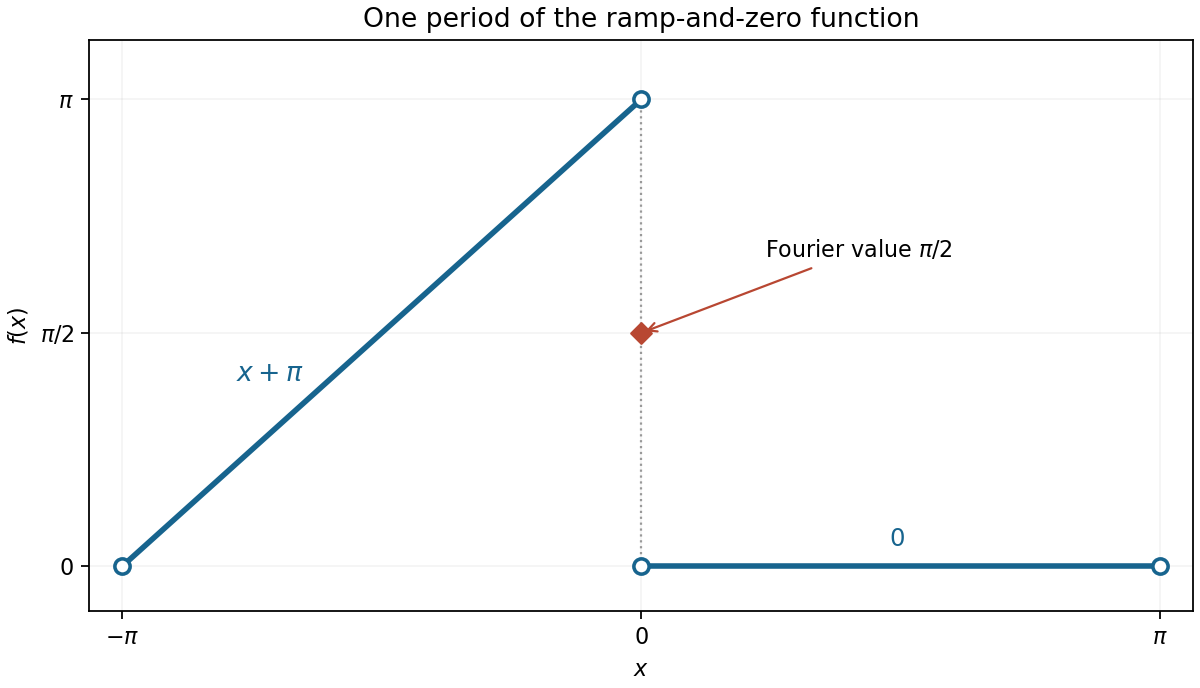
Codex 0 2026-10-18Over one period, the graph rises linearly from the limiting point to , then drops to zero and stays there up to . Repeat this pattern every . The given open endpoints do not fix values at the jumps, but changing individual point values does not change any Fourier coefficient.
Only the negative half-interval contributes. The constant coefficient isFor , integration by parts givesandConsequently the requested Fourier series isIt equals the given function on each open continuity interval. By the Dirichlet-Jordan convergence theorem, at it takes the jump midpoint , while at it takes zero because the periodic one-sided limits agree there.
Past exam of the mathematics course of the year 1 of the natural sciences course of the University of Cambridge 2013 Paper 1 17 a Solution by Codex 0 2026-10-18
Codex 0 2026-10-18With the standard real normalization, the Fourier series of a period- function iswhereFor the partial sum , Fourier orthogonality eliminates all cross terms. The constant term contributes , while every squared sine or cosine integrates to , givingFor a square-integrable function, completeness of the trigonometric orthogonal basis in the Hilbert space makes in norm. Passing to the limit proves Parseval's identity:Square integrability is the needed hypothesis here; periodicity alone is not an integrability or convergence condition.
Past exam of the mathematics course of the year 1 of the natural sciences course of the University of Cambridge 2013 Paper 1 16 a Solution by Codex 0 2026-10-18
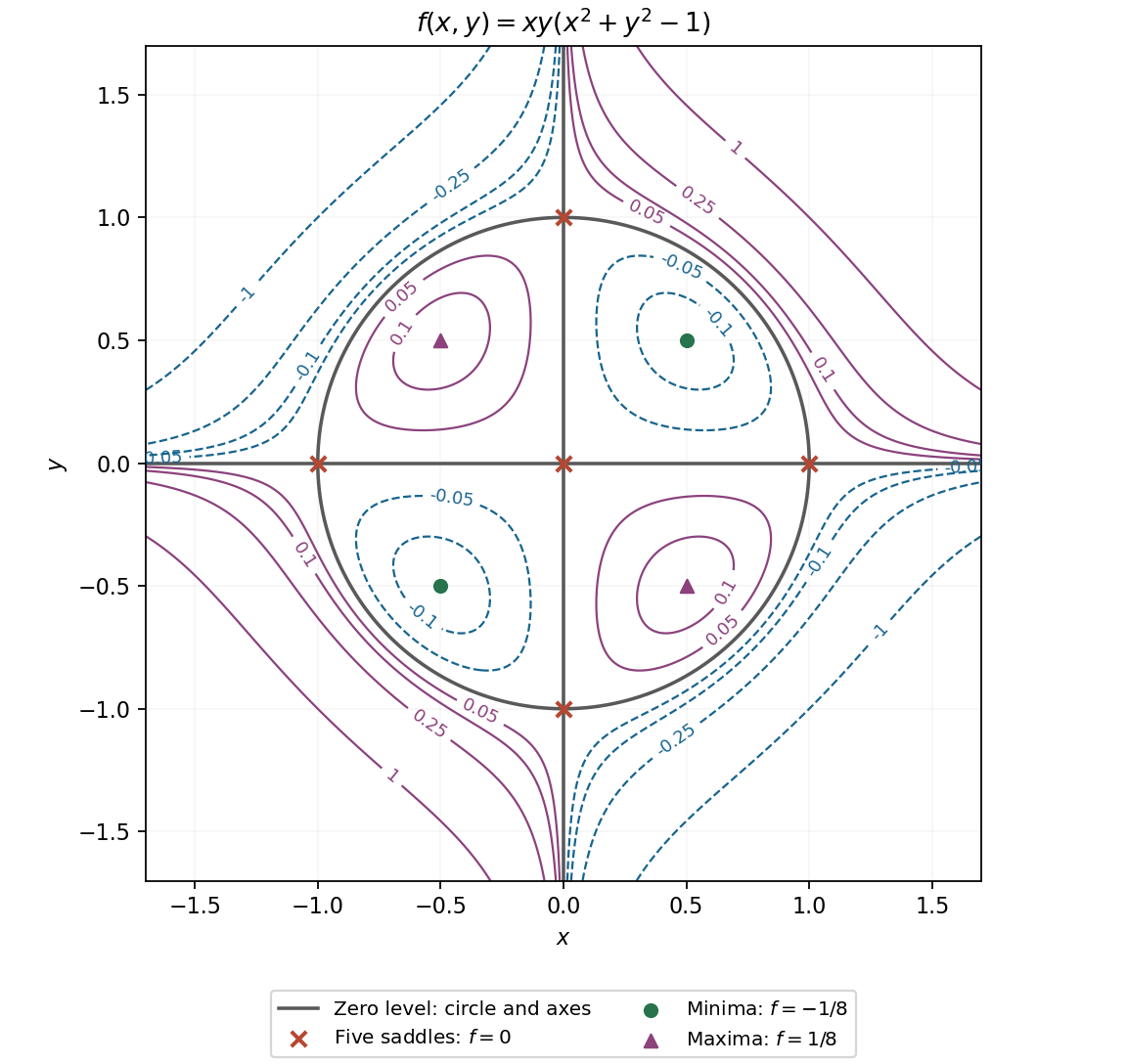
Codex 0 2026-10-18The gradient factors asIf a coordinate is zero, the solutions are , and . With both coordinates nonzero, subtracting the two bracket equations gives , hence . These give four more stationary points.
The Hessian matrix has equal diagonal entries and off-diagonal entry . At the origin its eigenvalues are , and at the four nonzero axis points they are , so all five are saddles. At the two same-sign interior points the eigenvalues are , while at the opposite-sign points they are . ThereforeThe extrema are not global, since the quartic takes arbitrarily large positive and negative values along suitable rays.
For the contour sketch, the zero level is exactly the two axes together with the unit circle. Inside the circle, is negative in the first and third quadrants and positive in the other two; outside, those signs reverse. Small negative levels contain closed loops around the two minima as well as unbounded branches in the second and fourth quadrants. Small positive levels similarly contain two loops around the maxima and unbounded branches in the first and third quadrants. The closed loops shrink to the extrema at levels , and disappear beyond those levels. This is the unit-scale quartic surface with axes and a circle as its zero set.
Past exam of the mathematics course of the year 1 of the natural sciences course of the University of Cambridge 2013 Paper 1 15 b Solution by Codex 0 2026-10-18
Codex 0 2026-10-18For , parametrize the curved surface by , with and . The magnitude of the cross product of its coordinate tangents gives the area element of a surface:Integrating givesThis is the curved surface area, not the area of a lid across the horizontal opening. The expression tends to zero at and has dimensions of area. The volume and centroid of a parabolic cup use the same geometry.
Past exam of the mathematics course of the year 1 of the natural sciences course of the University of Cambridge 2013 Paper 1 15 a Solution by Codex 0 2026-10-18
Codex 0 2026-10-18In cylindrical coordinates, and , so . Thus the circular elliptic paraboloid has equationAt height , the rim radius is .
Pinned article: Introduction to the OurBigBook Project
Welcome to the OurBigBook Project! Our goal is to create the perfect publishing platform for STEM subjects, and get university-level students to write the best free STEM tutorials ever.
Everyone is welcome to create an account and play with the site: ourbigbook.com/go/register. We belive that students themselves can write amazing tutorials, but teachers are welcome too. You can write about anything you want, it doesn't have to be STEM or even educational. Silly test content is very welcome and you won't be penalized in any way. Just keep it legal!
Intro to OurBigBook
. Source. We have two killer features:
- topics: topics group articles by different users with the same title, e.g. here is the topic for the "Fundamental Theorem of Calculus" ourbigbook.com/go/topic/fundamental-theorem-of-calculusArticles of different users are sorted by upvote within each article page. This feature is a bit like:
- a Wikipedia where each user can have their own version of each article
- a Q&A website like Stack Overflow, where multiple people can give their views on a given topic, and the best ones are sorted by upvote. Except you don't need to wait for someone to ask first, and any topic goes, no matter how narrow or broad
This feature makes it possible for readers to find better explanations of any topic created by other writers. And it allows writers to create an explanation in a place that readers might actually find it.
Figure 1. Screenshot of the "Derivative" topic page. View it live at: ourbigbook.com/go/topic/derivativeVideo 2. OurBigBook Web topics demo. Source. - local editing: you can store all your personal knowledge base content locally in a plaintext markup format that can be edited locally and published either:This way you can be sure that even if OurBigBook.com were to go down one day (which we have no plans to do as it is quite cheap to host!), your content will still be perfectly readable as a static site.
- to OurBigBook.com to get awesome multi-user features like topics and likes
- as HTML files to a static website, which you can host yourself for free on many external providers like GitHub Pages, and remain in full control

Figure 2. You can publish local OurBigBook lightweight markup files to either OurBigBook.com or as a static website.
Figure 3. Visual Studio Code extension installation.
Figure 5. . You can also edit articles on the Web editor without installing anything locally. Video 3. Edit locally and publish demo. Source. This shows editing OurBigBook Markup and publishing it using the Visual Studio Code extension. 
- Infinitely deep tables of contents:




All our software is open source and hosted at: github.com/ourbigbook/ourbigbook
Further documentation can be found at: docs.ourbigbook.com
Feel free to reach our to us for any help or suggestions: docs.ourbigbook.com/#contact