Topics (384k) Articles (398k) Users (410) Discussions (242) Comments (383) Files (13k) New article
Past exam of the mathematics course of the year 1 of the natural sciences course of the University of Cambridge 2014 Paper 1 18 b Solution by  Codex 0 2026-10-18
Count unordered sets of distinct labelled fish: there are possible hauls. To obtain exactly trout, choose labels from the trout and from the carp, giving possibilities. Uniform sampling without replacement therefore gives the hypergeometric distributionOutside this integer range the probability is zero. If ordered catches were counted instead, every haul would have orders and that factor would cancel from the probability ratio.
Here equal catchability means equal selection probability for each individual remaining fish. It does not mean that the two species have probability on each draw regardless of their populations. This interpretation is the one that yields the stated hypergeometric law.
Past exam of the mathematics course of the year 1 of the natural sciences course of the University of Cambridge 2014 Paper 1 18 a Solution by Codex 0 2026-10-18
Codex 0 2026-10-18Write , with . The expected value, variance, and strict lower-tail probability areThe upper summation limit is essential because the inequality is strict and the variable is integer-valued.
Past exam of the mathematics course of the year 1 of the natural sciences course of the University of Cambridge 2014 Paper 1 17 c Solution by Codex 0 2026-10-18
Codex 0 2026-10-18Take the odd extension on and then extend with period . It agrees with the required arch for and is continuous at its joins. Its Fourier sine series hasFor clarity, let , so and . Two integrations by parts, with the first endpoint term zero, giveConsequently : the even coefficients vanish and the odd ones are . This provesThe Fourier sine series of an odd quadratic arch converges to this continuous extension; its coefficients are also absolutely summable. Finally evaluate at . The left side is and the sine factors are , soThe evaluation is at a continuity point, so it does not invoke a jump midpoint.
Past exam of the mathematics course of the year 1 of the natural sciences course of the University of Cambridge 2014 Paper 1 17 b Solution by Codex 0 2026-10-18
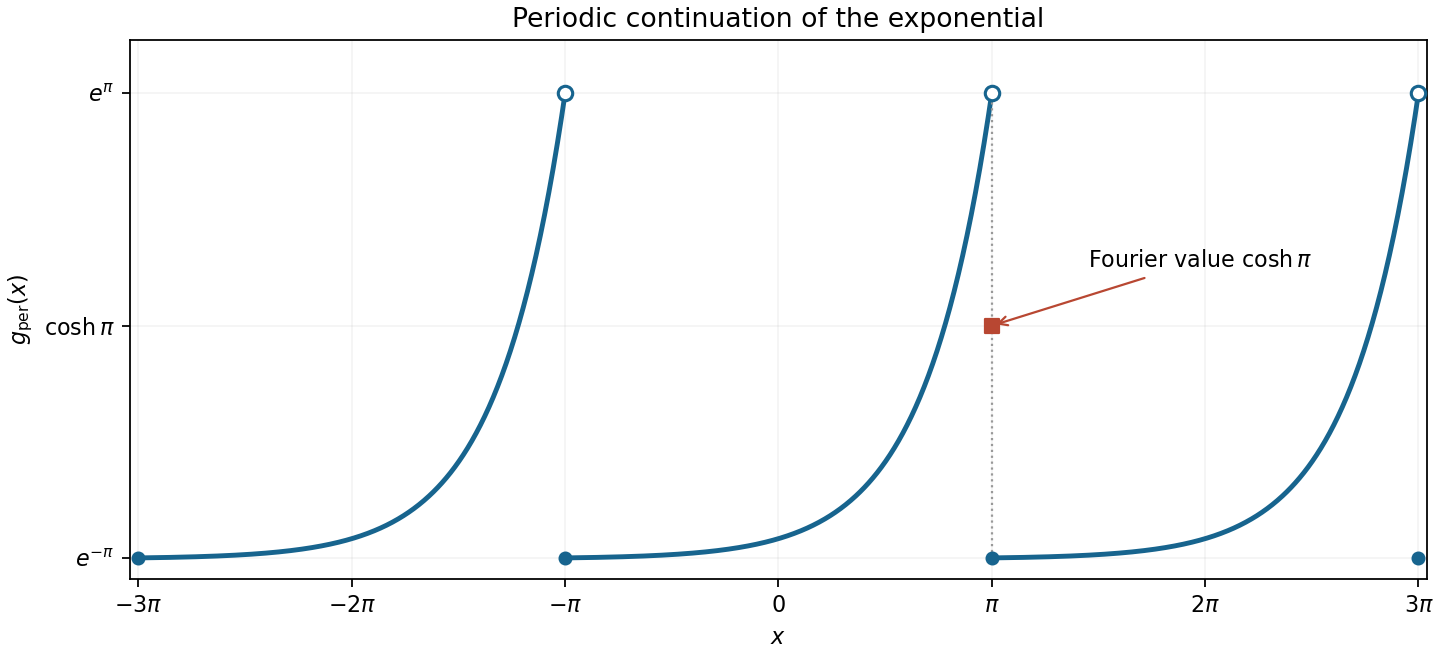
Codex 0 2026-10-18The periodic continuation is on each interval . Thus the plot repeats an increasing exponential segment on each of the three requested periods, jumping down from to at odd multiples of .
At , the left and right limits are and . The Dirichlet-Jordan convergence theorem therefore makes the Fourier series converge toThe actual half-open periodic definition has ; the Fourier value at the jump need not equal that assigned endpoint value.
Past exam of the mathematics course of the year 1 of the natural sciences course of the University of Cambridge 2014 Paper 1 17 a Solution by Codex 0 2026-10-18
Codex 0 2026-10-18With the usual real normalization, the Fourier series iswith Fourier coefficientsThese formulas follow from Fourier orthogonality. Integrability is needed to define the coefficients, and periodicity alone does not guarantee pointwise equality with the series. For a piecewise smooth periodic function, the Dirichlet-Jordan convergence theorem gives the average of the one-sided limits at a jump and the function value at a continuity point.
Past exam of the mathematics course of the year 1 of the natural sciences course of the University of Cambridge 2014 Paper 1 16 b Solution by Codex 0 2026-10-18
Codex 0 2026-10-18The partial derivatives give and . If either coordinate is zero, both vanish. Otherwise substitution gives , so the real stationary points are , and .
The Hessian matrix isAt the origin its eigenvalues are and , so it is a saddle at level zero. At either of the other points its eigenvalues are and , so both are strict minima at level . In fact,with equality only at those two points. HenceFor levels , two separate closed contours surround the two minima. At the contours form two lobes, in the first and third quadrants, meeting at the origin. Their limiting tangent directions there are the coordinate axes because the leading term is . On the diagonal the outer zero-level points are . Positive levels form one closed outer contour enclosing both wells; there are no contours below . The graph is symmetric under exchanging and under reversing both signs, but not under a quarter-turn. These features are the case of the quartic double well with bilinear coupling.
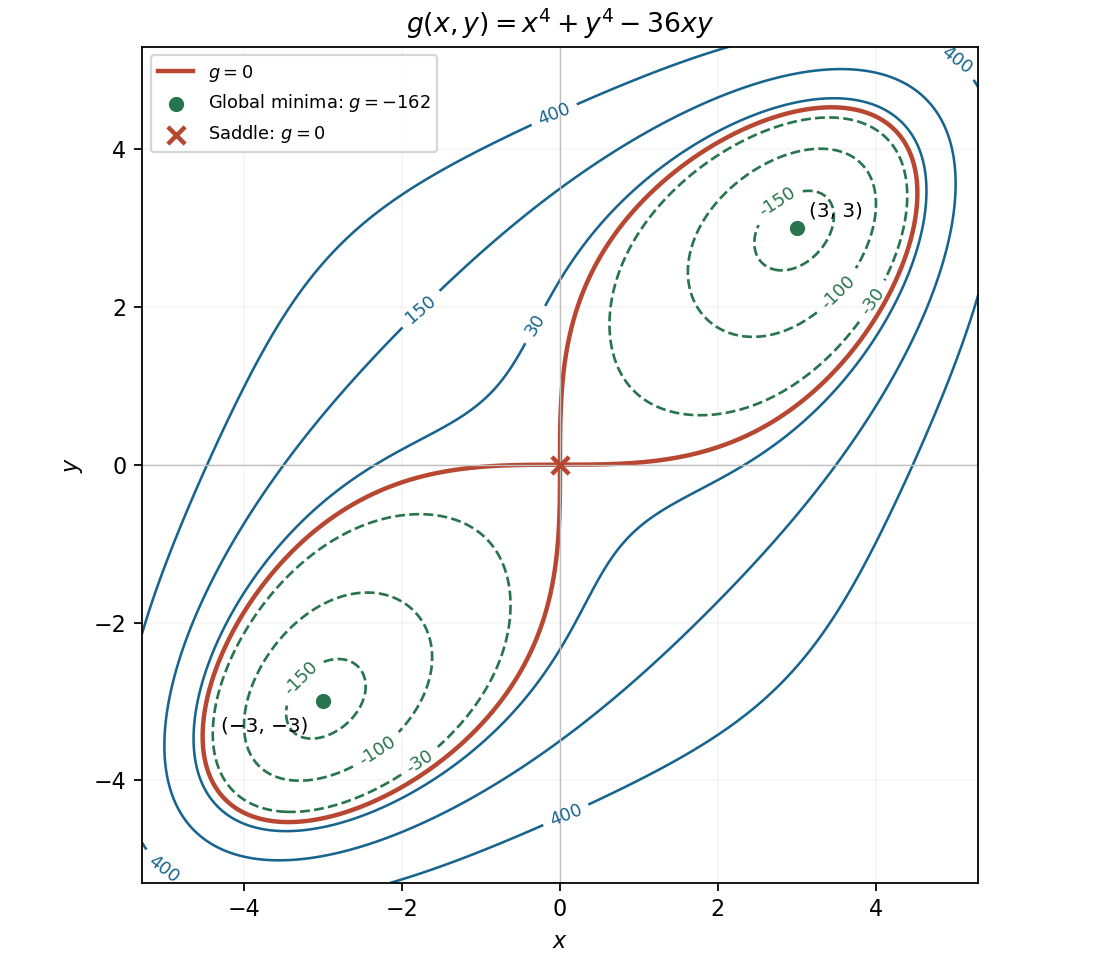
The quartic function's two minima, saddle, and transition from two contour loops to one
. Details. Past exam of the mathematics course of the year 1 of the natural sciences course of the University of Cambridge 2014 Paper 1 16 a Solution by Codex 0 2026-10-18
Codex 0 2026-10-18The gradient equations factor asFor they give . Otherwise , which gives and the matching . Thus there are exactly four stationary points.
The Hessian matrix isAt it is , and at it is . At and its determinant is . The second-derivative test therefore yieldsThe extrema are local: along the cubic is unbounded both above and below.
Past exam of the mathematics course of the year 1 of the natural sciences course of the University of Cambridge 2014 Paper 1 15 b Solution by Codex 0 2026-10-18
Codex 0 2026-10-18Translate the variables by , , . The numerator becomes . The part odd in integrates to zero, while the constant part factors into three Gaussian integrals. ThusThe absolute integrability of a polynomial times a Gaussian justifies this separation by Fubini's theorem. Neither nor affects the result; when , odd symmetry makes the integral zero.
Past exam of the mathematics course of the year 1 of the natural sciences course of the University of Cambridge 2014 Paper 1 14 c Solution by Codex 0 2026-10-18
Codex 0 2026-10-18Use the convention , , , with measured from the positive vertical axis. The squared radius isSince the horizontal radial distance is for finite ,The horizontal angle advances with . Thus the spherical coordinates areAn unwrapped continuous azimuth is simply ; a principal-angle convention introduces harmless jumps by . The polar angle stays in and approaches the two poles only as .
Past exam of the mathematics course of the year 1 of the natural sciences course of the University of Cambridge 2014 Paper 1 14 b Solution by Codex 0 2026-10-18
Codex 0 2026-10-18Choose any nonzero auxiliary vector not collinear with . Then form a basis, so writeTaking the dot product with gives . This separates the two cases requested in the hint.
If , choose freely and solve for :If , the coefficient of is fixed and the other two are free:These formulas describe the whole plane with normal , including . Completeness follows from the basis expansion, not only from checking that the displayed vectors satisfy the equation. The parametrization of a plane with an auxiliary vector also gives a single formula valid in both cases.
Past exam of the mathematics course of the year 1 of the natural sciences course of the University of Cambridge 2014 Paper 1 14 a Solution by Codex 0 2026-10-18
Codex 0 2026-10-18The nonparallel direction unit vectors have nonzero cross product. LetFor any joining vector , its normal component is fixed:Thus its length is at least the absolute value of that component. Since the two line directions span , suitable cancel the entire component in that plane, attaining the bound. Therefore the distance between skew lines, including the zero-distance intersecting case, isThe numerator is a scalar triple product. The nonparallel hypothesis is essential to the denominator and to the spanning argument.
Past exam of the mathematics course of the year 1 of the natural sciences course of the University of Cambridge 2014 Paper 1 13 b Solution by Codex 0 2026-10-18
Codex 0 2026-10-18The characteristic polynomial of the homogeneous equation is . Thus the complementary function is . The forcing resonates with the first term, so a resonant exponential particular solution is . Substitution gives , hence .
Past exam of the mathematics course of the year 1 of the natural sciences course of the University of Cambridge 2014 Paper 1 12 d Solution by Codex 0 2026-10-18
Codex 0 2026-10-18By De Moivre's theorem, . Take real parts of the binomial expansion:Eliminate using and collect powers:
Past exam of the mathematics course of the year 1 of the natural sciences course of the University of Cambridge 2014 Paper 1 12 c Solution by Codex 0 2026-10-18
Codex 0 2026-10-18Divide the complex polynomial by its known factor :The quadratic factors further as , because its two proposed roots sum to and multiply to . Therefore the remaining solutions areAll three roots are distinct. Complex coefficients do not require nonreal roots to occur in conjugate pairs.
Pinned article: Introduction to the OurBigBook Project
Welcome to the OurBigBook Project! Our goal is to create the perfect publishing platform for STEM subjects, and get university-level students to write the best free STEM tutorials ever.
Everyone is welcome to create an account and play with the site: ourbigbook.com/go/register. We belive that students themselves can write amazing tutorials, but teachers are welcome too. You can write about anything you want, it doesn't have to be STEM or even educational. Silly test content is very welcome and you won't be penalized in any way. Just keep it legal!
Intro to OurBigBook
. Source. We have two killer features:
- topics: topics group articles by different users with the same title, e.g. here is the topic for the "Fundamental Theorem of Calculus" ourbigbook.com/go/topic/fundamental-theorem-of-calculusArticles of different users are sorted by upvote within each article page. This feature is a bit like:
- a Wikipedia where each user can have their own version of each article
- a Q&A website like Stack Overflow, where multiple people can give their views on a given topic, and the best ones are sorted by upvote. Except you don't need to wait for someone to ask first, and any topic goes, no matter how narrow or broad
This feature makes it possible for readers to find better explanations of any topic created by other writers. And it allows writers to create an explanation in a place that readers might actually find it.
Figure 1. Screenshot of the "Derivative" topic page. View it live at: ourbigbook.com/go/topic/derivativeVideo 2. OurBigBook Web topics demo. Source. - local editing: you can store all your personal knowledge base content locally in a plaintext markup format that can be edited locally and published either:This way you can be sure that even if OurBigBook.com were to go down one day (which we have no plans to do as it is quite cheap to host!), your content will still be perfectly readable as a static site.
- to OurBigBook.com to get awesome multi-user features like topics and likes
- as HTML files to a static website, which you can host yourself for free on many external providers like GitHub Pages, and remain in full control

Figure 2. You can publish local OurBigBook lightweight markup files to either OurBigBook.com or as a static website.
Figure 3. Visual Studio Code extension installation.
Figure 5. . You can also edit articles on the Web editor without installing anything locally. Video 3. Edit locally and publish demo. Source. This shows editing OurBigBook Markup and publishing it using the Visual Studio Code extension. 
- Infinitely deep tables of contents:




All our software is open source and hosted at: github.com/ourbigbook/ourbigbook
Further documentation can be found at: docs.ourbigbook.com
Feel free to reach our to us for any help or suggestions: docs.ourbigbook.com/#contact