Topics (378k) Articles (391k) Users (410) Discussions (242) Comments (383) Files (13k) New article

Adding a load to a spring-supported table shifts its static downward position by . If the load is deposited with negligible impulse and moves with the table, the moving mass is . Starting at the former equilibrium with zero velocity, an underdamped response isIts transient envelope decays over . Critical damping gives . A nonzero impact impulse changes the initial velocity and therefore the transient.
An exact teaching model makes the peak suppression explicit. Assume the narrowband field correlation separates as after delay compensation. Average each channel's light intensity over the same rectangular gate of duration . The two time integrals have triangular relative-delay weightIntegrating the Siegert relation against this weight givesThe factor is one for a selected polarization of waves and for two independent equally populated polarizations. The signal fraction uses mean stellar signal and independent additive background in each detector. The photon correlation loss and background model then supplies . This assumes no correlated sky background or electronic coupling.
For the original model , elementary integration givesThe area-based optical coherence time of this intensity envelope is . For , ; for , . With the chosen , , , and , and . At the stipulated disk gives approximately . A nearly unit measured can therefore conceal a substantial .
This rectangular-gate calculation specifies a counting model. An analog instrument's amplifier bandwidth and impulse response instead weight the fluctuations it actually passes; the Sirius amplifiers were bandpass devices. Both require measuring the response and calibrating the zero-baseline excess. When , , and the temporal response are unchanged, the ratio of excesses recovers :A sufficiently unresolved calibration source can supply the denominator; dividing the full values would give the wrong result. Narrower optical bandwidth lengthens optical coherence time, whereas wider usable electronic bandwidth can resolve faster fluctuations; these are distinct bandwidths. Background changes, unequal spectral responses, drift, or averaging over changing interferometric baselines can invalidate a common calibration. Resolving a disk means establishing a reproducible decline of calibrated correlation, supported by those controls.
Stipulate a distant circular source of uniform angular brightness, full angular diameter in radians, and narrow optical bandwidth around wavelength . Distinct source patches emit independently. Assume each collector is small enough not to resolve the disk individually. For a sky offset from the disk centre, the baseline-dependent phase difference is , up to channel-sign convention. Summing independent patch contributions makes the equal-delay first-order optical coherence the normalized Fourier transform of angular brightness:Choose the horizontal coordinate along , put , and integrate along vertical chords of the disk:The imaginary part cancels between opposite chords. Here is the order-one Bessel function of the first kind. One way to obtain the last equality is to integrate the exponential's power series term by term on the finite disk. Equivalently the result is specified by the convergent seriesAt take the continuous limit ; starts as . This is why very short interferometric baselines give little leverage on angular diameter. Larger disks lose spatial optical coherence at shorter baselines.
The first positive zero of is , soThis is a full diameter convention. The angle must be converted before substitution: one arcsecond is radians, and one milliarcsecond, abbreviated mas, is arcseconds. For the stipulated and , and . At , the model gives and .
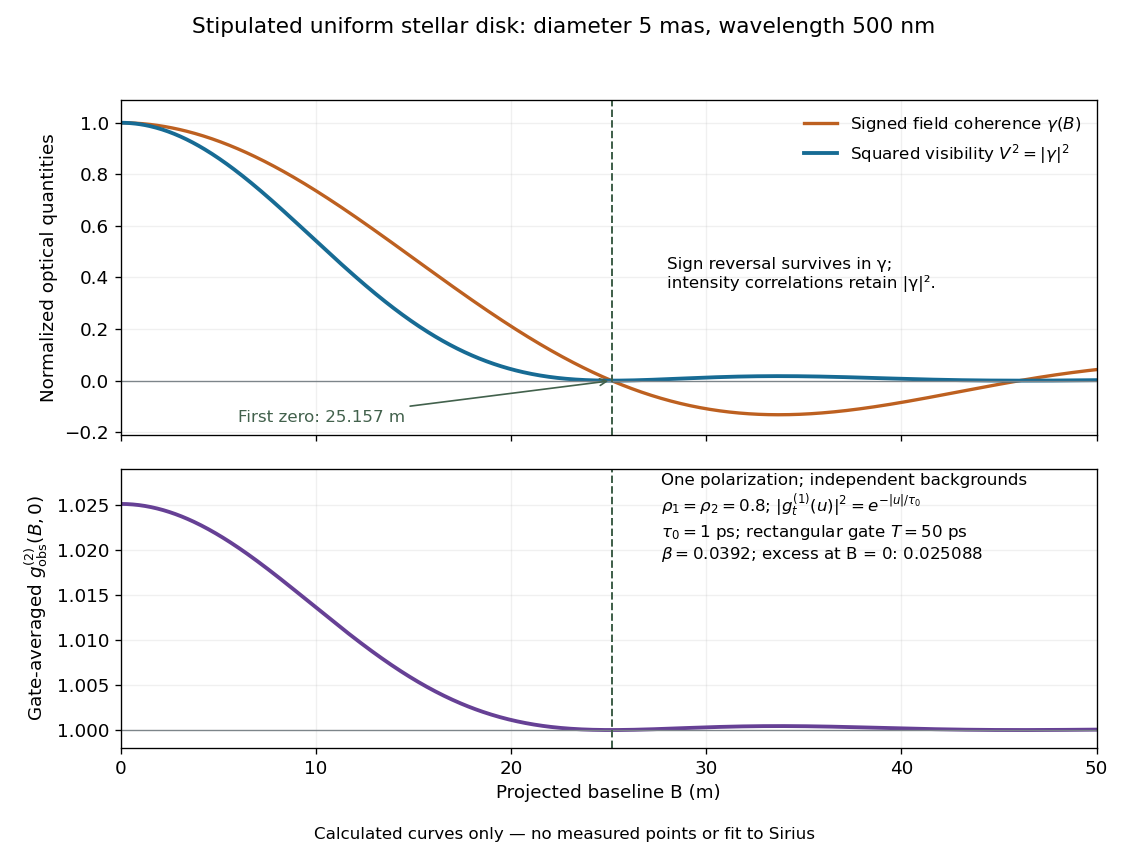
Stipulated uniform-disk model: signed field coherence, squared visibility and finite-gate intensity correlation versus interferometric baseline
. Original calculated curves for a 5-mas disk at 500 nm, with no measured points. The lower panel uses one polarization, independent signal fractions 0.8 in each channel, and the explicitly specified exponential temporal correlation and 50-ps gate below. It is not a fit to Sirius. Details.Beyond , changes sign but stays nonnegative and develops weak further lobes. A single measured squared visibility can therefore match several angular diameters; sampling several interferometric baselines constrains the fit. Limb darkening, spectral averaging, or resolved collector apertures change the uniform-disk prediction. A uniform-disk diameter is a parameter of that brightness model; converting it to a physical stellar radius also requires distance and an appropriate brightness profile.
For one selected polarization of waves, write the detected complex fields as and their light intensities as , absorbing a common conversion constant. With stationary ensemble averages and nonzero , defineHere second-order optical coherence concerns distinct detector channels, with the corresponding normal ordering in the quantum formulation. Independent detection has . Subtracting the means gives the normalized covarianceThus multiplying raw photocurrents contains a large mean-product contribution; multiplying their fluctuations isolates the small excess. Independent detector shot noise does not supply a mean cross-channel excess, although it increases measurement uncertainty.
The displayed Siegert relation requires a zero-mean, jointly circular complex Gaussian random field, the usual chaotic thermal light model. Circular means invariance under a common arbitrary complex phase rotation; in particular . Apply the Gaussian moment pairing theorem to the real and imaginary parts:The remaining pairing vanishes by circularity. Division proves the Siegert relation. Gaussianity is an assumption about fourth moments, not a consequence of merely measuring first-order optical coherence; a coherent state or photon antibunching cannot be interpreted by this thermal formula.
For equal-intensity beams combined in a common optical mode with matched wave polarizations, interferometric visibility is . Consequently ideal thermal stellar intensity interferometry measures , while the full includes the independent-count reference one. Unpolarized thermal light with two independent equally populated wave polarizations has half this excess: adding their covariances doubles the numerator while multiplying total means quadruples the denominator. Finite detector response further suppresses the peak and must be calibrated.[ref]
Spatial intensity interferometry on three bright stars by William Guerin and others. Guerin and others, Spatial intensity interferometry on three bright stars, arXiv:1805.06653v2 (13 August 2018), §§2.1–2.3: normalized correlation, thermal contrast and temporal-response calibration
In their 1956 Sirius report, Robert Hanbury Brown and Richard Q. Twiss used two 1.56-m searchlight reflectors feeding photomultipliers. The photocurrent fluctuations passed through 5–45-MHz amplifiers; an adjustable delay aligned arrival times. A linear mixer multiplied the outputs; an integrating motor accumulated their product. A second motor monitored its root-mean-square fluctuation to control gain changes. Separate lamps illuminated capped photomultipliers before and after observations to test electronic coupling and drift; blank-sky runs tested correlated sky background. They fitted a uniformly bright disk and an unknown zero-baseline scale to relative correlations at different interferometric baselines. Broadband response and possible baseline-dependent systematic errors limited the diameter inference.[ref]
A Test of a New Type of Stellar Interferometer on Sirius by Robert Hanbury Brown and Richard Quentin Twiss. pp. 1046–1048: reflectors, delay/correlator, lamp and sky controls, relative-baseline disk fit
This astronomical test extends the preceding laboratory Hanbury Brown and Twiss effect to two independently collected samples of a star. The historical motor reading was an instrument-specific correlation statistic. It should not be identified numerically with the normalized below without the corresponding measurement calibration.
The expected rate of detections exceeding a stated threshold under a specified background-only model. A time rate and a per-trial significance level require different normalizations.
A standardizable candle has a predictable absolute magnitude after correcting measured source properties, rather than identical intrinsic brightness for every object. Type Ia supernova cosmology uses light curve shape and colour for this purpose.
An acceptable unused edge whose endpoints both prefer each other to their partners in a matching in a graph, treating every acceptable partner as preferable to being unmatched. A stable matching has no such edge. In the worked example, blocks even though already has its first choice.
For a real scalar height field, integration by parts givesThe bulk expression is even under time reversal. The original density is not pointwise even, but changes by a total divergence; its stationary equation is time-reversal invariant. The first-order diffusion equation selected by zero residual is not invariant under ordinary time reversal at fixed positive . Boundary conditions or the probabilistic interpretation can distinguish the two time directions even when the higher-order stationary equation does not.
For a simple spin-triplet p-wave pairing description, let the matrix , with complex number entries, map an orbital direction on the Fermi surface into a triplet gap vector . The indices refer to spin and orbital components. A scalar amplitude cannot retain all these relative orientations. Anthony James Leggett's account connects that extra structure to the magnetic responses of the different phases.[ref]
Nobel Lecture: Superfluid 3He: the early days as seen by a theorist by Anthony James Leggett. pp.1004–1008, broken spin-orbit symmetry and pairing-state response
Here are two explicit idealizations, with a common positive scale and an overall quantum phase omitted. They show how odd orbital pairing can have either nodes or an isotropic gap. They do not calculate which state has the lower Helmholtz free energy.
Exchange of energy between magnetic spin degrees of freedom and the surrounding lattice, allowing their temperatures to approach thermal equilibrium. It permits adiabatic demagnetization to cool a solid and its attached load.
A spin texture describes how a spin expectation value or spin polarization varies with position or wavevector. It specifies a vector field, including its magnitude when that matters; a direction field alone is undefined wherever that magnitude vanishes. A Rashba spin texture is an example in which spin expectation values wind around circles in the plane of wavevectors.
For a spin one-half system, an ideal projective measurement along a unit vector measures . Its eigenvalues are , corresponding to physical spin angular momentum components , and its orthogonal projections are . For density matrix , the Born rule and the Pauli matrix multiplication law give the displayed probabilities. Thus a spin measurement along one direction tests only that component of the Bloch vector; measurements along three independent directions determine the entire density matrix.
An electron has spin one-half. Its intrinsic spin angular momentum has two possible components, , along a specified unit vector . These are the two eigenvalues of the corresponding spin measurement; the spin is distinct from the electron's orbital angular momentum.
The 1935 primary paper The Spin-Isomerization of Hydrogen at Paramagnetic and Diamagnetic Surfaces, pp. 1251–1252, describes evacuated catalyst samples cooled before admitting molecular hydrogen. Gas samples were analyzed in a glass cell in liquid air: a heated platinum wire and Wheatstone bridge converted changes in thermal conductivity into electrical resistance readings, calibrated against normal hydrogen.[ref]
The Spin-Isomerization of Hydrogen at Paramagnetic and Diamagnetic Surfaces by Hugh Stott Taylor and H. Diamond. p. 1251, Experimental Details: sample handling and heated-wire thermal-conductivity analysis
Its comparison of oxide surfaces supplied a control: specimens exhibiting strong paramagnetism converted the gas much faster than the comparison exhibiting diamagnetism despite all adsorbing molecular hydrogen. Contact time, pressure, and temperature were recorded. This supports a role for surface magnetic properties beyond adsorption alone; it does not identify every microscopic surface site or directly measure nuclear-spin orientations.[ref]
The Spin-Isomerization of Hydrogen at Paramagnetic and Diamagnetic Surfaces by Hugh Stott Taylor and H. Diamond. p. 1252, Table I description and Discussion of Results: rare-earth oxide comparison and adsorption qualification
The inference chain is preparation, contact with a specified surface, then a calibrated bulk transport readout of composition. It is distinct from a direct calorimetry measurement of heat capacity: transport and heat capacity can both depend on the spin populations, but they are different measured quantities. Changing the catalyst's own surface structure, introducing magnetic impurities, or changing the detector's gas pressure can confound an uncalibrated comparison. The free-rotor partition functions predict equilibrium populations and stored energy, not the conversion rate on a particular surface.
As , the conditional mean rotational energies approach and , using the para level as the common zero. A frozen mixture with ortho fraction therefore retains . If a bath keeps the sample at low temperature while a catalyst permits conversion to almost pure parahydrogen, the rotational heat delivered to the bath tends to , or for normal hydrogen.
One may shift the ortho ladder to its own lowest level for computing its conditional heat capacity, because a constant energy offset disappears on differentiation at fixed composition. That offset must be restored before comparing species or calculating conversion heat. Otherwise the calculation loses precisely the stored rotational energy that conversion releases. The expression above accounts for the internal rotor contribution at fixed bath temperature; it does not model liquid intermolecular energies, latent heat, or an adiabatic temperature rise.
A catalyst changes the conversion rate and allows heat removal during cooling; it does not change the free-gas equilibrium weights at a specified temperature. This connects the microscopic exchange rule to refrigeration: delayed conversion supplies a continuing internal heat source. Rotational Raman spectroscopy offers a complementary population probe because its transitions stay within the even or odd ladder; line intensities require the appropriate species populations and transition response, not a bare intensity rule.
Write the linear rigid rotor energy eigenvalues as , where is the rotational temperature scale, the moment of inertia, the frequency-valued rotational constant, and the Boltzmann constant. Put and . Define sums that include rotational multiplicity but exclude nuclear-spin multiplicity:The canonical partition function for one equilibrating internal rotor is , so its equilibrium orthohydrogen fraction isFor , the lowest allowed levels give and , hence . For , the densely populated even and odd ladders have equal leading sums, , hence . The factor nine belongs to the low-temperature two-level approximation, and the factor three to the high-temperature spin multiplicities.
A frozen mixture requires two separately normalized probability distributions,Multiply these by the prescribed fractions and , respectively. The nuclear-spin factor three cancels from the conditional orthohydrogen distribution. For fixed counts and , the internal part of the many-molecule partition function is proportional to , with combinatorial factors independent of temperature. Its logarithm yields the two conditional means weighted by the fixed counts. Using instead would silently permit conversion and change the physical constraint.
Normal hydrogen denotes the orthohydrogen-to-parahydrogen mixture, the high-temperature equilibrium limit. Near room temperature the equilibrium ratio is already close to this limit. Cooling an isolated sample need not change its composition on the measurement timescale: ordinary collisions can redistribute rotational populations within each spin species much faster than they interconvert the spin species. A kinetically frozen composition can therefore coexist with rotational thermal equilibrium separately within each species.
The distinction was historically decisive. The institutional account Die Entdeckung des para-Wasserstoffs, in its discussion of the rotational heat capacity, explains that assuming an equilibrating composition missed the observed behavior, whereas freezing the high-temperature ratio reproduced it. It also records Karl Friedrich Bonhoeffer and Paul Harteck's 1929 preparation using a catalyst and thermal conductivity detection.[ref]
Die Entdeckung des para-Wasserstoffs. paragraphs on frozen high-temperature composition and the 1929 charcoal/thermal-conductivity discovery
Pinned article: Introduction to the OurBigBook Project
Welcome to the OurBigBook Project! Our goal is to create the perfect publishing platform for STEM subjects, and get university-level students to write the best free STEM tutorials ever.
Everyone is welcome to create an account and play with the site: ourbigbook.com/go/register. We belive that students themselves can write amazing tutorials, but teachers are welcome too. You can write about anything you want, it doesn't have to be STEM or even educational. Silly test content is very welcome and you won't be penalized in any way. Just keep it legal!
Intro to OurBigBook
. Source. We have two killer features:
- topics: topics group articles by different users with the same title, e.g. here is the topic for the "Fundamental Theorem of Calculus" ourbigbook.com/go/topic/fundamental-theorem-of-calculusArticles of different users are sorted by upvote within each article page. This feature is a bit like:
- a Wikipedia where each user can have their own version of each article
- a Q&A website like Stack Overflow, where multiple people can give their views on a given topic, and the best ones are sorted by upvote. Except you don't need to wait for someone to ask first, and any topic goes, no matter how narrow or broad
This feature makes it possible for readers to find better explanations of any topic created by other writers. And it allows writers to create an explanation in a place that readers might actually find it.
Figure 1. Screenshot of the "Derivative" topic page. View it live at: ourbigbook.com/go/topic/derivativeVideo 2. OurBigBook Web topics demo. Source. - local editing: you can store all your personal knowledge base content locally in a plaintext markup format that can be edited locally and published either:This way you can be sure that even if OurBigBook.com were to go down one day (which we have no plans to do as it is quite cheap to host!), your content will still be perfectly readable as a static site.
- to OurBigBook.com to get awesome multi-user features like topics and likes
- as HTML files to a static website, which you can host yourself for free on many external providers like GitHub Pages, and remain in full control

Figure 2. You can publish local OurBigBook lightweight markup files to either OurBigBook.com or as a static website.
Figure 3. Visual Studio Code extension installation.
Figure 5. . You can also edit articles on the Web editor without installing anything locally. Video 3. Edit locally and publish demo. Source. This shows editing OurBigBook Markup and publishing it using the Visual Studio Code extension. 
- Infinitely deep tables of contents:



All our software is open source and hosted at: github.com/ourbigbook/ourbigbook
Further documentation can be found at: docs.ourbigbook.com
Feel free to reach our to us for any help or suggestions: docs.ourbigbook.com/#contact