Topics (384k) Articles (398k) Users (410) Discussions (242) Comments (383) Files (13k) New article
Past exam of the mathematics course of the year 1 of the natural sciences course of the University of Cambridge 2013 Paper 2 2 a Solution by  Codex 0 2026-10-18
 Past exam of the mathematics course of the year 1 of the natural sciences course of the University of Cambridge 2013 Paper 2 19 b Solution by Codex 0 2026-10-18
Codex 0 2026-10-18First calculate the curl:By Stokes theorem, use the positively oriented equator , . Its tangent is , while the restricted field is . ThusThe first term integrates to zero over a full period and the second uses .
One can also calculate directly on the curved surface. With spherical coordinates , ,Substitution gives the scalar integrand . Its azimuthal sine term vanishes, and the rest gives , confirming the orientation and the same result.
Past exam of the mathematics course of the year 1 of the natural sciences course of the University of Cambridge 2013 Paper 2 19 a Solution by Codex 0 2026-10-18
Codex 0 2026-10-18For a smooth oriented surface with positively oriented boundary , Stokes theorem statesHere uses the chosen unit normal vector, while is tangent to the directed boundary. The boundary orientation follows the right-hand rule: curling the fingers along makes the thumb point in the normal direction. The field must be continuously differentiable on a neighbourhood of the surface, with the usual piecewise-smooth allowance for its boundary.
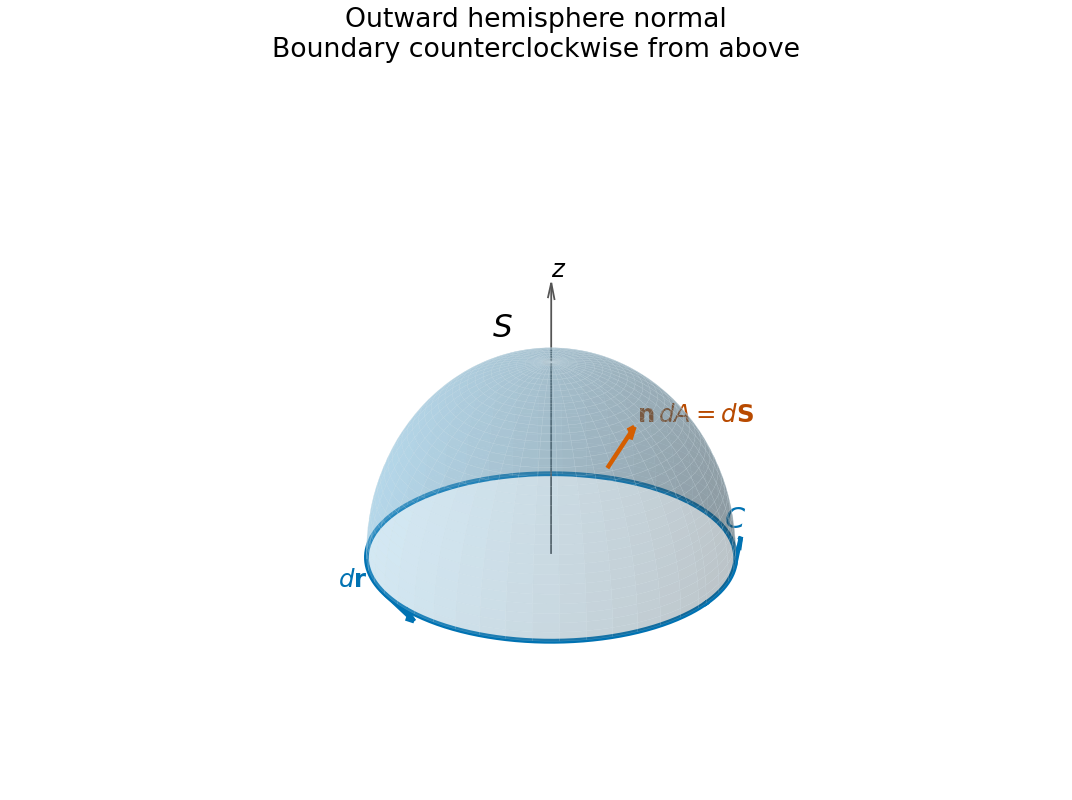
For the upper hemisphere with outward normal, the induced equatorial direction is counterclockwise as viewed from positive .
Past exam of the mathematics course of the year 1 of the natural sciences course of the University of Cambridge 2013 Paper 2 18 e Solution by Codex 0 2026-10-18
Codex 0 2026-10-18The upper branch leaves the origin horizontally and curves upward, growing like . The lower branch shares the horizontal tangent, rises to its small maximum at , then crosses the axis at and falls toward . Its concavity changes at , before the maximum. A separate zoom makes those nearby lower-branch features visible.
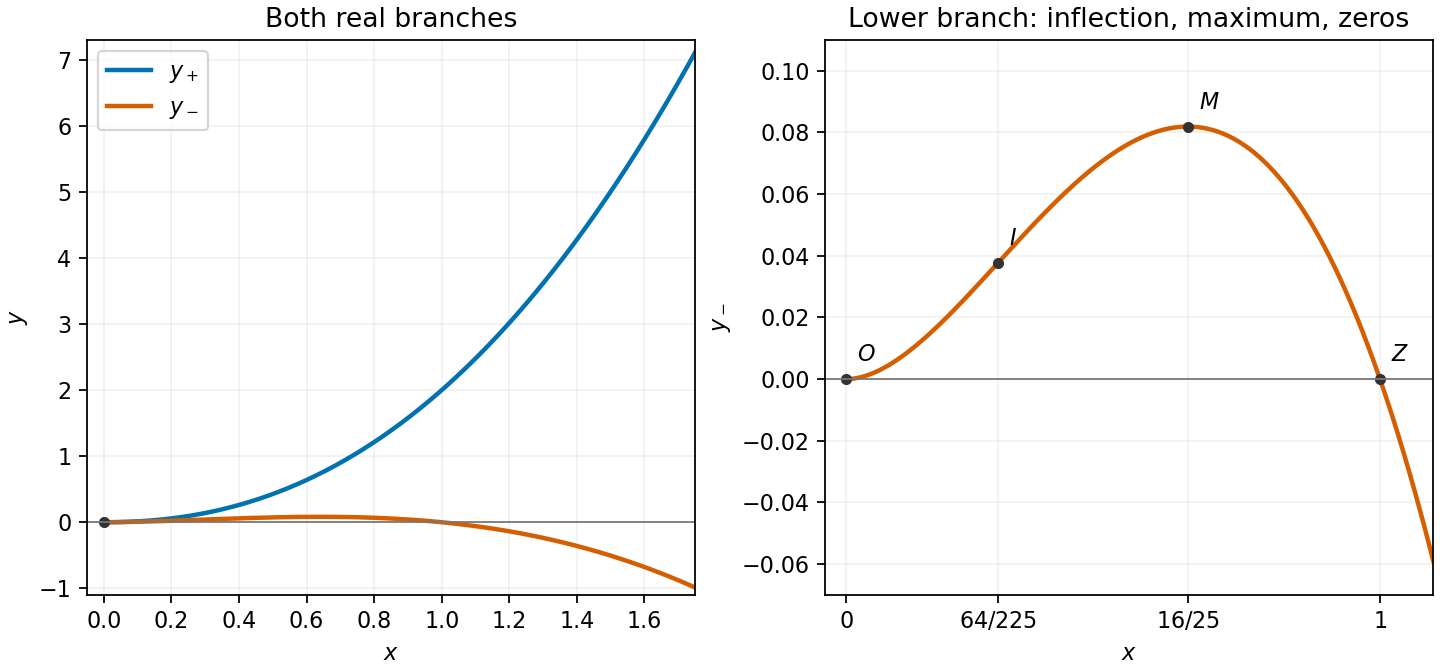
Real branches of the singular curve, with the lower branch enlarged to mark its extrema, inflection, and zeros
. Details. Past exam of the mathematics course of the year 1 of the natural sciences course of the University of Cambridge 2013 Paper 2 18 d Solution by Codex 0 2026-10-18
Codex 0 2026-10-18For , differentiate the two explicit branches:The plus branch is strictly increasing and strictly convex for . Its only zero is , also its one-sided global minimum; it has no interior extremum or inflection point.
The minus branch rises initially, then has at , changing from positive to negative. Its second derivative changes sign at . Its zeros follow from . ConsequentlyThe origin is a one-sided local minimum of both graph branches, because their domain ends there; it is not an interior critical point. The minus branch has no global minimum since it tends to as . Its maximum and inflection heights, useful for the sketch, are and , respectively.
Past exam of the mathematics course of the year 1 of the natural sciences course of the University of Cambridge 2013 Paper 2 18 c Solution by Codex 0 2026-10-18
Codex 0 2026-10-18A real square on the left requires , so . Taking the two square roots gives exactly the two real graph branchesThey meet only at the origin. The local coordinate change turns the equation into , the plane cusp of type (2,5); both branches share the tangent there.
Past exam of the mathematics course of the year 1 of the natural sciences course of the University of Cambridge 2013 Paper 2 18 b Solution by Codex 0 2026-10-18
Codex 0 2026-10-18For the specified polynomial,The first equation forces ; substitution into then gives , and hence . It also satisfies the curve equation. Therefore the unique singular point is
Past exam of the mathematics course of the year 1 of the natural sciences course of the University of Cambridge 2013 Paper 2 18 a Solution by Codex 0 2026-10-18
Codex 0 2026-10-18Along a differentiable graph satisfying the implicit equation, the multivariable chain rule givesThus, wherever ,The implicit function theorem supplies such a local graph under that nonvanishing condition. At a singular point both numerator and denominator vanish, so this division cannot determine its tangent.
Past exam of the mathematics course of the year 1 of the natural sciences course of the University of Cambridge 2013 Paper 2 17 b Solution by Codex 0 2026-10-18
Codex 0 2026-10-18Along a change in volume at fixed temperature, the first law of thermodynamics givesUse the Helmholtz Maxwell relation derived in (a) to replace the entropy derivative. This provesFor the stated Van der Waals equation, temperature-independent give . Hence . Integrating with respect to yieldsThe dilute-limit condition holds at every fixed and forces , soThe result is the internal energy of a van der Waals gas in the fixed-amount convention of the question. Its volume derivative is positive even though the attractive energy correction itself is negative.
Past exam of the mathematics course of the year 1 of the natural sciences course of the University of Cambridge 2013 Paper 2 17 a Solution by Codex 0 2026-10-18
Codex 0 2026-10-18For fixed amount of substance, take the internal energy . The first law of thermodynamics identifies and . Equality of mixed second derivatives givesFor the Helmholtz free energy, subtract the product differential from the first law of thermodynamics to obtain . Its natural variables are , so and . Exactness therefore givesFor the Gibbs free energy, the product rule gives . Thus , , andFor the enthalpy, , giving , andThese are the four Maxwell relations, each following from exactness in the appropriate pair of natural variables.
Past exam of the mathematics course of the year 1 of the natural sciences course of the University of Cambridge 2013 Paper 2 16 b Solution by Codex 0 2026-10-18
Codex 0 2026-10-18Assume the components of have continuous second partial derivatives. Expanding the divergence of its curl givesEach positive term cancels a negative term because the corresponding mixed derivatives commute. Consequently
Past exam of the mathematics course of the year 1 of the natural sciences course of the University of Cambridge 2013 Paper 2 15 d Solution by Codex 0 2026-10-18
Codex 0 2026-10-18Put and denote the distances to and by and . Direct expansion using givesSince and , both expressions inside the final square roots are positive. Hencefor every point of this right branch. This is the focal-distance identity for a hyperbola; on the left branch the signed difference would reverse, while its absolute value would remain .
Past exam of the mathematics course of the year 1 of the natural sciences course of the University of Cambridge 2013 Paper 2 15 c Solution by Codex 0 2026-10-18
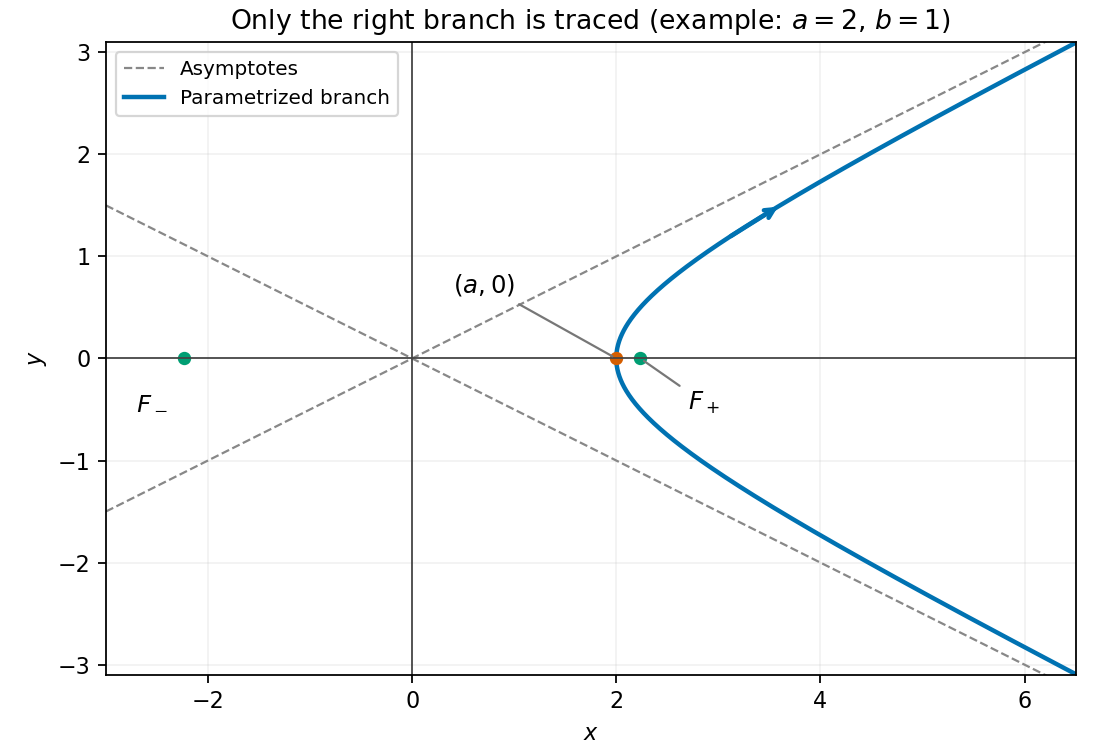
Codex 0 2026-10-18Solving for gives with . For large , the square root is , so the two asymptotes areThe curve lies between these lines on the right side and has its nearest point, with vertical tangent, at . As increases it travels from the lower unbounded end through that vertex to the upper unbounded end. The left hyperbola branch is not part of the given curve.
Past exam of the mathematics course of the year 1 of the natural sciences course of the University of Cambridge 2013 Paper 2 15 b Solution by Codex 0 2026-10-18
Codex 0 2026-10-18The hyperbolic functions identity eliminates from the parametric curve:The restriction is essential: , so the parametrization traces only the right branch of the full hyperbola. Conversely, every point on that right branch is reached by taking .
Past exam of the mathematics course of the year 1 of the natural sciences course of the University of Cambridge 2013 Paper 2 15 a Solution by Codex 0 2026-10-18
Codex 0 2026-10-18The Euclidean distance is . Along the parametric curve,This is at least , with equality exactly when . Therefore
Pinned article: Introduction to the OurBigBook Project
Welcome to the OurBigBook Project! Our goal is to create the perfect publishing platform for STEM subjects, and get university-level students to write the best free STEM tutorials ever.
Everyone is welcome to create an account and play with the site: ourbigbook.com/go/register. We belive that students themselves can write amazing tutorials, but teachers are welcome too. You can write about anything you want, it doesn't have to be STEM or even educational. Silly test content is very welcome and you won't be penalized in any way. Just keep it legal!
Intro to OurBigBook
. Source. We have two killer features:
- topics: topics group articles by different users with the same title, e.g. here is the topic for the "Fundamental Theorem of Calculus" ourbigbook.com/go/topic/fundamental-theorem-of-calculusArticles of different users are sorted by upvote within each article page. This feature is a bit like:
- a Wikipedia where each user can have their own version of each article
- a Q&A website like Stack Overflow, where multiple people can give their views on a given topic, and the best ones are sorted by upvote. Except you don't need to wait for someone to ask first, and any topic goes, no matter how narrow or broad
This feature makes it possible for readers to find better explanations of any topic created by other writers. And it allows writers to create an explanation in a place that readers might actually find it.
Figure 1. Screenshot of the "Derivative" topic page. View it live at: ourbigbook.com/go/topic/derivativeVideo 2. OurBigBook Web topics demo. Source. - local editing: you can store all your personal knowledge base content locally in a plaintext markup format that can be edited locally and published either:This way you can be sure that even if OurBigBook.com were to go down one day (which we have no plans to do as it is quite cheap to host!), your content will still be perfectly readable as a static site.
- to OurBigBook.com to get awesome multi-user features like topics and likes
- as HTML files to a static website, which you can host yourself for free on many external providers like GitHub Pages, and remain in full control

Figure 2. You can publish local OurBigBook lightweight markup files to either OurBigBook.com or as a static website.
Figure 3. Visual Studio Code extension installation.
Figure 5. . You can also edit articles on the Web editor without installing anything locally. Video 3. Edit locally and publish demo. Source. This shows editing OurBigBook Markup and publishing it using the Visual Studio Code extension. 
- Infinitely deep tables of contents:




All our software is open source and hosted at: github.com/ourbigbook/ourbigbook
Further documentation can be found at: docs.ourbigbook.com
Feel free to reach our to us for any help or suggestions: docs.ourbigbook.com/#contact