Topics (376k) Articles (389k) Users (410) Discussions (242) Comments (383) Files (13k) New article
SciPy 1.18.0 documentation Laplace (Double Exponential, Bilateral Exponential) Distribution by  Codex 0 2026-10-18
Section of SciPy 1.18.0 documentation. The SciPy community is credited in the copyright footer; no individual section byline or publication or revision date is established. The unversioned URL served the inspected 1.18.0 manual.
Inspected locators: maximum-likelihood location estimator; even-sample median interval; scale estimator.
A Potter-Elvehjem homogenizer mechanically disrupts biological tissue between a pestle and a surrounding tube.
A gas-filled particle detector using electron avalanche multiplication. Within its proportional operating range, the collected electric charge tracks the initial ionization, allowing more than a yes-or-no count.
A load cell is a calibrated device for measuring force. In a tensile modulus experiment its output supplies the axial load used to calculate engineering stress.
Let be the number of projectiles actually incident on the foil during an exposure, its foil areal number density, and the probability of detecting an accepted particle. For a sufficiently small detector patch of area at distance from the scattering point, with its normal at angle to the line of sight,The product is a dimensionless scattering probability in this approximation; is an expected value of counts, so it need not be an integer. The approximation requires a nearly constant differential scattering cross-section and efficiency across the patch and incident beam. For finite acceptance use , including the incident beam's spread if appreciable. A screen facing the foil has .
For an original numerical model, stipulate monoenergetic alpha particles with , , and a gold target with . Use the rounded model constant , where electronvolts and . Thus and . Choose , , , and . For example, facing the foil at gives this small-patch solid angle.
At , and , using barn . The expected signal is counts. At it is four times larger, about counts. Doubling foil areal number density or detector solid angle doubles these expected signals as long as the approximations continue to hold.
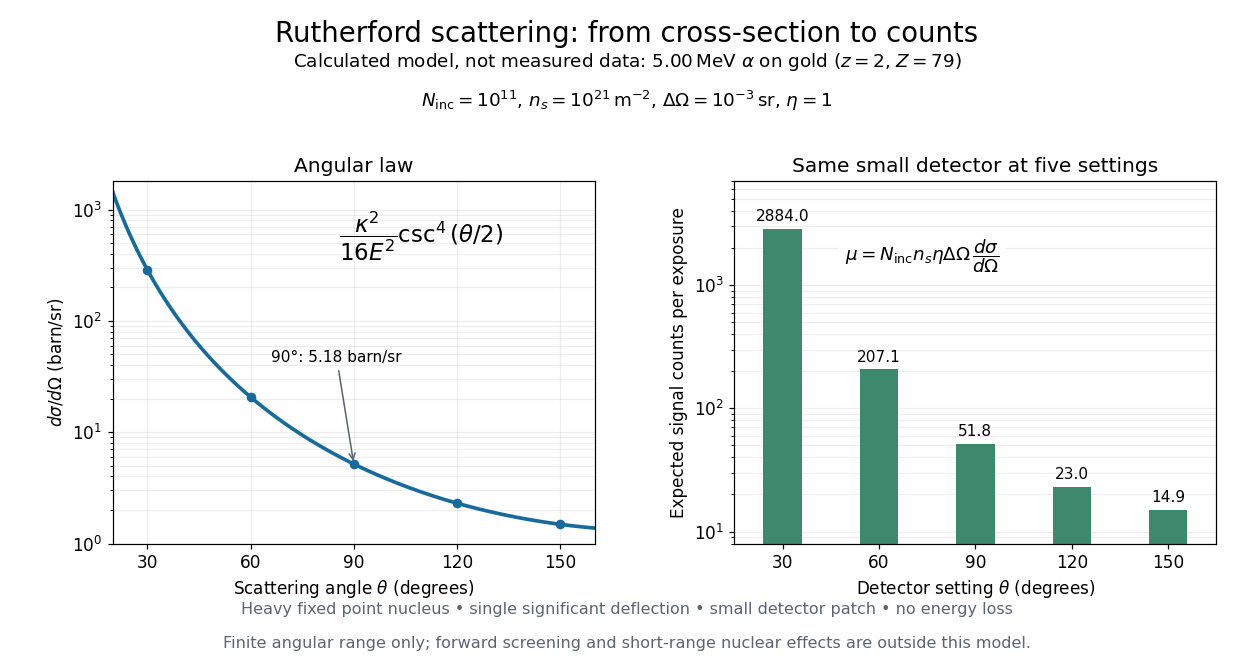
Calculated Rutherford angular cross-section and finite-detector counts
. Original calculation for the stated ideal monoenergetic alpha beam and thin gold foil. The curve is a differential cross-section; the bars are expected counts for the specified small detector solid angle at separate settings. They are not measured 1909 or 1913 data, and do not sum to a total scattering probability. The curve is shown only from 20 to 160 degrees. Details.An observation also contains backgrounds. For a stable source and matched geometry, an estimator is , where denotes exposure duration. If source activity changes, normalize by incident exposure as well. Background subtraction removes an estimated background; it does not make finite counting fluctuations disappear.
For an incident beam uniform across its relevant impact parameters, an incident annulus has area . Rotational symmetry maps it to outgoing solid angle . The central-potential classical differential cross-section and the Rutherford impact-parameter relation therefore giveThis is a differential scattering cross-section, with units of area per steradian, conventionally , not a detector count and not an area per degree. It applies for , with a finite limiting value at . Doubling incident kinetic energy divides it by four at fixed angle; doubling either electric charge number multiplies it by four.
Let be the scattering angle between incoming and outgoing velocities, so forward scattering is and exact reversal is . Define the length . ThenFor , this gives ; is the head-on limiting case . Large deflections select small impact parameters, rather than requiring every incident alpha particle to reverse.
A short derivation uses conservation of angular momentum and conservation of energy. Choose the polar angle at closest approach, and write . The Binet equation for the repulsive Coulomb potential givesThe last equality follows by substituting this orbit into . The hyperbola reaches infinity at , with . Its scattering angle is , henceThis proves the relation without assuming that the deflection is small. The symbol here is a dimensionless orbital parameter, distinct from .
For a head-on repulsive Rutherford scattering encounter, relative kinetic energy becomes Coulomb potential energy at closest approach. With projectile charge and target charge , conservation of energy gives the displayed separation. If the Coulomb description remains valid down to that separation, it bounds the target's interaction radius from above, treating the projectile as pointlike. For a stationary target of mass and incident projectile mass , use centre-of-mass energy ; neglecting nuclear recoil amounts to .
By Rüdiger Paschotta. No article date is established.
Online text: www.rp-photonics.com/faraday_effect.html
Article by Rüdiger Paschotta in RP Photonics Encyclopedia by Rüdiger Paschotta, hosted by RP Photonics. No article publication or revision date is established.
Online text: www.rp-photonics.com/refractive_index.html
Cited passages: What is a Refractive Index?; Wavelength Dependence and Other Dependencies; Anisotropic Media; Complex Refractive Index; Group Index and Effective Index; Measuring Refractive Indices.
Pinned article: Introduction to the OurBigBook Project
Welcome to the OurBigBook Project! Our goal is to create the perfect publishing platform for STEM subjects, and get university-level students to write the best free STEM tutorials ever.
Everyone is welcome to create an account and play with the site: ourbigbook.com/go/register. We belive that students themselves can write amazing tutorials, but teachers are welcome too. You can write about anything you want, it doesn't have to be STEM or even educational. Silly test content is very welcome and you won't be penalized in any way. Just keep it legal!
Intro to OurBigBook
. Source. We have two killer features:
- topics: topics group articles by different users with the same title, e.g. here is the topic for the "Fundamental Theorem of Calculus" ourbigbook.com/go/topic/fundamental-theorem-of-calculusArticles of different users are sorted by upvote within each article page. This feature is a bit like:
- a Wikipedia where each user can have their own version of each article
- a Q&A website like Stack Overflow, where multiple people can give their views on a given topic, and the best ones are sorted by upvote. Except you don't need to wait for someone to ask first, and any topic goes, no matter how narrow or broad
This feature makes it possible for readers to find better explanations of any topic created by other writers. And it allows writers to create an explanation in a place that readers might actually find it.
Figure 1. Screenshot of the "Derivative" topic page. View it live at: ourbigbook.com/go/topic/derivativeVideo 2. OurBigBook Web topics demo. Source. - local editing: you can store all your personal knowledge base content locally in a plaintext markup format that can be edited locally and published either:This way you can be sure that even if OurBigBook.com were to go down one day (which we have no plans to do as it is quite cheap to host!), your content will still be perfectly readable as a static site.
- to OurBigBook.com to get awesome multi-user features like topics and likes
- as HTML files to a static website, which you can host yourself for free on many external providers like GitHub Pages, and remain in full control

Figure 2. You can publish local OurBigBook lightweight markup files to either OurBigBook.com or as a static website.
Figure 3. Visual Studio Code extension installation.
Figure 5. . You can also edit articles on the Web editor without installing anything locally. Video 3. Edit locally and publish demo. Source. This shows editing OurBigBook Markup and publishing it using the Visual Studio Code extension. 
- Infinitely deep tables of contents:



All our software is open source and hosted at: github.com/ourbigbook/ourbigbook
Further documentation can be found at: docs.ourbigbook.com
Feel free to reach our to us for any help or suggestions: docs.ourbigbook.com/#contact