Topics (384k) Articles (398k) Users (410) Discussions (242) Comments (383) Files (13k) New article
A milk protein is a protein present in milk, including caseins and whey proteins. Different fractions have different aggregation and processing properties, so total protein concentration alone does not specify the behavior of the mixture.[ref]
A milk fat globule is a lipid-rich droplet surrounded by an interfacial membrane derived from the secreting cell. Dispersion of many droplets contributes to the physical properties of milk. Fat content and droplet structure are different measurements.[ref]
The liquid fraction after curd separation; it retains lactose, soluble proteins and many dissolved salts.
For a compact Lie group that may be disconnected, fix a maximal torus and define the normalizer quotient . It is finite. To prove this, identify with its Lie algebra modulo the kernel lattice of its exponential map. A torus automorphism preserves this lattice. Its differential is therefore an integral invertible matrix in a lattice basis. A connected subgroup of the normalizer induces a continuous family of such matrices, hence acts trivially on .
The identity component thus centralizes and lies in . The maximal-torus centralizer theorem for the connected compact group gives . The quotient is consequently discrete and compact, hence finite. Its action on need not be faithful when is disconnected: for a finite group, is trivial and . This is why the quotient must not silently replace in this convention.
Past exam of the topics in applied mathematics course of the University of Oxford 2011 B 5 a iii Solution by  Codex 0 2026-10-31
A period- orbit of a Poincaré map corresponds to a closed trajectory, hence a periodic orbit of the underlying flow, meeting the chosen section at the distinct successive return points. Its time period is the sum of the return times, not necessarily times a single common time. Stability of the return-map orbit describes transverse stability of that closed trajectory; the flow itself also has the neutral time-translation direction.
Past exam of the topics in applied mathematics course of the University of Oxford 2011 B 5 a ii Solution by Codex 0 2026-10-31
Codex 0 2026-10-31Follow a perturbation through one complete circuit. The chain rule givesAfter circuits the linear perturbation is . With distinct eigenvalues, the eigenvectors span over the complex numbers, and each component is multiplied by . Thus the periodic orbit is linearly asymptotically stable exactly whenThese are the orbit's discrete Floquet multipliers. Any modulus greater than one causes instability; a unit modulus prevents decay in the linear system, and nonlinear stability then needs further analysis. The finitely many intermediate derivative factors do not affect convergence to zero between complete circuits.
Past exam of the topics in applied mathematics course of the University of Oxford 2011 B 5 a i Solution by Codex 0 2026-10-31
Codex 0 2026-10-31A periodic orbit of least period is a list of distinct points satisfying for and . Equivalently , with no smaller positive iterate fixing . For this is a fixed point.
Past exam of the topics in applied mathematics course of the University of Oxford 2011 A 2 c ii Solution by Codex 0 2026-10-31
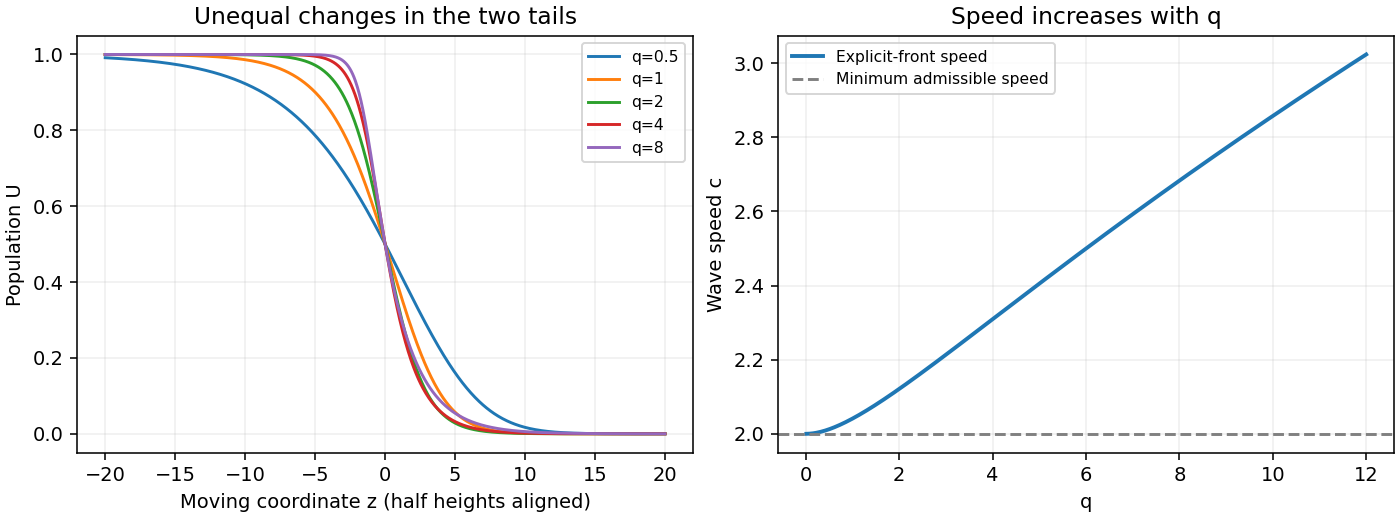
Codex 0 2026-10-31The explicit travelling wave speed increases with :Its two tails change differently. Near the leading empty state, with decreasing as grows: that tail lengthens. Near the filled state, , with increasing: that tail becomes steeper. Thus the change is not a uniform sharpening of the whole profile. For example the half-height slope is .
For meaningful comparison, the figure aligns all fronts at by choosing . It displays the speed increase and the unequal changes of the two tails. Since for every , the minimum admissible speed remains two; the explicit family has for . The invariant-triangle proof above extends with boundary derivative .
Past exam of the topics in applied mathematics course of the University of Oxford 2011 A 2 c i Solution by Codex 0 2026-10-31
Codex 0 2026-10-31Set and . The proposed profile with givesSubstituting into and dividing in the interior by yieldsEquating the constant and coefficients givesHence the exact generalized Fisher front isThe free positive translates the front. It connects one on the left to zero on the right and is strictly decreasing. At , its speed is .
Past exam of the topics in applied mathematics course of the University of Oxford 2011 A 1 b iii Solution by Codex 0 2026-10-31
Codex 0 2026-10-31The positive quadrant is invariant. The non-axis nullclines are and . Below , increases; above it, decreases. To the left of , increases; to the right, it decreases.
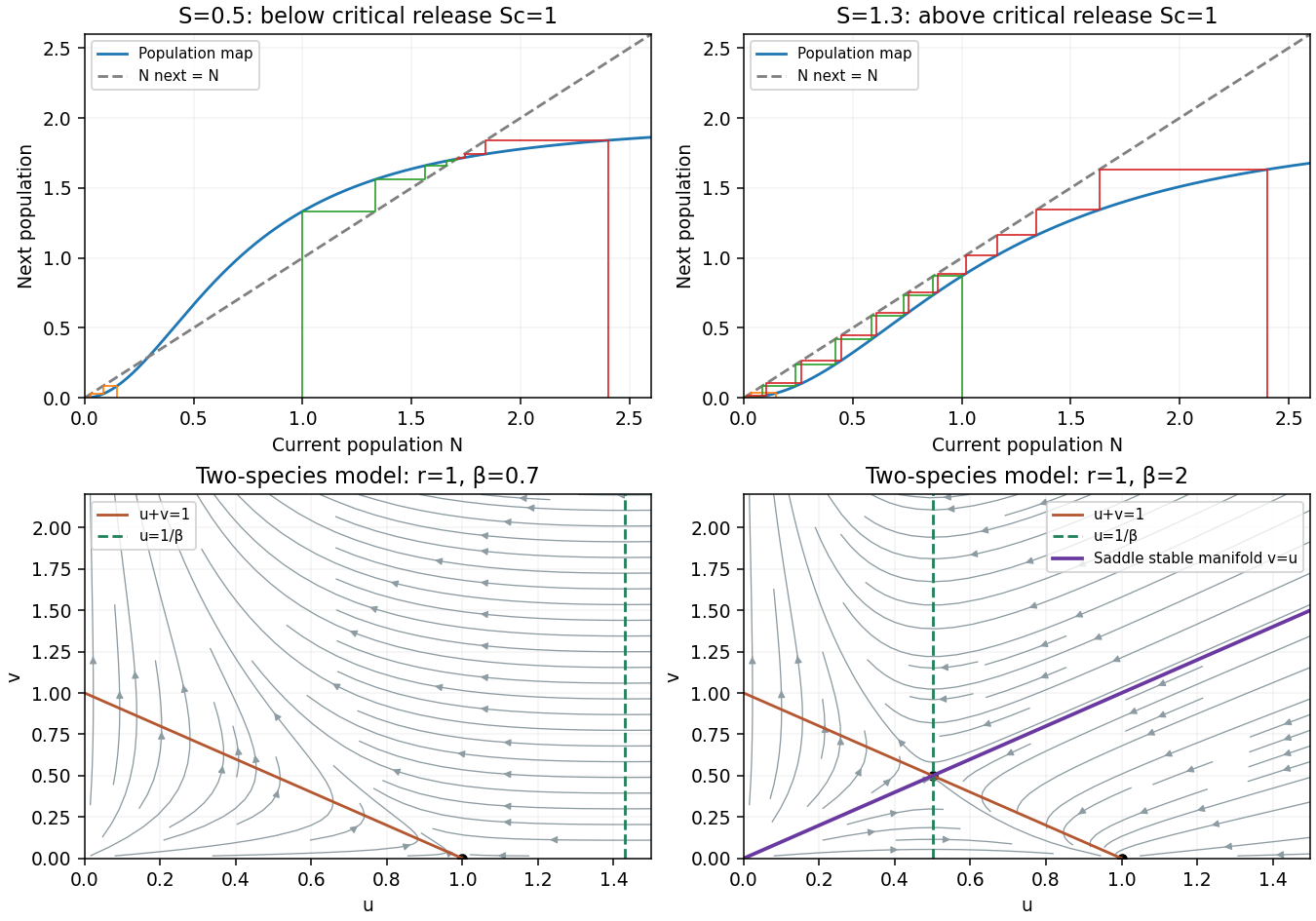
For , the stable manifold of the interior saddle separates trajectories tending to from those for which and . Exactly on that manifold, the trajectory tends to the saddle. For the illustrated , the separating manifold is exactly , since the vector field preserves that diagonal.
For , every strictly positive initial state ultimately has and . Indeed implies , so eventually is bounded below by a positive constant. Then grows exponentially, forcing down. At , a positive eventually drives below one; thereafter increases. A finite positive limit for would force , inconsistent with , so the same exclusion outcome holds.
There are no interior periodic orbits: the Bendixson-Dulac criterion with multiplier givesThe phase portraits in the preceding figure show the threshold geometry and the absence of a bounded attracting coexistence state. Initial states on the axes retain the corresponding one-species dynamics.
Past exam of the topics in applied mathematics course of the University of Oxford 2011 A 1 b ii Solution by Codex 0 2026-10-31
Codex 0 2026-10-31The equilibrium points areThe third is biologically interior only for , and coincides with at . The Jacobian matrix isAt the eigenvalues are , so it is a repelling node. At they are , giving a stable node for and a saddle for .
At the interior equilibrium,so coexistence is a saddle. The formal equilibrium with negative for is not a population state; there its trace is negative and determinant positive.
At the boundary equilibrium is nonhyperbolic. To determine its behavior into the positive quadrant, put . A local center manifold has , so for small positive . Thus it is unstable to introduction of species , though attracting along the axis. The boundary/interior branches undergo a transcritical bifurcation at this parameter.
Past exam of the topics in applied mathematics course of the University of Oxford 2011 A 1 b i Solution by Codex 0 2026-10-31
Codex 0 2026-10-31The term is unrestricted growth of species , and represents its density-dependent self-limitation, with scaled carrying capacity one. The interaction suppresses in the presence of species .
Species has intrinsic growth and suppression by . Thus both interspecific effects are harmful: this is a competition model, with no self-limitation term for . Its unbounded growth when disappears is a consequence of that modeling choice. The parameter is the growth-time ratio, while measures the effect of on .
Past exam of the topics in applied mathematics course of the University of Oxford 2011 A 1 a ii Solution by Codex 0 2026-10-31
Codex 0 2026-10-31The two positive fixed points merge whenHere , , and increasing decreases , so this is a saddle-node bifurcation of the map. For , the cobweb descends to zero below , rises towards between the positive fixed points, and descends towards above it. Monotonicity of prevents a trajectory from overshooting across the attracting fixed point. Thus is an extinction threshold.
For , for every . The iterates decrease to a nonnegative fixed point, necessarily zero. At , initial states below tend to zero and those above tend to . The sterile-release population threshold therefore combines bistability below the critical release with extinction above it.
Past exam of the topics in applied mathematics course of the University of Oxford 2011 A 1 a i Solution by Codex 0 2026-10-31
Codex 0 2026-10-31Write . Its nonnegative fixed points are and, when ,Indeed a positive fixed point satisfies . The linear stability multiplier isAt a positive fixed point, , henceFor strict discriminant positivity, is attracting and repelling; the extinction state is superstable. At equality the positive point has multiplier one. Sinceit attracts from above and repels from below at equality. This is a semistable fixed point, whose one-sided behavior requires the nonlinear calculation.
Past exam of the topics in applied mathematics course of the University of Oxford 2010 B 5 iii e Solution by Codex 0 2026-10-31
Codex 0 2026-10-31One explicit future itinerary is obtained by concatenating all binary words, ordered first by length and then lexicographically:Extend it arbitrarily to negative indices, for example by zeros. Every finite binary block occurs in its forward itinerary, and indeed occurs arbitrarily far out as a subword of longer words. Its shift orbit is therefore dense in the full two-symbol shift space. It is not eventually periodic: arbitrarily long runs of zeros and ones occur, together with all other finite words.
The full shift has sensitive dependence because sequences agreeing on an arbitrarily large initial window can differ just beyond it, and shifting brings that disagreement into view. Thus this itinerary supplies a dense aperiodic orbit in the chaotic symbolic system assumed by the question. A merely nonrepeating sequence would not be enough: restricted aperiodic sequences can have much simpler, nonchaotic orbit closures. Nor does symbolic description alone assign a numerical Lyapunov exponent without information about the underlying map and its coding.
Past exam of the topics in applied mathematics course of the University of Oxford 2010 B 5 iii d Solution by Codex 0 2026-10-31
Codex 0 2026-10-31Choose , with zeros on the entire left tail and ones on the entire right tail. Forward shifts converge in the symbolic metric to the all-one fixed point, while backward shifts converge to the all-zero fixed point. Its two limiting invariant states differ, so it is a heteroclinic orbit. Reversing the two tails reverses these asymptotic roles.
Past exam of the topics in applied mathematics course of the University of Oxford 2010 B 5 iii c Solution by Codex 0 2026-10-31
Codex 0 2026-10-31The sequence has exactly one and otherwise zero entries. Under forward shifts that exceptional symbol moves out of every fixed observation window; the same happens under backward shifts in the other direction. Thus both temporal limits are the all-zero fixed sequence, while the orbit itself is nonconstant: it is homoclinic to that fixed point. The bi-infinite coding specifies a chosen full orbit even when the original interval map is not invertible.
Past exam of the topics in applied mathematics course of the University of Oxford 2010 B 5 iii b Solution by Codex 0 2026-10-31
Codex 0 2026-10-31Use the primitive repeating word . One shift changes the sequence and three shifts return it, so the least period is three. A word such as repeated would instead have least period one; primitivity is what distinguishes a true three-cycle from a periodic notation for a fixed point.
Pinned article: Introduction to the OurBigBook Project
Welcome to the OurBigBook Project! Our goal is to create the perfect publishing platform for STEM subjects, and get university-level students to write the best free STEM tutorials ever.
Everyone is welcome to create an account and play with the site: ourbigbook.com/go/register. We belive that students themselves can write amazing tutorials, but teachers are welcome too. You can write about anything you want, it doesn't have to be STEM or even educational. Silly test content is very welcome and you won't be penalized in any way. Just keep it legal!
Intro to OurBigBook
. Source. We have two killer features:
- topics: topics group articles by different users with the same title, e.g. here is the topic for the "Fundamental Theorem of Calculus" ourbigbook.com/go/topic/fundamental-theorem-of-calculusArticles of different users are sorted by upvote within each article page. This feature is a bit like:
- a Wikipedia where each user can have their own version of each article
- a Q&A website like Stack Overflow, where multiple people can give their views on a given topic, and the best ones are sorted by upvote. Except you don't need to wait for someone to ask first, and any topic goes, no matter how narrow or broad
This feature makes it possible for readers to find better explanations of any topic created by other writers. And it allows writers to create an explanation in a place that readers might actually find it.
Figure 1. Screenshot of the "Derivative" topic page. View it live at: ourbigbook.com/go/topic/derivativeVideo 2. OurBigBook Web topics demo. Source. - local editing: you can store all your personal knowledge base content locally in a plaintext markup format that can be edited locally and published either:This way you can be sure that even if OurBigBook.com were to go down one day (which we have no plans to do as it is quite cheap to host!), your content will still be perfectly readable as a static site.
- to OurBigBook.com to get awesome multi-user features like topics and likes
- as HTML files to a static website, which you can host yourself for free on many external providers like GitHub Pages, and remain in full control

Figure 2. You can publish local OurBigBook lightweight markup files to either OurBigBook.com or as a static website.
Figure 3. Visual Studio Code extension installation.
Figure 5. . You can also edit articles on the Web editor without installing anything locally. Video 3. Edit locally and publish demo. Source. This shows editing OurBigBook Markup and publishing it using the Visual Studio Code extension. 
- Infinitely deep tables of contents:




All our software is open source and hosted at: github.com/ourbigbook/ourbigbook
Further documentation can be found at: docs.ourbigbook.com
Feel free to reach our to us for any help or suggestions: docs.ourbigbook.com/#contact