Topics (374k) Articles (387k) Users (410) Discussions (242) Comments (383) Files (13k) New article

The independent private values model is symmetric when bidders have identical roles and draw their valuations independently from the same distribution. For revenue equivalence in the usual single-object setting, bidders additionally have risk neutrality and quasilinear utility. Under a strictly increasing symmetric equilibrium bidding rule, a type wins with probability .
// Target: mathematical-optimization.bigb
For a horizontal field in constant downward gravity, equilibrium obeys . The displacement energy reduces to the displayed quadratic form. Perturbations independent of the field direction do not bend magnetic field lines and therefore have no magnetic tension penalty: an increasing mass density with height permits instability. A nonincreasing mass density gives nonnegative energy for all admitted incompressible perturbations. Along-field variation adds magnetic tension proportional to wavenumber squared, stabilizing sufficiently short waves when buoyancy is unfavorable.
A projective bundle with fibre over the four-dimensional Grassmannian . The condition of containing a fixed line imposes four independent linear conditions on the twenty cubic coefficients. The projection to is proper. The line is an isolated point over ; isolated fibre point forces dominance in equal dimensions then proves that every cubic surface contains a line.
For an initial mass function on , complete loss of material initially above removes fractionThe impulsive disruption by stellar mass loss threshold is , with unique finite root . Decreasing shifts mass to larger stars and increases , so the idealized system is globally unbound for . The derivation requires rapid, well-mixed loss and absence of a confining external potential.
In the local incompressible weak-field limit, take an axisymmetric wavevector and . Eliminating the pressure projects the radial force by . This yields the displayed dispersion relation, where is the radial epicyclic frequency. For a hydrodynamically stable rotation profile with outward-decreasing angular velocity, instability requires . A purely toroidal field has no axisymmetric local field-line-bending frequency and therefore no ordinary weak-field MRI in this approximation.
For local cylindrical shear with , maximizing the positive squared-growth root of the ideal magnetorotational dispersion relation gives the displayed formulas. For a Keplerian disk these are and . Field strength selects the fastest wavelength, while the maximum ideal rate is set by shear. Finite domains and magnetic diffusion can exclude that wavelength.
Restrict a cubic equation to the affine line through two distinct singular points. At each point the equation and its first directional derivative vanish, so the restricted polynomial has two distinct double roots. A polynomial of degree at most three with this property is identically zero. Hence the whole line lies in the hypersurface. The multiplicity argument works in every characteristic.
An X-piece is a curvature- four-holed sphere with geodesic boundary, formed by gluing two Y-pieces along equal-length cuffs. For a specified separating cuff and labelled outer boundaries, four outer lengths, the internal cuff length , and a twist determine the metric. The gluing is orientation-reversing on boundary circles, with relative arclength displacement measured from chosen seam endpoints. Without markings, the gluing displacement is taken modulo ; with a marking, records Dehn twists as well. Changing the chosen separating curve can give different parameter descriptions of the same unmarked surface.
For a fixed positive integer , is irrational. If it were rational with denominator , choose large enough that . After multiplication by , the finite partial sum is an integer and the remaining positive tail is bounded by a geometric series whose ratio is at most . For sufficiently large , this tail is strictly between zero and one, contradicting its integer value. Only a finite integer partial sum is used; convergence of an infinite series of rationals does not itself prove irrationality.
A catenary is the static shape of an ideal flexible, inextensible chain hanging under its own gravitational weight in a uniform gravitational field, with uniform linear mass density along its arc length. With the lowest point above , one convenient vertical origin givesHere has units of length. The supports and the chain's arc length determine the scale and position; horizontal and vertical shifts give the general catenary. [ref]
https://www.damtp.cam.ac.uk/user/reh10/lectures/nst-mmii-handout3.pdf. Robert Hunt, Cambridge Mathematical Methods II: worked example, The Catenary
For , the three points at have heights , , and . If heights should instead be measured from the lowest point, subtract :The same three heights are then approximately , , and . The shift changes the vertical origin and preserves the catenary shape.
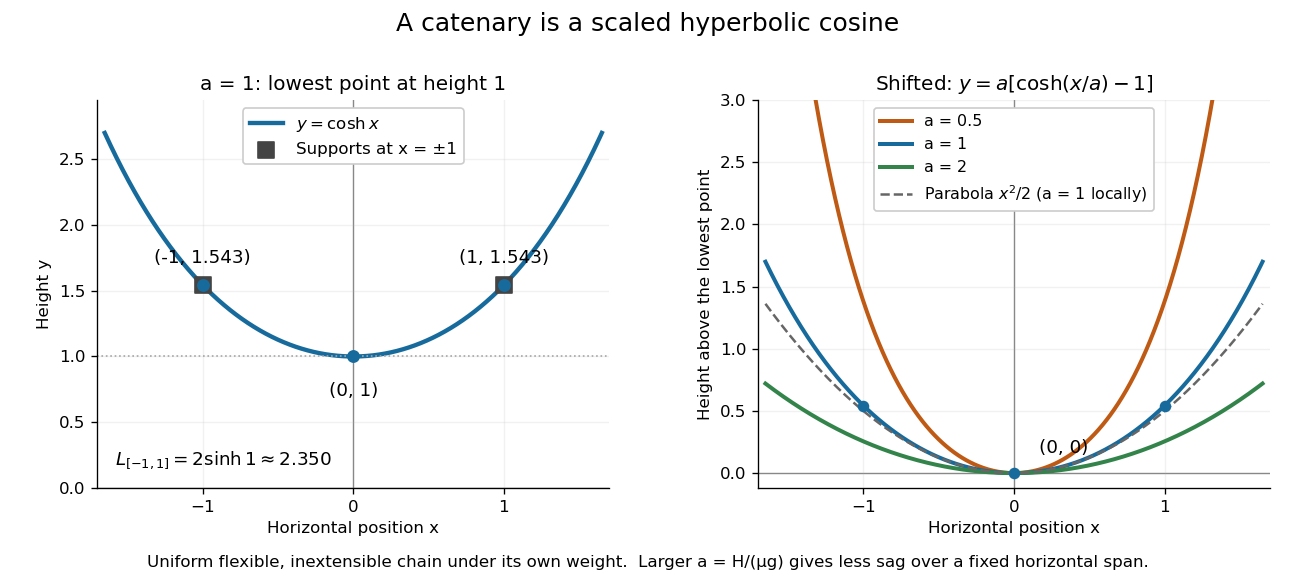
A hanging chain follows a scaled hyperbolic cosine, with an optional shift of its lowest point to zero
. The left panel marks on . The right panel puts the lowest point at zero, compares three positive scales , and shows the local parabola for . Details.The scale also measures tension: if is its constant horizontal component, is the linear mass density, and is the magnitude of gravitational acceleration, then . A short force balance explains this. For the portion from the lowest point to , with arc length , vertical tension balances its gravitational weight and horizontal tension givesApplying differentiation yields . The proposed hyperbolic cosine solves this differential equation, because and . This is the mechanism behind the shape, under the stated ideal chain assumptions.
The same identity simplifies the arc length between symmetric supports at :For , , exceeding the horizontal span of two. A larger at fixed gives a shallower sag: the Taylor series gives . Thus a parabola is a local approximation, while the exact ideal chain shape is a catenary. The useful connection is that the same hyperbolic Pythagorean identity controls its coordinates, force balance, and arc length.
For , apply Jensen's formula with the smooth curvature term to the hyperbolic derivative density. Its distributional Laplacian is , giving the displayed identity with ramification points defined by . If at zero, use as the origin counting term and replace the base constant by . Without this regularization the basepoint-critical formula is undefined.
In a grey atmosphere with and , hydrostatic equilibrium in optical depth gives . With and , integration gives the displayed pressure-temperature relation. At the matching surface , the Eddington surface boundary condition gives , hence .
Take an ideal gas grey atmosphere with , constant surface gravity of a star , vanishing external pressure and . Integrating hydrostatic equilibrium in optical depth gives . Its logarithmic temperature-pressure gradient is , so the Schwarzschild criterion for a monatomic gas is crossed at . The radiative continuation beyond that depth is unstable and must be replaced by convective transport.
The ionizing photon escape fraction is the fraction of photons capable of photoionization that leave their source environment. Only these escaping photons contribute to ionizing distant intergalactic medium. Its value can depend on frequency, source geometry, and time.
A spherical blackbody star emits photons per time above threshold . Integrating specific intensity over the outward hemisphere gives flux ; dividing the resulting spectral luminosity by photon energy and substituting proves the formula. The convergent series follows by integrating the geometric-series expansion termwise.
For two same-height throats carrying the same light-layer volume flux and reduced gravity, the narrower throat has the larger critical minimum energy. A narrower downstream throat can back up and submerge an upstream throat. If the first throat is narrower, it can control discharge and feed a supercritical current through the second; a hydraulic jump followed by a second control is also possible when the available energy drop and intermediate geometry permit it. Equal throat widths are a marginal lossless case. Relative width alone does not fix jump position or mixing in the intervening reservoir.
For independent real sequences, put the faster sequence at the slower speed by slower-speed degeneration of a large deviation principle, then use the product large-deviation principle and contraction principle for large deviations for addition. Unequal speeds give a translate of the slower sequence's rate. Equal speeds give the infimal convolution of the two rates. Its unique zero is the sum of their zero points, and a translated positive finite point has positive finite cost, since compactness attains each finite fiber infimum. Thus the defining nondegeneracy is preserved.
// Target: queueing-theory.bigb
If is simply connected and is onto, choose a homogeneous homology basis and representing sphere maps into . Their wedge sum gives a rational homology equivalence, hence a rational homotopy equivalence by the rational Whitehead theorem. All positive cup products therefore vanish. In a minimal model, the induced map from cohomology to the indecomposable quotient is injective; replacing a set of generators by cocycle representatives produces a quasi-isomorphism to the square-zero cohomology algebra, proving formality of a topological space.
Let be the initial instantaneous forward rate curve and choose . In the Hull-White model, take . To verify the fit, write with , , and . The Gaussian exponential formula gives .
Pinned article: Introduction to the OurBigBook Project
Welcome to the OurBigBook Project! Our goal is to create the perfect publishing platform for STEM subjects, and get university-level students to write the best free STEM tutorials ever.
Everyone is welcome to create an account and play with the site: ourbigbook.com/go/register. We belive that students themselves can write amazing tutorials, but teachers are welcome too. You can write about anything you want, it doesn't have to be STEM or even educational. Silly test content is very welcome and you won't be penalized in any way. Just keep it legal!
Intro to OurBigBook
. Source. We have two killer features:
- topics: topics group articles by different users with the same title, e.g. here is the topic for the "Fundamental Theorem of Calculus" ourbigbook.com/go/topic/fundamental-theorem-of-calculusArticles of different users are sorted by upvote within each article page. This feature is a bit like:
- a Wikipedia where each user can have their own version of each article
- a Q&A website like Stack Overflow, where multiple people can give their views on a given topic, and the best ones are sorted by upvote. Except you don't need to wait for someone to ask first, and any topic goes, no matter how narrow or broad
This feature makes it possible for readers to find better explanations of any topic created by other writers. And it allows writers to create an explanation in a place that readers might actually find it.
Figure 1. Screenshot of the "Derivative" topic page. View it live at: ourbigbook.com/go/topic/derivativeVideo 2. OurBigBook Web topics demo. Source. - local editing: you can store all your personal knowledge base content locally in a plaintext markup format that can be edited locally and published either:This way you can be sure that even if OurBigBook.com were to go down one day (which we have no plans to do as it is quite cheap to host!), your content will still be perfectly readable as a static site.
- to OurBigBook.com to get awesome multi-user features like topics and likes
- as HTML files to a static website, which you can host yourself for free on many external providers like GitHub Pages, and remain in full control

Figure 2. You can publish local OurBigBook lightweight markup files to either OurBigBook.com or as a static website.
Figure 3. Visual Studio Code extension installation.
Figure 5. . You can also edit articles on the Web editor without installing anything locally. Video 3. Edit locally and publish demo. Source. This shows editing OurBigBook Markup and publishing it using the Visual Studio Code extension. 
- Infinitely deep tables of contents:



All our software is open source and hosted at: github.com/ourbigbook/ourbigbook
Further documentation can be found at: docs.ourbigbook.com
Feel free to reach our to us for any help or suggestions: docs.ourbigbook.com/#contact