Topics (374k) Articles (387k) Users (410) Discussions (242) Comments (383) Files (13k) New article

For the , Hermite vertical mode of an isothermal disk, the local dispersion relation is . Its low inertial-frame frequency branches satisfy . These waves transport a changing tilt of successive annuli, or a warp, with group velocity . The vertical velocity is approximately independent of height. A rigid tilt is the zero-wavenumber, zero-pattern-frequency limit; the gas still executes vertical orbital motion at frequency in its rotating frame.
In coordinates , the Heisenberg group law is . Commutation for every forces , hence . The center of a group is therefore the -axis. The surjective group homomorphism has exactly this kernel of a group homomorphism, giving the stated quotient group by the first isomorphism theorem.
For an admissible pointed Heegaard diagram, is a free chain complex with one generator for each point of . Each generator is an unordered selection containing exactly one intersection on each alpha circle and exactly one on each beta circle. After choosing coherent orientations,Here is the moduli space modulo strip translation, is the Maslov index, and is multiplicity at the basepoint. Holomorphic representatives have nonnegative domain multiplicities. The differential lowers grading by one and lowers it by two. Boundary strata of one-dimensional moduli spaces give the cancellation proving . Its homology is .
Use the convention that is generated by with , and . The chain complexes areThe last complex is generated by . Equivalently it is with its absolute grading shifted up by two. The short exact sequence gives the fundamental long exact sequence. For a rational homology sphere in each Spin-c structure, . The plus tower is , with bottom degree ; its corresponding minus tower is a free module with top degree .
A smooth oriented cobordism with a Spin-c structure induces -equivariant maps on the corresponding Heegaard Floer homology groups. A handle decomposition defines the maps using generator selection for one- and three-handles and holomorphic triangle counts for two-handles. Composition sums over extensions of the prescribed Spin-c structures. When the boundary determinant classes are torsion, the absolute grading shift isThe square is defined using the rational relative lift. If , the infinity map vanishes. Between rational homology spheres, when , the infinity map is an isomorphism of Laurent towers.
For a knot in an integral homology three-sphere and , fix a Spin-c structure on the -surgery. Write for structures on zero-surgery with , using a capped Seifert surface. In compatible labels the completed-minus triangle isOne can equally use the plus theory without completing. The first map is the congruence-restricted zero-surgery trace map; the last is the sum of reverse, orientation-reversed -surgery trace maps. The middle map uses a Heegaard triple with an auxiliary lens-space generator. For that lens space is , giving the usual three two-ended cobordism maps. For it is important to retain the auxiliary boundary and its fixed Spin-c structure. The U-adic completion of Heegaard Floer homology makes the sums of maps well-defined.
For a closed smooth oriented four-manifold with , remove two balls to obtain , and choose an Admissible cut for a Heegaard Floer mixed map. Positivity and naturality show that the minus map of lands in , while the plus map of descends from . ThusThe coefficient of the bottom plus generator in this map, applied to , defines , up to the orientation sign, with . It vanishes unless . The construction is independent of the admissible cut by the cobordism composition and associativity laws. Two positive pieces explain the condition .
For a linear output , the second term limits the growth produced by the Hebbian term. On the averaged dynamics with , . For , positive-eigenvalue equilibria have norm and align with eigenvectors of . If inputs are centered, is their covariance matrix.
With , the squared weight norm satisfies . It moves monotonically toward without crossing it. Explicitly equals its initial value times . Persistent excitation therefore drives to ; without excitation it can remain stationary. This nonlinear normalization avoids the unbounded amplification of unmodified Hebbian learning.
For in geodesic normal coordinates, the Gauss lemma gives . Substituting into therefore yields , with . Integration along radial rays gives the displayed formula. Every coefficient is smooth at the centre. Any smooth solution of is zero for , since is constant and tends to zero at . This proves uniqueness. In this special divergence-form case , so every for is zero: the Gaussian itself solves the equation exactly on the coordinate ball. The positive Laplace-Beltrami operator instead has a metric volume-density term and a nonconstant leading amplitude.
For on scalar functions, the leading coefficient of the heat parametrix in normal coordinates is the inverse square root of the metric volume density: . The heat-kernel transport equations give . This gives the displayed diagonal expansion. The coefficient is specific to the minimally coupled scalar operator; a bundle connection or a curvature-dependent potential changes the general Laplace-type coefficients.
For the positive scalar Laplace-Beltrami operator on a compact manifold without boundary, the heat invariants are the integrated coefficients in the short-time heat kernel expansion. In particular and , with the scalar curvature. They are determined by the heat trace, hence by the spectrum with multiplicities. The leading positive coefficient recovers the dimension from .
A connected subset of Euclidean space containing distinct points has Hausdorff dimension at least one. The Lipschitz map maps onto a set containing , since continuous images of connected spaces are connected. A Lipschitz map cannot increase Hausdorff dimension, whereas an interval has Hausdorff dimension one. Consequently any set of Hausdorff dimension less than one is totally disconnected.
Suppose shrinking interval covers of have length-power sums with logarithmic growth rate , and is strictly decreasing with zero . For every those sums tend to zero exponentially. The definition of Hausdorff measure then gives , hence the displayed upper bound. A matching lower bound requires additional information and does not follow from this covering argument alone.
The middle-third Cantor set has Hausdorff dimensionIts Lebesgue measure is zero, yet . These assertions measure different aspects of size: interval length is too coarse to distinguish this set from a null set, while the critical fractional measuring rule captures its remaining structure.
At level , the construction covers by intervals of diameter . Their total -cost isFor it tends to zero, proving the upper dimension bound. At it equals one, giving . For this particular cover's cost grows, but that alone would not prove a lower bound on Hausdorff measure.
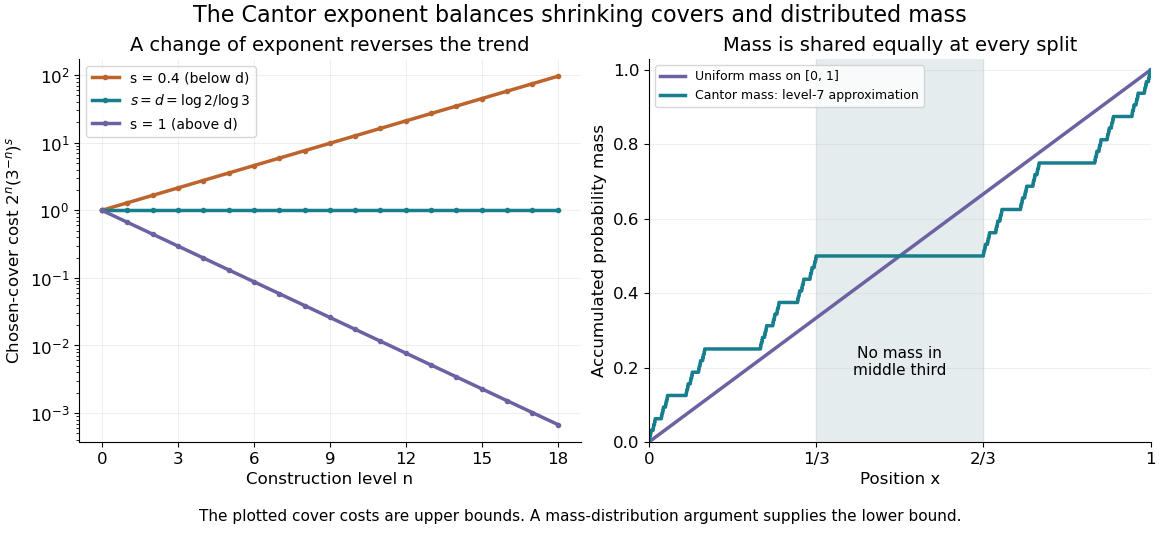
Cantor cover costs change trend at the critical exponent, and distributed mass supplies the lower bound
. Details. For the matching lower bound, use the Cantor distribution, which assigns mass to each level- Cantor cylinder. An interval of length with meets at most two level- construction intervals, since their gaps are at least . Its mass is therefore at mostEvery covering set of diameter in the line lies in an interval of length , so any small cover must have total -cost at least . This is the mass distribution principle in its interval form: , sufficient to prove the claimed dimension. The constants are convenient bounds, rather than an assertion of the exact critical Hausdorff measure. In the diagram, the right panel is a finite-stage approximation to the Cantor function, showing how probability is shared while the middle third receives none.
The reusable pattern is to obtain an upper bound by constructing covers and a lower bound by distributing mass. The same strategy underlies Cartesian powers of the Cantor set and the dimension formula for a finite similarity iterated function system satisfying the open set condition.
The mass distribution principle converts a diffuse measure into a lower bound on Hausdorff dimension. Let and let a Borel probability measure give a Borel set full mass. If, for some , every ball centered in satisfiesthen in the diameter-cost convention, and consequently .
The idea is to keep unit mass from being crowded into cheap covering pieces. For a piece of positive diameter meeting , choose . A ball of radius contains ; letting gives , where is the associated outer measure. Zero-diameter pieces have zero mass by the same estimate. For any sufficiently small cover,Thus every cover costs at least . This is the lower-bound counterpart to the explicit covers in scale-restricted Hausdorff content. The Cantor distribution supplies the needed mass in Hausdorff dimension of the Cantor set. [ref]
https://www.math.stonybrook.edu/~bishop/fractalbook.pdf. Bishop and Peres, §1.2: the mass distribution principle
.Uniform fixed-aspect rectangle crossing in bond percolation bounds at the self-dual parameter yield a positive lower bound for closed dual circuits in geometrically spaced disjoint annuli. The independent annular barriers for percolation imply that an origin-to-infinity open graph path has probability zero. Parameter monotonicity gives zero percolation probability for every .
For a positive harmonic function on the unit disc, choose a global harmonic conjugate and apply the Carathéodory derivative bound for the right half-plane to . This gives by the Cauchy-Riemann equations. A disk automorphism sending zero to has derivative modulus , so the chain rule gives the displayed bound. Composing a boundary-pole Poisson kernel with a disk automorphism attains equality, proving the coefficient is optimal at every point.
Planar Brownian motion started at , , exits the positive quadrant through either positive coordinate axis with probability one-half. The density along each axis is for , measured with respect to distance along that axis. Squaring maps the quadrant to the upper half-plane and sends the starting point to . The boundary square therefore has the centered Cauchy distribution of scale ; pulling it back by gives the displayed density. The radius has distribution function , independently of which axis is chosen. There is no atom at the origin.
For , the exponential growth rate of a q-ary Hamming ball is . Stirling's formula gives the exponent of each summand , and the sum lies between its largest term and times that term. Above the entropy-maximizing radius fraction, the exponent is one.
// Target: algebra.bigb
Pinned article: Introduction to the OurBigBook Project
Welcome to the OurBigBook Project! Our goal is to create the perfect publishing platform for STEM subjects, and get university-level students to write the best free STEM tutorials ever.
Everyone is welcome to create an account and play with the site: ourbigbook.com/go/register. We belive that students themselves can write amazing tutorials, but teachers are welcome too. You can write about anything you want, it doesn't have to be STEM or even educational. Silly test content is very welcome and you won't be penalized in any way. Just keep it legal!
Intro to OurBigBook
. Source. We have two killer features:
- topics: topics group articles by different users with the same title, e.g. here is the topic for the "Fundamental Theorem of Calculus" ourbigbook.com/go/topic/fundamental-theorem-of-calculusArticles of different users are sorted by upvote within each article page. This feature is a bit like:
- a Wikipedia where each user can have their own version of each article
- a Q&A website like Stack Overflow, where multiple people can give their views on a given topic, and the best ones are sorted by upvote. Except you don't need to wait for someone to ask first, and any topic goes, no matter how narrow or broad
This feature makes it possible for readers to find better explanations of any topic created by other writers. And it allows writers to create an explanation in a place that readers might actually find it.
Figure 1. Screenshot of the "Derivative" topic page. View it live at: ourbigbook.com/go/topic/derivativeVideo 2. OurBigBook Web topics demo. Source. - local editing: you can store all your personal knowledge base content locally in a plaintext markup format that can be edited locally and published either:This way you can be sure that even if OurBigBook.com were to go down one day (which we have no plans to do as it is quite cheap to host!), your content will still be perfectly readable as a static site.
- to OurBigBook.com to get awesome multi-user features like topics and likes
- as HTML files to a static website, which you can host yourself for free on many external providers like GitHub Pages, and remain in full control

Figure 2. You can publish local OurBigBook lightweight markup files to either OurBigBook.com or as a static website.
Figure 3. Visual Studio Code extension installation.
Figure 5. . You can also edit articles on the Web editor without installing anything locally. Video 3. Edit locally and publish demo. Source. This shows editing OurBigBook Markup and publishing it using the Visual Studio Code extension. 
- Infinitely deep tables of contents:



All our software is open source and hosted at: github.com/ourbigbook/ourbigbook
Further documentation can be found at: docs.ourbigbook.com
Feel free to reach our to us for any help or suggestions: docs.ourbigbook.com/#contact