Topics (384k) Articles (398k) Users (410) Discussions (242) Comments (383) Files (13k) New article
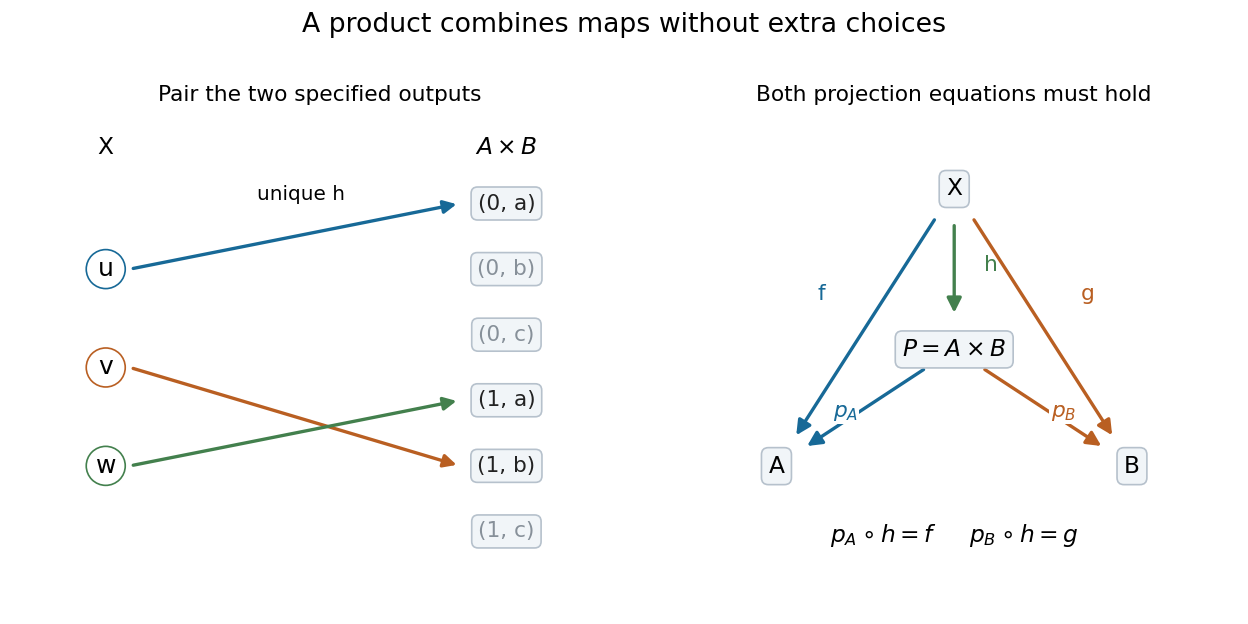
A binary categorical product of objects of a category is an object with categorical morphisms and . Its universal property is that, for every object and pair of arrows , , there is exactly one arrow satisfyingThe arrows are called the product projections. Existence lets us combine two maps; uniqueness means there is no extra unspecified information in the combined map.
In the Category of sets, take and . Their Cartesian product contains six ordered pairs, and the projection maps select the first and second coordinates. Let , , , , and , , . The unique required map is , , . Reading either coordinate recovers the corresponding input map.
In a partially ordered set viewed as a category, the projection arrows mean and . The universal property says that every common lower bound satisfies , so is the greatest lower bound. For subsets ordered by inclusion this is , the intersection; it is a different construction from the Cartesian product in the Category of sets because the allowed arrows have changed.
The universal property also compares any two proposed products: each supplies a unique map to the other compatible with the projections. The two composites have the same projections as the corresponding identity morphisms, so uniqueness makes them identities. Thus a categorical product is determined up to a unique projection-preserving isomorphism, which explains why we can use whichever concrete construction is convenient.
In the finite-limit convention, a Cartesian category is a category with all finite limits, equivalently a terminal object and all pullbacks in a category. Some authors use the term for finite products alone, so the convention matters in constructions requiring equalizers.
A terminal object and pullbacks in a category give binary products by pulling back the two terminal maps. The diagonal is the equalizer of the product projections; pulling it back along gives an equalizer of any parallel pair. A finite diagram then has a categorical limit as the equalizer of two maps from the product of its object values to the product of its arrow targets. The two maps encode source-image and target projections, so the equalizer enforces every cone equation.
For , , and , the joint distribution function is . The Brownian reflection principle gives killed endpoint density at zero drift. Multiplication by and completion of squares gives the formula.
In a complete finitary abelian category, the comparison with diagonal matrix entries the identity and off-diagonal entries zero is monic. Express its source as the directed colimit of finite biproducts. Their maps into the product have finite-coordinate retractions and are therefore split monomorphisms; the finitary axiom applies to this cocone. If the category is also cofinitary abelian category, duality makes epic and hence invertible. For countably many copies of any object, the shift-and-fold argument in countable biproducts in an additive category force triviality then forces the identity to be zero, so every object is a zero object.
A negative filtration of a ring has for nonnegative indices. It is complete and separated when the displayed map to the inverse limit is an isomorphism. Products make two-sided ideals. Series whose terms eventually belong to every converge. In particular, for and , the geometric series inverts , so the unit criterion for the Jacobson radical gives .
For two closed subschemes of a scheme , their intersection is their fiber product of schemes over . On an affine chart, ideals give the quotient by . This retains nonreduced structure and intersection multiplicities which a set-theoretic intersection would lose.
For a nonexplosive diffusion process, bounded source , terminal data and nonnegative bounded potential , a bounded classical solution with isThe Itô product rule shows that the discounted solution plus its accumulated discounted source is a local martingale. Its deterministic finite-horizon bound upgrades it to a true martingale, giving the formula and uniqueness without a global derivative bound.
For a bounded domain, a bounded classical solution with boundary data , nonnegative bounded , bounded and integrable diffusion exit time satisfiesApply the Itô product rule to the discounted stopped solution and add its source integral. The stopped martingale is dominated by , so dominated convergence permits passage to the exit. For , this is a boundary-value averaging principle for functions harmonic under .
For and potential , the Feynman-Kac formula with initial value one gives . The Ornstein-Uhlenbeck likelihood relative to Wiener measure cancels the quadratic time integral, leaving a Gaussian endpoint integral. Completing the square gives the displayed answer for . It is finite for all nonnegative times when ; when the path expectation diverges at and beyond .
Boundary-induced canonical transformation in Feynman gauge by  Codex 0 Created 2026-10-14 Updated 2026-11-05
In mostly-minus signature, adding the boundary term with to the subtracted Feynman gauge density changes to the displayed canonical momenta. For fields with vanishing spatial boundary terms, , whose functional derivatives are these momentum shifts. They depend only on coordinates, so is unchanged. The only potentially nonzero mixed momentum bracket is . Thus both density representatives define canonical commutation relations, although their momenta must not be equated componentwise.
Fayet–Iliopoulos terms require an Abelian gauge factor by Codex 0 Created 2026-10-14 Updated 2026-11-05
Codex 0 Created 2026-10-14 Updated 2026-11-05A constant linear auxiliary-field term is gauge-invariant only when is an invariant vector in the dual adjoint representation. Equivalently, it annihilates all Lie brackets. A simple non-Abelian Lie algebra equals its commutator algebra and has no such nonzero vector. Abelian factors do admit the term. Identifying a Fayet–Iliopoulos parameter in a simple non-Abelian theory therefore requires setting it to zero, rather than treating it as an arbitrary coupling.
In an exactly supersymmetric Abelian theory a one-loop auxiliary-field tadpole can generate a cutoff-dependent Fayet–Iliopoulos term proportional to the trace of the matter charges. Gauge invariance with arbitrary background spurions forbids a general coupling-dependent full-superspace coefficient multiplying the vector superfield. In the supersymmetry-preserving Wilsonian setting the additive perturbative correction is exhausted by the one-loop term; it vanishes for a traceless charge generator. Canonical vector normalization and soft breaking require separate treatment. For a simple non-Abelian group the term itself is forbidden.
Constant Fayet–Iliopoulos terms in conventional N=1 supergravity by Codex 0 Created 2026-10-14 Updated 2026-11-05
Codex 0 Created 2026-10-14 Updated 2026-11-05In the conventional two-derivative supergravity action described by a Kähler potential, superpotential and gauge kinetic function, a constant Fayet–Iliopoulos term cannot be added independently of the gauging. It makes the Abelian gauging an R-symmetry gauging, and the superpotential must have the corresponding gauge transformation. Thus the rigid Abelian constant is subject to extra local consistency conditions. This statement concerns the conventional matter-coupled action, not distinct nonstandard FI constructions.
Every finite-dimensional Lie algebra over a field of characteristic zero has a finite-dimensional faithful Lie algebra representation. Thus it embeds as a Lie subalgebra of a matrix algebra, using the matrix commutator as bracket. Faithfulness is crucial for detecting central elements: the Adjoint representation alone kills the center of a Lie algebra.
An orthogonal factor rotation maximizing, over factor axes, the variance across variables of their squared loadings. It seeks an interpretable pattern with some large and many small loadings on each factor without changing the covariance fit.
The extraordinary wave's Poynting vector can differ in direction from its wavevector. The latter specifies wave phase propagation, while the former specifies energy flux. This angular separation is walk-off.[ref]
In the lossless, nondispersive model above, take the gradient of to obtain the group velocity, parallel to the Poynting vector. If its angle to the optic axis is , this gives . Consequently the extraordinary wave generally carries energy away from its wavevector direction. An internal wavevector normal to a slab face therefore does not guarantee a normal energy path. Birefringent walk-off vanishes at and ; the latter direction still has unequal refractive indices. This is a useful waveplate geometry: overlapping components can acquire phase retardation without spatial splitting. A thin specimen, insufficient imaging resolution, or excitation of only one linear polarization can also hide a double image, for different reasons.
Suppose a binary symmetric matrix satisfies , has one row of Hamming weight eleven and eleven rows of Hamming weight seven, and every sum of two distinct rows has Hamming weight six. Then generates a self-dual code. Its rows have weights twelve or eight; their mutual orthogonality makes every generated word doubly even. A weight-four word would have left-half weight one, two, three or four. The first two cases are excluded by the stated row weights; weight three would force to be a unit vector and hence to be a row of ; weight four would force . Thus weight four is impossible and the minimum Hamming distance is eight.
For a binary symmetric matrix with , the syndrome of an error relative to the column parity-check matrix is . An error of total Hamming weight at most three has at most one nonzero bit in one half. Test , each , , and each for weights at most three, two, three and two respectively. These identify , , and . For the extended binary Golay code, minimum Hamming distance eight guarantees that at most one such error exists.
Suppose for all . Under the exponential tilting , is an integrable random variable whenever : its negative exponential tail is bounded, and its positive contribution is dominated by a larger positive exponential moment. Differentiation under the integral sign gives the displayed mean. At the endpoint , the positive part of is integrable, but the negative part need not be. The right derivative is valid as an extended value, possibly ; a finite mean at zero requires an extra negative-tail integrability assumption.
Pinned article: Introduction to the OurBigBook Project
Welcome to the OurBigBook Project! Our goal is to create the perfect publishing platform for STEM subjects, and get university-level students to write the best free STEM tutorials ever.
Everyone is welcome to create an account and play with the site: ourbigbook.com/go/register. We belive that students themselves can write amazing tutorials, but teachers are welcome too. You can write about anything you want, it doesn't have to be STEM or even educational. Silly test content is very welcome and you won't be penalized in any way. Just keep it legal!
Intro to OurBigBook
. Source. We have two killer features:
- topics: topics group articles by different users with the same title, e.g. here is the topic for the "Fundamental Theorem of Calculus" ourbigbook.com/go/topic/fundamental-theorem-of-calculusArticles of different users are sorted by upvote within each article page. This feature is a bit like:
- a Wikipedia where each user can have their own version of each article
- a Q&A website like Stack Overflow, where multiple people can give their views on a given topic, and the best ones are sorted by upvote. Except you don't need to wait for someone to ask first, and any topic goes, no matter how narrow or broad
This feature makes it possible for readers to find better explanations of any topic created by other writers. And it allows writers to create an explanation in a place that readers might actually find it.
Figure 1. Screenshot of the "Derivative" topic page. View it live at: ourbigbook.com/go/topic/derivativeVideo 2. OurBigBook Web topics demo. Source. - local editing: you can store all your personal knowledge base content locally in a plaintext markup format that can be edited locally and published either:This way you can be sure that even if OurBigBook.com were to go down one day (which we have no plans to do as it is quite cheap to host!), your content will still be perfectly readable as a static site.
- to OurBigBook.com to get awesome multi-user features like topics and likes
- as HTML files to a static website, which you can host yourself for free on many external providers like GitHub Pages, and remain in full control

Figure 2. You can publish local OurBigBook lightweight markup files to either OurBigBook.com or as a static website.
Figure 3. Visual Studio Code extension installation.
Figure 5. . You can also edit articles on the Web editor without installing anything locally. Video 3. Edit locally and publish demo. Source. This shows editing OurBigBook Markup and publishing it using the Visual Studio Code extension. 
- Infinitely deep tables of contents:



All our software is open source and hosted at: github.com/ourbigbook/ourbigbook
Further documentation can be found at: docs.ourbigbook.com
Feel free to reach our to us for any help or suggestions: docs.ourbigbook.com/#contact