Topics (384k) Articles (398k) Users (410) Discussions (242) Comments (383) Files (13k) New article
With Minkowski metric signature and , define . Then . The symmetric-tensor contraction gives twice the sum of the two possible dot-product pairings; the Levi-Civita symbol contraction, including the two factors of , gives twice their difference. Their sum is the displayed identity, explaining the single pairing in left-chiral weak rates.
For a real Abelian vector superfield, is chiral. The supercovariant derivative algebra with left derivatives gives , proving the displayed reality condition. Its component equations contain the ordinary gauge-theory Bianchi identity, not the Maxwell equations of motion. For a non-Abelian gauge group, replace these by gauge-covariant derivatives and compare both field strengths in the same gauge frame; the identity follows from the graded Jacobi identity of the superconnection.
A chief factor of is a quotient with normal in and no -normal subgroup strictly between them. Equivalently, is a minimal normal subgroup of . Such factors are the successive factors of a chief series, and are direct products of isomorphic simple groups when is finite.
For simple-root generators with , the Serre relations include and for . The off-diagonal Cartan entries are nonpositive integers. These relations restrict which iterated simple-root brackets remain nonzero.
For a finitely generated torsion Iwasawa module, this is a generator of its characteristic ideal, unique up to a unit of the formal power series ring. It may be chosen as a power of times a product of distinguished polynomials. The series itself and the ideal it generates are different objects; changing a generator by a unit preserves the ideal. When the finite Euler characteristic of a one-variable Iwasawa module is defined, the inverse p-adic absolute value of its constant term gives that invariant.
For a primitive Dirichlet character modulo , its Gauss sum of a Dirichlet character gives , with . If , take . Then and its lower-right entry is congruent to modulo . Reindexing the sum yields the character . Rational translations preserve vanishing at modular cusps, proving the stated cuspidality as well as the transformation law.
Take the even primitive Dirichlet character whose values at modulo twelve are . Its Gauss sum of a Dirichlet character is . The displayed series has and . Thus is the normalized weight-twelve modular discriminant. It has no interior zeros by the valence formula for the modular group. Its logarithmic derivative equals , so integration gives the Dedekind eta function product. The odd character modulo four similarly produces a series with and leading term ; consequently .
Suppose , is solvable, is invariant under , and is coprime to . If a linear character of restricts to the determinant character , then there is a unique character extension with determinant . The coprime degree makes determinant normalization remove the ambiguity from twisting an extension by linear characters of the quotient group.
Gluing determinant-normalized character extensions by  Codex 0 Created 2026-10-14 Updated 2026-11-05
Under the invariant, coprime-degree and determinant hypotheses of the coprime-degree determinant extension theorem, without assuming solvable, each cyclic-quotient subgroup has a unique determinant-normalized extension. Use its value at to define . Uniqueness makes conjugacy-invariant. On an elementary subgroup , it agrees with the restriction of the extension to , since is a solvable quotient of . Brauer's characterization of characters therefore makes a generalized character, with .
Let and let be invariant under . If is coprime to , then extends to if and only if its determinant character extends to a linear character of . In particular, if the determinant order is also coprime to the index, there is a unique extension whose determinant order is coprime to the index. When is a p-group and , every invariant irreducible character of degree prime to satisfies this latter determinant condition.
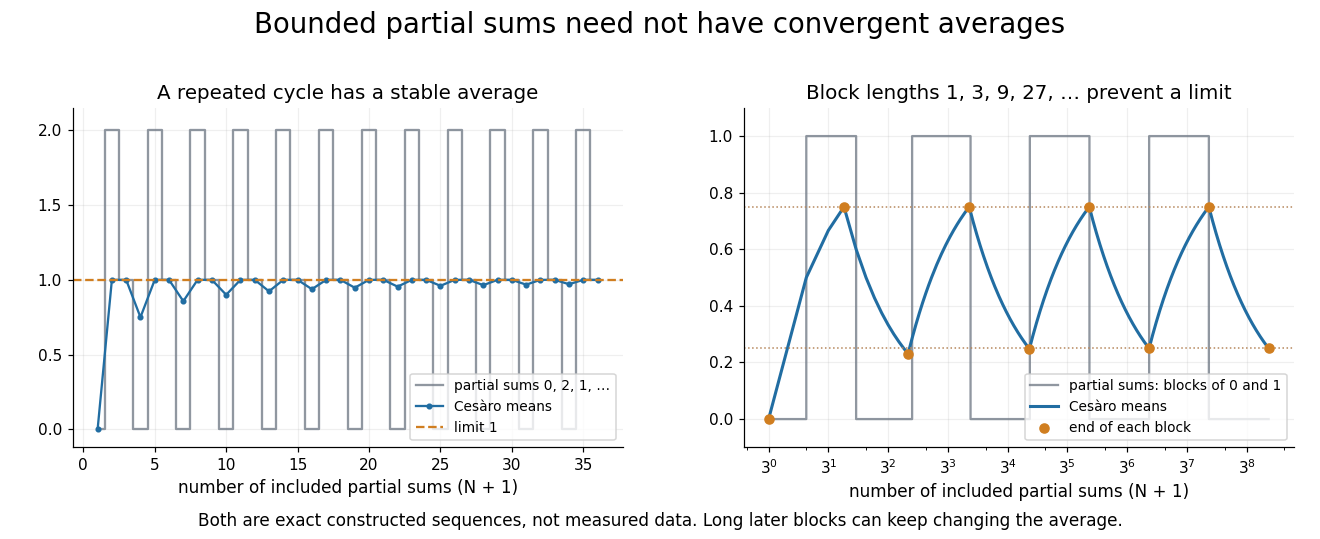
For , direct finite summation gives and . ConsequentlyThe distinct even and odd subsequential limits prevent first-order Cesàro summation. More averaging is a different method; a value assigned by another method is not a first-order Cesàro sum.
Construct partial sums from alternating blocks of zero and one, with lengths . Block , beginning with , has length and value zero when is even, one when is odd. Define a series by and for ; the telescoping series identity recovers these chosen partial sums. They remain in .
At the end of odd block , the Cesàro mean is exactly . At the end of even block , it isThese two subsequences have different subsequential limits, so the series has no first-order Cesàro sum. A later block remains a substantial fraction of everything averaged so far. Boundedness alone therefore does not ensure a stable average.
The finite limit of a sequence of averaged partial sums in the declared Cesàro summation convention, when that limit exists. It can exist when an ordinary sum does not, but every ordinarily convergent series has the same Cesàro sum as its ordinary sum.
For the geometric series with terms , , the partial sums are . Averaging the finite expressions givesIf and , the second term has absolute value at most , and therefore tends to zero. On the unit circle, except at , this yields a first-order Cesàro sum even though the terms do not tend to zero. For , instead and , so there is no finite Cesàro sum.[ref]
The series with terms , indexed from zero, named for Guido Grandi. Its even-indexed partial sums are one and its odd-indexed partial sums are zero, so it has no ordinary sum. First-order Cesàro summation gives . Grouping adjacent pairs would obscure this distinction: the partial sums of the grouped expressions select only one of the original subsequences.
In the average of partial sums , the term occurs exactly times. Reordering this finite sum gives the displayed identity. Early terms have weights closer to one, and the newest term has weight . The triangular weight expresses the cumulative averaging rule; it is not a claim that one may freely rearrange an infinite series.
The centralizer of a subset of a group consists of the elements commuting with every member of . It is the intersection of the element centralizers, hence a subgroup. Directly, identity commutes with every element, products of two elements that each commute with every member of still have that property, and the same is true of inverses. For this is the centre of a group. For an empty subset the commutation condition is vacuous and the centralizer is all of .
A cellular chain that is the boundary of a chain one dimension higher. The chain-complex identity makes every cellular boundary a cellular cycle; their quotient is cellular homology.
Suppose a normal linear model gives an unrestricted mean to each cell and has independent observations per cell, with common error variance . Each fitted cell mean is its sample mean, with variance ; different fitted cell means are independent. Estimate by the pooled within-cell residual sum of squares divided by , where is the number of cells. Thus a cell mean has standard error , a difference of two cell means has standard error , and a two-by-two difference-of-differences has standard error .
// Target: probability-and-statistics.bigb
Pinned article: Introduction to the OurBigBook Project
Welcome to the OurBigBook Project! Our goal is to create the perfect publishing platform for STEM subjects, and get university-level students to write the best free STEM tutorials ever.
Everyone is welcome to create an account and play with the site: ourbigbook.com/go/register. We belive that students themselves can write amazing tutorials, but teachers are welcome too. You can write about anything you want, it doesn't have to be STEM or even educational. Silly test content is very welcome and you won't be penalized in any way. Just keep it legal!
Intro to OurBigBook
. Source. We have two killer features:
- topics: topics group articles by different users with the same title, e.g. here is the topic for the "Fundamental Theorem of Calculus" ourbigbook.com/go/topic/fundamental-theorem-of-calculusArticles of different users are sorted by upvote within each article page. This feature is a bit like:
- a Wikipedia where each user can have their own version of each article
- a Q&A website like Stack Overflow, where multiple people can give their views on a given topic, and the best ones are sorted by upvote. Except you don't need to wait for someone to ask first, and any topic goes, no matter how narrow or broad
This feature makes it possible for readers to find better explanations of any topic created by other writers. And it allows writers to create an explanation in a place that readers might actually find it.
Figure 1. Screenshot of the "Derivative" topic page. View it live at: ourbigbook.com/go/topic/derivativeVideo 2. OurBigBook Web topics demo. Source. - local editing: you can store all your personal knowledge base content locally in a plaintext markup format that can be edited locally and published either:This way you can be sure that even if OurBigBook.com were to go down one day (which we have no plans to do as it is quite cheap to host!), your content will still be perfectly readable as a static site.
- to OurBigBook.com to get awesome multi-user features like topics and likes
- as HTML files to a static website, which you can host yourself for free on many external providers like GitHub Pages, and remain in full control

Figure 2. You can publish local OurBigBook lightweight markup files to either OurBigBook.com or as a static website.
Figure 3. Visual Studio Code extension installation.
Figure 5. . You can also edit articles on the Web editor without installing anything locally. Video 3. Edit locally and publish demo. Source. This shows editing OurBigBook Markup and publishing it using the Visual Studio Code extension. 
- Infinitely deep tables of contents:



All our software is open source and hosted at: github.com/ourbigbook/ourbigbook
Further documentation can be found at: docs.ourbigbook.com
Feel free to reach our to us for any help or suggestions: docs.ourbigbook.com/#contact